
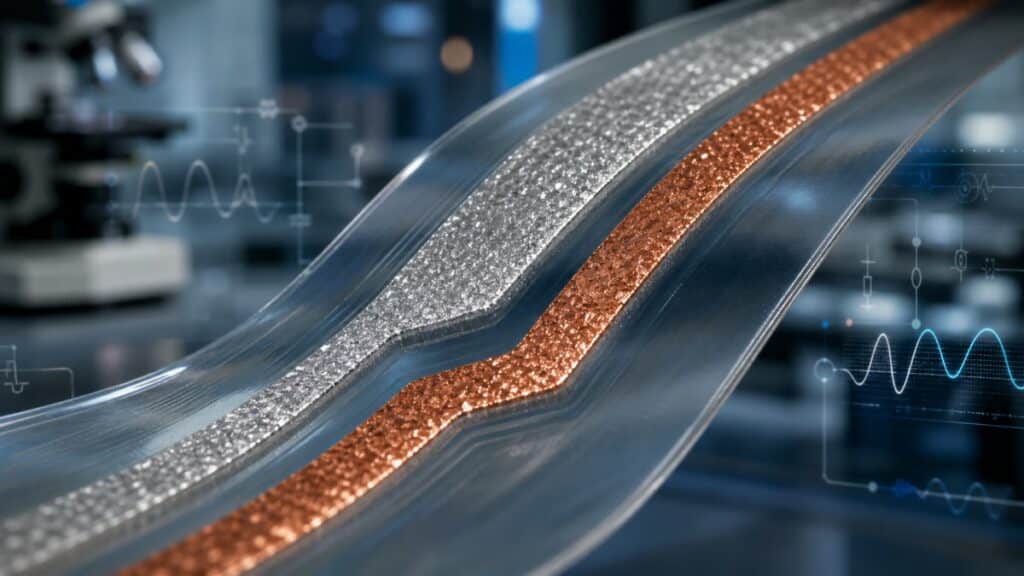
Copper has long been viewed as the low‑cost challenger to silver in flake‑based conductive inks, but in real hybrid electronics production silver still dominates by a wide margin.
This article, based on an expanded and edited version of “Silver Takes the Crown: Why Copper Can’t Crack the Conductive Ink Code” by Ryan Banfield, Global Product Manager Thick Film at Heraeus Electronics, delves into the reasons behind silver’s continued dominance in the conductive ink market.
It explores the challenges that copper faces in surpassing silver and examines the conditions under which copper-based inks could potentially replace silver in various applications, including automotive, industrial, and medical electronics.
Why silver still dominates conductive inks
For flake‑based conductive inks used in membrane switches, printed interconnects, sensors and flexible circuits, silver remains the default choice for most manufacturers. Silver combines high bulk conductivity with surface chemistry that is unusually forgiving in normal production and use conditions. It forms dense, highly conductive networks after curing, and it maintains low resistivity over time without requiring exotic handling.
In practice, this means that a printed silver trace typically stays stable and conductive over the lifetime of the device when processed according to the manufacturer’s recommendations. The material tolerates standard air environments during printing and curing, and it does not demand complex encapsulation schemes just to keep its surface from degrading. This robustness is one of the main reasons why silver‑filled polymer thick film inks became the workhorse material for keypads, printed sensors and hybrid interconnects.
Why copper looks attractive on paper
From a pure materials cost perspective, copper is appealing: it is significantly cheaper per kilogram than silver, while offering nearly comparable bulk conductivity. For cost‑sensitive high‑volume applications such as automotive controls, consumer interfaces or disposable medical sensors, the idea of replacing silver with copper flakes is attractive to both engineers and purchasing teams. The motivation is straightforward: keep the same level of electrical performance at a lower material cost.
The challenge is that in flake form, and especially in polymer thick film inks with large exposed surface area, copper is far more vulnerable to oxidation than silver. Once a non‑conductive or poorly conductive oxide layer forms on the flakes, the resulting printed trace can suffer a dramatic increase in resistivity. This oxidation risk is present not only during field operation but already during storage of the ink, during printing and throughout the curing process.
The oxidation challenge of copper flakes
Oxidation is the main barrier that prevents copper from acting as a drop‑in replacement for silver in conductive inks. Silver’s surface chemistry allows it to resist rapid oxidation in air, and even when surface species form they do not degrade conductivity to the same extent as copper oxides. Copper, by contrast, begins to tarnish quickly under typical process and operating conditions, and the resulting oxides impede electron flow through the flake network.
In flake‑based systems this issue is amplified because the high specific surface area means a large fraction of the copper is directly exposed to oxygen and moisture. Preventing or slowing this oxidation requires additional measures, such as protective coatings on the flakes, processing in controlled atmospheres, or robust encapsulating overcoats on the cured traces. Each of these steps adds both cost and complexity, and can negatively impact printability, adhesion or solderability.
Cost realities: silver vs. engineered copper
At first glance, substituting a lower‑cost filler metal seems like an obvious way to cut bill‑of‑materials cost in printed electronics. However, when all processing and reliability requirements are taken into account, silver often ends up being more economical in practice. Silver‑based inks can typically be printed, dried or cured and integrated using standard equipment and process windows without additional protective infrastructure.
Copper‑based inks, on the other hand, usually demand additional engineering to control oxidation, stabilize the wet ink and maintain long‑term conductivity. This can include more elaborate flake chemistries, specialized solvents or binders, protective atmospheres during curing, and more stringent storage and handling requirements. Once these mitigation measures are added, the total system cost can erode or even outweigh the savings from the cheaper metal itself.
Implications for hybrid circuits and passive components
For design engineers working with hybrid thick‑film circuits, printed resistors and sensor structures, the conductor material choice affects not only cost but also long‑term stability and interaction with other passive components. Silver‑based inks provide predictable performance alongside chip resistors, capacitors and discrete inductors on ceramic or polymer substrates. The relative chemical stability simplifies qualification, especially in safety‑critical sectors such as automotive or medical electronics.
If copper‑based conductors are considered, engineers must carefully evaluate how any additional protective layers or encapsulants influence solderability, contact resistance to discrete components, and the system’s thermal behavior. For example, an added dielectric overcoat to shield copper from oxygen may change creepage distances, alter high‑frequency behavior or impact reworkability. These system‑level trade‑offs are an important reason why many teams remain with silver unless there is a compelling cost or sustainability driver.
Technical highlights: what copper must achieve to compete
From a technical standpoint, for copper inks to displace silver at scale they must meet several conditions simultaneously:
- Comparable initial conductivity to established silver‑based polymer thick film systems.
- Stable resistivity over the full operating life of the product in realistic humidity, temperature and bias conditions.
- Storage stability of the uncured ink without significant viscosity drift or filler degradation.
- Process compatibility with existing printing and curing equipment, ideally without requiring controlled atmospheres.
- Robust adhesion and, where needed, solderability or reliable interconnection to discrete components and terminations.
Manufacturers continue to investigate advanced flake coatings, improved ink vehicles and encapsulation methods to address these points. However, the current state of the technology still tends to favor silver when all of these criteria are weighed together.
Silver vs. copper inks: key characteristics
| Parameter | Silver flake inks | Copper flake inks (target) |
|---|---|---|
| Base material cost | High | Low |
| Bulk conductivity | Very high | Very high |
| Oxidation tendency | Low in typical use environments | High, requires mitigation |
| Process atmosphere | Usually air | Often benefits from controlled atmosphere |
| Long‑term stability | Proven in many hybrid and flexible uses | Still under development in many applications |
| Engineering complexity | Moderate, mature solutions available | Higher, needs coatings/encapsulation strategies |
Exact values are application‑dependent and should be taken from the manufacturer datasheets and process guidelines.
Outlook: can copper ever truly displace silver?
The underlying message from current industry practice is that copper does not lack fundamental potential; rather, it has not yet met the combined requirements of conductivity, chemical stability, printability and lifetime reliability at a cost that clearly beats silver. Silver continues to “check all the boxes” for most flake‑based conductive ink applications today, which explains its continued dominance despite higher raw material costs.
For copper to truly displace silver in mainstream hybrid electronics, the industry will need oxidation‑resistant copper flake systems that can be mass‑produced economically and used in standard printing and curing environments. Ongoing research into polymer thick film conductors, new flake treatments and advanced encapsulation gives reason for cautious optimism, but for now silver remains the default choice for designers who want predictable, durable conductivity with minimal process surprises.
Source
This article is based on information and expert commentary published by Heraeus Electronics in their thick film blog, complemented by related official material on polymer thick film conductors and product selector resources from the same manufacturer.
References
- Heraeus Electronics – The Dominance of Silver Flakes in Conductive Inks Over Copper
- Heraeus Electronics – Polymer Pastes
- Heraeus Electronics – Thick Film Whitepaper: Solderable Polymer Thick Film Conductors Meet Low-Temperature Substrate Demands
- Heraeus Electronics – Thick Film Product Selector

