





Passive Components Blog
No Result
View All Result
  • Home
  • News
    • All
    • Aerospace & Defence
    • Antenna
    • Applications
    • Automotive
    • Capacitors
    • Circuit Protection Devices
    • electro-mechanical news
    • Filters
    • Fuses
    • Inductors
    • Industrial
    • Integrated Passives
    • inter-connect news
    • Market & Supply Chain
    • Market Insights
    • Medical
    • Modelling and Simulation
    • New Materials & Supply
    • New Technologies
    • Non-linear Passives
    • Optoelectronics and Isolation
    • Oscillators
    • Passive Sensors News
    • Resistors
    • RF & Microwave
    • Telecommunication
    • Weekly Digest
    Siemens executives Markus Grabmeier and Barry Powell with Skeleton Technologies CEO Taavi Madiberk at the investment announcement

    Siemens Backs Skeleton’s US AI Power Manufacturing Expansion

    Concept illustration of an LTCC antenna module with multilayer ceramic substrate, antenna elements and an integrated beamforming IC

    Murata LTCC 6G Antenna Module Demonstrates 135 GHz Operation

    TDK X series surface-mount multilayer varistors with ceramic chip bodies and metal end terminations

    TDK X Series SMD Varistors for Industrial Transient Protection

    Littelfuse TP7.0SMD-XC automotive TVS diodes with black surface-mount bodies and silver end terminals.

    Littelfuse Introduces Extremely Low Clamping Voltage TVS Diodes for Automotive Protection

    Supercapacitor LSM production

    LS Materials Wins $51.5M AI Data Center Supercapacitor Order

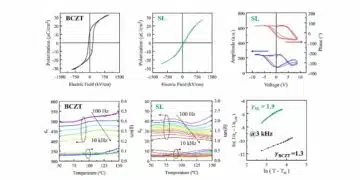
    Features of BCZT and strontium titanate dielectric layers in a thin-film superlattice

    Relaxor superlattice capacitors approach 99% efficiency

    Stackpole RMAN thick-film chip resistors with rectangular bodies and metal end terminations

    Stackpole 2512 AlN Thick-Film Resistors Rated up to 3.5 W

    ECIA September 2026 Industry Pulse electronic component trends and sentiment report

    ECIA September 2026 Pulse: Growth Holds, Supply Pressure Persists

    Wk 39 Electronics Supply Chain Digest

    Trending Tags

    • Ripple Current
    • RF
    • Leakage Current
    • Tantalum vs Ceramic
    • Snubber
    • Low ESR
    • Feedthrough
    • Derating
    • Dielectric Constant
    • New Products
    • Market Reports
  • Knowledge Blog
  • Dossiers
    • Aerospace and Defense Passive Components Dossier
    • AI Hardware Dossier
    • Automotive Dossier
    • Industrial Robotics Dossier
    • Power Converter Dossier
    • Capacitor Dossier
    • Circuit Protection Dossier
    • Inductor Dossier
    • Resistor Dossier
    • Silicon Capacitors and Integrated Passives Dossier
  • Suppliers
    • Who is Who
  • PCNS
    • PCNS 2025
    • PCNS 2023
    • PCNS 2021
    • PCNS 2019
    • PCNS 2017
  • Events
  • Home
  • News
    • All
    • Aerospace & Defence
    • Antenna
    • Applications
    • Automotive
    • Capacitors
    • Circuit Protection Devices
    • electro-mechanical news
    • Filters
    • Fuses
    • Inductors
    • Industrial
    • Integrated Passives
    • inter-connect news
    • Market & Supply Chain
    • Market Insights
    • Medical
    • Modelling and Simulation
    • New Materials & Supply
    • New Technologies
    • Non-linear Passives
    • Optoelectronics and Isolation
    • Oscillators
    • Passive Sensors News
    • Resistors
    • RF & Microwave
    • Telecommunication
    • Weekly Digest
    Siemens executives Markus Grabmeier and Barry Powell with Skeleton Technologies CEO Taavi Madiberk at the investment announcement

    Siemens Backs Skeleton’s US AI Power Manufacturing Expansion

    Concept illustration of an LTCC antenna module with multilayer ceramic substrate, antenna elements and an integrated beamforming IC

    Murata LTCC 6G Antenna Module Demonstrates 135 GHz Operation

    TDK X series surface-mount multilayer varistors with ceramic chip bodies and metal end terminations

    TDK X Series SMD Varistors for Industrial Transient Protection

    Littelfuse TP7.0SMD-XC automotive TVS diodes with black surface-mount bodies and silver end terminals.

    Littelfuse Introduces Extremely Low Clamping Voltage TVS Diodes for Automotive Protection

    Supercapacitor LSM production

    LS Materials Wins $51.5M AI Data Center Supercapacitor Order

    Features of BCZT and strontium titanate dielectric layers in a thin-film superlattice

    Relaxor superlattice capacitors approach 99% efficiency

    Stackpole RMAN thick-film chip resistors with rectangular bodies and metal end terminations

    Stackpole 2512 AlN Thick-Film Resistors Rated up to 3.5 W

    ECIA September 2026 Industry Pulse electronic component trends and sentiment report

    ECIA September 2026 Pulse: Growth Holds, Supply Pressure Persists

    Wk 39 Electronics Supply Chain Digest

    Trending Tags

    • Ripple Current
    • RF
    • Leakage Current
    • Tantalum vs Ceramic
    • Snubber
    • Low ESR
    • Feedthrough
    • Derating
    • Dielectric Constant
    • New Products
    • Market Reports
  • Knowledge Blog
  • Dossiers
    • Aerospace and Defense Passive Components Dossier
    • AI Hardware Dossier
    • Automotive Dossier
    • Industrial Robotics Dossier
    • Power Converter Dossier
    • Capacitor Dossier
    • Circuit Protection Dossier
    • Inductor Dossier
    • Resistor Dossier
    • Silicon Capacitors and Integrated Passives Dossier
  • Suppliers
    • Who is Who
  • PCNS
    • PCNS 2025
    • PCNS 2023
    • PCNS 2021
    • PCNS 2019
    • PCNS 2017
  • Events
No Result
View All Result
Passive Components Blog
No Result
View All Result

Incremental Use of Car Radars Raise Interference Concerns

3.1.2020
Reading Time: 4 mins read
A A

Less expensive, computationally less demanding, and impervious to almost all environmental conditions, radar technology offers a compelling advantage in many automotive safety applications. Little wonder, then, that it accounts for more than one third of the automotive collision avoidance sensor market, according to Grandview Research. On the other hand as the usage of radar technology in cars increases, so does the potential for increased levels of interference that can impact detection performance.

Key applications where radar is currently being used are in adaptive cruise control, blind spot detection, forward collision warning, intelligent parking assistance, autonomous emergency braking, and other advanced driver-assistance systems (ADAS).

RelatedPosts

Siemens Backs Skeleton’s US AI Power Manufacturing Expansion

Murata LTCC 6G Antenna Module Demonstrates 135 GHz Operation

TDK X Series SMD Varistors for Industrial Transient Protection

And its market share is on the rise: The National Highway Traf­fic Safety Administration (NHTSA) announced that all automakers will supply collision avoidance by 2022, and further development of autonomous vehicles will present even more opportunities.

But as the usage of radar technology in cars increases—and thereby the number of sensors operating in proximity to each other at the same time—so does the potential for increased levels of interference. And interference can impact the very thing that is critical to get right in safety applications: detection performance.

Concern over this specific issue prompted NHTSA to conduct a study on radar congestion. Published in September 2018, the results of the study show that levels of interference based on operation of current systems in congested environments will be significant.

Here’s how it works: Assume, for example, two cars approach an intersection, facing each other. Both cars have a front-looking radar sensor operating in the 76-77 GHz band. Both sensors are expected to send signals in the 76-77 GHz band, and the reflected signals from the objects (metal body of the other car, in this case) come back to each sensor for processing to confirm the detection of the car in the front.

Interference or cross-talk occurs when one sensor captures signals from the other sensor along with its own reflections from the object. If the interference is ignored, the result could be a missed object, false detection, or the manifestation of a ghost target, which is a reflection of the actual target.

The NHTSA report noted that “Up to this point, attention has been paid to making the technology operate, and not much consideration has been given to the mutual impact of the highway infrastructure and safety systems when deployed.”

But that doesn’t mean various strategies are not under active investigation.

Today component suppliers and radar sensor designers are looking at different approaches to detect and mitigate interference. The report noted several, including:

  • A technique focused on detecting interference and repairing receiver results in time domain
  • Stretch processing, which lowers the systems’ overall signal-to-noise ratio
  • Digital Beam Forming, which allows the radar to restrict the receiver’s spatial field of view

“As the number of radar sensors per car increases and the number of cars with ADAS functionality increases, TI also agrees that there would be potential risk of interference or cross talk,” said Sneha Narnakaje, Business Manager and Director of Marketing, Automotive Radar, at Texas Instruments.

Narnakaje noted that there are approaches within region/country specific regulation bodies to deploy radar more efficiently depending on the application. “The FCC has expanded the spectrum available for vehicular radars, to include the entire 76-81 GHz band, with 76-77 GHz regulated for moving vehicles and ADAS functions,” Narnakaje said.

For long range detections and highway conditions, 76-77 GHz could be used, she noted, while for short range detections and urban conditions, 77-81 GHz could be used. “Traffic management or monitoring could use the unlicensed 60 GHz band, so the sensor usage is distributed across frequency bands and the environment becomes less prone to interference or crosstalk. Even the sensor installation orientation on the car will also play role in the interference environment.”

She noted there are also developments in chip architectures targeted at helping to mitigate interference.

TI, for example, said there are performance advantages to using its complex-baseband architecture in Frequency Modulated Continuous Waveform (FMCW) radar systems. ADAS uses this type of sensor, which is less prone (although not immune) to interference due to the continuous waves.

The technology was designed mainly for RF performance reasons, but TI engineers found a way to exploit this architecture to detect interference more accurately and efficiently and deal with it.

And that’s exactly what industry is focusing its efforts on now.
Related

Source: Fierce Electronics

Recent Posts

Littelfuse TP7.0SMD-XC automotive TVS diodes with black surface-mount bodies and silver end terminals.

Littelfuse Introduces Extremely Low Clamping Voltage TVS Diodes for Automotive Protection

13.10.2026
17
Stackpole RMAN thick-film chip resistors with rectangular bodies and metal end terminations

Stackpole 2512 AlN Thick-Film Resistors Rated up to 3.5 W

12.10.2026
10
Samtec automotive interconnect technologies for software-defined vehicle electronics

Samtec Links Automotive Connector Demands to Software-Defined Cars

8.10.2026
12
Conceptual illustration of Littelfuse AQ4315-01ETG and SP4315-01WTG TVS diode applications on high-speed PCB data lines

Littelfuse Adds Low-Capacitance TVS Diodes for Fast Data Links

7.10.2026
14
Datasheet-style illustration of a TDK MLJ1608-G multilayer chip inductor with end terminals

TDK Expands1608 Inductors for Automotive PoC Filters

6.10.2026
12
Murata electronica 2026 technology preview featuring MGJ2T2 power converters and SCI36LT inertial sensors.

Murata Previews SiC Power and AI Sensors at electronica 2026

6.10.2026
65
TDK B3272 series boxed DC-link film capacitors with radial leads for automotive and industrial power-electronics applications

TDK Expanded DC-Link Film Capacitors to Reach +135 °C

2.10.2026
57
Vishay Sfernice D2TO35S TO-263 top-side cooled thick-film power resistor with metal heatsink interface

Vishay Unveils Top-Side Cooled 35 W Power Resistor

30.9.2026
19
Coilcraft CSX7045 surface-mount current sense transformers with compact chip-style package

Coilcraft Extends Current Sense Transformers with 1.8 kVrms Isolation

29.9.2026
18

Upcoming Events

Oct 19
15:00 - 16:00 CEST

ESCC-qualified Pt Temperature Sensors for Space Applications

Oct 27
15:00 - 16:00 CET

Heraeus Electronics Webinar: What materials perform when failure is not an option?

Oct 27
16:00 - 17:00 CET

Power Inductor technologies

View Calendar

Popular Posts

  • Buck Converter Design and Calculation

    0 shares
    Share 0 Tweet 0
  • Boost Converter Design and Calculation

    0 shares
    Share 0 Tweet 0
  • LLC Resonant Converter Design and Calculation

    0 shares
    Share 0 Tweet 0
  • Capacitor Charging and Discharging

    0 shares
    Share 0 Tweet 0
  • Flyback Converter Design and Calculation

    0 shares
    Share 0 Tweet 0
  • Audio Capacitors: Choosing Capacitors for Crossover Circuits

    0 shares
    Share 0 Tweet 0
  • MLCC and Ceramic Capacitors

    0 shares
    Share 0 Tweet 0
  • Resistor Symbols

    0 shares
    Share 0 Tweet 0
  • Passive Low Pass Filters: Fundamentals and EMI Design

    0 shares
    Share 0 Tweet 0
  • RF Connector Types: How To Choose the Right One

    0 shares
    Share 0 Tweet 0

Newsletter Subscription


Passive Components Blog

© 2015–2026
All rights reserved

  • Home
  • Privacy Policy
  • EPCI Membership & Advertisement
  • About

No Result
View All Result
  • Home
  • Knowledge Blog
  • Dossiers
  • PCNS

© 2015–2026
All rights reserved