








Passive Components Blog
No Result
View All Result
  • Home
  • NewsFilter
    • All
    • Aerospace & Defence
    • Antenna
    • Applications
    • Automotive
    • Capacitors
    • Circuit Protection Devices
    • electro-mechanical news
    • Filters
    • Fuses
    • Inductors
    • Industrial
    • Integrated Passives
    • inter-connect news
    • Market & Supply Chain
    • Market Insights
    • Medical
    • Modelling and Simulation
    • New Materials & Supply
    • New Technologies
    • Non-linear Passives
    • Oscillators
    • Passive Sensors News
    • Resistors
    • RF & Microwave
    • Telecommunication
    • Weekly Digest

    YAGEO Extends its Supercapacitor Series Line-Up

    SCHURTER Presents EKO High‑Voltage Fuses for Global Energy Systems

    June 2026: AI Demand Pushes Japanese and Korean MLCC Makers to Five‑Year Shipment High

    TDK Releases SMD Common‑Mode Chokes for Compact High‑Current EMI Filtering

    July 2026 Interconnect, Passives and Electromechanical Components Market Insights

    Samsung Introduces 1000V C0G and X7 MLCCs for 800V DC Systems

    Wk 29 Electronics Supply Chain Digest

    Bourns Introduces LTCC GNSS L‑Band Diplexer for Compact RF Front Ends

    TT Electronics: How Qualification Underpins Reliable Selection of Thick‑Film Resistors

    Trending Tags

    • Ripple Current
    • RF
    • Leakage Current
    • Tantalum vs Ceramic
    • Snubber
    • Low ESR
    • Feedthrough
    • Derating
    • Dielectric Constant
    • New Products
    • Market Reports
  • VideoFilter
    • All
    • Antenna videos
    • Capacitor videos
    • Circuit Protection Video
    • Filter videos
    • Fuse videos
    • Inductor videos
    • Inter-Connect Video
    • Non-linear passives videos
    • Oscillator videos
    • Passive sensors videos
    • Resistor videos

    EMC Design Fundamentals: Safe Use of Varistors and Common Mode Chokes in Mains and Data-Line Filters

    Ferrite versus Nanocrystalline Power Inductor Cores: Turns, Gap and Size

    KYOCERA AVX Presents Antenna Integrator Studio Tutorial for Antenna Placement and RF Design

    Power Design Simulation Tools for Faster Inductor Selection and Loss Optimization

    EMC‑Compliant PCB and Connector Design Guidelines

    Why Isolated DC/DC Power Supplies Fail Late, Würth Elektronik Podcast

    Designing 800 V DC EMC Filters: Calculation, Simulation and Measurement

    Current Sense Transformer Datasheet and Design‑in Guide

    Designing a USB Type‑C Flyback Planar Transformer with Frenetic’s Planar Tool

    Trending Tags

    • Capacitors explained
    • Inductors explained
    • Resistors explained
    • Filters explained
    • Application Video Guidelines
    • EMC
    • New Products
    • Ripple Current
    • Simulation
    • Tantalum vs Ceramic
  • Knowledge Blog
  • Dossiers
    • AI Hardware Dossier
    • Power Converter Dossier
    • Automotive Dossier
    • Capacitor Dossier
    • Resistor Dossier
    • Inductor Dossier
    • Circuit Protection Dossier
  • Suppliers
    • Who is Who
  • PCNS
    • PCNS 2025
    • PCNS 2023
    • PCNS 2021
    • PCNS 2019
    • PCNS 2017
  • Events
  • Home
  • NewsFilter
    • All
    • Aerospace & Defence
    • Antenna
    • Applications
    • Automotive
    • Capacitors
    • Circuit Protection Devices
    • electro-mechanical news
    • Filters
    • Fuses
    • Inductors
    • Industrial
    • Integrated Passives
    • inter-connect news
    • Market & Supply Chain
    • Market Insights
    • Medical
    • Modelling and Simulation
    • New Materials & Supply
    • New Technologies
    • Non-linear Passives
    • Oscillators
    • Passive Sensors News
    • Resistors
    • RF & Microwave
    • Telecommunication
    • Weekly Digest

    YAGEO Extends its Supercapacitor Series Line-Up

    SCHURTER Presents EKO High‑Voltage Fuses for Global Energy Systems

    June 2026: AI Demand Pushes Japanese and Korean MLCC Makers to Five‑Year Shipment High

    TDK Releases SMD Common‑Mode Chokes for Compact High‑Current EMI Filtering

    July 2026 Interconnect, Passives and Electromechanical Components Market Insights

    Samsung Introduces 1000V C0G and X7 MLCCs for 800V DC Systems

    Wk 29 Electronics Supply Chain Digest

    Bourns Introduces LTCC GNSS L‑Band Diplexer for Compact RF Front Ends

    TT Electronics: How Qualification Underpins Reliable Selection of Thick‑Film Resistors

    Trending Tags

    • Ripple Current
    • RF
    • Leakage Current
    • Tantalum vs Ceramic
    • Snubber
    • Low ESR
    • Feedthrough
    • Derating
    • Dielectric Constant
    • New Products
    • Market Reports
  • VideoFilter
    • All
    • Antenna videos
    • Capacitor videos
    • Circuit Protection Video
    • Filter videos
    • Fuse videos
    • Inductor videos
    • Inter-Connect Video
    • Non-linear passives videos
    • Oscillator videos
    • Passive sensors videos
    • Resistor videos

    EMC Design Fundamentals: Safe Use of Varistors and Common Mode Chokes in Mains and Data-Line Filters

    Ferrite versus Nanocrystalline Power Inductor Cores: Turns, Gap and Size

    KYOCERA AVX Presents Antenna Integrator Studio Tutorial for Antenna Placement and RF Design

    Power Design Simulation Tools for Faster Inductor Selection and Loss Optimization

    EMC‑Compliant PCB and Connector Design Guidelines

    Why Isolated DC/DC Power Supplies Fail Late, Würth Elektronik Podcast

    Designing 800 V DC EMC Filters: Calculation, Simulation and Measurement

    Current Sense Transformer Datasheet and Design‑in Guide

    Designing a USB Type‑C Flyback Planar Transformer with Frenetic’s Planar Tool

    Trending Tags

    • Capacitors explained
    • Inductors explained
    • Resistors explained
    • Filters explained
    • Application Video Guidelines
    • EMC
    • New Products
    • Ripple Current
    • Simulation
    • Tantalum vs Ceramic
  • Knowledge Blog
  • Dossiers
    • AI Hardware Dossier
    • Power Converter Dossier
    • Automotive Dossier
    • Capacitor Dossier
    • Resistor Dossier
    • Inductor Dossier
    • Circuit Protection Dossier
  • Suppliers
    • Who is Who
  • PCNS
    • PCNS 2025
    • PCNS 2023
    • PCNS 2021
    • PCNS 2019
    • PCNS 2017
  • Events
No Result
View All Result
Passive Components Blog
No Result
View All Result

Murata Releases World’s First Inner Cavity-Structure Ultra-Low-Loss LCP Flexible Substrate

10.12.2025
Reading Time: 2 mins read
A A

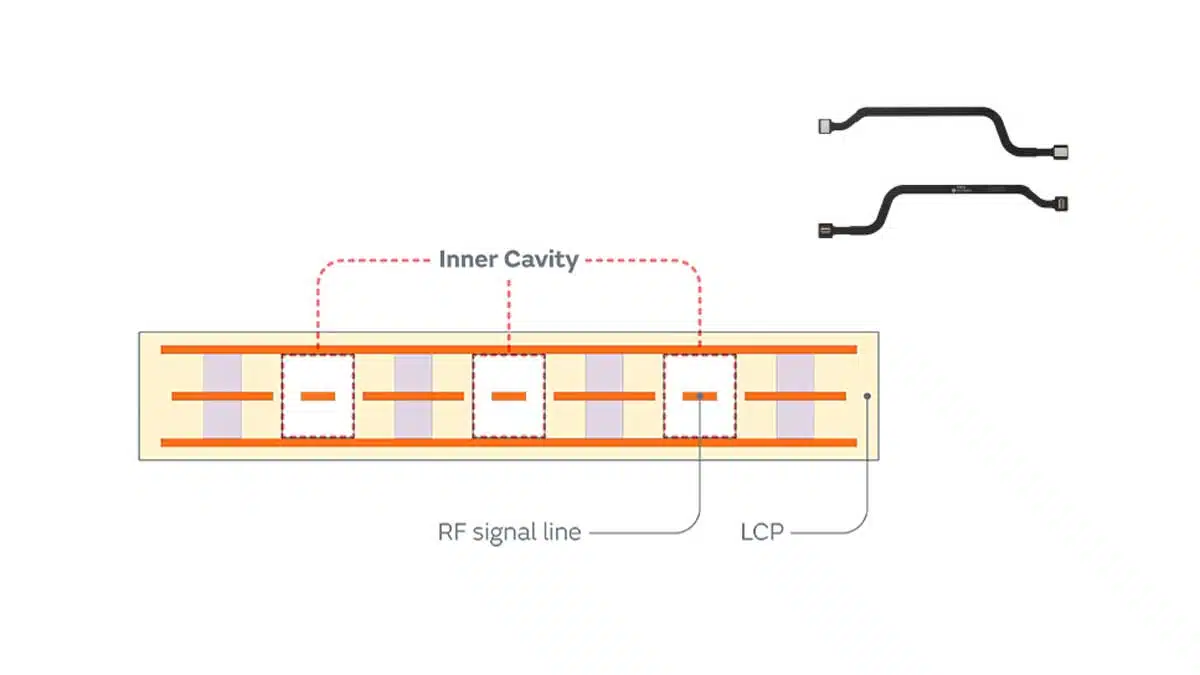
Murata Manufacturing Co., Ltd announces the World’s First LCP (liquid crystal polymer) flexible substrate with an Inner Cavity structure, ULTICIRC, and has already begun mass production.

Murata’s proprietary design incorporates an Inner Cavity within the substrate to achieve a dielectric constant (Dk) below 2.0, dramatically reducing transmission loss.

RelatedPosts

June 2026: AI Demand Pushes Japanese and Korean MLCC Makers to Five‑Year Shipment High

Murata Unveils Lead Disc Ceramic Capacitors for Automotive Safety and EMI Suppression

Murata Expands Ansys Simulation Models for RF inductors, MLCCs, and Power Inductors

With 6G expected to leverage the FR3 (Frequency Range 3) band—roughly 7–24 GHz—substrates with minimal transmission loss are essential to enable high-speed, high-capacity communications at high frequencies. At the same time, demand is growing for thin, space-saving flexible substrates that support free-form mechanical design to meet the ongoing miniaturization of smartphones and communication equipment.

Murata has provided LCP flexible substrates with excellent high-frequency characteristics, featuring a proprietary high-performance resin that eliminates spring-back and an adhesive-free, one-shot press multilayer lamination process; building on this expertise for 6G readiness, Murata has developed and launched ULTICIRC.

Conventional flexible substrates faced the challenge that making them thinner resulted in increased transmission loss, but this product incorporates an Inner Cavity structure within the substrate, achieving a dielectric constant (Dk) below 2.0, which is significantly lower than Murata’s conventional products, enabling both thin profiles and ultra-low transmission loss simultaneously.

Furthermore, thanks to an adhesive-free proprietary manufacturing method and the excellent barrier properties of LCP, the Inner Cavity structure maintains high moisture resistance. 

Details on our LCP flexible substrates are available on the product website; the web page for ULTICIRC will be updated at a later date. 
Related

Source: Murata

Recent Posts

Murata Unveils Lead Disc Ceramic Capacitors for Automotive Safety and EMI Suppression

15.7.2026
98

In the Age of AI, Every Watt Counts: Implications for Components

13.7.2026
124

Molex Unveils Automotive Ethernet Connectors for Next‑Gen SDV Architectures

2.7.2026
57

binder Prints Electronics on 3D Components Connector Surface

1.7.2026
26

100 V Hybrid Polymer Capacitor from VINA Enesol Targets 48–72 V Power Platforms

26.6.2026
283

KYOCERA AVX Releases NTN Antenna Selection Guide Brochure

25.6.2026
65

Würth Elektronik Expands Nanocrystalline Cable Cores for Broadband EMI Suppression

23.6.2026
88

EMC‑Compliant PCB and Connector Design Guidelines

22.6.2026
131

Knowles Expands High‑Q Ceramic Core Inductors for RF designs

19.6.2026
51

Upcoming Events

Jul 29
17:30 - 18:30 CEST

To Ferrite or to Nanocrystalline in Transformer Design

Sep 29
16:00 - 17:00 CEST

Cybersecurity 2026

View Calendar

Popular Posts

  • Buck Converter Design and Calculation

    0 shares
    Share 0 Tweet 0
  • Boost Converter Design and Calculation

    0 shares
    Share 0 Tweet 0
  • YAGEO Announces July 2026 Capacitor Price Increase

    0 shares
    Share 0 Tweet 0
  • Flyback Converter Design and Calculation

    0 shares
    Share 0 Tweet 0
  • LLC Resonant Converter Design and Calculation

    0 shares
    Share 0 Tweet 0
  • MLCCs in the Age of AI: Q2 2026 Market Tightness

    0 shares
    Share 0 Tweet 0
  • MLCC and Ceramic Capacitors

    0 shares
    Share 0 Tweet 0
  • Earthing Systems and IEC Classification Explained

    0 shares
    Share 0 Tweet 0
  • Dual Active Bridge (DAB) Topology

    0 shares
    Share 0 Tweet 0
  • Nvidia Vera Rubin: Why One AI Rack Needs So Many More MLCC Capacitors

    0 shares
    Share 0 Tweet 0

Newsletter Subscription


Passive Components Blog

© EPCI - Leading Passive Components Educational and Information Site

  • Home
  • Privacy Policy
  • EPCI Membership & Advertisement
  • About

No Result
View All Result
  • Home
  • Knowledge Blog
  • Dossiers
  • PCNS

© EPCI - Leading Passive Components Educational and Information Site

This website uses cookies. By continuing to use this website you are giving consent to cookies being used. Visit our Privacy and Cookie Policy.