






Resistors in power and signal circuits rarely see pure DC; they are often stressed by pulses, surges and elevated temperatures that can dramatically reduce lifetime if not handled correctly. This guide provides a practical, step‑by‑step methodology to select and derate resistors for reliable operation under pulse, power and voltage stress.
Resistor pulse load design requires separate checks of average dissipation, peak voltage, peak current, pulse energy and temperature; a continuous wattage rating alone does not establish pulse capability. This guide explains how design and component engineers can select and derate resistors for switching-power circuits, inrush limiting, snubbers, surge-exposed inputs and signal circuits using the exact manufacturer’s ratings and the actual mounting conditions.
Key Takeaways
Reliable pulse-loaded resistor selection depends on the complete stress waveform and on the conditions attached to each datasheet limit.
- Check continuous power, peak voltage, peak current and pulse capability separately. Passing an average-power calculation does not demonstrate that the resistive element can survive an individual pulse.
- Use the manufacturer’s single-pulse or repetitive-pulse curves for the exact resistor series, resistance value and package. Confirm pulse shape, repetition rate, temperature and permissible resistance change.
- Distinguish maximum continuous working voltage from a separately specified pulse or surge voltage. A short pulse may exceed the continuous limit only where the manufacturer explicitly permits it under defined conditions.
- Calculate pulse energy from the actual waveform. Equal-energy rectangular conversion is useful for suitable thermal pulses, but it is not a general replacement for checking sharp surge voltage.
- Apply power derating using the temperature reference specified in the datasheet. Ambient temperature, terminal temperature, resistive-element temperature and PCB temperature are not interchangeable.
- Validate the installed circuit, including hot restart, tolerances, source impedance, layout, pulse count and protection coordination. A technology label or automotive qualification statement does not replace application-specific verification.
Basic Concepts and Definitions
Pulse-loaded resistors must remain within several simultaneous electrical and thermal limits. The following relationships apply to an approximately ohmic resistive element; fast-edge applications also require attention to parasitic inductance and capacitance, while strongly temperature-dependent resistance requires calculation with the changing resistance rather than a fixed nominal value. [1, 2]
Periodic pulse loads
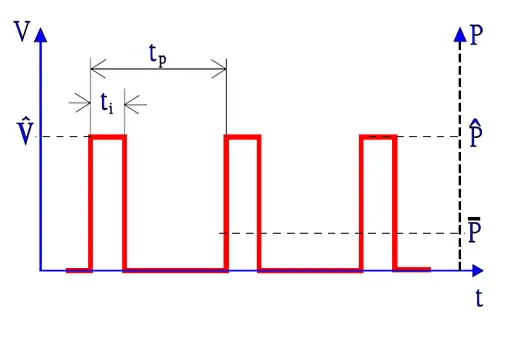
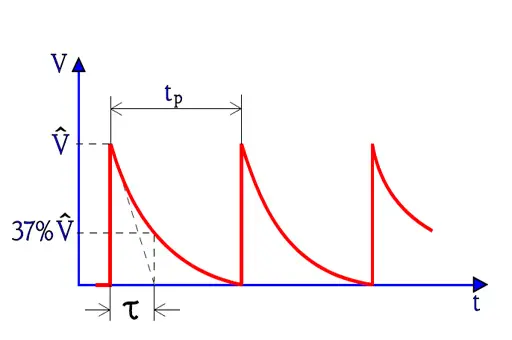
Figures 1 and 2 illustrate rectangular and exponentially decaying pulse trains. Real switching pulses have finite edges and may contain overshoot or ringing, so measure or calculate the voltage and current at the resistor rather than assuming that the source waveform appears unchanged across it.
Let v(t) be the instantaneous voltage across the resistive element, i(t) the current through it, R its resistance and p(t) the instantaneous power dissipated in that element. For constant R, Eq. (1) gives the equivalent power expressions. Use volts, amperes, ohms, watts and seconds consistently.
If the measured terminal voltage includes a significant inductive component, terminal voltage multiplied by current describes power entering the complete component, not necessarily the instantaneous heat generated in its resistive element. For most slower film-resistor pulses the simple resistive approximation is adequate; low-ohmic shunts, wirewound resistors and fast switching edges require a closer assessment of impedance and measurement bandwidth. [1, 2]
Pulse energy and average power
Pulse energy E is the integral of dissipated power over the event. For a periodic waveform, the mean power P̄ is the energy dissipated during one complete period tp divided by that period. Eq. (2) includes any background dissipation between pulses when that dissipation is included in p(t).
For identical, non-overlapping events repeated at frequency f = 1/tp, with negligible dissipation between events, Eq. (3) relates energy and average power. Where an event occurs on top of a continuous load, calculate the total waveform or add only the incremental pulse energy to the correctly evaluated baseline power.
The mean power must remain below the permissible continuous dissipation PT at the relevant temperature and mounting condition. This is a necessary condition, not a complete pulse check: local element temperature or electric-field stress can exceed its limit even when the average dissipation is low. [1, 2]
Rectangular pulses
For a rectangular voltage pulse of amplitude Vpk, duration ti and period tp, define duty cycle D = ti/tp. With negligible power between pulses, Eq. (4) gives peak power Ppk, pulse energy and mean power.
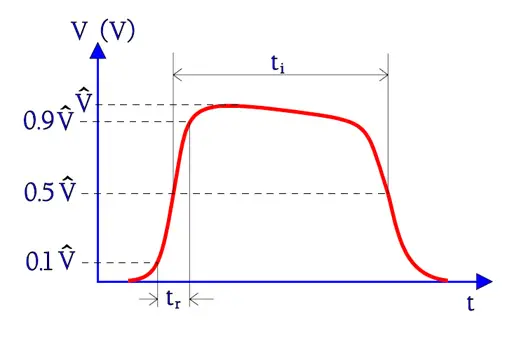
Figure 3 retains the original graphical timing convention. When using a datasheet curve, use the manufacturer’s pulse-width definition rather than automatically substituting a width measured at another percentage of the pulse amplitude.
Exponential pulses
For a voltage that decays as v(t) = V0 exp(−t/τe), V0 is the initial voltage and τe is the electrical decay time constant. Because power depends on voltage squared, its decay is twice as fast in the exponent. Eq. (5) gives the energy accumulated up to time tend. [1]
For a substantially complete decay, Eq. (6) follows. The corresponding mean power fE is valid when each event starts at V0, the decay is substantially complete before the next event, and other losses between events are negligible. A pulse that restarts before the previous decay ends requires integration of the actual periodic waveform.
For an ideal capacitor C discharging only through R, τe = RC and Eq. (6) becomes E = CV0²/2. Where other resistances, semiconductor losses or an active source participate, calculate the share dissipated in the resistor under review rather than assigning all stored energy to it.
Single pulses and repetitive exposure
An isolated pulse starts from a sufficiently recovered thermal condition that residual heat from the preceding event is negligible. A repetitive pulse train can maintain an elevated starting temperature. The interval required for recovery depends on the component and mounting, not simply on whether the circuit calls an event a startup or a surge. [2]
Thermal recovery does not erase permanent damage or accumulated resistance drift. Repeated events separated by long cooling intervals must still satisfy any specified lifetime pulse-count and resistance-change limits. A rating established for a few qualification pulses must not be treated as unlimited lifetime endurance.
Pulse Terminology and Standard Test Waveforms
Pulse dimensions are meaningful only when the waveform and measurement convention are stated. Rectangular pulses, exponential decays and standardized high-voltage surges use different timing parameters and should not be interchanged without checking their definitions. [1, 3]
Timing parameters
- Pulse duration ti: the duration used for a rectangular-pulse calculation or datasheet limit. State the amplitude thresholds used when measuring a non-ideal rectangle.
- Rise time tr: the transition interval between stated amplitude levels. A step-edge rise-time definition is not automatically the same as the virtual front-time definition used for a surge.
- Pulse period tp: the interval between equivalent points of successive pulses. The repetition frequency is f = 1/tp.
- Electrical time constant τe: the decay parameter of an exponential voltage or current waveform. It is distinct from a resistor’s thermal time constants.
- Pulse count N: the number of events used in qualification or expected over the operating life. Record exceptional events and normal repetitive operation separately.
Single-pulse high-voltage tests
The surge designations 1.2/50 µs and 10/700 µs identify front time and time to half-value on the falling portion of the waveform. They do not mean a rectangular pulse with those rise-time and width values. The generator network and source impedance also matter because loading can alter the voltage and current delivered to a resistor. [1]
IEC 60115-1:2020 places the single-pulse high-voltage overload test in Clause 8.2 and the periodic-pulse high-voltage overload test in Clause 8.3. The single-pulse method and its adjustable severities were revised from the earlier edition; legacy references to Clause 4.27 therefore need an edition check. [3]
| Test framework | What it establishes | Application check |
|---|---|---|
| IEC 60115-1:2020, Clause 8.2 | Single-pulse high-voltage overload testing with specified waveform and severity | Confirm the applicable detail specification, generator conditions, pulse count and permitted resistance change. |
| IEC 60115-1:2020, Clause 8.3 | Periodic-pulse high-voltage overload testing | Do not substitute a single-pulse rating for repetitive operation. |
| IEC 60115-8:2023 | Sectional requirements for fixed surface-mount resistors | Confirm the selected test methods, mounting requirements and declared product classification. |
| Manufacturer application rating | Permissible operation for the stated resistor series and conditions | Match resistance, waveform, temperature, repetition and drift requirements to the circuit. |
IEC 60115-8:2023 includes the periodic-pulse high-voltage overload method among its default tests while retaining a legacy periodic-pulse overload method for historical products. This is a reason to compare the test method and edition behind a qualification claim, rather than comparing the phrase “pulse tested” alone. [4]
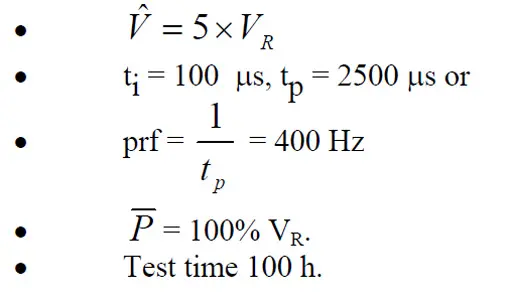
Overload Factors: Power, Voltage and Current
Overload factors express pulse stress relative to a clearly stated reference rating. Their notation is not sufficiently universal to use a symbol from one graph with a definition from another; always retain the definition and reference conditions supplied with the curve.
Explicit definitions for design calculations
In this guide, kP is peak pulse power divided by reference continuous power Pref; kV is peak pulse voltage divided by reference voltage Vref; and kI is peak pulse current divided by reference current Iref. Eq. (7) defines the ratios without relying on historical symbol conventions.
Only when the reference values describe the same resistance and satisfy Vref²/R = Iref²R = Pref does Eq. (8) apply. If the reference voltage is instead an independent construction-related voltage limit, the same relationship cannot be assumed.
Pulse duration and historical curves
A shorter pulse can permit higher instantaneous power because less energy is deposited before the pulse ends. The allowable increase is limited by element heating, current density and electric-field stress, and must come from the appropriate manufacturer curve. It is not valid to extend a constant-energy line indefinitely towards shorter durations. [1, 2]
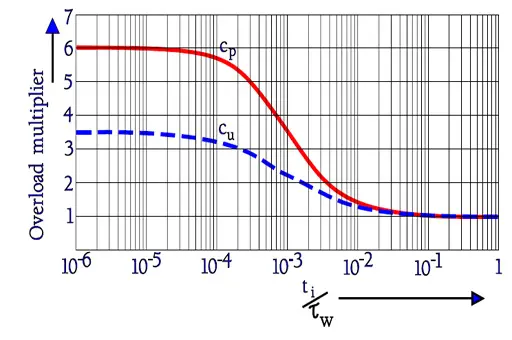
Figure 5 illustrates the original normalized approach. It is not a universal operating envelope for modern carbon-film, thin-film, thick-film or wirewound products. Its historical notation should not be transferred to a different component series without the corresponding definitions and rating conditions.
Voltage Limits, Critical Resistance and Limiting Voltage
A resistor can reach its voltage limit before reaching its continuous power limit, especially at high resistance. Continuous working voltage and pulse withstand must therefore be evaluated separately, with the actual voltage across each component rather than the supply voltage alone. [1, 2]
Continuous working voltage
Let PR be rated continuous power under the specified reference conditions and Vg the construction-related limiting continuous voltage used in this article. Manufacturer terminology varies, so identify the corresponding maximum working or limiting-element voltage in the selected datasheet. At a condition where permissible continuous power is PT, Eq. (9) gives the power-derived and voltage-derived constraints.
Vcont,max is the maximum continuous voltage allowed by these two checks. For AC operation, use the datasheet’s RMS definition and check any separate peak-voltage restrictions. Eq. (9) does not grant a pulse rating and does not replace requirements for insulation, spacing or environmental conditions.
Critical resistance
At the rated reference conditions, critical resistance Rcrit is where the power-derived voltage reaches Vg. Eq. (10) gives that crossover. Below it, rated dissipation normally sets the continuous limit; above it, the continuous voltage limit restricts permissible power.
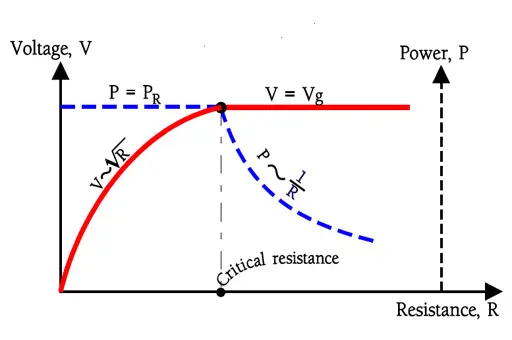
In the voltage-limited region, permissible continuous power is Vg²/R rather than the full rated wattage. At a higher operating temperature, repeat the continuous check using PT; do not assume that a catalog critical-resistance value already includes the application’s temperature derating.
Pulse voltage is a separate rating
A manufacturer may permit a short pulse above the continuous working-voltage limit. Such permission is valid only for the specified waveform, duration, repetition, resistance range, temperature and acceptance criteria. Conversely, a short-time overload test voltage is not automatically an allowable repetitive operating voltage. [1, 2]
For a proposed pulse power, calculate the corresponding voltage using Vpk = √(PpkR) and compare it with the applicable pulse-voltage limit. For a current-driven event, calculate Vpk = IpkR. Increasing R reduces current in an ideal voltage-driven circuit, but increases voltage and power in an ideal current-driven circuit; it is not a universal stress-reduction measure.
Where voltage sharing is required, divide the required total resistance among a series chain and verify the voltage, power and energy of every element. Preserve the circuit’s required total resistance unless a circuit redesign explicitly calls for a different value.
Temperature Derating of Power
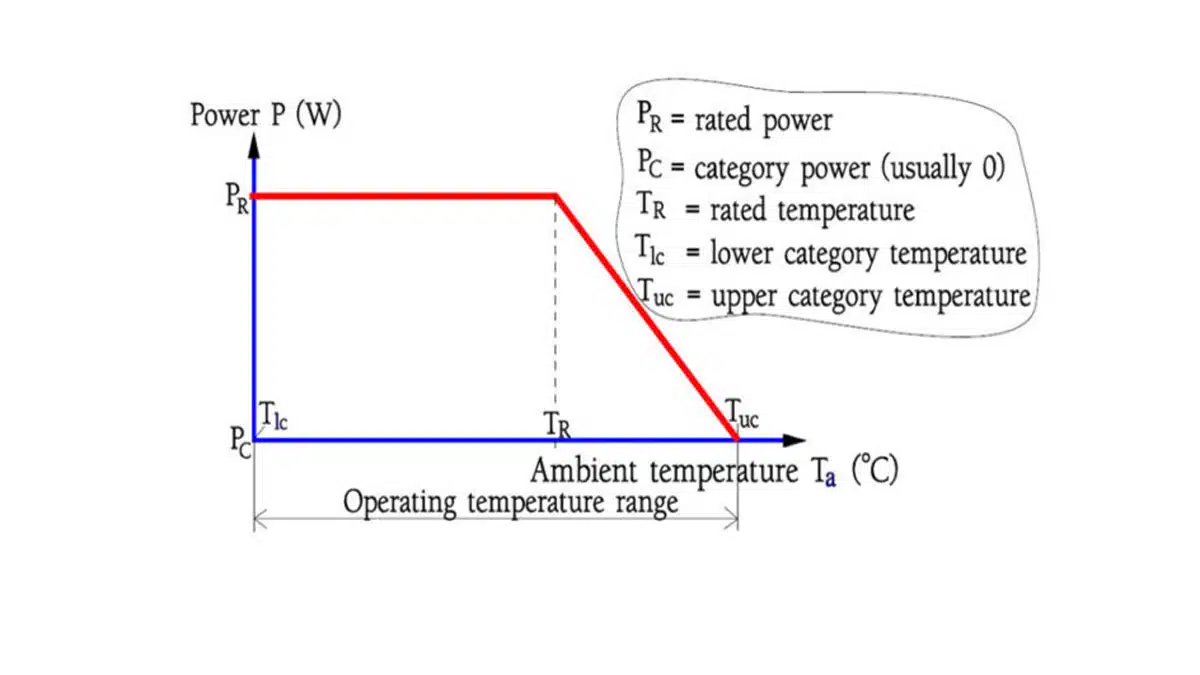
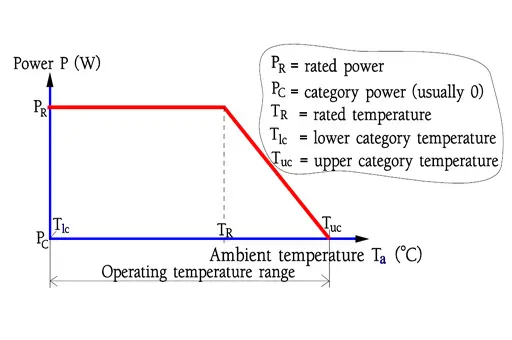
Continuous power ratings depend on a specified thermal reference and mounting arrangement. Use the selected resistor’s derating curve together with the actual local conditions; do not apply an ambient-temperature curve to a terminal-temperature rating or assume that every package follows the same derating law. [1, 2, 4]
Applying a linear derating curve
Where the datasheet specifies a straight-line reduction from rated power PR at reference temperature Tref to zero applied power at Tmax, Eq. (11) interpolates the permissible power between those endpoints. T is the temperature variable used by that particular curve.
Below Tref, do not exceed PR unless the manufacturer explicitly provides a higher rating. At or above the zero-power endpoint, the curve does not authorize powered operation. A nonlinear curve, multiple operating modes or a heatsink-dependent rating must be used as published rather than replaced by Eq. (11).
The familiar ambient rating at 70 °C is one convention, not a universal resistor property. Some SMD ratings instead relate to terminal or element temperature, while chassis-mounted power ratings may depend on a defined heatsink. IEC 60115-8:2023 also revised test boards for higher rated dissipation and recognizes transverse styles with wide terminals, reinforcing the importance of mounting conditions when comparing power ratings. [1, 4]
Continuous derating is not a universal pulse correction
Always compare total average dissipation with PT. Separately check the starting temperature and temperature conditions of the pulse rating. Pulse diagrams may be specified at room temperature, and continuous background dissipation can reduce the available thermal headroom before a pulse begins. [2]
Do not multiply a room-temperature pulse-energy limit by PT/PR unless the manufacturer endorses that relationship. Continuous dissipation and short-pulse energy involve different heat-flow timescales, and an element-limited pulse may not scale with the ambient derating curve.
High-reliability and project-specific derating
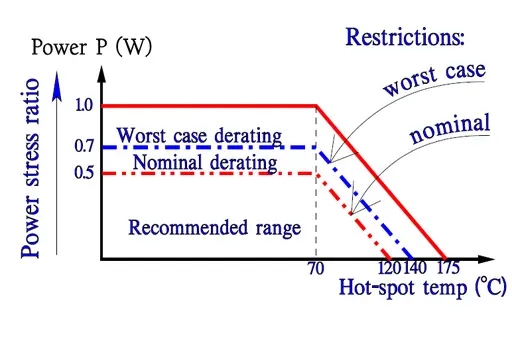
A project may impose additional operating margins to control drift, fault risk or lifetime uncertainty. Apply the actual project specification and resistor detail specification rather than treating a historical military curve or a fixed percentage of catalog wattage as a universal design rule.
Energy-Based View and Thermal Time Constant
Pulse energy helps quantify capacitor discharge, inrush and other transient loads, but energy alone does not define a safe operating point. Duration, peak power, peak voltage, local current density and initial temperature determine how that energy stresses the resistive element. [1, 2]
Element heating versus whole-body heating
During a sufficiently short pulse, heat has little time to leave the resistive element. The relevant heat capacity is then primarily that of the active element participating in the transient, not the total mass of the ceramic body, coating or PCB. A large substrate can improve longer-duration heat removal without providing a proportional increase in very-short-pulse capability. [2]
For longer pulses, heat spreads into surrounding materials and mounting structures. The transition depends on construction, so a single body warm-up time constant cannot describe every local thermal process. A short pulse can create an internal hot spot before an externally measured surface temperature changes appreciably.
Thermal time constants and repetition
A thermal time constant τth characterizes a particular thermal response. In a simple first-order approximation, temperature approaches a new steady state exponentially after a power step. Real resistors can have separate element-to-body, body-to-terminal and mounting-to-environment responses, so use measured transient data or manufacturer guidance where pulse margins are small.
- For an isolated short pulse, check the single-pulse curve and the specified initial temperature. Do not infer allowable energy solely from a body warm-up time constant.
- For a pulse train, check both the repetitive-pulse envelope and total average power. The temperature immediately before each pulse may be well above the surrounding air temperature.
- For bursts, evaluate pulse spacing within the burst, the burst duration and the recovery interval between bursts. Neither a single-event calculation nor a long-term average alone necessarily represents the hottest condition.
- For infrequent but repeated surges, check cumulative drift and the lifetime number of events even if the component cools between them.
Equivalent rectangular pulse
For a suitable thermal-energy pulse, an equivalent rectangular duration teq can be defined by preserving both pulse energy and peak power. Eq. (12) is useful only where the manufacturer’s method permits this waveform conversion. [2]
For the fully decayed exponential voltage in Eq. (6), teq = τe/2. This result follows because power decays as exp(−2t/τe), not exp(−t/τe). Do not use equal-energy conversion to dismiss the peak-voltage constraint of a sharp surge: use the specified surge waveform and voltage rating instead. [1, 2]
Using Datasheet Pulse and Derating Curves
The manufacturer’s application data provide the operating envelope for the selected resistor. Read the graph together with its notes, resistance range, mounting conditions and acceptance criteria; a plotted line without these conditions is not a complete rating. [2]
Typical datasheet information
- Continuous rated power and the temperature or mounting condition to which it applies.
- Maximum continuous working voltage, limiting-element voltage and any separate overload or pulse-voltage limits.
- Single-pulse power versus duration, or energy versus duration, for the relevant resistance value or stated resistance range.
- Repetitive-pulse capability, including repetition rate, duty cycle, number of pulses or defined endurance conditions.
- Specified surge waveforms, generator impedance and permitted voltage for the applicable test conditions.
- Maximum resistance change after exposure, inspection requirements and whether the limit describes normal operation, qualification or destructive capability.
Reading and applying the curves
First identify the exact series, package, resistance and construction option. A high-power, pulse-rated or untrimmed version can differ significantly from a standard part with the same nominal resistance and footprint. Do not transfer the curve of one version to another. [2]
Next convert the application stress into the metric used by the graph. Compare rectangular-pulse peak power at the applicable duration, pulse energy at the applicable duration, or surge voltage for the specified surge waveform. Retain separate peak-voltage and peak-current checks even when the main graph is expressed in watts or joules.
For repetitive operation, verify that each pulse satisfies the repetitive envelope and that total mean power remains below the temperature-derated continuous limit. If only single-pulse data are published, obtain repetitive-load guidance from the manufacturer rather than inventing a reduction factor.
For an isolated event, confirm the initial temperature, recovery interval and permitted lifetime pulse count. A room-temperature demonstration does not establish hot-restart performance, and a destructive test limit is not an operating rating. [2]
Resistance range and acceptance criteria
Pulse performance can change within a resistor series as resistance changes the film pattern, wire diameter, element length or active mass. Establish whether a curve applies to the full resistance range, a subset or one test value. A comparison at one resistance must not be generalized to all values. [2]
The permitted resistance change is equally important. A component that remains electrically continuous after a pulse may still be unsuitable for a precision divider, current shunt or feedback network. Set an application drift budget and compare it with the published post-pulse limit, not merely with a statement that the part survives.
Document the chosen operating margin and its purpose. Margin should account for waveform uncertainty, manufacturing tolerance, temperature, aging and the consequence of failure, but it cannot compensate for a missing voltage rating or an unsupported extrapolation beyond the published curve.
Design Procedure for Pulse-Loaded Resistors
Build the selection around the complete operating envelope rather than around nominal resistance and wattage. The checklist below records the information needed for engineering approval and purchasing control; the seven-step procedure at the end of this guide puts these checks into an implementation sequence.
Electrical and thermal requirements
- Define the circuit function, required total resistance, tolerance and allowable resistance drift. For sensing and feedback circuits, include the effect of drift on measurement or control accuracy.
- Record maximum continuous voltage and current, peak pulse voltage and current, waveform, duration, source impedance, repetition rate, burst pattern and lifetime number of events.
- Include supply tolerance, initial capacitor voltage, capacitance tolerance, clamp tolerance and relevant resistance-temperature changes. Determine the worst case for each stress rather than assuming one component-tolerance corner covers every check.
- Specify local ambient temperature, neighboring heat sources, enclosure conditions, airflow, mounting orientation and available PCB copper or heatsink.
- Check cold startup, normal repetitive operation, hot restart and credible fault conditions separately. A resistor may start its most severe pulse while already heated by previous operation.
Datasheet and supplier comparison
For each candidate, record the exact ordering code and the conditions behind its ratings. A supplier comparison should distinguish guaranteed operating limits from typical performance, qualification results and destructive-test demonstrations. [2]
| Parameter | What to compare | Reason |
|---|---|---|
| Resistance and construction | Exact value, tolerance, element technology and pulse-rated option | Pulse capability may vary with resistance and construction within the same footprint. |
| Continuous power | Reference temperature, test board or heatsink and derating curve | Catalog wattages are not directly comparable without their thermal conditions. |
| Continuous voltage | Rated voltage and maximum working or limiting-element voltage | A high-value resistor may be voltage-limited before reaching rated power. |
| Pulse capability | Waveform, peak power or energy, duration, repetition and temperature | A single-pulse rating does not establish repetitive capability. |
| Surge capability | Waveform, generator impedance, voltage, pulse count and polarity where specified | Equal-energy conversion cannot replace a sharp-surge voltage check. |
| Acceptance criteria | Maximum resistance change, inspection criteria and failure definition | Survival without an open circuit may not meet the application’s accuracy requirement. |
| Environmental and safety requirements | Required qualification, termination, coating and documented fault behavior | Pulse performance alone does not establish suitability for the complete environment or protection function. |
Catalog versus custom resistors
Prefer a catalog part where its guaranteed ratings cover the required operating envelope and its construction is controlled by a complete ordering code. Obtain written clarification when the published graph omits the required resistance range, operating temperature or repetition conditions.
Consider a custom resistor or assembly when standard products cannot meet the combination of energy, voltage, inductance, mounting, cooling and dimensional constraints. Agree a controlled drawing and electrical specification covering the element construction, resistance, terminals, mounting conditions, pulse waveform, pulse count, permissible drift and qualification acceptance criteria. A custom designation by itself is not evidence of a wider operating envelope.
For approved alternatives, compare the conditions behind the ratings rather than matching resistance, package and nominal wattage alone. Treat a change of element construction, trim geometry, coating or thermal reference as an engineering change requiring review of pulse performance.
Qualification and safety
Qualify representative components on the intended mounting arrangement using the worst-case application waveform and initial temperature. Measure resistance under consistent conditions before exposure and after the specified recovery interval; distinguish reversible temperature effects from permanent drift.
For safety-related positions, define the required response to abnormal operation and coordinate the resistor with the circuit’s protective devices. Flameproof construction, a specified fusing characteristic and surge withstand describe different functions. Do not assume that a general-purpose resistor will open safely or that a flameproof resistor will interrupt a fault within a required time.
Component qualification supports selection, but it does not establish compliance of the finished equipment. Verify the application’s required insulation distances, fault conditions and protective behavior in the complete assembly.
Technology-Specific Pulse Capability
Construction provides a useful shortlist, but there is no universal ranking that applies to every resistance, waveform and drift requirement. Active-element mass, current-path geometry, trimming, coating and mounting can be more important than nominal package size. [1, 2]
Carbon-film and metal-film resistors
Selected carbon-film constructions offer strong pulse capability, particularly where a cylindrical element provides a large effective resistive area and a suitable helical trim distributes the load. This advantage is construction-specific: it does not establish the capability of every carbon-film part or make carbon film interchangeable with carbon composition. [2]
Metal-film and thin-film products are often selected for precision, stability and low excess noise. Their pulse capability also depends on geometry and trim pattern. A well-designed thin-film chip or MELF resistor can outperform a standard thick-film chip under a defined energy pulse, so it is incorrect to assume that the thinner film must always be the weaker pulse option. [1, 2]
For precision dividers, signal conditioning and feedback networks, compare post-pulse drift as well as initial tolerance and temperature coefficient. For power and protection positions, also check peak voltage, pulse energy and the required fault behavior.
Thick-film chip resistors
Standard thick-film chips can develop localized current crowding near trimming features and within the resistive material. Their pulse limits vary with resistance, pattern and construction; neither package size nor continuous wattage alone predicts the result. [1, 2]
Dedicated pulse-rated thick-film products can improve the effective resistive area or avoid restrictive trim features. Examples of construction approaches include untrimmed elements and resistive films on both sides of the substrate. These approaches change the current and heat distribution, but their benefit must still be established from the exact series data. [2]
A low-resistance thick-film part may perform differently from a high-value part in the same family. Do not extrapolate a low-value pulse result across the full range. Similarly, a substrate selected for better heat conduction can help longer-duration or continuous dissipation without proportionally increasing the energy that the element can absorb during an extremely short pulse.
Wirewound and dedicated surge resistors
Wirewound resistors are strong candidates for high-energy capacitor discharge, pre-charge, braking and other power duties because the wire can provide substantial active-element mass. Pulse capability is strongly resistance-dependent because wire diameter and length determine both resistance and the mass available to absorb energy. [2]
Check inductance where the circuit requires fast current changes, damping or controlled impedance. A wirewound part suitable for a relatively slow pre-charge event may be unsuitable for a fast snubber unless its winding and impedance are appropriate. A non-inductive construction still requires verification at the frequencies and edge rates relevant to the circuit.
Dedicated surge resistors can use film or wire elements with construction optimized for a specified overload or surge environment. Compare the declared waveform, pulse count and permitted drift rather than assuming that the term “surge resistor” implies one common test or energy rating.
Metal-element current-sense resistors
Low-ohmic metal-element resistors can provide substantial short-pulse capability because the resistive element itself has useful mass. For these parts, current handling, terminal temperature and connection geometry are often more consequential than a high-voltage rating. [2]
For current sensing in converters, motor drives and battery circuits, check overload-induced drift against the measurement error budget. Include the parasitic resistance and inductance of current paths, and use the specified sense connections so that PCB voltage drops are not mistaken for the resistor’s voltage.
Series and Parallel Configurations for Pulse Sharing
A resistor network can distribute voltage, current and energy while preserving a required total resistance. The benefit depends on the actual circuit source, component tolerances, parasitics and thermal coupling; adding components does not automatically provide proportional operating margin.
Series connection
For n equal resistors replacing a required total resistance Rtotal, select each nominal element as Rtotal/n. In the ideal resistive case, each element receives one nth of the total applied voltage and dissipated energy. The same current passes through all elements.
Eq. (13) assumes equal resistance and negligible parasitic effects. In a real chain, assess the highest voltage and energy imposed on an individual element by resistance tolerance, temperature differences and the waveform. Under a common series current, an element with higher resistance dissipates more power.
For high-voltage or fast-edge pulses, capacitance to surrounding conductors can disturb transient voltage sharing. Verify the installed geometry before adding equalizing components. Any added capacitance changes displacement current, energy and circuit response, so it requires its own voltage and safety assessment.
Maintain the required creepage and clearance across the complete chain, between neighboring elements and to nearby conductors. Dividing the resistor voltage does not automatically divide every insulation stress in the surrounding assembly.
Parallel connection
For n equal branches replacing Rtotal, each branch must have resistance nRtotal. Ideal equal branches share current and energy, but each branch sees the full applied voltage.
Eq. (14) assumes equal branch impedance. Use symmetric current paths and account for trace resistance, terminal resistance and inductance, particularly with low-ohmic parts and fast pulses. Under a common applied voltage, a lower-resistance branch dissipates more power.
Parallel connection does not reduce the voltage across an individual resistor. It can also increase loading if identical resistors are simply added without preserving the required total resistance. Recalculate the complete circuit rather than assuming that an added branch always reduces stress.
Thermal coupling and fault behavior
Closely grouped resistors heat one another and share the same PCB thermal paths. The continuous capacity of an installed network can therefore be less than the sum of isolated-component catalog ratings.
Consider the consequences of an open or shorted element. A failed parallel branch can overload the remaining branches, while a failed element in a high-voltage chain can alter voltage distribution or expose adjacent structures to greater stress. Verify these conditions where they form part of the equipment’s required fault assessment.
Application Examples
The following examples retain the original application classes: inrush limiting, flyback snubbers and automotive transients. Their purpose is to identify the correct waveform and checks before choosing a resistor; a separate capacitor-discharge calculation demonstrates the relationship between time constant, energy and equivalent duration.
Example 1: Inrush limiting in an AC-DC converter
A resistor charging a bulk capacitor generally does not experience a rectangular pulse train. Depending on the rectifier, source impedance, input phase, capacitor state and bypass arrangement, the waveform may resemble an exponential decay or a more complicated sequence of charging pulses.
For the idealized case of a capacitor initially at voltage VC0 connected to a constant source VS through a single resistor, define ΔV = VS − VC0. Eq. (15) gives the initial current, initial resistor power and energy dissipated during complete charging.
Eq. (15) assumes an ideal constant-voltage source, constant resistance and no other dissipative path. Increasing R reduces initial current and peak power but extends the charging transient; it does not reduce the total resistor energy in this ideal circuit. If other series resistances participate, calculate the energy share in the resistor being selected.
- Model or measure the worst-case charging waveform, including maximum input voltage, capacitance and the initial capacitor voltage.
- Check the largest peak-current and peak-power condition separately from the longest-duration or highest-energy condition.
- If the resistor remains in circuit, include normal operating dissipation. If it is bypassed, evaluate the bypass timing and the consequences of a failed or delayed bypass.
- Include rapid power cycling and hot restart. The next charging event may occur before the resistor has cooled, even if the capacitor has partly discharged.
- Compare the actual pulse with the applicable energy or power-duration curve and verify peak voltage, lifetime event count and post-pulse drift.
Calculation check: Published capacitor-discharge example
A published resistor pulse-load test uses a 16 µF capacitor discharged into a 1 kΩ resistor and states an electrical time constant of 16 ms. Recalculation with Eq. (16) confirms that value. [1]
The equivalent rectangular duration at the same peak power is therefore 8 ms, not 16 ms. The capacitor’s initial voltage is needed to determine numerical peak power and energy; it should not be inferred from the time constant. With initial voltage V0, peak power is V0²/R and total energy is CV0²/2.
This calculation establishes the electrical stress, not the suitability of any particular resistor. Compare the resulting waveform with the exact part’s pulse rating, initial-temperature conditions and permitted resistance change.
Example 2: Snubber resistor in a flyback converter
Distinguish an RC damping network from an RCD clamp. An RC network can experience charging and discharging pulses associated with switching-node voltage transitions, while an RCD clamp transfers and dissipates energy according to its clamp topology and operating point. Neither should be reduced to a generic exponential pulse without checking the actual waveform.
Where a leakage inductance Lleak carries current Ioff immediately before switch turn-off, its stored energy is given by Eq. (17). This is a useful starting point, but it is not automatically the total energy dissipated in a particular snubber resistor.
The fraction reaching the resistor depends on the topology, clamp voltage, parasitic capacitances and other loss paths. Integrate the resistor’s dissipated power over a switching period, including all relevant charging and discharging events. Then use the complete event energy and switching frequency to determine mean power.
- Measure or simulate the resistor voltage and current at the operating points that produce the largest peak stress and mean dissipation.
- Include startup, load changes and burst operation where these create a different pulse pattern from steady-state switching.
- Check repetitive-pulse capability and temperature-derated continuous power independently.
- Select sufficiently low parasitic impedance for the intended damping function. Verify the final layout because resistor and interconnect inductance can change the waveform.
Example 3: Automotive load dump and surge protection
Automotive supply exposure must be defined by the applicable vehicle and customer requirements. ISO 16750-2:2023 addresses electrical loads for road-vehicle electrical and electronic equipment; its scope explicitly excludes electromagnetic compatibility. Treat electrical-load qualification and EMC requirements as distinct parts of the test plan. [5]
The resistor does not necessarily see the open-circuit generator waveform. Harness impedance, upstream protection, clamp behavior, load current and the resistor’s position determine its actual voltage, current and energy. A battery pre-charge resistor also has a different duty from a resistor in a transient-protection input.
- Identify the required transient waveform, generator impedance, clamp condition, repetition and acceptance criteria from the applicable equipment specification.
- Calculate or measure the waveform at the resistor with the complete protection network operating, including relevant tolerances and temperature conditions.
- For high-energy events, evaluate wirewound, metal-element or dedicated surge constructions as appropriate to resistance, voltage and mounting requirements.
- Verify pulse energy, peak power, peak voltage, initial temperature and drift. Do not infer application suitability from an automotive qualification label alone.
- Validate the assembled protection network and its behavior after the required number of events, including the consequences of a resistor or clamp failure.
Failure Modes Under Pulse Stress
Pulse failure is not limited to an immediately visible open circuit. Local damage can produce permanent resistance drift before the component loses continuity, which is particularly important in sensing, feedback and precision-divider applications. [1, 2]
Electrical and thermal damage
- Excessive local element temperature can damage a film or wire, alter resistance or produce an open circuit.
- Current crowding near a trim feature or restricted current path can create a hot spot even when the average temperature appears acceptable.
- Excessive voltage can cause breakdown or flashover within the component or across contaminated surfaces in the assembly.
- Repeated temperature excursions can stress the substrate, coating, terminations and solder joints.
- Fault heating can damage adjacent components or PCB material even if the resistor itself eventually opens.
Mitigation by derating and layout
Select an element construction and pulse rating with a documented margin to the application stress. Use series or parallel arrangements only after recalculating the complete network, and provide sufficient separation from temperature-sensitive components and materials.
For chip resistors, follow the manufacturer’s recommended land pattern and provide a suitable conductive path from terminals into PCB copper. A thermal-relief connection introduces a constriction in that path and should not be described as an inherent cooling improvement. Balance assembly requirements with thermal performance and verify the installed temperature.
Use thermal measurements to assess continuous and repetitive heating, but do not treat a modest surface-temperature reading as proof that a very short pulse is safe. Local element heating may occur faster than the measurement system or package surface can respond. [2]
Qualification measurements and acceptance
Record the delivered voltage and current waveform, initial temperature, mounting conditions and pulse sequence. Use measurement connections and bandwidth appropriate to the waveform, and avoid a probe arrangement that materially changes the circuit.
Measure resistance before testing and after a defined recovery period under consistent measurement conditions. Where practical and relevant, monitor intermediate drift during repeated exposure. For low-ohmic parts, use a measurement connection that excludes unwanted lead and contact resistance.
Set acceptance limits for resistance change, continuity, physical condition and functional performance. Check insulation or protective behavior where required by the application. For critical designs, agree the sampling plan and acceptance criteria with the responsible quality and safety functions rather than relying on a single successful specimen.
Conclusion
Reliable resistor pulse-load design requires separate checks of continuous dissipation, pulse energy, peak voltage, peak current, temperature and allowable drift. Define the actual waveform and initial conditions, then compare them with the exact resistor’s operating data rather than treating nominal wattage, package size or technology as a complete rating.
Use the manufacturer’s repetitive or single-pulse envelope as appropriate, preserve the distinction between continuous working voltage and rated surge voltage, and validate the intended mounting arrangement. For inrush limiters, snubbers, automotive protection and precision circuits, the final decision should be supported by documented assumptions, controlled component specifications and representative testing.
FAQ
These answers summarize the selection checks that most often distinguish a suitable pulse-rated resistor from a part selected only by nominal resistance and wattage.
For rectangular pulses with negligible dissipation between events, multiply peak pulse power by duty cycle. For a general periodic waveform, integrate dissipated power over one complete period and divide by that period. Compare the result with the temperature-derated continuous rating, then check individual pulse capability separately.
Only where the manufacturer explicitly specifies a permissible pulse or surge voltage above the continuous working limit. That permission applies to defined waveform, duration, repetition, resistance and temperature conditions. A short-time overload qualification voltage is not automatically an allowable repetitive operating voltage, and low average power does not remove the voltage constraint.
No. Energy must be assessed together with pulse duration, peak power, peak voltage, current, initial temperature and permitted resistance change. Equal-energy conversion can support suitable thermal-pulse comparisons when the manufacturer permits it. It cannot replace the specified voltage check for a sharp surge or establish unlimited lifetime pulse endurance.
There is no universal winner. Wirewound and metal-element constructions can provide substantial active-element mass, while selected carbon-film, thin-film and pulse-rated thick-film designs suit other pulse conditions. Compare the exact resistance, construction, waveform, temperature and permitted drift. Inductance, precision, mounting and required fault behavior can change the preferred choice.
Use the datasheet derating curve to check total average dissipation at its specified temperature reference and mounting condition. Separately confirm the initial temperature allowed by the pulse rating. Do not scale pulse energy directly by the continuous-power derating ratio unless the manufacturer supports that method for the selected resistor.
Equal series elements ideally share voltage and energy while carrying the same current. Equal parallel branches ideally share current and energy, but every branch sees the full applied voltage. Preserve the required total resistance and check tolerances, parasitic impedance, thermal coupling and each element’s individual pulse limit.
Request the applicable resistance range, waveform, pulse duration, repetition conditions, temperature, mounting arrangement and maximum permitted resistance change. Identify whether the information describes normal operation, qualification or destructive testing. If published data omit the required conditions, obtain written application guidance and qualify the exact ordering code in the intended assembly.
How to Select and Qualify a Pulse-Loaded Resistor
Use this procedure for a new design or a proposed component substitution. Record the assumptions and supporting data so that later supplier or circuit changes can be reviewed against the same operating envelope.
Select and qualify a resistor by checking electrical stress, temperature, pulse endurance, mounting and required failure behavior.
- Step 1: Define the electrical and thermal environment
Record the circuit function, continuous load, pulse waveform, source impedance, peak voltage and current, duration, repetition pattern and lifetime event count. Include supply and component tolerances, local temperature, mounting conditions, hot restart and relevant fault conditions.
- Step 2: Select resistance, construction and package
Choose the required resistance and accuracy, then shortlist constructions suited to the energy, voltage, current and frequency conditions. Identify the exact series and ordering option. Consider a custom specification only where catalog products cannot cover the combined requirements.
- Step 3: Check continuous and pulse voltage separately
Calculate the voltage across each resistor. Check continuous working voltage independently from the waveform-specific pulse or surge rating. For current-driven events, account for the increase in voltage with resistance. If using a series chain, verify individual-element stress and transient sharing.
- Step 4: Verify average power and temperature derating
Calculate total average dissipation from the complete waveform, including background load and bursts. Apply the selected datasheet derating curve at its stated temperature reference and mounting condition. Confirm that the installed board or heatsink can support the required thermal performance.
- Step 5: Verify pulse power, energy and endurance
Calculate peak power and pulse energy for the actual waveform. Compare with the appropriate single-pulse, repetitive-pulse or surge data for the resistance and temperature. Confirm pulse count and permitted drift. Obtain manufacturer guidance where the published conditions do not cover the application.
- Step 6: Review layout, protection and failure behavior
Check copper paths, terminals, thermal coupling, current sharing, parasitic impedance and insulation distances. Coordinate the resistor with protective devices and assess the required fault behavior. Do not infer a controlled fusing function from flameproof construction or from a general pulse rating.
- Step 7: Qualify and document the approved component
Test representative samples in the intended assembly under the worst-case waveform and initial temperature. Record delivered waveforms, resistance drift, physical condition and functional results against defined acceptance limits. Approve the exact ordering code and retain the supporting data for change control.
Further Reading
These complementary guides cover resistor fundamentals, construction, thermal behavior and application-specific selection. Use their broader explanations alongside the exact manufacturer data required for a pulse-critical design.
- What Is a Resistor? Types, Ratings and Selection — reviews resistance, power, voltage, tolerance and the main selection parameters.
- Resistor Types and Construction Fundamentals — explains how element, substrate, trimming and package choices affect performance.
- Resistivity and Thermal Resistance — provides background on thermal resistance, temperature coefficient and heat transfer into the mounting structure.
- Wirewound Resistors — examines wirewound construction and its implications for power and pulse applications.
- How to Choose Current Sense Resistor — discusses low-ohmic selection, connection errors and practical sensing trade-offs.
References
The numbered references support the calculation methods, construction discussion and standards framework used in this guide. Product-specific operating limits must come from the selected resistor’s current specification.
- Joachim von der Ohe, Pulse Load on SMD Resistors: At the Limit, Vishay Beyschlag, application note 28870, revision 15 August 2013.
- Vishay Intertechnology, 12 Things to Know About Resistors in Pulse Load Applications, Vishay, document MS9702509-2401, 2024.
- International Electrotechnical Commission, IEC 60115-1:2020 — Fixed Resistors for Use in Electronic Equipment, Part 1: Generic Specification, IEC, edition 5.0, 2020.
- International Electrotechnical Commission, IEC 60115-8:2023 — Fixed Resistors for Use in Electronic Equipment, Part 8: Sectional Specification: Fixed Surface Mount Resistors, IEC, edition 3.0, 2023.
- International Organization for Standardization, ISO 16750-2:2023 — Road Vehicles: Environmental Conditions and Testing for Electrical and Electronic Equipment, Part 2: Electrical Loads, ISO, edition 5, 2023.