





Passive Components Blog
No Result
View All Result
  • Home
  • News
    • All
    • Aerospace & Defence
    • Antenna
    • Applications
    • Automotive
    • Capacitors
    • Circuit Protection Devices
    • electro-mechanical news
    • Filters
    • Fuses
    • Inductors
    • Industrial
    • Integrated Passives
    • inter-connect news
    • Market & Supply Chain
    • Market Insights
    • Medical
    • Modelling and Simulation
    • New Materials & Supply
    • New Technologies
    • Non-linear Passives
    • Oscillators
    • Passive Sensors News
    • Resistors
    • RF & Microwave
    • Telecommunication
    • Weekly Digest

    August 2026 Interconnect, Passives and Electromechanical Components Market Insights

    AEM Introduced High-Power Fuses for Compact Automotive and Industrial Overcurrent Protection

    Knowles Cornell Dubilier 105C Flatpack Aluminum Electrolytic Capacitors Target Low-Profile High-Density Power Designs

    Vishay Thin Film Chip Resistors Combine up to 50 GHz Operation with High Power Density

    Samsung Electro-Mechanics Secures KRW 1.0722 Trillion AI Server MLCC Supply Contract

    KYOCERA AVX Adds 0201 C0G RF MLCCs to KGU Ultra-Low-ESR Capacitor Series

    Vishay Extends High-Current Common-Mode Chokes with 30 A EMI Filtering up to 150 °C

    Bourns Copper-Electrode MOV Series Targets High-Energy Line Surge Protection

    Bourns Expands 12 mm SMD Incremental Encoder with Shaft-Length Options for Compact HMI Controls

    Trending Tags

    • Ripple Current
    • RF
    • Leakage Current
    • Tantalum vs Ceramic
    • Snubber
    • Low ESR
    • Feedthrough
    • Derating
    • Dielectric Constant
    • New Products
    • Market Reports
  • Knowledge Blog
  • Dossiers
    • AI Hardware Dossier
    • Automotive Dossier
    • Industrial Robotics Dossier
    • Power Converter Dossier
    • Capacitor Dossier
    • Resistor Dossier
    • Inductor Dossier
    • Circuit Protection Dossier
  • Suppliers
    • Who is Who
  • PCNS
    • PCNS 2025
    • PCNS 2023
    • PCNS 2021
    • PCNS 2019
    • PCNS 2017
  • Events
  • Home
  • News
    • All
    • Aerospace & Defence
    • Antenna
    • Applications
    • Automotive
    • Capacitors
    • Circuit Protection Devices
    • electro-mechanical news
    • Filters
    • Fuses
    • Inductors
    • Industrial
    • Integrated Passives
    • inter-connect news
    • Market & Supply Chain
    • Market Insights
    • Medical
    • Modelling and Simulation
    • New Materials & Supply
    • New Technologies
    • Non-linear Passives
    • Oscillators
    • Passive Sensors News
    • Resistors
    • RF & Microwave
    • Telecommunication
    • Weekly Digest

    August 2026 Interconnect, Passives and Electromechanical Components Market Insights

    AEM Introduced High-Power Fuses for Compact Automotive and Industrial Overcurrent Protection

    Knowles Cornell Dubilier 105C Flatpack Aluminum Electrolytic Capacitors Target Low-Profile High-Density Power Designs

    Vishay Thin Film Chip Resistors Combine up to 50 GHz Operation with High Power Density

    Samsung Electro-Mechanics Secures KRW 1.0722 Trillion AI Server MLCC Supply Contract

    KYOCERA AVX Adds 0201 C0G RF MLCCs to KGU Ultra-Low-ESR Capacitor Series

    Vishay Extends High-Current Common-Mode Chokes with 30 A EMI Filtering up to 150 °C

    Bourns Copper-Electrode MOV Series Targets High-Energy Line Surge Protection

    Bourns Expands 12 mm SMD Incremental Encoder with Shaft-Length Options for Compact HMI Controls

    Trending Tags

    • Ripple Current
    • RF
    • Leakage Current
    • Tantalum vs Ceramic
    • Snubber
    • Low ESR
    • Feedthrough
    • Derating
    • Dielectric Constant
    • New Products
    • Market Reports
  • Knowledge Blog
  • Dossiers
    • AI Hardware Dossier
    • Automotive Dossier
    • Industrial Robotics Dossier
    • Power Converter Dossier
    • Capacitor Dossier
    • Resistor Dossier
    • Inductor Dossier
    • Circuit Protection Dossier
  • Suppliers
    • Who is Who
  • PCNS
    • PCNS 2025
    • PCNS 2023
    • PCNS 2021
    • PCNS 2019
    • PCNS 2017
  • Events
No Result
View All Result
Passive Components Blog
No Result
View All Result

3D Printing of Electronic Components Creates New Manufacturing Possibilities

11.2.2022
Reading Time: 5 mins read
A A

Vincent Charbonneau provided an overview of 3D printing capabilities on engineering.com website. This overview complete the picture of article about 3D printed capacitors by Nano-Dimension 3D printer here.

As a technology, 3D printing has existed for longer than some might think. Also known as additive manufacturing, due to the fact that objects are printed by adding material layer by layer, 3D printing first came to prominence in the 1990s. Given the technology’s infancy at the time, it was mostly suitable for the creation of aesthetic reference models during a project’s rapid prototyping phase.

RelatedPosts

August 2026 Interconnect, Passives and Electromechanical Components Market Insights

AEM Introduced High-Power Fuses for Compact Automotive and Industrial Overcurrent Protection

Knowles Cornell Dubilier 105C Flatpack Aluminum Electrolytic Capacitors Target Low-Profile High-Density Power Designs

Since that time, 3D printing has matured to the point where complex electronic components like circuit boards can now be constructed entirely through the use of CAD models and specialized 3D printers.

3D Printing Electronic Components

While several methods exist for 3D printing electronic components, typically this is accomplished by utilizing a dual-material fused filament process with conductive thermoplastic filaments. These thermoplastic filaments are often made with copper, but occasionally carbon and graphene are used instead. The latter are more brittle than copper, however, and have a tendency to shatter when subjected to significant vibrations.

As with all 3D printing, a digital CAD model of the desired part must first be designed, as this will serve as the printer’s instruction model, providing it with all the dimensional data required to build the component. Once the printing process begins, a trace is created (sort of like a part’s “fingerprint”), and then the requisite materials needed for that specific part are added in layers.

One key challenge when it comes to 3D printing electronic components compared to other printing projects is the need to use wider and thicker traces to compensate for the fact that the conductive ink, paint or filament utilized to build the traces has a higher resistance than the copper that is commonly used.
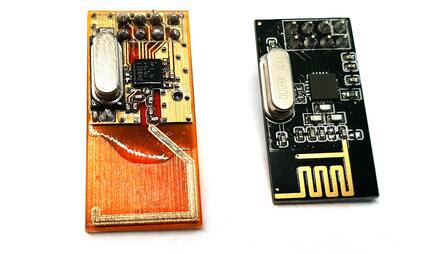
3D-printed Microstrip antennas. (Image courtesy of Nano Dimension.)

Many companies have already made significant forays into overcoming the numerous challenges posed by 3D printing complex components, allowing them to produce systems that are increasingly scalable and efficient. One such company is Nano Dimension.

Nano Dimension’s flagship platform is its DragonFly Lights-Out Digital Manufacturing (LDM) system for electronic circuitry. DragonFly LDM integrates a precise inkjet deposition printer with dedicated nano-inks and 3D software to print electronic circuits such as printed circuit boards (PCBs), antennas, capacitors and sensors.

DragonFly LDM printing method. (Image courtesy of Nano Dimension.)

The DragonFly’s eponymous “Lights-Out” manufacturing system signifies that the device is designed to run 24/7 with little to no operator intervention. According to Nano Dimension, “In the case of additive manufacturing, LDM means DragonFly users can 3Dprint more functioning electronic circuitry faster, extending the DragonFly’s rapid prototyping capabilities beyond prototyping. Users can now 3D print one-off prototypes as well as low-volume manufacturing of printed electronics.”

Making use of two self-cleaning print heads, one for nano-silver conductive ink and the other for dielectric polymer ink, DragonFly LDM is able to concurrently print with both inks in a single print job. Nano Dimension’s Switch software also plays an important role by preparing electronic designs for printing.

Switch users can adjust many characteristics of a 3D file, such as layer thickness, conductor width, layer order, punching, rotation options, as well as the shape or object outline. In addition, the software helps optimize the printing process by maximizing the use of the printing surface.

“The DragonFly LDM is designed to help our customers prepare for Industry 4.0 and stay competitive in a world that demands electronic devices with increasingly sophisticated features. Like its predecessor, the DragonFly Pro, it’s the first of its kind on the market, carefully designed for both ease of use and even more agile, faster and affordable 3D printing of functional circuitry,” said Amit Dror, CEO and cofounder of Nano Dimension. “We’re confident that the LDM system will provide best-in-class additive manufacturing of printed electronics on the market, making it possible for companies to be more innovative, improve productivity and reliability, lower costs, and reduce time-to-market.”

Another company that has thrown its hat into the electronic 3D printing ring is Optomec, which is focusing its efforts on Aerosol Jet technology and has developed a 3D printer capable of printing interconnects, traces, and even passive and active components on 2D and 3D substrates.

Printers equipped with the Aerosol Jet 3D printing system are able to print on a multitude of substrates, including plastics, ceramics and metallic structures. In addition, Aerosol Jet printers can print conformal interconnects on 3D surfaces, eliminating the need for wire bonding (for instance, printing electrical connections on 3D stacked die or for LED chip fabrication).
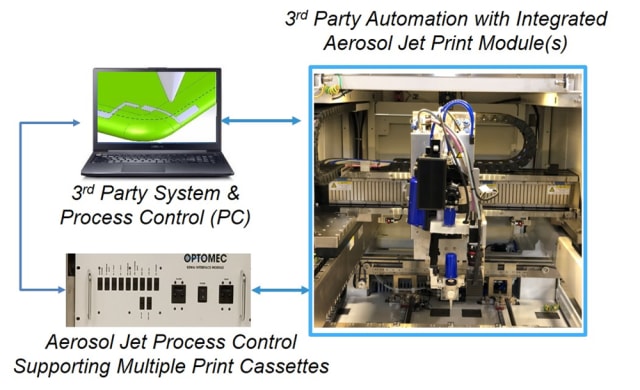
Aerosol Jet printing system. (Image courtesy of Optomec.)

In terms of emerging applications for its technology, Optomec hopes to one day add biological component printing to its printer’s list of capabilities. “The technology behind Aerosol Jet can print electronic and biological components onto 2D and 3D surfaces. By tightly integrating electronic circuitry with physical packaging, Aerosol Jet is fueling growth in new consumer and military applications where increased functionality in smaller spaces is a key driving factor,” the company stated.

All told, there are many advantages associated with 3D printing, some of which have already been discussed above. From mass customization, greater design freedom, tooling reductions and packing efficiencies, there is no shortage of benefits from 3D printing.

That is not to say that the technology is flawless—far from it. There are still many hurdles to overcome before 3D printing, especially the printing of complex components like PCBs, can really take off on a large scale. Currently, the 3D printing of electronics still has a high energy consumption when contrasted with traditional manufacturing systems, and the printing process itself can be quite slow. Furthermore, as more and more people gain access to sophisticated 3D printers and the less complex the process becomes, the more difficult it will be to stop the illegal manufacturing or “pirating” of proprietary technology.

3D printing has tremendous potential, and as the technology continues to be refined over time, there is little doubt that increasingly complex components—both organic and artificial—will be printed and produced on a mass scale. There may even come a day when advanced 3D printers become a common household staple, just like refrigerators or stoves. Until that day arrives, companies like Nano Dimension, Optomec and others will continue to push the boundaries of electronic manufacturing via 3D printing.

featured image source: Nano-Dimension

Related

Source: Engineering.com

Recent Posts

August 2026 Interconnect, Passives and Electromechanical Components Market Insights

4.9.2026
11

Knowles Cornell Dubilier 105C Flatpack Aluminum Electrolytic Capacitors Target Low-Profile High-Density Power Designs

4.9.2026
6

Vishay Thin Film Chip Resistors Combine up to 50 GHz Operation with High Power Density

3.9.2026
9

Samsung Electro-Mechanics Secures KRW 1.0722 Trillion AI Server MLCC Supply Contract

3.9.2026
34

KYOCERA AVX Adds 0201 C0G RF MLCCs to KGU Ultra-Low-ESR Capacitor Series

3.9.2026
17

Vishay Extends High-Current Common-Mode Chokes with 30 A EMI Filtering up to 150 °C

3.9.2026
15

Bourns Expands 12 mm SMD Incremental Encoder with Shaft-Length Options for Compact HMI Controls

1.9.2026
8

KEMET HRA X7R High-Reliability MLCCs Target Higher Capacitance in Defense and Aerospace Electronics

1.9.2026
37

B–H Curve-Based Inductor Modelling in LTspice: A Current-Dependent Magnetic Model

31.8.2026
35

Upcoming Events

Sep 10
11:00 - 12:00 CEST

Equipment models and model strategies for Space Missions

Sep 16
17:00 - 18:00 CEST

Designing a 5 kW, 800 V-to-50 V PSFB Converter for Next-Generation Data Centers

Sep 29
16:00 - 17:00 CEST

Cybersecurity 2026

View Calendar

Popular Posts

  • Buck Converter Design and Calculation

    0 shares
    Share 0 Tweet 0
  • LLC Resonant Converter Design and Calculation

    0 shares
    Share 0 Tweet 0
  • Boost Converter Design and Calculation

    0 shares
    Share 0 Tweet 0
  • Earthing Systems and IEC Classification Explained

    0 shares
    Share 0 Tweet 0
  • MLCC and Ceramic Capacitors

    0 shares
    Share 0 Tweet 0
  • Flyback Converter Design and Calculation

    0 shares
    Share 0 Tweet 0
  • Capacitor Charging and Discharging

    0 shares
    Share 0 Tweet 0
  • Audio Capacitors: Choosing Capacitors for Crossover Circuits

    0 shares
    Share 0 Tweet 0
  • Resistor Symbols

    0 shares
    Share 0 Tweet 0
  • Thermistors Basics, NTC and PTC Thermistors

    0 shares
    Share 0 Tweet 0

Newsletter Subscription


Passive Components Blog

© 2015–2026
All rights reserved

  • Home
  • Privacy Policy
  • EPCI Membership & Advertisement
  • About

No Result
View All Result
  • Home
  • Knowledge Blog
  • Dossiers
  • PCNS

© 2015–2026
All rights reserved