





Passive Components Blog
No Result
View All Result
  • Home
  • News
    • All
    • Aerospace & Defence
    • Antenna
    • Applications
    • Automotive
    • Capacitors
    • Circuit Protection Devices
    • electro-mechanical news
    • Filters
    • Fuses
    • Inductors
    • Industrial
    • Integrated Passives
    • inter-connect news
    • Market & Supply Chain
    • Market Insights
    • Medical
    • Modelling and Simulation
    • New Materials & Supply
    • New Technologies
    • Non-linear Passives
    • Optoelectronics and Isolation
    • Oscillators
    • Passive Sensors News
    • Resistors
    • RF & Microwave
    • Telecommunication
    • Weekly Digest
    TDK M704 and M705 NTC temperature sensors with a leaded plastic housing and metal-tag ring-lug assembly

    TDK M704 and M705 NTC Sensors for High-Voltage Power Systems

    Conceptual illustration for Modelithics COMPLETE 26.5 showing RF capacitors, inductors and resistors on a microwave PCB.

    Modelithics COMPLETE 26.5 Adds RF Passive Models for AWR

    TDK B3201 series Y1 film safety capacitors with rectangular cases and parallel wire leads

    TDK Introduces Y1 Film Safety Capacitors for 500 V AC EMI Filtering

    Littelfuse C&K SDE surface-mount DIP switches with gull-wing terminals and top-mounted actuators

    Littelfuse C&K SDE End-Stackable SMT DIP Switches

    Bourns SM91522AL BMS signal transformer with integrated common-mode chokes

    Bourns Releases BMS Transformer with 3.5 mm Height

    DigiKey product distribution center in Thief River Falls, Minnesota

    DigiKey Invests $100 Million to Expand Distribution Capacity

    Conceptual illustration of a Murata NCU01 surface-mount NTC thermistor beside densely arranged electronic components

    Murata World First 008004 NTC Thermistors for Temperature Sensing

    Modelithics COMPLETE+3D v26.4 library for RF passive-component and 3D electromagnetic simulation in Keysight ADS/RFPro

    Modelithics COMPLETE+3D v26.4 Expands RF Models and 3D Workflows

    Wk 42 Electronics Supply Chain Digest

    Trending Tags

    • Ripple Current
    • RF
    • Leakage Current
    • Tantalum vs Ceramic
    • Snubber
    • Low ESR
    • Feedthrough
    • Derating
    • Dielectric Constant
    • New Products
    • Market Reports
  • Knowledge Blog
  • Dossiers
    • Aerospace and Defense Passive Components Dossier
    • AI Hardware Dossier
    • Automotive Dossier
    • Industrial Robotics Dossier
    • Power Converter Dossier
    • Capacitor Dossier
    • Circuit Protection Dossier
    • Inductor Dossier
    • Resistor Dossier
    • Silicon Capacitors and Integrated Passives Dossier
  • Suppliers
    • Who is Who
  • PCNS
    • PCNS 2025
    • PCNS 2023
    • PCNS 2021
    • PCNS 2019
    • PCNS 2017
  • Events
No Result
View All Result
Passive Components Blog
No Result
View All Result

A Simple Method for a Capacitor’s ESR Measurement

27.11.2019
Reading Time: 6 mins read
A A

source: Power Electronics article

Farzin Asadi, Nurettin Abut | Sep 07, 2017, Accurate modeling of power electronic converters, i.e., obtaining control to output transfer function, must include series resistance of capacitors and inductors. A simple method allows measurement of a capacitor’s Equivalent Series Resistance (ESR).

RelatedPosts

KEMET Design it Day: Capacitors and Inductors Selection Guide for Decoupling And Filtering

How to determine and measure MLCC ripple current and ESR

Degradation of ESR in Polymer Tantalum Capacitors during High Temperature Storage BEST PAPER AWARD

 Capacitors are classified according to their dielectric’s type. Electrolytic capacitors are popular in power electronic circuits, due to their high volumetric efficiency and excellent price performance ratio.[1] Unfortunately, their characteristics change with operating frequency, whereas an ideal capacitor’s impedance decreases with frequency. But, in the real world this is not seen in the laboratory. Increasing frequency up to a certain point leads to the expected impedance reduction but increasing frequency causes the impedance to increase, i.e., it acts like a resonance circuit. To model the behavior of an actual capacitor requires the addition of extra elements to the capacitor model. ESR is actually the resistance that a capacitor shows in the border between capacitor-like behavior and inductor-like behavior, i.e., resistance at the resonance frequency.

When modeling the dynamic behavior of power converters, ESR is important value because it predicts the output ripple of the converter as well as predicting capacitor lifetime.[2] Power dissipated in ESR causes the capacitor’s temperature to increase and its capacitance and lifetime to decrease.

A simple and direct method for measuring ESR is proposed in [3], in which the ESR is determined directly by the ratio of the capacitor’s ripple voltage to ripple current. But the implementation is quite expensive and troublesome. To determine ESR using only voltage measurements, Chen et al. [4] suggested that under some specific conditions, the inductor ripple current could be assumed to be constant and hence the output ripple voltage determines the ESR. However, the proposed method is limited and its precision is not high.

 A laboratory method that can be used to determine the intrinsic value of ESR of electrolytic capacitors was proposed in [5]. However, the method is expensive to implement.

Here, we present a simple measurement technique for the determination of capacitor ESR.

Proposed Method:

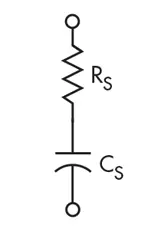
Assume a model like that shown in Fig. 1, for Capacitor Under Test (CUT):

1. Model of capacitor under test.


This model ignores lead inductance. Suppose that CUT is connected to a sine wave generator with frequency Fg and internal resistance rg, as shown in Fig. 2:

2. CUT connected to a sine wave generator.

The transfer function of this circuit is:

Equation 1, shows the high pass nature of this circuit. Therefore, we can approximate the transfer function as:

Equation 2 is the basis for our capacitor ESR measurement. When the input frequency is high enough we can simplify the input-output relation as algebraic Equation 2. For high frequencies, the circuit acts like an attenuator with the attenuation factor:

Measurement of circuit’s attenuation factor and generator’s internal resistance leads to rc, the capacitor’s ESR:

Instead of using a sine wave excitation, we can use a square wave. This allows us to use a Fourier series to write an equation with levels +Vm and -Vm, and period T:

Where:

A square wave consists of odd harmonics. When fundamental harmonic is high enough, a capacitor acts like short circuit and output voltage is approximately attenuated version of input voltage in steady state. Circuit attenuation in steady state is directly related to capacitor equivalent series resistance, rc , that can be obtained by measuring the circuit’s attenuation factor and using Equation 3.

Simulation Results:

Simulink diagram is shown in Fig. 3:

3. Simulation diagram of circuit in Simulink.

A square wave with amplitude +1 and -1 volt is used as excitation. Signal generator output resistance is taken as 50 Ω, capacitor is 30 μF with 0.8 Ω ESR. Steady-state output waveform is shown in Fig. 4:


4. Steady-state output of circuit.

The calculated attenuation factor of the circuit is:

and CUT’s ESR is calculated as:

Laboratory Results:

A signal generator with nominal 50 Ω output resistance provides the excitation. An output resistance of 47.1 Ω is measured with the aid of a simple voltage divider. Steady state output voltage peak-peak voltage is measured with the aid of a digital scope. Figure 5 shows s sample output.

5. Sample output voltage waveform.

Calculated ESR Values

This simple measurement technique provides accurate results and allows a more precise power converter model.


References

1. Amaral A.M.R., Cardoso A.J.M.: An experimental technique for estimating the ESR and reactance intrinsic values of aluminium electrolytic capacitors. Proc. Instrumentation and Measurement Technology Conf., IMTC 2006, April 2006, pp. 1820–1825.

2. Sankaran V.A., Rees F.L., Avant C.S.: Electrolytic capacitor life testing and prediction. Proc. 32nd Annual Meeting IEEE Industry Applications Society, October 1997, vol. 2, pp. 1058–1065

3. Venet P., Perisse F., El-Husseini M.H., Rojat G.: Realization of a smart electrolytic capacitor circuit, IEEE Ind. Appl. Mag., 2002, 8, (1), pp. 16–20

4. Chen Y.-M., Chou M.-W., Wu H.-C.: Electrolytic capacitor failure prediction of LC filter for switching-mode power converters. Proc. 40th Annual Meeting IEEE Industry Applications Society, October 2005, vol. 2, pp. 1464–1469.

5. Amaral A.M.R., Cardoso A.J.M.: An ESR meter for high frequencies. Proc. Int. Conf. on Power Electronics and Drives Systems, PEDS, 2005, pp. 1628–163

6. D.W. Hart, “Power electronics,” Mc Graw Hill, 2010.

7. N. Mohan,T. M. Undeland , W. P. Robbins, “Power Electronics: Converters, Applications and Design,” John Wiley and Sons, 2002.

8. R.W. Ericson, D. Maksimovic, “Fundamental of power electronics,” Springer, 2001.

9. A.M.R. Amaral, A.J.M Cardoso: “An ESR meter for high frequencies“. Proc. Int. Conf. on Power Electronics and Drives Systems, PEDS, 2005, pp. 1628–1633.

10. R. Chen, J.D.V. Wyk, S. Wang, W.G. Odendaal: Improving the characteristics of integrated EMI filters by embedded conductive layers. IEEE Trans. Power Electron., 2005, pp. 611–619.

11. A.M.R. Amaral, A.J.M Cardoso: An experimental technique for estimating the ESR and reactance intrinsic values of aluminium electrolytic capacitors. Proc. Instrumentation and Measurement Technology Conf., IMTC 2006, April 2006, pp. 1820–1825.

Related

Recent Posts

TDK B3201 series Y1 film safety capacitors with rectangular cases and parallel wire leads

TDK Introduces Y1 Film Safety Capacitors for 500 V AC EMI Filtering

21.10.2026
18
Modelithics COMPLETE+3D v26.4 library for RF passive-component and 3D electromagnetic simulation in Keysight ADS/RFPro

Modelithics COMPLETE+3D v26.4 Expands RF Models and 3D Workflows

19.10.2026
11
Siemens executives Markus Grabmeier and Barry Powell with Skeleton Technologies CEO Taavi Madiberk at the investment announcement

Siemens Backs Skeleton’s US AI Power Manufacturing Expansion

15.10.2026
57
Supercapacitor LSM production

LS Materials Wins $51.5M AI Data Center Supercapacitor Order

13.10.2026
93
Features of BCZT and strontium titanate dielectric layers in a thin-film superlattice

Relaxor superlattice capacitors approach 99% efficiency

12.10.2026
39
Conceptual Toray heat-resistant film capacitor beside an inverter cooling structure.

Toray Film Capacitor Enables 150°C Inverter Operation

9.10.2026
81
Silicon capacitors and integrated passives dossier cover

Silicon Capacitors and Integrated Passives Dossier Report 10/26

8.10.2026
71
Panasonic Industry PGS graphite heat-spreading technology and passive components for spacecraft thermal management

Panasonic Targets Space Thermal Design at SPCD 2026

8.10.2026
41
tungsten-bronze-ceramic-capacitor-stack

Tungsten bronze capacitors combine high κ and thermal stability

7.10.2026
43

Upcoming Events

Oct 27
15:00 - 16:00 CET

Heraeus Electronics Webinar: What materials perform when failure is not an option?

Oct 27
16:00 - 17:00 CET

Power Inductor technologies

Oct 28
13:00 - 14:00 CDT

Inductor Design in a Multi-Phase Buck Converter

View Calendar

Popular Posts

  • Buck Converter Design and Calculation

    0 shares
    Share 0 Tweet 0
  • Boost Converter Design and Calculation

    0 shares
    Share 0 Tweet 0
  • LLC Resonant Converter Design and Calculation

    0 shares
    Share 0 Tweet 0
  • Capacitor Charging and Discharging

    0 shares
    Share 0 Tweet 0
  • Flyback Converter Design and Calculation

    0 shares
    Share 0 Tweet 0
  • Audio Capacitors: Choosing Capacitors for Crossover Circuits

    0 shares
    Share 0 Tweet 0
  • MLCC and Ceramic Capacitors

    0 shares
    Share 0 Tweet 0
  • Passive Low Pass Filters: Fundamentals and EMI Design

    0 shares
    Share 0 Tweet 0
  • RF Connector Types: How To Choose the Right One

    0 shares
    Share 0 Tweet 0
  • September 2026 Interconnect, Passives and Electromechanical Components Market Insights

    0 shares
    Share 0 Tweet 0

Newsletter Subscription


Passive Components Blog

© 2015–2026
All rights reserved

  • Home
  • Privacy Policy
  • EPCI Membership & Advertisement
  • About

No Result
View All Result
  • Home
  • Knowledge Blog
  • Dossiers
  • PCNS

© 2015–2026
All rights reserved