







Passive Components Blog
No Result
View All Result
  • Home
  • News
    • All
    • Aerospace & Defence
    • Antenna
    • Applications
    • Automotive
    • Capacitors
    • Circuit Protection Devices
    • electro-mechanical news
    • Filters
    • Fuses
    • Inductors
    • Industrial
    • Integrated Passives
    • inter-connect news
    • Market & Supply Chain
    • Market Insights
    • Medical
    • Modelling and Simulation
    • New Materials & Supply
    • New Technologies
    • Non-linear Passives
    • Optoelectronics and Isolation
    • Oscillators
    • Passive Sensors News
    • Resistors
    • RF & Microwave
    • Telecommunication
    • Weekly Digest
    Siemens executives Markus Grabmeier and Barry Powell with Skeleton Technologies CEO Taavi Madiberk at the investment announcement

    Siemens Backs Skeleton’s US AI Power Manufacturing Expansion

    Concept illustration of an LTCC antenna module with multilayer ceramic substrate, antenna elements and an integrated beamforming IC

    Murata LTCC 6G Antenna Module Demonstrates 135 GHz Operation

    TDK X series surface-mount multilayer varistors with ceramic chip bodies and metal end terminations

    TDK X Series SMD Varistors for Industrial Transient Protection

    Littelfuse TP7.0SMD-XC automotive TVS diodes with black surface-mount bodies and silver end terminals.

    Littelfuse Introduces Extremely Low Clamping Voltage TVS Diodes for Automotive Protection

    Supercapacitor LSM production

    LS Materials Wins $51.5M AI Data Center Supercapacitor Order

    Features of BCZT and strontium titanate dielectric layers in a thin-film superlattice

    Relaxor superlattice capacitors approach 99% efficiency

    Stackpole RMAN thick-film chip resistors with rectangular bodies and metal end terminations

    Stackpole 2512 AlN Thick-Film Resistors Rated up to 3.5 W

    ECIA September 2026 Industry Pulse electronic component trends and sentiment report

    ECIA September 2026 Pulse: Growth Holds, Supply Pressure Persists

    Wk 39 Electronics Supply Chain Digest

    Trending Tags

    • Ripple Current
    • RF
    • Leakage Current
    • Tantalum vs Ceramic
    • Snubber
    • Low ESR
    • Feedthrough
    • Derating
    • Dielectric Constant
    • New Products
    • Market Reports
  • Knowledge Blog
  • Dossiers
    • Aerospace and Defense Passive Components Dossier
    • AI Hardware Dossier
    • Automotive Dossier
    • Industrial Robotics Dossier
    • Power Converter Dossier
    • Capacitor Dossier
    • Circuit Protection Dossier
    • Inductor Dossier
    • Resistor Dossier
    • Silicon Capacitors and Integrated Passives Dossier
  • Suppliers
    • Who is Who
  • PCNS
    • PCNS 2025
    • PCNS 2023
    • PCNS 2021
    • PCNS 2019
    • PCNS 2017
  • Events
  • Home
  • News
    • All
    • Aerospace & Defence
    • Antenna
    • Applications
    • Automotive
    • Capacitors
    • Circuit Protection Devices
    • electro-mechanical news
    • Filters
    • Fuses
    • Inductors
    • Industrial
    • Integrated Passives
    • inter-connect news
    • Market & Supply Chain
    • Market Insights
    • Medical
    • Modelling and Simulation
    • New Materials & Supply
    • New Technologies
    • Non-linear Passives
    • Optoelectronics and Isolation
    • Oscillators
    • Passive Sensors News
    • Resistors
    • RF & Microwave
    • Telecommunication
    • Weekly Digest
    Siemens executives Markus Grabmeier and Barry Powell with Skeleton Technologies CEO Taavi Madiberk at the investment announcement

    Siemens Backs Skeleton’s US AI Power Manufacturing Expansion

    Concept illustration of an LTCC antenna module with multilayer ceramic substrate, antenna elements and an integrated beamforming IC

    Murata LTCC 6G Antenna Module Demonstrates 135 GHz Operation

    TDK X series surface-mount multilayer varistors with ceramic chip bodies and metal end terminations

    TDK X Series SMD Varistors for Industrial Transient Protection

    Littelfuse TP7.0SMD-XC automotive TVS diodes with black surface-mount bodies and silver end terminals.

    Littelfuse Introduces Extremely Low Clamping Voltage TVS Diodes for Automotive Protection

    Supercapacitor LSM production

    LS Materials Wins $51.5M AI Data Center Supercapacitor Order

    Features of BCZT and strontium titanate dielectric layers in a thin-film superlattice

    Relaxor superlattice capacitors approach 99% efficiency

    Stackpole RMAN thick-film chip resistors with rectangular bodies and metal end terminations

    Stackpole 2512 AlN Thick-Film Resistors Rated up to 3.5 W

    ECIA September 2026 Industry Pulse electronic component trends and sentiment report

    ECIA September 2026 Pulse: Growth Holds, Supply Pressure Persists

    Wk 39 Electronics Supply Chain Digest

    Trending Tags

    • Ripple Current
    • RF
    • Leakage Current
    • Tantalum vs Ceramic
    • Snubber
    • Low ESR
    • Feedthrough
    • Derating
    • Dielectric Constant
    • New Products
    • Market Reports
  • Knowledge Blog
  • Dossiers
    • Aerospace and Defense Passive Components Dossier
    • AI Hardware Dossier
    • Automotive Dossier
    • Industrial Robotics Dossier
    • Power Converter Dossier
    • Capacitor Dossier
    • Circuit Protection Dossier
    • Inductor Dossier
    • Resistor Dossier
    • Silicon Capacitors and Integrated Passives Dossier
  • Suppliers
    • Who is Who
  • PCNS
    • PCNS 2025
    • PCNS 2023
    • PCNS 2021
    • PCNS 2019
    • PCNS 2017
  • Events
No Result
View All Result
Passive Components Blog
No Result
View All Result

High-Accuracy Current Measurements: Low-Value Resistors

26.6.2017
Reading Time: 3 mins read
A A

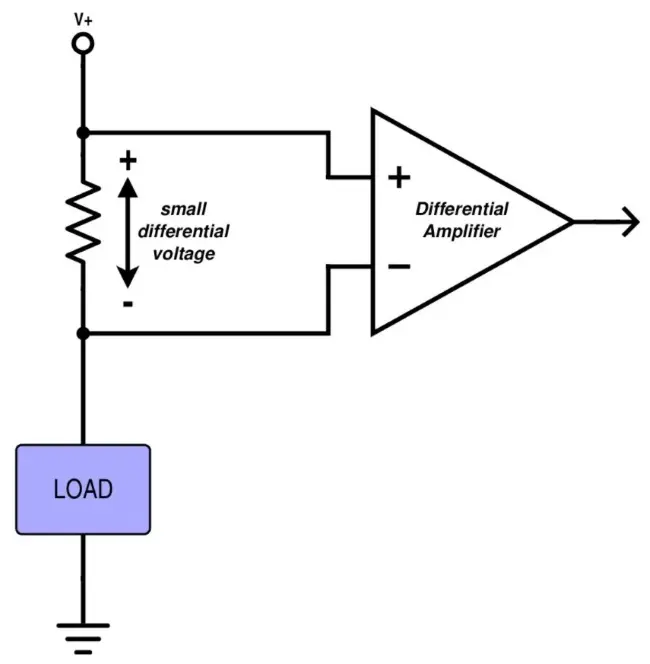
source: All about circuits article

If you need high precision in your current measurements, you also need high precision in your current-sense resistor.

RelatedPosts

Siemens Backs Skeleton’s US AI Power Manufacturing Expansion

Murata LTCC 6G Antenna Module Demonstrates 135 GHz Operation

TDK X Series SMD Varistors for Industrial Transient Protection

Despite the astonishing advancements in so many aspects of electronics technology, the dominant approach to measuring current is still based, as far as I can tell, on the use of a current-sense resistor. The resistor goes in series with the current-to-be-measured, the resulting voltage drop is proportional to the current, you measure the voltage, you divide by resistance, and you’re done. It’s a conceptually simple technique, but the details can be troublesome.

The “observer effect” tells us that any measurement will alter the state of the thing being measured. The change might be negligible or even undetectable, but it’s always there. So we know that any method of measuring any quantity in a circuit will have some effect on the state of the circuit. Nevertheless, the nature of electricity is such that we can often measure voltage without significantly altering the rest of the circuit. This “measurement-friendly” nature of potential difference makes current measurements look all the worse.


The Trade-Off

The fact is, the use of a current-sense resistor is an invasive technique. You’re deliberately adding resistance where previously you had only a conductor. Of course you can make the resistance very small, but this is a diminishing-returns situation: Yes, lower resistance is better (to a point), because you have less wasted power and the resistor more closely resembles the effect of a wire or PCB trace. But the whole point here is to generate a voltage that can be measured and converted into current. This voltage will be fed to an amplifier, and amplifiers come with fixed errors, i.e., errors that are not dependent on the amplitude of the input signal. Thus, smaller sense resistance means lower voltage, which means lower signal-to-noise ratio, which means lower accuracy in your current measurement.


Don’t forget to consider the less-effort-required solutions, such as the INA250 from Texas Instruments. It already has a sense resistor and probably works better than anything that I could design.


So as always, everything depends on your requirements and restrictions. You can combine a very-low-value resistor (say, 1 mΩ or less) with a high-precision amplifier and end up with fabulous current measurements and minimal effect on the original circuit. But, you might find that the current-sense circuit costs more than the rest of your device, or you might botch the PCB layout and thereby downgrade your accuracy from “fabulous” to, say, “above average.”


KOA Speer’s Contribution

My instinct tells me that 1 mΩ is a bit extreme for most applications, and that is reflected in the resistance range of KOA Speer’s UR73V2A series of current-sense resistors, which are available from 10 mΩ to 100 mΩ. The power rating is 0.5 W, and the package is 0805.


We often don’t have to worry about power dissipation with very-low-value resistors, but just in case you’re measuring high currents, remember to derate.


I think we all realize that precision is important when you’re choosing a current-sense resistor: you determine current based on the resistance; if the resistance in your calculation is different from the actual resistance, you have error. But another thing to keep in mind is the temperature coefficient.

Like just about everything else in a circuit, resistance is affected by temperature. This means that if your calculation uses a single value for the current-sense resistance, it will always be at least a little bit wrong, unless your device is designed to operate only in a temperature chamber. The easiest way to reduce this wrongness is to choose a resistor with a low temperature coefficient. The UR73V2A series comes with temperature coefficient as low as ±75 ppm/°C. The parts per million thing can be distracting, so let’s take an example.

Your device is sitting next to an oven which is now actively baking some French bread, and the operational temperature eventually increases by 20°C. This corresponds to 75 ppm/°C × 20°C = 1500 ppm, and (1500 ppm)/106 = 0.15%. This higher resistance will create a higher voltage drop, but your code still uses the original resistance, so your calculation will yield a current that is 0.15% higher than the actual current. I don’t know what your requirements are, but I’m guessing that most applications could cope with this sort of error.

Related

Recent Posts

Stackpole RMAN thick-film chip resistors with rectangular bodies and metal end terminations

Stackpole 2512 AlN Thick-Film Resistors Rated up to 3.5 W

12.10.2026
11
Concept illustration of TT Electronics resistor and sensing technologies with chip resistors, a shaft potentiometer and a slotted optical sensor

TT Electronics: Resistor and Sensing Trends at electronica 2026

9.10.2026
13
Panasonic Industry PGS graphite heat-spreading technology and passive components for spacecraft thermal management

Panasonic Targets Space Thermal Design at SPCD 2026

8.10.2026
37
Ruggedized passive component customization overview covering capacitors, resistors and inductors.

Ruggedized Passive Components: Reliability Beyond the Datasheet

6.10.2026
46
Bourns CSI2F bolt-down current sense resistors for high-current busbar measurement

Bourns Current Sense Resistors Reach 36 W

5.10.2026
19
bourns-crk2725-wide-terminal-current-sense-resistors

Bourns Releases 5 W Wide-Terminal Current Sense Resistors

2.10.2026
21
Knowles ATT A-Series surface-mount RF attenuator in compact ceramic thin-film package

Knowles A-Series RF Attenuators Target Compact 20 GHz Designs

1.10.2026
19
Isabellenhütte HFF flexible Kapton heater with etched MANGANIN foil structure and wire lead exit

Isabellenhütte Introduces Flexible Heaters for Space Thermal Control

1.10.2026
41
Bourns CRT-TN TaN thin-film chip resistors in 0402, 0603, 0805 and 1206 package sizes

Bourns Releases TaN Thin Film Resistors Target Precision Circuits

1.10.2026
23

Upcoming Events

Oct 19
15:00 - 16:00 CEST

ESCC-qualified Pt Temperature Sensors for Space Applications

Oct 27
15:00 - 16:00 CET

Heraeus Electronics Webinar: What materials perform when failure is not an option?

Oct 27
16:00 - 17:00 CET

Power Inductor technologies

View Calendar

Popular Posts

  • Buck Converter Design and Calculation

    0 shares
    Share 0 Tweet 0
  • Boost Converter Design and Calculation

    0 shares
    Share 0 Tweet 0
  • LLC Resonant Converter Design and Calculation

    0 shares
    Share 0 Tweet 0
  • Capacitor Charging and Discharging

    0 shares
    Share 0 Tweet 0
  • Flyback Converter Design and Calculation

    0 shares
    Share 0 Tweet 0
  • Audio Capacitors: Choosing Capacitors for Crossover Circuits

    0 shares
    Share 0 Tweet 0
  • MLCC and Ceramic Capacitors

    0 shares
    Share 0 Tweet 0
  • Thermistors Basics, NTC and PTC Thermistors

    0 shares
    Share 0 Tweet 0
  • Passive Low Pass Filters: Fundamentals and EMI Design

    0 shares
    Share 0 Tweet 0
  • RF Connector Types: How To Choose the Right One

    0 shares
    Share 0 Tweet 0

Newsletter Subscription


Passive Components Blog

© 2015–2026
All rights reserved

  • Home
  • Privacy Policy
  • EPCI Membership & Advertisement
  • About

No Result
View All Result
  • Home
  • Knowledge Blog
  • Dossiers
  • PCNS

© 2015–2026
All rights reserved