

Passive Components Blog has released the 2026 Annual Inductor, Transformer & Magnetics Technology Dossier, a 28‑page comprehensive analysis of how inductors and transformers evolved from commodity supply‑chain components to strategic enablers of AI infrastructure, electric vehicle powertrains, and 5G connectivity in 2025.
Executive Overview
The inductor, transformer, and magnetics industry underwent a pivotal transformation in 2025, evolving from a supply-chain-constrained, commodity-dominated sector into a strategic technology landscape where high-current power inductors, coupled TLVR magnetics, and high-frequency planar transformers became critical enablers of AI infrastructure, electric vehicle powertrains, and 5G-Advanced connectivity. This shift was driven by three converging forces: the exponential power delivery demands of artificial intelligence accelerators requiring 180–250 inductors per 8-GPU server with sub-milliohm DCR and saturation currents exceeding 90 A per phase; the voltage architecture revolution in electric vehicles demanding 150–300 magnetic components per vehicle for 800V on-board chargers, DC-DC converters, and EMI filtering; and the frequency density requirements of 5G-Advanced massive MIMO arrays consuming 200–400 inductors per macro base station. Collectively, these applications created a bifurcated market where application-specific, high-performance magnetics commanded premium pricing and extended lead times, while general-purpose chip inductors faced margin pressure from Asian oversupply.
The global inductor market reached an estimated USD 11.28 billion in 2025, representing a 4.23% compound annual growth rate, while the broader transformer market exceeded USD 64–71 billion driven by grid modernization and data center power infrastructure. Growth was highly non-uniform: strategic segments including coupled TLVR inductors for AI servers, automotive-qualified power inductors, and thin-film RF inductors grew at 8–15% CAGR, while commodity multilayer chip inductors stagnated at 3–4%. The divergence reflects a critical industry inflection point: inductors and transformers are no longer passive cost-driven commodities but active determinants of power conversion efficiency, electromagnetic compatibility, and thermal management in mission-critical applications.
What the dossier covers
Content
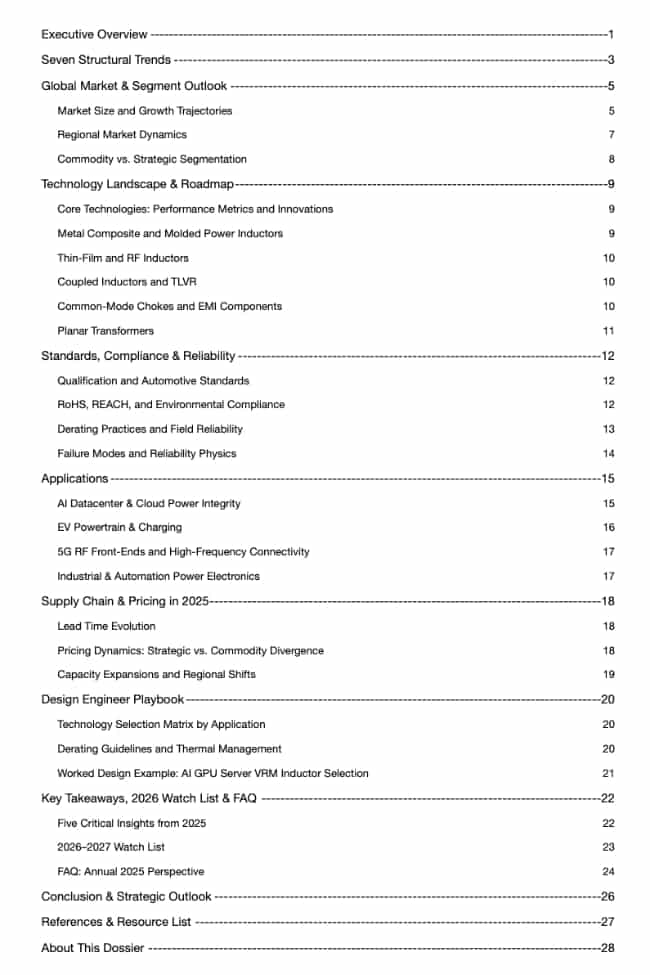
- Seven structural trends shaping 2025
From AI datacenter power delivery dominance and the 800V EV architecture tipping point to 5G‑Advanced RF front‑end proliferation, GaN/SiC high‑frequency switching revolution, regional supply chain reconfiguration, materials innovation (nanocrystalline and metal composite cores), and integrated power modules with embedded magnetics. - Hard numbers behind the shift
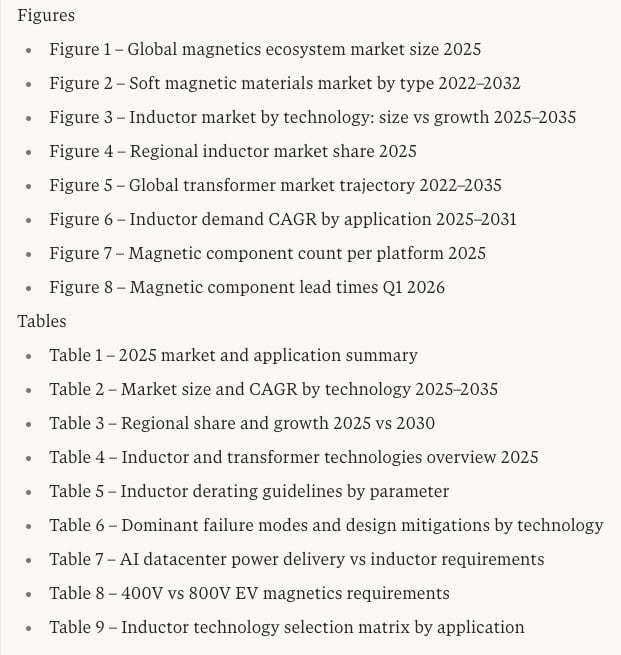
Detailed tables quantify 2025 market size and 2035 projections by technology, including multilayer chip inductors, power inductors (molded/composite), thin‑film RF inductors, coupled/TLVR inductors, common‑mode chokes, planar transformers, and ferrite beads, revealing the dramatic value shift toward strategic segments. - AI, EV and other application chapters
Application‑focused sections dissect magnetic component roles in AI datacenter power integrity and TLVR VRMs, 800V EV powertrains, OBC and charging, 5G RF front‑ends and massive MIMO, and industrial automation, with concrete design examples including a worked AI GPU server VRM inductor selection. - Technology landscape & roadmap
A comprehensive technology map compares multilayer chip, wire‑wound chip, thin‑film RF, molded power, coupled/TLVR, common‑mode chokes, planar transformers, and ferrite beads across inductance range, current capability, DCR, frequency range, temperature ratings and primary applications, plus adoption roadmap through 2031. - Qualification, compliance and reliability
The dossier summarizes AEC‑Q200 Rev. E implications for automotive magnetics, insulation and voltage surge requirements, RoHS/REACH and Digital Product Passport mandates, and provides practical derating guidelines, thermal management strategies, and failure‑mode analysis for long‑life automotive, datacenter and industrial designs.
Who should read it
- Component manufacturers and distributors
Planning 2026–2030 roadmaps for power inductors, TLVR coupled magnetics, thin‑film RF inductors, planar transformers and automotive‑qualified magnetic components. - OEM and Tier‑1 engineering teams
Designing AI servers, EV powertrains and charging infrastructure, 5G base stations, industrial motor drives and renewable energy systems who need a consolidated view of inductor and transformer technologies, specifications and trade‑offs. - Sourcing, category and product managers
Managing lead‑time risk, qualification challenges, and strategic allocation in TLVR coupled inductors and automotive‑grade magnetics.
Why it stands apart
Unlike generic inductor reports that stop at high‑level market sizing, the 2026 Annual Inductor, Transformer & Magnetics Technology Dossier combines:
- Quantitative market and CAGR data across all major inductor and transformer technologies with regional dynamics and commodity vs. strategic segmentation analysis.
- Detailed technology benchmarking (saturation current, DCR, frequency capability, temperature ratings, core materials, volumetric efficiency).
- Application engineering guidance for AI datacenters, EV powertrains, 5G infrastructure, and industrial systems, including real TLVR design examples, derating calculations, and thermal management best practices.
- Supply chain intelligence covering lead times, pricing dynamics (strategic vs. commodity divergence), capacity expansions, and regional shifts affecting availability and costs.
The result is a compact, high‑density reference that can be read in an afternoon and used all year for strategy, design and sourcing decisions.
Availability
The Annual Inductor, Transformer & Magnetics Technology Dossier is available now at 699 EUR exclusively from passive-components.eu as a paid download.
To learn more and purchase your copy, visit the Technology Dossiers page on the passive-components.eu blog.

