










Passive Components Blog
No Result
View All Result
  • Home
  • NewsFilter
    • All
    • Aerospace & Defence
    • Antenna
    • Applications
    • Automotive
    • Capacitors
    • Circuit Protection Devices
    • electro-mechanical news
    • Filters
    • Fuses
    • Inductors
    • Industrial
    • Integrated Passives
    • inter-connect news
    • Market & Supply Chain
    • Market Insights
    • Medical
    • Modelling and Simulation
    • New Materials & Supply
    • New Technologies
    • Non-linear Passives
    • Oscillators
    • Passive Sensors News
    • Resistors
    • RF & Microwave
    • Telecommunication
    • Weekly Digest

    Tapped Inductor Buck Converter Fundamentals

    TAIYO YUDEN Releases Mini Metal Power Inductors

    Molecular Memristor Shows Record 145 kH Emergent Inductance

    Planar vs Conventional Transformer: When it Make Sense

    Researchers Propose Next‑Gen Compact Memory Using Ultra-thin Ferroelectric Capacitors

    Nichicon ADN Automotive Hybrid Aluminum Capacitors Now Available in EMEA

    Wk 19 Electronics Supply Chain Digest

    Electrocaloric Multilayer Capacitors: Towards Quiet, Solid‑State Cooling Around Room Temperature

    High-Crystallinity Nanocrystalline Composites for MHz Chip Inductors

    Trending Tags

    • Ripple Current
    • RF
    • Leakage Current
    • Tantalum vs Ceramic
    • Snubber
    • Low ESR
    • Feedthrough
    • Derating
    • Dielectric Constant
    • New Products
    • Market Reports
  • VideoFilter
    • All
    • Antenna videos
    • Capacitor videos
    • Circuit Protection Video
    • Filter videos
    • Fuse videos
    • Inductor videos
    • Inter-Connect Video
    • Non-linear passives videos
    • Oscillator videos
    • Passive sensors videos
    • Resistor videos

    Tapped Inductor Buck Converter Fundamentals

    Planar vs Conventional Transformer: When it Make Sense

    Modeling Fringing Field Losses in Inductors & Transformers

    Why Power Inductors Use a Ferrite Core With an Air Gap

    Transformer-Based Power-Line Harvester Magnetic Design

    Thermal Modeling of Magnetics

    Standard vs Planar LLC transformers Comparison for Battery Chargers

    How Modern Tools Model Magnetic Components for Power Electronics

    Advanced Loss Modeling for Planar Magnetics in the Frenetic Planar Tool

    Trending Tags

    • Capacitors explained
    • Inductors explained
    • Resistors explained
    • Filters explained
    • Application Video Guidelines
    • EMC
    • New Products
    • Ripple Current
    • Simulation
    • Tantalum vs Ceramic
  • Knowledge Blog
  • DossiersNew
  • Suppliers
    • Who is Who
  • PCNS
    • PCNS 2025
    • PCNS 2023
    • PCNS 2021
    • PCNS 2019
    • PCNS 2017
  • Events
  • Home
  • NewsFilter
    • All
    • Aerospace & Defence
    • Antenna
    • Applications
    • Automotive
    • Capacitors
    • Circuit Protection Devices
    • electro-mechanical news
    • Filters
    • Fuses
    • Inductors
    • Industrial
    • Integrated Passives
    • inter-connect news
    • Market & Supply Chain
    • Market Insights
    • Medical
    • Modelling and Simulation
    • New Materials & Supply
    • New Technologies
    • Non-linear Passives
    • Oscillators
    • Passive Sensors News
    • Resistors
    • RF & Microwave
    • Telecommunication
    • Weekly Digest

    Tapped Inductor Buck Converter Fundamentals

    TAIYO YUDEN Releases Mini Metal Power Inductors

    Molecular Memristor Shows Record 145 kH Emergent Inductance

    Planar vs Conventional Transformer: When it Make Sense

    Researchers Propose Next‑Gen Compact Memory Using Ultra-thin Ferroelectric Capacitors

    Nichicon ADN Automotive Hybrid Aluminum Capacitors Now Available in EMEA

    Wk 19 Electronics Supply Chain Digest

    Electrocaloric Multilayer Capacitors: Towards Quiet, Solid‑State Cooling Around Room Temperature

    High-Crystallinity Nanocrystalline Composites for MHz Chip Inductors

    Trending Tags

    • Ripple Current
    • RF
    • Leakage Current
    • Tantalum vs Ceramic
    • Snubber
    • Low ESR
    • Feedthrough
    • Derating
    • Dielectric Constant
    • New Products
    • Market Reports
  • VideoFilter
    • All
    • Antenna videos
    • Capacitor videos
    • Circuit Protection Video
    • Filter videos
    • Fuse videos
    • Inductor videos
    • Inter-Connect Video
    • Non-linear passives videos
    • Oscillator videos
    • Passive sensors videos
    • Resistor videos

    Tapped Inductor Buck Converter Fundamentals

    Planar vs Conventional Transformer: When it Make Sense

    Modeling Fringing Field Losses in Inductors & Transformers

    Why Power Inductors Use a Ferrite Core With an Air Gap

    Transformer-Based Power-Line Harvester Magnetic Design

    Thermal Modeling of Magnetics

    Standard vs Planar LLC transformers Comparison for Battery Chargers

    How Modern Tools Model Magnetic Components for Power Electronics

    Advanced Loss Modeling for Planar Magnetics in the Frenetic Planar Tool

    Trending Tags

    • Capacitors explained
    • Inductors explained
    • Resistors explained
    • Filters explained
    • Application Video Guidelines
    • EMC
    • New Products
    • Ripple Current
    • Simulation
    • Tantalum vs Ceramic
  • Knowledge Blog
  • DossiersNew
  • Suppliers
    • Who is Who
  • PCNS
    • PCNS 2025
    • PCNS 2023
    • PCNS 2021
    • PCNS 2019
    • PCNS 2017
  • Events
No Result
View All Result
Passive Components Blog
No Result
View All Result

Inductor Technology Dossier

19.3.2026
Reading Time: 5 mins read
A A

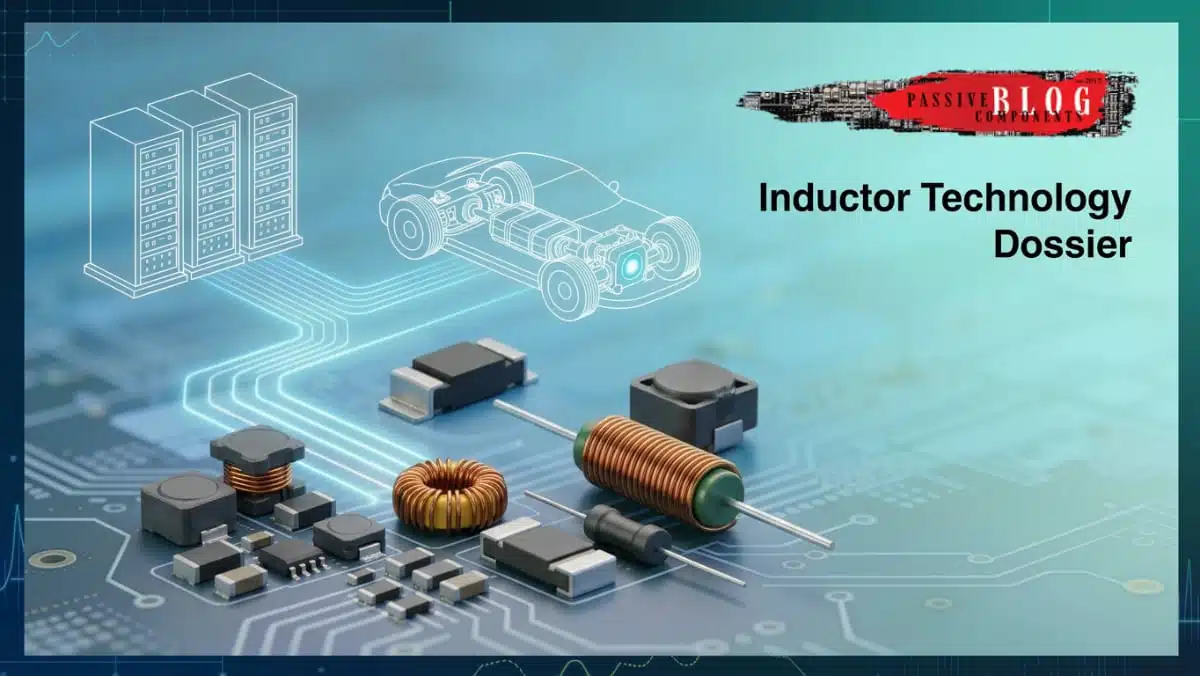
Passive Components Blog has released the 2026 Annual Inductor, Transformer & Magnetics Technology Dossier, a 28‑page comprehensive analysis of how inductors and transformers evolved from commodity supply‑chain components to strategic enablers of AI infrastructure, electric vehicle powertrains, and 5G connectivity in 2025.

Executive Overview

The inductor, transformer, and magnetics industry underwent a pivotal transformation in 2025, evolving from a supply-chain-constrained, commodity-dominated sector into a strategic technology landscape where high-current power inductors, coupled TLVR magnetics, and high-frequency planar transformers became critical enablers of AI infrastructure, electric vehicle powertrains, and 5G-Advanced connectivity. This shift was driven by three converging forces: the exponential power delivery demands of artificial intelligence accelerators requiring 180–250 inductors per 8-GPU server with sub-milliohm DCR and saturation currents exceeding 90 A per phase; the voltage architecture revolution in electric vehicles demanding 150–300 magnetic components per vehicle for 800V on-board chargers, DC-DC converters, and EMI filtering; and the frequency density requirements of 5G-Advanced massive MIMO arrays consuming 200–400 inductors per macro base station. Collectively, these applications created a bifurcated market where application-specific, high-performance magnetics commanded premium pricing and extended lead times, while general-purpose chip inductors faced margin pressure from Asian oversupply.

RelatedPosts

Resistor Technology Dossier

Capacitor Technology Dossier

The global inductor market reached an estimated USD 11.28 billion in 2025, representing a 4.23% compound annual growth rate, while the broader transformer market exceeded USD 64–71 billion driven by grid modernization and data center power infrastructure. Growth was highly non-uniform: strategic segments including coupled TLVR inductors for AI servers, automotive-qualified power inductors, and thin-film RF inductors grew at 8–15% CAGR, while commodity multilayer chip inductors stagnated at 3–4%. The divergence reflects a critical industry inflection point: inductors and transformers are no longer passive cost-driven commodities but active determinants of power conversion efficiency, electromagnetic compatibility, and thermal management in mission-critical applications.

What the dossier covers

Content
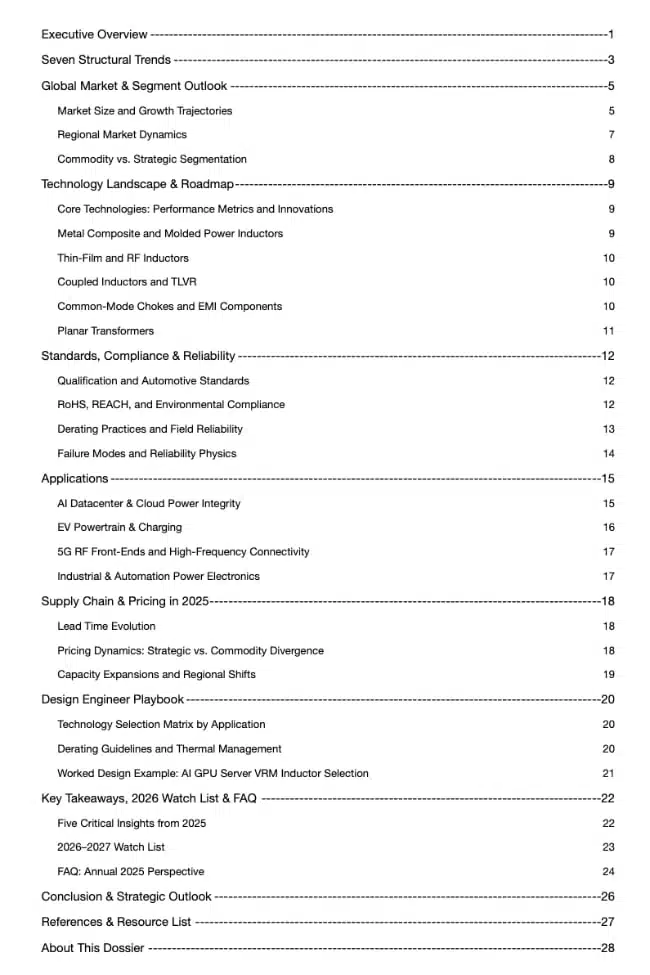
  • Seven structural trends shaping 2025
    From AI datacenter power delivery dominance and the 800V EV architecture tipping point to 5G‑Advanced RF front‑end proliferation, GaN/SiC high‑frequency switching revolution, regional supply chain reconfiguration, materials innovation (nanocrystalline and metal composite cores), and integrated power modules with embedded magnetics.
  • Hard numbers behind the shift
    Detailed tables quantify 2025 market size and 2035 projections by technology, including multilayer chip inductors, power inductors (molded/composite), thin‑film RF inductors, coupled/TLVR inductors, common‑mode chokes, planar transformers, and ferrite beads, revealing the dramatic value shift toward strategic segments.
  • AI, EV and other application chapters
    Application‑focused sections dissect magnetic component roles in AI datacenter power integrity and TLVR VRMs, 800V EV powertrains, OBC and charging, 5G RF front‑ends and massive MIMO, and industrial automation, with concrete design examples including a worked AI GPU server VRM inductor selection.
  • Technology landscape & roadmap
    A comprehensive technology map compares multilayer chip, wire‑wound chip, thin‑film RF, molded power, coupled/TLVR, common‑mode chokes, planar transformers, and ferrite beads across inductance range, current capability, DCR, frequency range, temperature ratings and primary applications, plus adoption roadmap through 2031.
  • Qualification, compliance and reliability
    The dossier summarizes AEC‑Q200 Rev. E implications for automotive magnetics, insulation and voltage surge requirements, RoHS/REACH and Digital Product Passport mandates, and provides practical derating guidelines, thermal management strategies, and failure‑mode analysis for long‑life automotive, datacenter and industrial designs.

Who should read it

  • Component manufacturers and distributors
    Planning 2026–2030 roadmaps for power inductors, TLVR coupled magnetics, thin‑film RF inductors, planar transformers and automotive‑qualified magnetic components.
  • OEM and Tier‑1 engineering teams
    Designing AI servers, EV powertrains and charging infrastructure, 5G base stations, industrial motor drives and renewable energy systems who need a consolidated view of inductor and transformer technologies, specifications and trade‑offs.
  • Sourcing, category and product managers
    Managing lead‑time risk, qualification challenges, and strategic allocation in TLVR coupled inductors and automotive‑grade magnetics.

Why it stands apart

Unlike generic inductor reports that stop at high‑level market sizing, the 2026 Annual Inductor, Transformer & Magnetics Technology Dossier combines:

  • Quantitative market and CAGR data across all major inductor and transformer technologies with regional dynamics and commodity vs. strategic segmentation analysis.
  • Detailed technology benchmarking (saturation current, DCR, frequency capability, temperature ratings, core materials, volumetric efficiency).
  • Application engineering guidance for AI datacenters, EV powertrains, 5G infrastructure, and industrial systems, including real TLVR design examples, derating calculations, and thermal management best practices.
  • Supply chain intelligence covering lead times, pricing dynamics (strategic vs. commodity divergence), capacity expansions, and regional shifts affecting availability and costs.

The result is a compact, high‑density reference that can be read in an afternoon and used all year for strategy, design and sourcing decisions.

Availability

The Annual Inductor, Transformer & Magnetics Technology Dossier is available now at 699 EUR exclusively from passive-components.eu as a paid download.

To learn more and purchase your copy, visit the Technology Dossiers page on the passive-components.eu blog.
Related

Recent Posts

Tapped Inductor Buck Converter Fundamentals

13.5.2026
4

TAIYO YUDEN Releases Mini Metal Power Inductors

13.5.2026
3

Planar vs Conventional Transformer: When it Make Sense

11.5.2026
32

Nichicon ADN Automotive Hybrid Aluminum Capacitors Now Available in EMEA

11.5.2026
22

High-Crystallinity Nanocrystalline Composites for MHz Chip Inductors

7.5.2026
63

European Components Distribution Shows Strong Q1 2026 Growth Amid Geopolitical Uncertainty

7.5.2026
66

Stackpole Expanded its AlN Thick Film Chip Resistors

6.5.2026
22

Würth Elektronik Introduces Compact Flat-wire SMT Power Inductors for Automotive

5.5.2026
49

KYOCERA AVX Extends MLV Varistors for 48V Automotive Protection

5.5.2026
25

Upcoming Events

May 13
17:00 - 17:30 CEST

Winding Loss Modeling for Toroidal Magnetics – Including Gapped Cores

May 19
16:00 - 17:00 CEST

Designing Qi2 Wireless Power Systems: Practical Development and EMC Optimization

Jun 2
16:00 - 17:00 CEST

Calculation, Simulation and Measurement of 800V EMC Filters

View Calendar

Popular Posts

  • Buck Converter Design and Calculation

    0 shares
    Share 0 Tweet 0
  • Boost Converter Design and Calculation

    0 shares
    Share 0 Tweet 0
  • Flyback Converter Design and Calculation

    0 shares
    Share 0 Tweet 0
  • LLC Resonant Converter Design and Calculation

    0 shares
    Share 0 Tweet 0
  • MLCC and Ceramic Capacitors

    0 shares
    Share 0 Tweet 0
  • Dual Active Bridge (DAB) Topology

    0 shares
    Share 0 Tweet 0
  • Capacitor Charging and Discharging

    0 shares
    Share 0 Tweet 0
  • What Electronics Engineer Needs to Know About Passive Low Pass Filters

    0 shares
    Share 0 Tweet 0
  • Ripple Current and its Effects on the Performance of Capacitors

    3 shares
    Share 3 Tweet 0
  • MLCC Case Sizes Standards Explained

    0 shares
    Share 0 Tweet 0

Newsletter Subscription


Passive Components Blog

© EPCI - Leading Passive Components Educational and Information Site

  • Home
  • Privacy Policy
  • EPCI Membership & Advertisement
  • About

No Result
View All Result
  • Home
  • Knowledge Blog
  • PCNS

© EPCI - Leading Passive Components Educational and Information Site

This website uses cookies. By continuing to use this website you are giving consent to cookies being used. Visit our Privacy and Cookie Policy.
Go to mobile version