
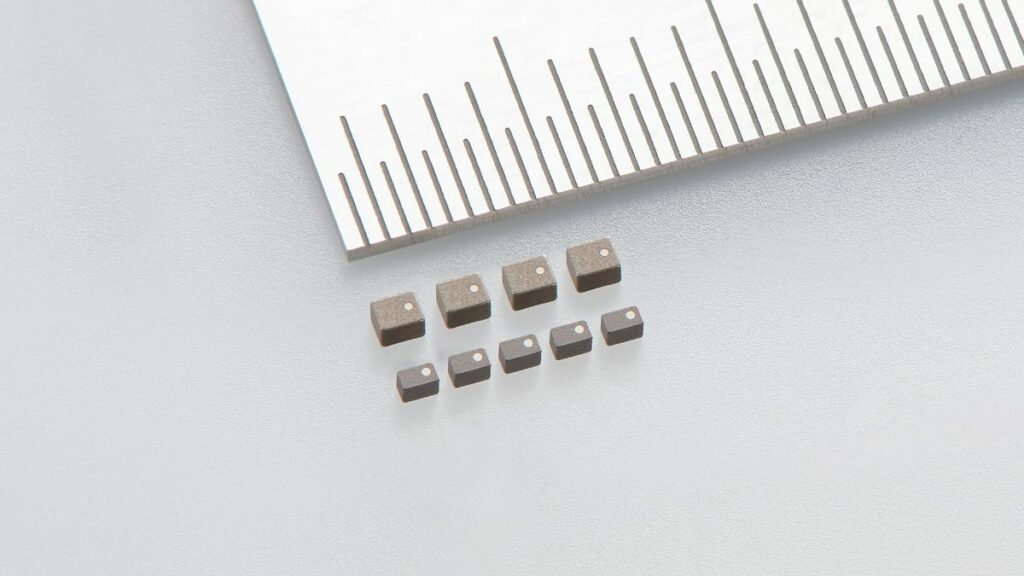
TAIYO YUDEN has expanded its MCOIL LSCN series with nine new multilayer metal SMD power inductors in ultra‑compact case sizes aimed at power stages in smartphones and wearable devices.
The new SMD inductor parts focus on reducing footprint while maintaining current capability and DC saturation performance, which is critical where every square millimeter of PCB and every milliamp of efficiency matters.
Key features and benefits
- Miniaturized case sizes for high‑density designs
The new inductors are released in four compact footprints, including 0.8 x 0.45 x 0.65 mm and 1.0 x 0.8 x 0.80 mm, enabling tighter layouts in compact devices where board space is heavily constrained. - Significant footprint reduction vs. previous generation
The LSCND0805FET1R2MJ achieves roughly 30% smaller footprint than the company’s previous smallest multilayer metal power inductor rated at 1.0 x 0.5 x 0.33 mm, supporting further size reduction in ultra‑miniaturized modules. - Smaller size at equivalent electrical performance
The LSCND1008HKT1R5MF, specified with nominal inductance of 1.5 microhenry and saturation current of 1.2 ampere, offers about 40% smaller footprint than the earlier LSCNB1210EKT1R5MB while maintaining similar inductance and saturation current, which means designers can free up PCB area without sacrificing power capability. - Metallic magnetic material with strong DC saturation characteristics
By using metallic magnetic core materials, the inductors keep inductance more stable under DC bias compared to many ferrite solutions, improving efficiency and helping buck converters maintain regulation at higher load currents. - Optimized for efficiency and battery runtime
The combination of small case size, low profile, and good saturation behavior supports high‑efficiency power stages, which translates into longer battery life in smartphones, smartwatches, and TWS earphones where average and peak loads continue to increase. - Volume production readiness
Mass production started in April 2026 at TAIYO YUDEN’s Wakayama facility, with samples available, which is relevant for OEMs needing secure supply for upcoming design cycles in consumer and wearable platforms.
Typical applications
TAIYO YUDEN positions the new MCOIL LSCN series parts primarily as choke coils in compact DC‑DC converter stages. In practice, they fit into several common use cases in handheld and wearable platforms:
- Power supply choke for application processors and baseband SoCs in smartphones, where high transient currents combine with aggressive board area targets.
- Buck/boost converter output inductors in smartwatches and fitness bands, with strict thickness and footprint budgets under the main board shield can.
- DC‑DC inductors in TWS earphones and charging cases, supporting functions such as active noise cancellation, Bluetooth radio, and audio signal processing in very small modules.
- Local regulation stages for imaging subsystems, sensors, and AI co‑processors in mobile platforms, where small inductors allow regulators to be placed closer to the load.
- General compact consumer electronics, such as portable audio and small IoT nodes, where high‑current inductors in sub‑millimeter footprints can simplify power tree integration.
In all of these applications, the trade‑off between footprint, height, inductor value, and saturation current is critical, and the new parts are targeted exactly at designs where this balance is under pressure.
Technical highlights
While the press release focuses on flagship examples, the new lineup consists of nine multilayer metal power inductors across four package sizes within the MCOIL LSCN family. Detailed values for each part number, such as DCR, inductance tolerance, and full current ratings, should be taken directly from the manufacturer’s datasheet.
Example performance specifications
| Part number | Case size (L x W x H, mm) | Nominal inductance | Saturation current | Key benefit vs. previous part |
|---|---|---|---|---|
| LSCND0805FET1R2MJ | 0.8 x 0.45 x 0.65 | According to datasheet | According to datasheet | Footprint about 30% smaller than earlier 1.0 x 0.5 mm device |
| LSCND1008HKT1R5MF | 1.0 x 0.8 x 0.80 | 1.5 microhenry | 1.2 ampere | Footprint about 40% smaller than LSCNB1210EKT1R5MB at equivalent rating |
| LSCNB1210EKT1R5MB | 1.25 x 1.05 x 0.5 | 1.5 microhenry | 1.2 ampere | Reference point for footprint reduction |
The reduction in footprint without downgrading inductance or saturation current is particularly important in power trees where the inductor is one of the larger discrete components. Moving from a 1.25 x 1.05 mm footprint to 1.0 x 0.8 mm can free routing channels and may allow narrower module outlines or more functionality in the same board area.
Manufacturing and supply
Mass production of the new LSCN series inductors has started at WAKAYAMA TAIYO YUDEN CO., LTD. in Japan. This indicates that the devices are not just engineering samples but are already in volume production, which is relevant for projects entering qualification and ramp. Samples are indicated at a nominal price of 50 yen per unit, giving purchasing teams an initial cost benchmark for early bill‑of‑materials estimation.
For final cost and supply chain planning, OEMs should confirm pricing and availability through authorized distributors or direct TAIYO YUDEN channels, as actual price will depend on volume, logistics, and commercial terms.
Design‑in notes for engineers
- Check DC bias and saturation margin
Metal composite inductors typically exhibit better DC saturation characteristics than many ferrites, but designers should still confirm that the inductance at peak load current remains within the range required for converter stability and ripple current. Using the inductance vs. current curves in the datasheet helps set an adequate margin. - Balance footprint against loss and temperature rise
Smaller inductors have less core and copper volume, so they can run hotter at the same current. It is important to check both rated current and temperature rise current in the datasheet, and to simulate or measure worst‑case operating conditions, especially in sealed wearable enclosures with limited airflow. - Consider height and mechanical constraints
The new LSCN parts offer low profiles down to around 0.65–0.80 mm, which is key under shielding cans and inside stacked assemblies such as TWS earphones. Mechanical clearance to lids, batteries, and RF shields should be verified early in layout. - Place inductors close to the converter
In noise‑sensitive designs like Bluetooth audio and RF front‑ends, routing from the power IC to the inductor should be as short and wide as possible to reduce parasitic inductance and radiated emissions. The reduced footprint of these LSCN inductors can help place them closer to the power stage pins. - EMC and audible noise considerations
Metal composite structures can offer favorable noise characteristics, but designers should still consider EMC test results of the complete converter and, where necessary, pair these inductors with proper layout practices and input/output filtering to meet regulatory or customer‑specific limits. - Use manufacturer tools and documentation
For detailed electrical characteristics, temperature coefficients, and recommended land patterns, engineers should refer to the individual LSCN series datasheets and any design support tools provided by TAIYO YUDEN. This is particularly important when pushing operating temperature or current close to rated limits.
Source
This article is based on information from an official TAIYO YUDEN press release on the launch of new MCOIL LSCN series multilayer metal power inductors, complemented by the manufacturer’s online product information and search tools.
References
- TAIYO YUDEN press release – “TAIYO YUDEN Launches New Metal Power Inductors Combining Advanced Performance with a Smaller Size”
- TAIYO YUDEN product search – MCOIL LSCN series (LSCND…)

