
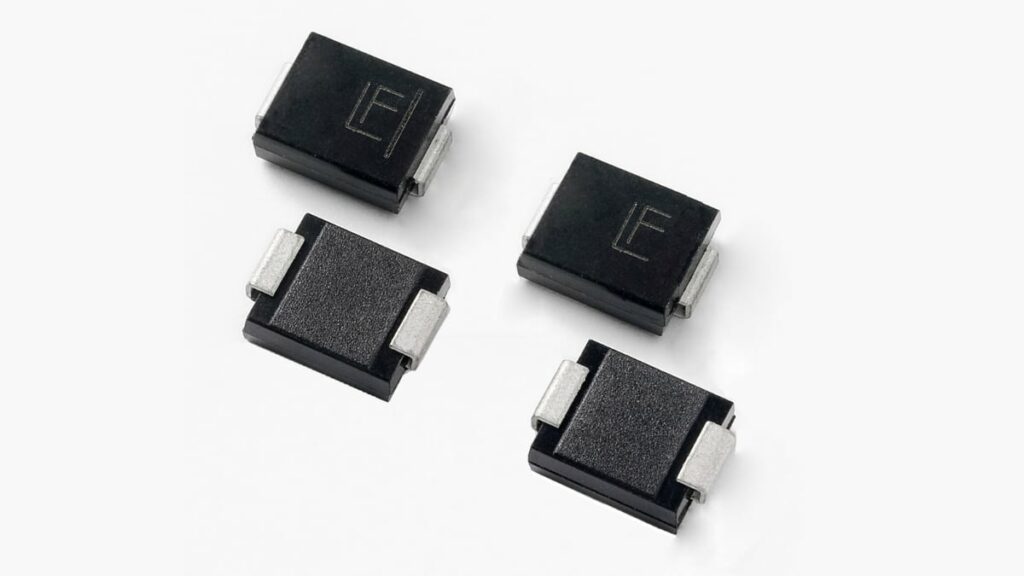
Littelfuse has expanded its TP Series with high-voltage TPSMC TPSMD and TP5.0SMDJ transient voltage suppression (TVS) diodes designed for automotive power electronics.
These Littelfuse AEC-Q101 qualified over-voltage protection devices offer standoff voltages up to 400 V and high peak pulse power ratings enabling single-device protection for GaN/SiC MOSFETs and IGBTs against load dumps and inductive switching transients. They help engineers simplify designs reduce BOM costs and improve efficiency in electrified vehicle systems.
Key Features and Benefits
- High standoff voltages from 180 V to 540 V allow single-device clamping in high-voltage rails eliminating the need for series-connected lower-voltage TVS diodes.
- Peak pulse power ratings of 1500 W (TPSMC) 3000 W (TPSMD) and 5000 W (TP5.0SMDJ) at 10/1000 μs waveform handle severe automotive transients like load dumps.
- Peak surge current up to 300 A supports protection in high-energy events while fast response time (<1 ps) ensures effective clamping before sensitive power semiconductors are damaged.
- DO-214AB (SMC) surface-mount package optimizes PCB space with low profile and built-in strain relief for reliable assembly.
- AEC-Q101 qualified PPAP capable and IEC-61000-4-2 ESD compliant up to 30 kV providing automotive-grade reliability.
- Low incremental surge resistance and typical reverse leakage <1 μA above 13 V minimize conduction losses in normal operation.
- Glass passivated junction and 260°C/10s soldering guarantee enhance thermal performance and manufacturing robustness.
Technical Highlights
These TVS diodes feature unidirectional and bidirectional configurations to suit various circuit needs. The table below summarizes key series specifications:
| Series | Standoff Voltage Range | Peak Pulse Power (10/1000 μs) | Package |
|---|---|---|---|
| TPSMC | 300-540 V | 1500 W | DO-214AB |
| TPSMD | 180-400 V | 3000 W | DO-214AB |
| TP5.0SMDJ | Up to high voltages | 5000 W | SMC |
Exact part numbers voltages and clamping voltages are detailed in manufacturer datasheets. Peak surge current and power ratings indicate the device’s ability to absorb energy from transients without failure typically shorting in overstress for fail-safe operation.
Typical Applications
In battery disconnect units (BDUs) these diodes protect high-voltage DC rails from inductive spikes during switching. High-voltage HVAC compressors and PTC heaters benefit from their surge handling in power stages where GaN/SiC MOSFETs or IGBTs face load dumps exceeding 100 V. They also suit high-voltage DC distribution in electrified vehicles reducing protection complexity compared to multi-device arrays.
Design-in Notes for Engineers
- Select based on standoff voltage slightly above normal operating voltage (e.g. ≥400 V for 400 V rails) to avoid leakage while ensuring clamping below power device ratings.
- Place close to protected semiconductors with adequate copper pad area (e.g. 8×8 mm per terminal) for thermal dissipation during surges.
- Use bidirectional parts for AC lines or floating rails; verify AEC-Q101 for PPAP in automotive production.
- Combine with fuses or current limiters for coordinated protection; simulate transients using 10/1000 μs waveform for validation.
- Lower peak power devices enable cost-optimized power semiconductors reducing overall conduction losses.
Source
This article is based on the official Littelfuse press release announcing the TPSMC TPSMD and TP5.0SMDJ high-voltage TVS diode series along with product page details.

