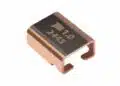









TDK has extended its NTCSP chip thermistor family with new automotive‑grade parts qualified up to 175 °C for conductive‑glue mounting on power modules and high‑temperature PCBs.
These small 1.6 × 0.8 mm sensors target accurate temperature detection and compensation in demanding automotive environments where conventional 150 °C components and solder joints become a limitation.
Key features and benefits
The new NTCSP devices are negative temperature coefficient (NTC) chip thermistors optimized for high‑temperature automotive use and adhesive assembly instead of solder. This combination addresses both reliability and process constraints in modern power electronics.
Key characteristics include:
- Wide operating temperature range from -55 °C to +175 °C, covering cold‑start and under‑hood hot‑spot conditions in a single sensor type.
- AEC‑Q200 compliance, making the series suitable for automotive qualification flows without custom reliability work.
- Use of AgPd (silver‑palladium) terminations specifically designed for conductive‑glue mounting, enabling robust joints at temperatures that challenge conventional solder.
- Compact 1.6 × 0.8 × 0.8 mm package that saves board area in dense power modules and ECUs.
- Two standard nominal resistances at 25 °C (R25): 10 kΩ and 100 kΩ, covering common interface and sensing ranges in automotive electronics.
- Tight resistance tolerance of 1% and B‑constant tolerance of 1%, supporting accurate temperature measurement and compensation with minimal calibration overhead.
For designers, the combination of AEC‑Q200 status, extended temperature rating, and glue‑mount terminals simplifies design reuse from 150 °C platforms to 175 °C environments while maintaining a similar NTC concept.
Typical applications
The NTCSP high‑temperature versions are intended wherever the sensing point experiences elevated temperatures or where solder is undesirable, especially in power modules and under‑hood assemblies.
Typical use cases include:
- Temperature detection for anti‑lock braking systems (ABS), for example monitoring actuator or control electronics temperatures.
- Transmission control units and mechatronic modules mounted directly on or near the gearbox, where oil and housing temperatures can be high.
- Engine‑related modules, such as control units, actuators, and sensors located in the engine compartment.
- General temperature detection and compensation circuits that must operate reliably across a wide range from -55 °C to +175 °C, such as power inverters, DC‑DC converters, or on‑board chargers when mechanical integration calls for adhesive mounting.
In many of these systems, NTC thermistors serve as local hot‑spot detectors on power semiconductor substrates, busbars, or heat sinks, feeding back temperature information to derating, protection, or closed‑loop control algorithms.
Technical highlights
The series expansion is focused on a single compact chip size with carefully chosen resistance/B‑constant combinations for automotive sensing.
Electrical characteristics
- Series: NTCSP, automotive NTC chip thermistors for high‑temperature conductive‑glue mounting.
- Nominal resistance at 25 °C (R25):
- 10 kΩ type (NTCSP163JF103FT1H).
- 100 kΩ type (NTCSP164KF104FT1H).
- Resistance tolerance: 1% at 25 °C for both variants.
- B‑constant (B25/85):
- 3435 K for the 10 kΩ type.
- 4485 K for the 100 kΩ type.
- B‑constant tolerance: 1%.
In practice, a lower B‑constant results in a somewhat flatter R–T curve, while a higher B‑constant provides a steeper change of resistance with temperature. Designers can select between 10 kΩ and 100 kΩ options depending on input bias current, ADC range, and desired sensitivity around the key operating temperature.
Mechanical and packaging data
- Package size: 1.6 × 0.8 × 0.8 mm (chip thermistor format).
- Termination system: AgPd terminals designed for conductive‑glue mounting.
- Operating temperature range: -55 °C to +175 °C.
Unlike conventional solder‑terminated NTC chips, the AgPd terminals are optimized for conductive adhesives, which typically have different mechanical and thermal properties than solder alloys.
Automotive qualification
- Automotive grade: AEC‑Q200 compliant.
AEC‑Q200 is the prevailing stress test qualification standard for passive components in automotive applications. Compliance indicates that the NTCSP parts have passed a defined set of environmental and mechanical tests, such as thermal cycling, high‑temperature storage, and mechanical shock, within specified limits.
Availability and part numbers
The current NTCSP high‑temperature lineup comprises two part numbers in mass production as of February 2026.
| Part number | Size [mm] | R25 [kΩ] | R25 tolerance [%] | B25/85 [K] | B tolerance [%] | Notes |
|---|---|---|---|---|---|---|
| NTCSP163JF103FT1H | 1.6 × 0.8 × 0.8 | 10 | 1 | 3435 | 1 | Automotive, high‑temperature NTC |
| NTCSP164KF104FT1H | 1.6 × 0.8 × 0.8 | 100 | 1 | 4485 | 1 | Automotive, high‑temperature NTC |
For detailed curves, R–T tables, derating information, and mounting recommendations, designers should refer to the official NTCSP automotive NTC thermistor datasheet according to the manufacturer documentation.
Design‑in notes for engineers
When designing these NTCSP thermistors into new or existing platforms, a few practical considerations help to get the most out of the extended temperature capability and glue‑mount concept.
Electrical design considerations
- Selection of 10 kΩ vs 100 kΩ:
- 10 kΩ is often preferred for microcontroller ADC interfaces with moderate bias currents and where line impedance must be kept low in electrically noisy environments.
- 100 kΩ can reduce self‑heating at high ambient temperatures, especially if a higher bias resistor is used, and can be useful where input leakage currents are significant relative to the thermistor current.
- ADC interface design:
- Use appropriately stable reference resistors with low temperature coefficients to avoid degrading the effective accuracy of the NTC.
- Check that the R–T curve and chosen divider topology provide sufficient resolution around critical temperature thresholds (for example 150–175 °C in thermal protection).
- Self‑heating:
- At high ambient temperatures, keep the sensing current low enough to minimize self‑heating error, especially in confined spaces with poor airflow.
- Simulate or calculate power dissipation and compare with the thermal resistance figures from the datasheet where available.
Mechanical and assembly aspects
- Conductive‑glue mounting:
- These parts are intended for conductive adhesives rather than solder, which can be advantageous on substrates or module designs where solder reflow is not possible or where the joint must survive repeated exposure near or above conventional solder melting points.
- Follow the manufacturer’s recommendations regarding adhesive type, curing profile, pad design, and minimum bond line thickness to ensure both electrical performance and mechanical reliability.
- Placement and thermal coupling:
- Position the NTC as close as practical to the critical hot‑spot (for example directly on a power semiconductor module or near a heat‑spreader) while observing creepage and clearance requirements.
- Ensure good thermal coupling between the NTC, the adhesive, and the monitored surface; avoid air gaps and large, thermally resistive intermediate materials.
- Environmental exposure:
- The specified operating range of -55 °C to +175 °C covers typical automotive temperature classes, but the surrounding materials (adhesive, PCB, potting) must also be suitable for these conditions.
- Pay attention to potential chemical exposure (oil, coolant, cleaning agents) in engine and transmission environments, and confirm compatibility at the module level.
System‑level considerations
- Functional safety:
- In safety‑relevant systems such as ABS or engine management, consider using redundancy (for example multiple NTCs or cross‑checks with internal semiconductor junction temperature sensors) to meet ISO 26262 requirements.
- Reuse from 150 °C platforms:
- Designs currently using earlier NTCSP parts limited to 150 °C can often be updated to the new 175 °C devices while retaining the overall circuit concept, provided that recalibration is performed using the appropriate R–T data from the latest datasheet.
Source
This article is based on information provided in the official TDK Corporation press release and the associated NTCSP automotive NTC thermistor documentation, with additional independent commentary for design‑in guidance.