













The Modelithics Library for MathWorks MATLAB provides an extensive set of high‑accuracy, measurement‑based models for RF, microwave and high‑speed designs that rely heavily on passive components such as capacitors, inductors and resistors.
For design engineers, it bridges the gap between ideal schematic elements and real‑world component behavior on specific substrates and pad geometries. This can significantly improve first‑pass design success, particularly in demanding applications up to mmWave and 5G frequencies.
Key features and benefits
Modelithics positions its MATLAB library as a collection of Microwave Global Models that represent thousands of commercially available components from over 30 manufacturers, spanning passive and active devices. These models are fully integrated into MATLAB’s EDA workflow, enabling direct use in circuit simulations and system‑level studies.
Key library features include:
- Measurement‑based models developed under device‑specific test conditions, improving correlation between simulation and hardware.
- Scalability for many models with respect to part value, substrate, pad size and temperature, allowing one model to cover a wide range of component options.
- Per‑model documentation (model datasheets) that explains validity ranges, test fixtures, and model‑to‑measurement comparisons.
- A substrate library containing measurement‑based parameters for many commonly used PCB materials.
- A large device pool, with approximately 28,000 components represented, enabling broad coverage of widely used RF and microwave passives and related parts.
For engineers accustomed to ideal R, L, C primitives, these capabilities provide a more realistic representation of parasitics, frequency dependence and substrate effects, which is critical for filters, matching networks, bias tees and other RF networks. Purchasing and component engineering teams can also use the library’s vendor‑specific coverage as a guide to which manufacturers and series are already characterized for high‑frequency design flows.
Typical applications
The Modelithics Library for MATLAB is aimed at RF, microwave and mmWave applications where component parasitics and layout details have a strong impact on performance.
Typical use cases include:
- Design and optimization of RF matching networks for LNAs, PAs and mixers using realistic capacitor and inductor models.
- High‑Q resonators, filters and coupling networks where ESR, Q‑factor and PCB effects must be accurately predicted.
- 5G, mmWave and high‑frequency front‑ends where models are validated to at least 30 GHz, and in some cases up to 125 GHz.
- Evaluation of component choices and tolerances by sweeping part values within a Global Model family (e.g. inductor series across multiple inductance values and case sizes).
- Design on different substrate materials using the substrate library, assessing how dielectric constant and thickness influence performance.
Having models for specific vendor series simplifies design reuse: once a preferred vendor family is qualified in simulation, it can form the basis for multiple projects, with lower risk when transferring designs between bands or boards.
Technical highlights
The MATLAB library uses Microwave Global Models, which are parameterized to represent entire component families rather than a single fixed value or footprint. This approach is particularly useful for passives where engineers often migrate between values and package sizes during tuning.
Measurement‑based models
Each model is built from extensive measurements of real components, using specialized fixtures and device‑specific conditions. The associated model datasheet documents:
- Recommended model validity ranges (frequency, power, temperature where applicable).
- Measurement and test fixture details, including de‑embedding approach.
- Comparison plots between measured data and simulation, enabling engineers to judge accuracy for their use case.
This level of documentation helps design teams justify model usage to quality and verification teams, and supports more rigorous sign‑off of RF blocks.
Scalability and parameterization
Many models incorporate:
- Part value scalability (e.g. a single inductor model representing multiple inductance values and sometimes multiple case sizes within a series).
- Substrate scalability, allowing the same model to be adapted to different PCB materials using the substrate library.
- Pad size scalability, enabling tuning of the footprint geometry used in the simulation to match the actual layout.
- Temperature scalability for selected devices, useful in applications with wide ambient or self‑heating ranges.
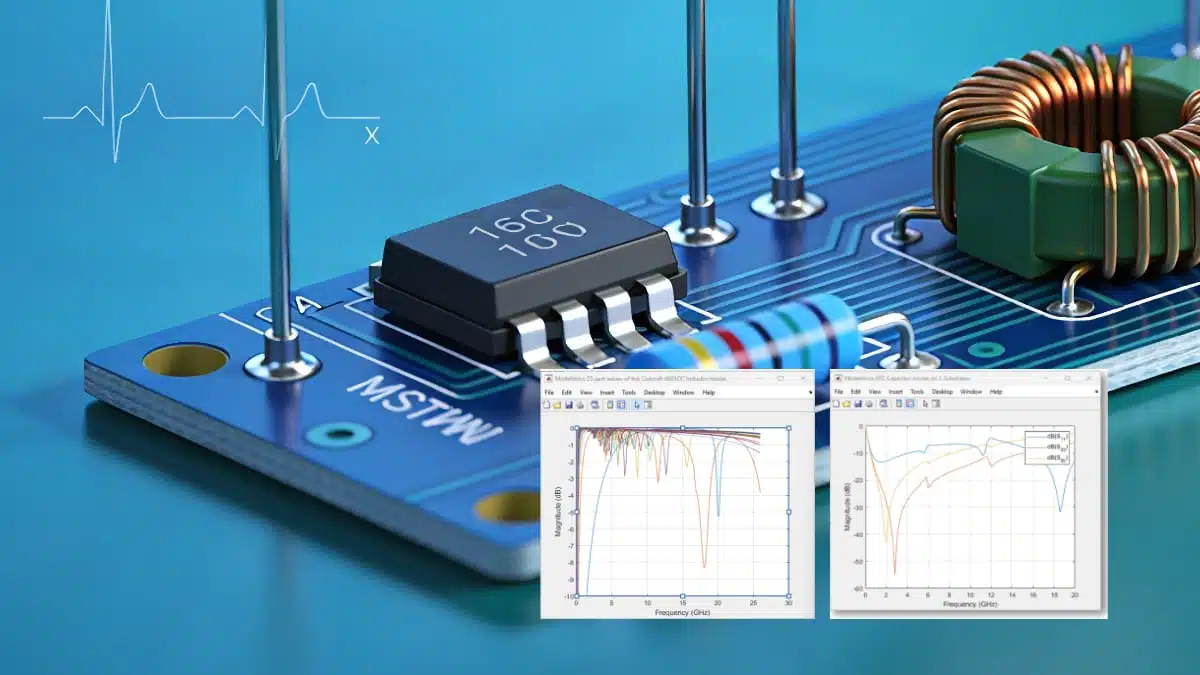
An example highlighted in the material is a Coilcraft 0603DC inductor model with 25 part values available from a single Global Model, and a TDK MLG1608B inductor model swept across part values in MATLAB. This kind of parametric sweep is useful for quickly exploring trade‑offs between inductance, Q‑factor and size.
Sub‑libraries and high‑frequency focus
Within the Modelithics Library for MATLAB, several sub‑libraries organize content by application or vendor:
- mmWave & 5G Library: focuses on models validated to a minimum of 30 GHz, with some devices characterized up to 125 GHz. This is particularly relevant for 5G FR2 bands, satellite communications and other mmWave links.
- Single‑Vendor Sub‑Library: groups all models for a selected vendor, which can simplify qualification and standardization around a preferred supplier.
The library also identifies Modelithics Vendor Partners (MVPs), where broader coverage exists for specific manufacturers.
Availability and vendor coverage
The MATLAB library aggregates models for components from over 30 commercial vendors, including well‑known passive component manufacturers. The documentation lists a broad selection of series across capacitors, inductors and resistors.
Examples from the passive domain include (non‑exhaustive, based on the published list):
- Capacitors: series from Johanson (e.g. R05L, R07S, QCCF, QCCP, various high‑Q RF parts), Dalicap Kyocera‑AVX (DLP70A, DLP75P, DLP74D, DLP70B), Darfon (C0402NP0, C0603NP0), DLI (Milli‑Cap, Opti‑Cap and various C0x series), Passive Plus (01005BB104, 0201N, 0505C, 1111C and others), Murata, TDK, Taiyo Yuden, Samsung and many more.
- Inductors: families such as Murata LQP and LQW series, Johanson L‑05C/L‑07C/L‑14C, Coilcraft 0201–2929 inductors including popular 0603DC, and numerous Würth Elektronik WE‑ series.
- Resistors: ranges from NIC Components, KOA, Susumu, Vishay and others, including specialized high‑frequency and current‑sense parts.
For purchasing and component engineers, this list effectively acts as a map of which vendor component series currently have high‑frequency models available in the MATLAB environment. If a preferred series is not covered, Modelithics actively solicits customer input for “dream library” additions via their sales channel, and pre‑release models are said to be prioritized according to demand.
Access is provided as a licensed library, and Modelithics mentions a free trial request path via their website and sales contact.
Source
The information in this article is based on the official Modelithics Library for MathWorks MATLAB brochure and associated links provided by the manufacturer, with interpretation and commentary added for design‑engineering context. Exact details such as full series lists, frequency ranges and validation conditions should be confirmed against the latest Modelithics documentation and model datasheets.