
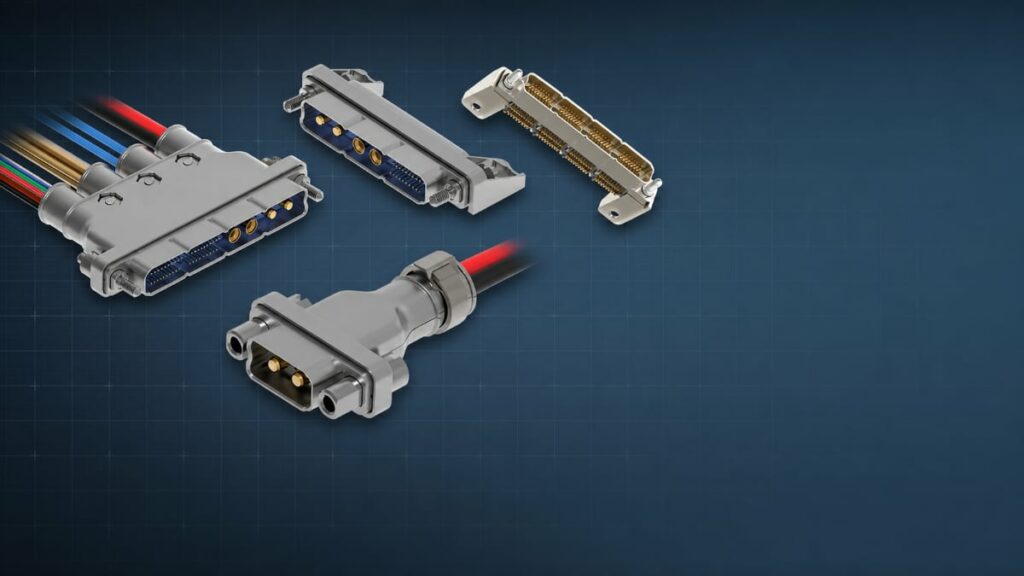
Molex has expanded its AirBorn SInergy modular high-speed hybrid connector platform with new high-power modules that deliver up to 25.0 A per bay while keeping the same compact, rugged format.
For engineers working in aerospace, defense, and other space-constrained systems, the main value is the ability to combine power, high-speed data, and RF contacts in one configurable connector family.
Key features and benefits
- Up to 25.0 A per bay. Molex says the new heavy-duty power contacts raise per-bay power capability by 12.5 times versus the earlier configuration, which is significant for distributed power in compact assemblies.
- Hybrid contact mix. One connector platform can combine power, high-speed data, and RF contacts, reducing the need for separate interconnects.
- Small footprint. A one-bay connector is roughly the size of a U.S. quarter, which helps when panel and PCB space is limited.
- Position-by-position flexibility. Up to five interchangeable bays can be configured in different combinations of signal, power, and RF modules.
- Ruggedized design intent. The platform is positioned for extreme temperature, vibration, shock, and moisture exposure in mission-critical environments.
Why it matters in practice
For design teams, the important change is not only higher current capacity, but also the ability to keep interconnect architecture simpler. A single modular connector can replace several separate functions, which can reduce BOM count, simplify harnessing, and cut qualification effort.
That matters most in systems where reliability and packaging density are both under pressure. Typical examples include aircraft launch systems, advanced radar, avionics, satellites, and combat vehicles.
Technical highlights
| Item | Published detail |
|---|---|
| Power per bay | Up to 25.0 A |
| Power gain | 12.5x increase in per-bay power capacity |
| Data performance | Up to 25 Gbps |
| RF performance | Up to 40 GHz |
| Connector configuration | Up to five interchangeable bays |
| Form factor | One-bay connector about the size of a U.S. quarter |
The new power contacts are engineered to the MIL-DTL-39029 contact crimp standard. Molex also states that the SInergy portfolio meets MIL-DTL-83513 specifications and is designed for harsh environmental conditions.
The power module is rated at a 30°C temperature-rise baseline over ambient. In practical terms, that means the current rating is tied to a controlled thermal rise limit, which is especially relevant where airflow and heat sinking are constrained.
Configuration and integration
The main engineering advantage of SInergy is that it is not locked into a fixed pinout. Instead, the user can assign the needed contact type to each position, which is useful when a system needs mixed power delivery, data links, and RF in the same mechanical envelope.
This can help in dense PCB or backplane layouts where routing multiple single-function connectors would increase complexity. It also gives procurement teams a narrower supplier footprint, because more of the interconnect content can come from one platform rather than several separate vendors.
Typical applications
- Aircraft launch systems.
- Avionics and onboard electronics.
- Advanced radar and sensing platforms.
- Satellites and space systems.
- Combat vehicles and other defense electronics.
These applications share the same basic challenge: high electrical performance in a harsh environment, with limited space for connectors, cabling, and mechanical tolerance stack-up.
Design-in notes for engineers
- Check the thermal budget early. The 30°C T-rise baseline is useful, but it should be matched to the actual enclosure temperature and airflow conditions.
- Treat power and signal allocation as a system decision. The value of the platform depends on placing the right contact type in the right bay from the start.
- Validate mating and mounting constraints. The compact format is helpful, but dense packaging still needs careful mechanical alignment.
- Review qualification data for the exact configuration. The press release points to de-rating test data, but final design choices should be based on the relevant datasheet and application limits.
- Consider sourcing simplification. A modular connector family can reduce part variety, which may help both purchasing and long-term supply chain planning.
Availability and product family
The expansion applies to the AirBorn SInergy Modular High-Speed Hybrid Connectors family, with the new high-power modules added to the existing platform. Molex also references the AirBorn M Series MIL-DTL-83513 Micro-D Connectors and AirBorn N Series MIL-DTL-32139 Nano-D Connectors as part of the broader heritage behind the platform.
For buyers and engineers, the practical question is not just whether the connector can carry the current, but whether the complete bay configuration fits the application’s electrical, thermal, and mechanical constraints.
Source
This article is based on the manufacturer’s press release and the linked official Molex product pages. Exact configuration details, ratings, and qualification limits should be confirmed against the relevant product documentation for the selected bay arrangement.
References
- Molex press release
- AirBorn SInergy Modular High-Speed Hybrid Connectors
- AirBorn M Series MIL-DTL-83513 Micro-D Connectors
- AirBorn N Series MIL-DTL-32139 Nano-D Connectors
- Molex aerospace and defense design engineering report

