

Samsung Electro-Mechanics has announced the release of a full lineup of 008004 inch High Q C0G multilayer ceramic capacitors, scheduled for mass production in October 2026.
These Samsung ultra-compact high Q value MLCC capacitors are designed to meet the demands of millimeter-wave RF front-end modules where both signal integrity in high-frequency bands and board space optimization are critical design constraints.
Key features and benefits
- Ultra-miniaturized footprint: The 008004 size measures just 0.25 × 0.125 mm, reducing mounting area by approximately 50% compared to the conventional 01005 inch format, freeing valuable PCB real estate in densely packed RF modules
- High Q performance: Optimized quality factor minimizes signal loss in high-frequency circuits above 5 GHz, directly improving link efficiency in mmWave bands
- Reduced parasitic elements: Smaller physical dimensions inherently lower parasitic inductance and resistance, crucial for maintaining circuit performance at frequencies where even sub-nanohenry differences matter
- Wide capacitance range: Available from 0.2 pF to 10 pF, covering matching networks, resonant circuits, and DC blocking applications
- Tight tolerance options: Precision matching with tolerances down to ±0.05 pF and ±0.1 pF, enabling predictable tuning in filters and impedance-matching stages
- C0G/NP0 temperature coefficient: Stable capacitance across the full operating temperature range with virtually zero drift, essential for maintaining filter center frequencies and matching network precision
- Maximum thickness: 0.138 mm allows compatibility with high-density pick-and-place processes
Typical applications
The 008004 High Q MLCC family is primarily intended for RF front-end modules in communication infrastructure and mobile devices operating in millimeter-wave frequency bands.
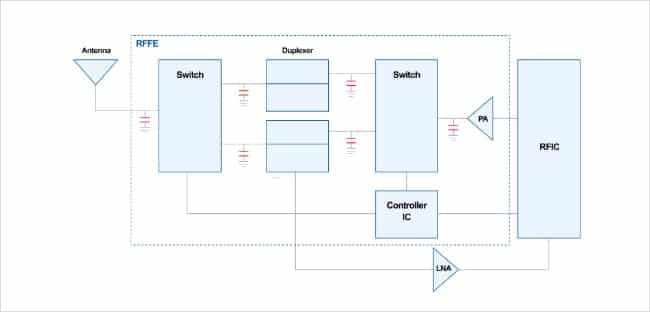
Specific circuit functions include:
- Impedance matching networks in power amplifier output stages
- DC blocking capacitors in RF signal paths
- Resonant elements and tuning capacitors in bandpass filters
- Coupling capacitors in low-noise amplifier input circuits
- Parasitic suppression in antenna switch modules
- High-frequency bypass and decoupling near RF integrated circuits
As 5G networks expand into the 24–71 GHz range and early 6G research targets even higher bands, RFFE modules must accommodate additional antennas, filters, and power amplifiers within the same or smaller footprint. Migrating from 01005 to 008004 capacitors enables engineers to maintain or increase filter order and matching section complexity without enlarging the module outline.
Technical highlights
Samsung Electro-Mechanics offers the 008004 High Q MLCC in two Q-value grades. The High Q variant operates at 25 V rated voltage, while the standard Q version is available at both 16 V and 25 V ratings, giving designers flexibility to trade quality factor against voltage headroom depending on circuit requirements.
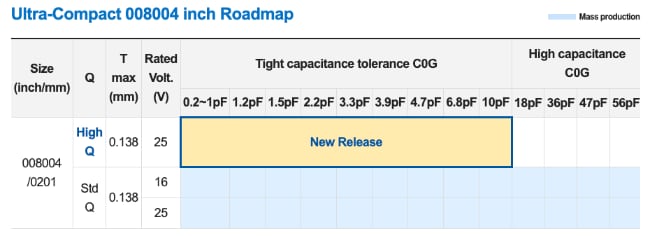
| Part Number | Capacitance | Rated Voltage | TCC | Max Thickness | Q Grade |
|---|---|---|---|---|---|
| CLR1C010BA1GNN# | 1 pF | 25 Vdc | C0G | 0.138 mm | High Q |
| CLR1C050BA1GNN# | 5 pF | 25 Vdc | C0G | 0.138 mm | High Q |
| CLR1C100JA1GNN# | 10 pF | 25 Vdc | C0G | 0.138 mm | High Q |
The C0G dielectric ensures that capacitance remains essentially constant from -55 °C to +125 °C, a critical property for RF circuits where even small capacitance shifts translate directly into filter passband drift or matching network detuning. This temperature stability makes C0G the preferred dielectric class for precision analog and RF applications, despite its lower volumetric efficiency compared to X7R or Y5V formulations.
Design-in notes for engineers
- Placement and soldering: The 008004 package pushes the limits of standard SMT assembly. Verify that your pick-and-place equipment supports sub-0.3 mm component handling and that solder paste stencil apertures are optimized for such small pads. Tomb-stoning and component loss during reflow are common failure modes with ultra-miniature parts.
- Parasitics and layout: At mmWave frequencies, pad geometry, trace width, and via placement near the capacitor can introduce parasitic inductance comparable to the component’s own reactance. Use electromagnetic simulation to model the complete structure, not just the ideal capacitor value.
- Quality factor trade-offs: High Q means low equivalent series resistance, but ESR also provides useful damping in some matching networks. Review whether your circuit benefits from maximizing Q or whether a standard Q part offers sufficient performance with broader supply availability.
- Mechanical stress sensitivity: Ceramic capacitors are brittle. The smaller the package, the more vulnerable it becomes to board flexure during assembly, testing, and field use. Ensure adequate underfill or conformal coating if the module will experience mechanical shock or thermal cycling.
- Tight tolerances and cost: ±0.05 pF precision is achieved through screening and binning, which increases unit cost. Evaluate whether your filter or matching network design truly requires this level of matching, or whether a wider tolerance with tuning elements offers a more economical solution.
Source
This article is based on the official press release published by Samsung Electro-Mechanics on May 20, 2026, announcing the introduction of the 008004 inch High Q MLCC product family for RF front-end applications.
- Samsung Electro-Mechanics – Presenting the Ultra-Compact 008004 inch High Q MLCC
- Samsung Electro-Mechanics MLCC Product Search

