



Passive Components Blog
No Result
View All Result
  • Home
  • News
    • All
    • Aerospace & Defence
    • Antenna
    • Applications
    • Automotive
    • Capacitors
    • Circuit Protection Devices
    • electro-mechanical news
    • Filters
    • Fuses
    • Inductors
    • Industrial
    • Integrated Passives
    • inter-connect news
    • Market & Supply Chain
    • Market Insights
    • Medical
    • Modelling and Simulation
    • New Materials & Supply
    • New Technologies
    • Non-linear Passives
    • Oscillators
    • Passive Sensors News
    • Resistors
    • RF & Microwave
    • Telecommunication
    • Weekly Digest

    Samsung MLCC Revenue Seen Above KRW 8T by 2027, Murata EOL Actions Reshape Supply

    ROHM SDR01 high anti-surge thick-film chip resistor in 1005 metric 0402 package with 0.33 W rated power

    ROHM Introduces Anti-Surge 0402 Resistors Rated at 0.33 W

    ECIA Industry Pulse Q3 2026 chart showing passive components, semiconductors and electro-mechanical component market sentiment and lead-time pressure

    ECIA Industry Pulse Moderates as Passive Lead Times Tighten

    LG Innotek Demonstrates FC-BGA Substrates With Embedded Silicon Capacitors for AI Power Delivery

    On-Chip 3D-Printed Copper Microinductors: A New Route to Compact RF Electronics

    Emerging Capacitor Markets in Fusion Energy

    Murata DLW32SH_MF 1210 surface-mount common mode choke coil with metal terminals for automotive CAN FD signal-line noise suppression

    Murata Introduces Common Mode Chokes for Automotive CAN FD up to 150°C

    onsemi solid-state transformer concept for 800 V HVDC AI data center power conversion with SiC modules, DC-link capacitors and high-frequency magnetics

    Solid-State Transformers for 800 V AI Data Centers: Passive Component Design Considerations

    Littelfuse TX00AT314AMA omnipolar TMR magnetic switch sensor in a leaded TO-92-3 through-hole package

    Littelfuse Expands Omnipolar TMR Switch with Leaded TO-92 Package Option

    Trending Tags

    • Ripple Current
    • RF
    • Leakage Current
    • Tantalum vs Ceramic
    • Snubber
    • Low ESR
    • Feedthrough
    • Derating
    • Dielectric Constant
    • New Products
    • Market Reports
  • Knowledge Blog
  • Dossiers
    • AI Hardware Dossier
    • Automotive Dossier
    • Industrial Robotics Dossier
    • Power Converter Dossier
    • Capacitor Dossier
    • Resistor Dossier
    • Inductor Dossier
    • Circuit Protection Dossier
  • Suppliers
    • Who is Who
  • PCNS
    • PCNS 2025
    • PCNS 2023
    • PCNS 2021
    • PCNS 2019
    • PCNS 2017
  • Events
  • Home
  • News
    • All
    • Aerospace & Defence
    • Antenna
    • Applications
    • Automotive
    • Capacitors
    • Circuit Protection Devices
    • electro-mechanical news
    • Filters
    • Fuses
    • Inductors
    • Industrial
    • Integrated Passives
    • inter-connect news
    • Market & Supply Chain
    • Market Insights
    • Medical
    • Modelling and Simulation
    • New Materials & Supply
    • New Technologies
    • Non-linear Passives
    • Oscillators
    • Passive Sensors News
    • Resistors
    • RF & Microwave
    • Telecommunication
    • Weekly Digest

    Samsung MLCC Revenue Seen Above KRW 8T by 2027, Murata EOL Actions Reshape Supply

    ROHM SDR01 high anti-surge thick-film chip resistor in 1005 metric 0402 package with 0.33 W rated power

    ROHM Introduces Anti-Surge 0402 Resistors Rated at 0.33 W

    ECIA Industry Pulse Q3 2026 chart showing passive components, semiconductors and electro-mechanical component market sentiment and lead-time pressure

    ECIA Industry Pulse Moderates as Passive Lead Times Tighten

    LG Innotek Demonstrates FC-BGA Substrates With Embedded Silicon Capacitors for AI Power Delivery

    On-Chip 3D-Printed Copper Microinductors: A New Route to Compact RF Electronics

    Emerging Capacitor Markets in Fusion Energy

    Murata DLW32SH_MF 1210 surface-mount common mode choke coil with metal terminals for automotive CAN FD signal-line noise suppression

    Murata Introduces Common Mode Chokes for Automotive CAN FD up to 150°C

    onsemi solid-state transformer concept for 800 V HVDC AI data center power conversion with SiC modules, DC-link capacitors and high-frequency magnetics

    Solid-State Transformers for 800 V AI Data Centers: Passive Component Design Considerations

    Littelfuse TX00AT314AMA omnipolar TMR magnetic switch sensor in a leaded TO-92-3 through-hole package

    Littelfuse Expands Omnipolar TMR Switch with Leaded TO-92 Package Option

    Trending Tags

    • Ripple Current
    • RF
    • Leakage Current
    • Tantalum vs Ceramic
    • Snubber
    • Low ESR
    • Feedthrough
    • Derating
    • Dielectric Constant
    • New Products
    • Market Reports
  • Knowledge Blog
  • Dossiers
    • AI Hardware Dossier
    • Automotive Dossier
    • Industrial Robotics Dossier
    • Power Converter Dossier
    • Capacitor Dossier
    • Resistor Dossier
    • Inductor Dossier
    • Circuit Protection Dossier
  • Suppliers
    • Who is Who
  • PCNS
    • PCNS 2025
    • PCNS 2023
    • PCNS 2021
    • PCNS 2019
    • PCNS 2017
  • Events
No Result
View All Result
Passive Components Blog
No Result
View All Result

Antiferromagnetic Material’s Promise for High-Speed and Low-Power Consuming Next-Generation Electronic Devices.

13.11.2020
Reading Time: 3 mins read
A A
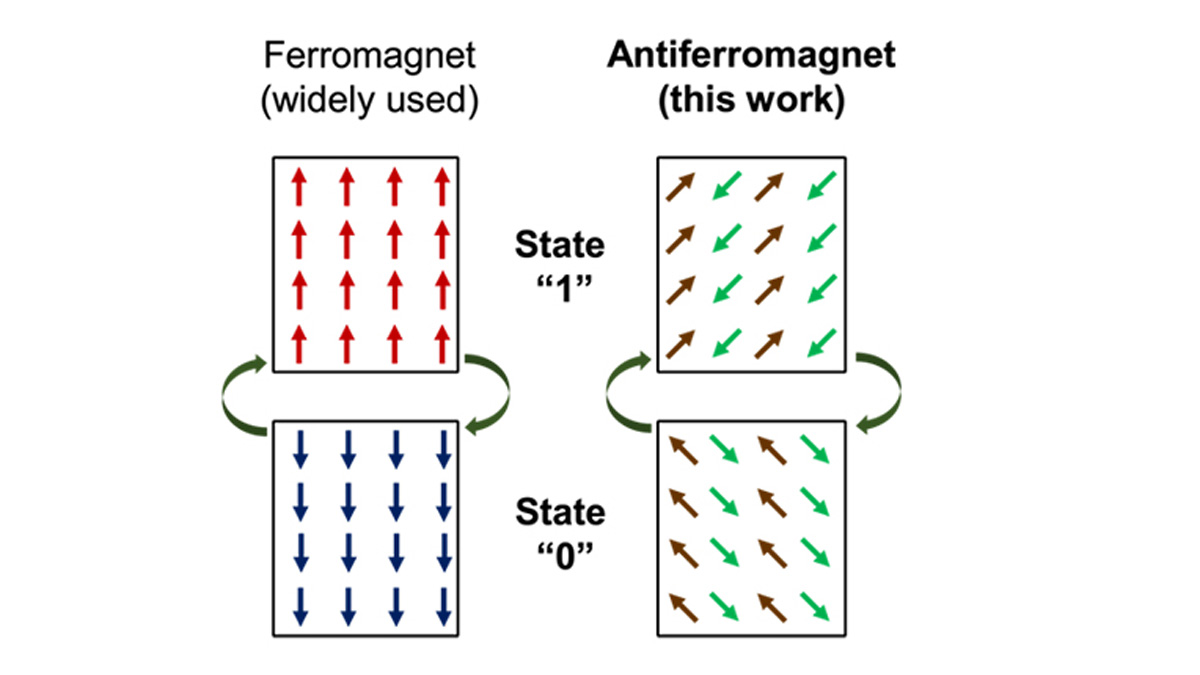
Fig.1: A schematic diagram of information storage using conventional ferromagnet (FM)-based spintronic devices (left) and the proposed antiferromagnets (AFMs)-based devices (right) (the arrows indicate magnetic moments). In FM-based devices (left), bits of information (state "1" or "0") are encoded in the orientation (red/up or blue/down) of the moments. The compensated structure of AFMs (right) entails unique advantages while posing significant hurdles at the same time. ©︎Samik DuttaGupta and Shunsuke Fukami

Fig.1: A schematic diagram of information storage using conventional ferromagnet (FM)-based spintronic devices (left) and the proposed antiferromagnets (AFMs)-based devices (right) (the arrows indicate magnetic moments). In FM-based devices (left), bits of information (state "1" or "0") are encoded in the orientation (red/up or blue/down) of the moments. The compensated structure of AFMs (right) entails unique advantages while posing significant hurdles at the same time. ©︎Samik DuttaGupta and Shunsuke Fukami

The quest for high throughput intelligent computing paradigms – for big data and artificial intelligence – and the ever-increasing volume of digital information has led to an intensified demand for high-speed and low-power consuming next-generation electronic devices. The “forgotten” world of antiferromagnets (AFM), a class of magnetic materials, offers promise in future electronic device development and complements present-day ferromagnet-based spintronic technologies.

Formidable challenges for AFM-based functional spintronic device development are high-speed electrical manipulation (recording), detection (retrieval), and ensuring the stability of the recorded information – all in a semiconductor industry-friendly material system.

RelatedPosts

Samsung MLCC Revenue Seen Above KRW 8T by 2027, Murata EOL Actions Reshape Supply

ROHM Introduces Anti-Surge 0402 Resistors Rated at 0.33 W

ECIA Industry Pulse Moderates as Passive Lead Times Tighten

Researchers at Tohoku University, University of New South Wales (Australia), ETH Zürich (Switzerland), and Diamond Light Source (United Kingdom) successfully demonstrated current-induced switching in a polycrystalline metallic antiferromagnetic heterostructure with high thermal stability. The established findings show potential for information storage and processing technologies.

The research group used a Mn-based metallic AFM (PtMn)/heavy metal (HM) heterostructure – attractive because of its significant antiferromagnetic anisotropy and its compatibility with PtMn Silicon-based electronics (Fig. 2(a)). Electrical recording of resistance states (1 or 0) was obtained through the spin-orbit interaction of the HM layer; a charge current in the adjacent HM resulted in spin-orbit torques acting on the AFM, leading to a change in the resistance level down to a microsecond regime (Fig. 2(b)).
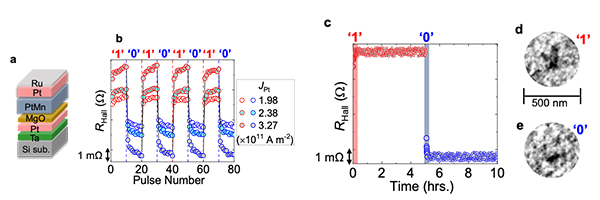
Fig.2: (a) A schematic diagram of the developed stack structure. (b) The experimental results of current-induced switching of AFM/HM PtMn/Pt structure under applied current JPt in the Pt layer. The reading of the antiferromagnetic states was achieved by measuring the output read resistance (RHall). (c) The stability of recorded states (1 or 0) was investigated by measuring RHall for several hours. The red and blue shaded area corresponds to the electrical recording of the high resistive (“1”) or low resistive (“0”) states. (d), (e) X-ray magnetic imaging of the PtMn/Pt structure after the application of current pulses. White and black areas of the image indicate regions of opposite magnetic contrast, representing the reversal of the antiferromagnetic order. ©︎Samik DuttaGupta and Shunsuke Fukami

“Interestingly, the switching degree is controllable by the strength of the current in the HM layer and shows long-term data retention capabilities,” said Samik DuttaGupta, corresponding author of the study (Fig. 2(c)). “The experimental results from electrical measurements were supplemented by a magnetic X-ray imaging, helping to clarify the reversible nature of switching dynamics localized within nm-sized AFM domains.” (Fig. 2(d),(e)).

The results are the first demonstration of current-induced switching of an industry-compatible AFM down to the microsecond regime within the field of metallic antiferromagnetic spintronics. These findings are expected to initiate new avenues for research and encourage further investigations towards the realization of functional devices using metallic AFMs for information storage and processing technologies.

Publication Details:

Title: Spin-orbit torque switching of an antiferromagnetic metallic heterostructure
Authors: S. DuttaGupta, A. Kurenkov, O. A. Tretiakov, G. Krishnaswamy, G. Sala, V. Krizakova, F. Maccherozzi, S. S. Dhesi, P. Gambardella, S. Fukami and H. Ohno
Journal: Nature Communications
DOI: 10.1038/s41467-020-19511-4

Related

Source: Tohoku University

Recent Posts

On-Chip 3D-Printed Copper Microinductors: A New Route to Compact RF Electronics

10.9.2026
14
Murata DLW32SH_MF 1210 surface-mount common mode choke coil with metal terminals for automotive CAN FD signal-line noise suppression

Murata Introduces Common Mode Chokes for Automotive CAN FD up to 150°C

10.9.2026
11
onsemi solid-state transformer concept for 800 V HVDC AI data center power conversion with SiC modules, DC-link capacitors and high-frequency magnetics

Solid-State Transformers for 800 V AI Data Centers: Passive Component Design Considerations

9.9.2026
64
Overview of fabricated ferroelectric capacitors improving hyperdimensional computing task learning accuracy. a The experimental work reported in this study comprises ferroelectric capacitor (FeCAP) device fabrication, structural and electrical characterization, analog state identification and their reliability study. b The computational part of the work explores the benefits of using characteristics from the fabricated devices in a hyperdimensional computing scheme; source: authors

High-Precision Hyperdimensional Computing with Multi-Level Ferroelectric HZO Capacitors

7.9.2026
23

Coilcraft Introduces Automotive Common Mode Chokes Target CISPR 25 Class 5 EMC Compliance

7.9.2026
17

Murata Expands Automotive Metal Power Inductor Range

7.9.2026
37

August 2026 Interconnect, Passives and Electromechanical Components Market Insights

4.9.2026
51

Vishay Extends High-Current Common-Mode Chokes with 30 A EMI Filtering up to 150 °C

3.9.2026
36

B–H Curve-Based Inductor Modelling in LTspice: A Current-Dependent Magnetic Model

31.8.2026
57

Upcoming Events

Sep 16
17:00 - 18:00 CEST

Designing a 5 kW, 800 V-to-50 V PSFB Converter for Next-Generation Data Centers

Sep 29
16:00 - 17:00 CEST

Cybersecurity 2026

Nov 24
16:00 - 17:00 CET

Component selection with the WE REDEXPERT® DC-DC Converter Designer Tool

View Calendar

Popular Posts

  • Buck Converter Design and Calculation

    0 shares
    Share 0 Tweet 0
  • LLC Resonant Converter Design and Calculation

    0 shares
    Share 0 Tweet 0
  • Boost Converter Design and Calculation

    0 shares
    Share 0 Tweet 0
  • Flyback Converter Design and Calculation

    0 shares
    Share 0 Tweet 0
  • Earthing Systems and IEC Classification Explained

    0 shares
    Share 0 Tweet 0
  • MLCC and Ceramic Capacitors

    0 shares
    Share 0 Tweet 0
  • Resistor Symbols

    0 shares
    Share 0 Tweet 0
  • Capacitor Charging and Discharging

    0 shares
    Share 0 Tweet 0
  • Audio Capacitors: Choosing Capacitors for Crossover Circuits

    0 shares
    Share 0 Tweet 0
  • Thermistors Basics, NTC and PTC Thermistors

    0 shares
    Share 0 Tweet 0

Newsletter Subscription


Passive Components Blog

© 2015–2026
All rights reserved

  • Home
  • Privacy Policy
  • EPCI Membership & Advertisement
  • About

No Result
View All Result
  • Home
  • Knowledge Blog
  • Dossiers
  • PCNS

© 2015–2026
All rights reserved