




Passive Components Blog
No Result
View All Result
  • Home
  • News
    • All
    • Aerospace & Defence
    • Antenna
    • Applications
    • Automotive
    • Capacitors
    • Circuit Protection Devices
    • electro-mechanical news
    • Filters
    • Fuses
    • Inductors
    • Industrial
    • Integrated Passives
    • inter-connect news
    • Market & Supply Chain
    • Market Insights
    • Medical
    • Modelling and Simulation
    • New Materials & Supply
    • New Technologies
    • Non-linear Passives
    • Optoelectronics and Isolation
    • Oscillators
    • Passive Sensors News
    • Resistors
    • RF & Microwave
    • Telecommunication
    • Weekly Digest
    Siemens executives Markus Grabmeier and Barry Powell with Skeleton Technologies CEO Taavi Madiberk at the investment announcement

    Siemens Backs Skeleton’s US AI Power Manufacturing Expansion

    Concept illustration of an LTCC antenna module with multilayer ceramic substrate, antenna elements and an integrated beamforming IC

    Murata LTCC 6G Antenna Module Demonstrates 135 GHz Operation

    TDK X series surface-mount multilayer varistors with ceramic chip bodies and metal end terminations

    TDK X Series SMD Varistors for Industrial Transient Protection

    Littelfuse TP7.0SMD-XC automotive TVS diodes with black surface-mount bodies and silver end terminals.

    Littelfuse Introduces Extremely Low Clamping Voltage TVS Diodes for Automotive Protection

    Supercapacitor LSM production

    LS Materials Wins $51.5M AI Data Center Supercapacitor Order

    Features of BCZT and strontium titanate dielectric layers in a thin-film superlattice

    Relaxor superlattice capacitors approach 99% efficiency

    Stackpole RMAN thick-film chip resistors with rectangular bodies and metal end terminations

    Stackpole 2512 AlN Thick-Film Resistors Rated up to 3.5 W

    ECIA September 2026 Industry Pulse electronic component trends and sentiment report

    ECIA September 2026 Pulse: Growth Holds, Supply Pressure Persists

    Wk 39 Electronics Supply Chain Digest

    Trending Tags

    • Ripple Current
    • RF
    • Leakage Current
    • Tantalum vs Ceramic
    • Snubber
    • Low ESR
    • Feedthrough
    • Derating
    • Dielectric Constant
    • New Products
    • Market Reports
  • Knowledge Blog
  • Dossiers
    • Aerospace and Defense Passive Components Dossier
    • AI Hardware Dossier
    • Automotive Dossier
    • Industrial Robotics Dossier
    • Power Converter Dossier
    • Capacitor Dossier
    • Circuit Protection Dossier
    • Inductor Dossier
    • Resistor Dossier
    • Silicon Capacitors and Integrated Passives Dossier
  • Suppliers
    • Who is Who
  • PCNS
    • PCNS 2025
    • PCNS 2023
    • PCNS 2021
    • PCNS 2019
    • PCNS 2017
  • Events
  • Home
  • News
    • All
    • Aerospace & Defence
    • Antenna
    • Applications
    • Automotive
    • Capacitors
    • Circuit Protection Devices
    • electro-mechanical news
    • Filters
    • Fuses
    • Inductors
    • Industrial
    • Integrated Passives
    • inter-connect news
    • Market & Supply Chain
    • Market Insights
    • Medical
    • Modelling and Simulation
    • New Materials & Supply
    • New Technologies
    • Non-linear Passives
    • Optoelectronics and Isolation
    • Oscillators
    • Passive Sensors News
    • Resistors
    • RF & Microwave
    • Telecommunication
    • Weekly Digest
    Siemens executives Markus Grabmeier and Barry Powell with Skeleton Technologies CEO Taavi Madiberk at the investment announcement

    Siemens Backs Skeleton’s US AI Power Manufacturing Expansion

    Concept illustration of an LTCC antenna module with multilayer ceramic substrate, antenna elements and an integrated beamforming IC

    Murata LTCC 6G Antenna Module Demonstrates 135 GHz Operation

    TDK X series surface-mount multilayer varistors with ceramic chip bodies and metal end terminations

    TDK X Series SMD Varistors for Industrial Transient Protection

    Littelfuse TP7.0SMD-XC automotive TVS diodes with black surface-mount bodies and silver end terminals.

    Littelfuse Introduces Extremely Low Clamping Voltage TVS Diodes for Automotive Protection

    Supercapacitor LSM production

    LS Materials Wins $51.5M AI Data Center Supercapacitor Order

    Features of BCZT and strontium titanate dielectric layers in a thin-film superlattice

    Relaxor superlattice capacitors approach 99% efficiency

    Stackpole RMAN thick-film chip resistors with rectangular bodies and metal end terminations

    Stackpole 2512 AlN Thick-Film Resistors Rated up to 3.5 W

    ECIA September 2026 Industry Pulse electronic component trends and sentiment report

    ECIA September 2026 Pulse: Growth Holds, Supply Pressure Persists

    Wk 39 Electronics Supply Chain Digest

    Trending Tags

    • Ripple Current
    • RF
    • Leakage Current
    • Tantalum vs Ceramic
    • Snubber
    • Low ESR
    • Feedthrough
    • Derating
    • Dielectric Constant
    • New Products
    • Market Reports
  • Knowledge Blog
  • Dossiers
    • Aerospace and Defense Passive Components Dossier
    • AI Hardware Dossier
    • Automotive Dossier
    • Industrial Robotics Dossier
    • Power Converter Dossier
    • Capacitor Dossier
    • Circuit Protection Dossier
    • Inductor Dossier
    • Resistor Dossier
    • Silicon Capacitors and Integrated Passives Dossier
  • Suppliers
    • Who is Who
  • PCNS
    • PCNS 2025
    • PCNS 2023
    • PCNS 2021
    • PCNS 2019
    • PCNS 2017
  • Events
No Result
View All Result
Passive Components Blog
No Result
View All Result

TDK Develops Spin-Memristor for Neuromorphic Devices to Reduce AI Power Consumption to 1/100

3.10.2024
Reading Time: 4 mins read
A A

TDK develops “spin-memristor” for neuromorphic devices, and collaborates with CEA and Tohoku University to achieve practical application of neuromorphic devices able to reduce power consumption of AI down to 1/100.

TDK Corporation announced the development of a neuromorphic element called a “spin-memristor” that has very low power consumption.

RelatedPosts

TDK X Series SMD Varistors for Industrial Transient Protection

TDK Expands1608 Inductors for Automotive PoC Filters

TDK Expanded DC-Link Film Capacitors to Reach +135 °C

By mimicking the energy-efficient operation of the human brain, this element could cut the power consumption of AI applications down to 1/100th of traditional devices.

Collaborating with the French research organization CEA (Alternative Energies and Atomic Energy Commission), TDK has proven that its “spin-memristor” can serve as the basic element of a neuromorphic device. Going forward, TDK will collaborate with the Center for Innovative Integrated Electronic Systems at Tohoku University on the practical development of the technology.

In recent years, digital transformation (DX) has advanced due to the development of AI; it is predicted that energy consumption utilizing big data and AI will boom and make certain issues more apparent — such as the complexity around the computational processing of vast amounts of data, and the increased power consumption associated with the development of AI. TDK strives to contribute to solving these social and environmental issues.

The human brain requires around 20 W of power, which enables it to make more complex decisions than current digital AI processors, but with far lower power consumption. Therefore, TDK set itself a goal to develop a device that electrically simulates the synapses of the human brain: the memristor.

While conventional memory elements store data in the form of either 0 or 1, a “spin-memristor” can store data in analog form, just as the brain does. This makes it possible to perform complex computations with ultra-low power consumption. Although memristors for neuromorphic devices already exist, they face issues such as changes in resistance over time, difficulties in controlling the precise writing of data, and the need for control to ensure that data is retained. TDK’s “spin-memristor” solves these issues and is expected to offer immunity to environmental influences and long-term data storage while reducing power consumption by cutting leakage current in existing devices.

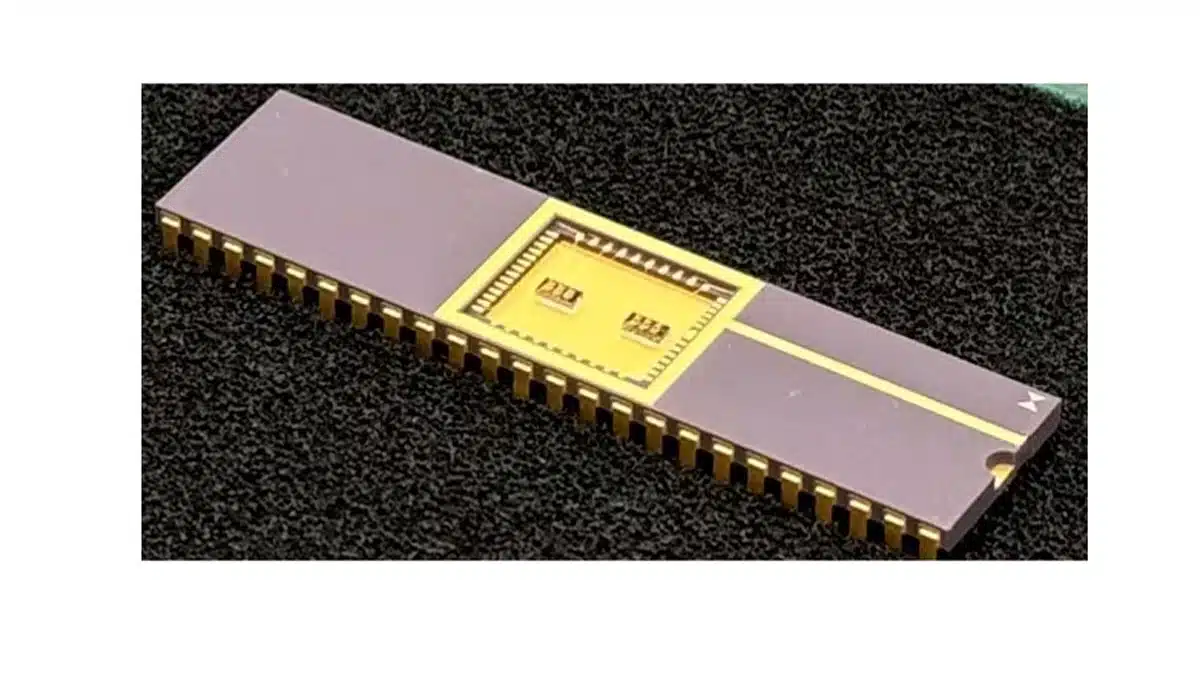
To achieve this, TDK started collaborating with the CEA in 2020. With this support, we developed an AI circuit equipped with a “spin-memristor” (3 elements × 2 sets × 4 chips) and confirmed its successful operation through a sound separation demonstration, proving that “spin-memristors” can serve as basic elements in AI circuits.
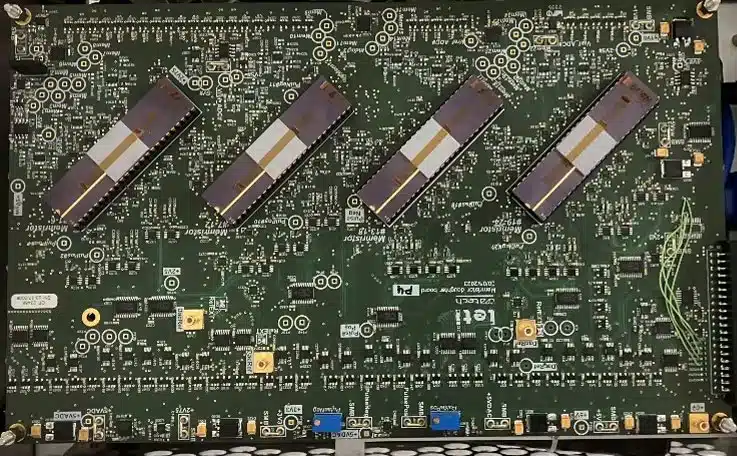
AI circuit board equipped with four spin-memristor ceramic packages

In the demonstration, even when three types of sound (music, speech, and noise) were mixed with arbitrary ratios, the circuit was able to learn and separate the three types of sound in real-time. In general machine learning, AI operations are performed based on data that the AI model has previously been trained on, but TDK’s device is uniquely capable of learning in a changing environment in real-time.

Now that it has been confirmed that the “spin-memristor” can serve as the basic element of a neuromorphic device, TDK will advance this project from basic development to the next stage, practical application. The manufacturing of these products requires the integration of semiconductor and spintronic manufacturing processes. This integration has been achieved in the manufacturing of MRAM, a product similar to memristors, and TDK has decided to pursue integrated technological development on a joint basis with Tohoku University, a leading academic institution in MRAM research and development.

Comment from Dr. Marc Duranton, Senior Fellow of CEA
“The synergy between TDK and CEA is remarkable, as our complementary expertise fosters a highly creative and constructive collaboration. This research partnership is breaking new ground to develop more sustainable, reliable, highly efficient solutions that will meet the growing demands of modern AI applications.”

Comment from Dr. Tetsuo Endoh, the director of CIES Tohoku University
“AI semiconductors are extremely important for the information-oriented society of the future, but the societal issues are improving AI processing power and reducing power consumption. In light of this social demand, TDK’s AI semiconductor development program, which fuses memristor and spintronics technology, is extremely important. We will do our best to contribute to this project with the academic knowledge held by Tohoku University and the manufacturing technology of the 12-inch prototype line.”

Glossary

  • Spintronics: A technology that utilizes both the charge and spin of electrons or the spin element alone

Features

  • Technology that reduces the power consumption of AI computations down to 1/100
  • “Spin-memristor” using spintronics
  • Novel “spin-memristor” can solve the reliability issues experienced with conventional memristors
  • The aim is to solve social issues associated with AI through international collaboration between industry, academia and government
Related

Source: TDK

Recent Posts

Features of BCZT and strontium titanate dielectric layers in a thin-film superlattice

Relaxor superlattice capacitors approach 99% efficiency

12.10.2026
26
tungsten-bronze-ceramic-capacitor-stack

Tungsten bronze capacitors combine high κ and thermal stability

7.10.2026
31
Schematic of the step-wise LPG/LPG@MnOx/LPG-O functionally graded thick cathode for a zinc-ion hybrid capacitor, Hefei Institutes of Physical Science.

Laser-Engineered Zinc-Ion Cathodes Target Thick Electrodes

1.10.2026
18
Antiferroelectric hafnia crystal structure showing alternating polar layers and field-aligned polar state, University of Nebraska–Lincoln

Antiferroelectric Hafnia at the 2D Limit

29.9.2026
33

On-Chip 3D-Printed Copper Microinductors: A New Route to Compact RF Electronics

10.9.2026
50
Overview of fabricated ferroelectric capacitors improving hyperdimensional computing task learning accuracy. a The experimental work reported in this study comprises ferroelectric capacitor (FeCAP) device fabrication, structural and electrical characterization, analog state identification and their reliability study. b The computational part of the work explores the benefits of using characteristics from the fabricated devices in a hyperdimensional computing scheme; source: authors

High-Precision Hyperdimensional Computing with Multi-Level Ferroelectric HZO Capacitors

7.9.2026
39

Ultrahigh Energy Storage in Lead‑Free BiFeO₃‑Based Ceramic Capacitors via Local Polar Structure Design

16.6.2026
80

Imec Presents High-density MIMCAP RF interposer for III-V chiplets

15.6.2026
158

All‑Water Supercapacitor Based on 1‑nm Clay Channels and Nanoconfined Water Electrolyte

10.6.2026
115

Upcoming Events

Oct 19
15:00 - 16:00 CEST

ESCC-qualified Pt Temperature Sensors for Space Applications

Oct 27
15:00 - 16:00 CET

Heraeus Electronics Webinar: What materials perform when failure is not an option?

Oct 27
16:00 - 17:00 CET

Power Inductor technologies

View Calendar

Popular Posts

  • Buck Converter Design and Calculation

    0 shares
    Share 0 Tweet 0
  • Boost Converter Design and Calculation

    0 shares
    Share 0 Tweet 0
  • LLC Resonant Converter Design and Calculation

    0 shares
    Share 0 Tweet 0
  • Flyback Converter Design and Calculation

    0 shares
    Share 0 Tweet 0
  • Capacitor Charging and Discharging

    0 shares
    Share 0 Tweet 0
  • Audio Capacitors: Choosing Capacitors for Crossover Circuits

    0 shares
    Share 0 Tweet 0
  • MLCC and Ceramic Capacitors

    0 shares
    Share 0 Tweet 0
  • Passive Low Pass Filters: Fundamentals and EMI Design

    0 shares
    Share 0 Tweet 0
  • Thermistors Basics, NTC and PTC Thermistors

    0 shares
    Share 0 Tweet 0
  • Resistor Symbols

    0 shares
    Share 0 Tweet 0

Newsletter Subscription


Passive Components Blog

© 2015–2026
All rights reserved

  • Home
  • Privacy Policy
  • EPCI Membership & Advertisement
  • About

No Result
View All Result
  • Home
  • Knowledge Blog
  • Dossiers
  • PCNS

© 2015–2026
All rights reserved