

Rising prices of silver, gold, palladium and other critical metals are no longer a background macro topic – they are now directly visible in official price‑increase notices from leading passive component manufacturers. For design engineers and purchasing teams, this is turning raw‑material volatility into a design and sourcing constraint that must be actively managed.
Key background trends: from metals to BOMs
Over the past two years, several structural trends have converged:
- Strong demand from AI servers, data centers, automotive electronics and electrification is pushing up consumption of advanced capacitors, inductors, ferrites and resistors.
- Precious and critical metals such as silver, tantalum, palladium and gold represent a significant share of the variable production cost for many passive technologies.
- Major manufacturers are responding with selective but often double‑digit list‑price increases across tantalum capacitors, ferrite beads and other lines, while also accelerating technology shifts toward more base‑metal content and higher material efficiency.
For end users, this shows up as higher unit prices, more frequent PCNs and shifting recommended alternatives, especially in high‑reliability and high‑density applications.
Broader wave of passive component price hikes
YAGEO group provide some of the clearest examples of how metal and demand trends are flowing into concrete product‑level pricing:
- KEMET, YAGEO group a major tantalum capacitor supplier with a leading global share, has implemented multiple rounds of price increases on polymer tantalum series such as T520, T521 and T530, with reported adjustments typically in the 20–30% range in late 2025.
- Earlier notices from Yageo specified that tantalum capacitors in the 2.5–10 V, 47–330 µF range in B‑case packages – widely used in automotive electronics, servers and power‑management rails – would see double‑digit hikes, driven by rising material, labor and equipment costs as well as strong AI‑server demand and extended lead times.
- Market commentary notes that demand for polymer tantalum capacitors in AI servers is an order of magnitude higher than in traditional servers, tightening supply and leading to persistent shortages and longer lead times for popular high‑reliability parts.
Ferrite beads and small inductive components are also being affected, particularly where silver‑rich terminations or pastes dominate the cost structure:
- Pulse Electronics, the magnetic components unit of Yageo Group, has officially notified customers of price increases on selected ferrite bead products effective 1 January 2026.
- The adjustment applies to ferrite bead sizes from 1608 (0603) and above, with existing contracts and ongoing projects exempt, indicating a targeted change focused on new business and open‑order pricing. The company and industry sources point to sustained high silver prices as a key driver, with silver paste able to represent more than half of the production cost of certain ferrite bead types; recent NYMEX silver futures levels above 70 USD/oz and very high year‑on‑year percentage gains have squeezed margins to the point where passing through cost increases is unavoidable. Demand from automotive electronics, AI server power stages, networking and high‑speed computing remains robust, meaning that even as prices rise there is little demand destruction in critical applications such as 800 V EV platforms and AI‑server power modules.
Multiple suppliers across regions and product categories have recently announced similar measures:
- Global and regional manufacturers have issued notices covering MLCCs, chip resistors, inductors, ferrite beads, varistors and thick‑film circuit products, often citing a combination of higher metal costs, higher capex and compliance costs, and tight supply as reasons for “rational” price adjustments.
- In tantalum capacitors, Panasonic has announced 15–30% price increases on tens of polymer tantalum capacitor specifications, with effective dates into early 2026, linked to higher material and process costs in the context of AI‑driven demand.
- Industry observers report that several Chinese manufacturers have implemented broad increases: for example, indicating ranges such as +5–25% for inductors and ferrite beads, +10–20% for silver‑electrode varistors and ceramic capacitors, and +15–30% for thick‑film circuit products, with silver cost explicitly highlighted.
- Distribution and market analysis sources also point to double‑digit hikes on MLCCs and chip resistors by some suppliers in response to demand recovering and previously very low margins, especially for smaller case sizes and automotive‑grade parts.
This pattern confirms that the current wave is not limited to one brand or one material, but reflects a sector‑wide rebalancing after years of intense price competition.
Why precious and critical metals drive pricing
The connection between raw‑material prices and passive component pricing is particularly strong for a few reasons:
- In many passive electronic components silver‑based pastes and terminations can account for a large share of the unit cost, so a sustained spike in silver prices flows almost linearly into the cost of goods.
- For connectors and some high‑reliability terminations, gold and palladium content is small in mass but large in monetary value; even small plating thickness changes can have significant cost implications, but plating thickness is constrained by reliability and corrosion‑resistance requirements.
By contrast, base metals such as copper and nickel are also volatile but typically represent a smaller proportion of total cost for many finished components, and suppliers have more options to optimize geometries and layer counts to absorb moderate fluctuations.
Technology responses: base metals, optimization and specialization
Manufacturers are not only changing price lists; they are also adjusting technologies and product strategies:
- Migration from precious‑metal to base‑metal electrodes in MLCCs and other capacitors continues, with nickel‑electrode MLCCs dominating high‑capacitance and high‑volume segments while palladium‑based electrodes are increasingly confined to demanding high‑reliability niches.
- Termination systems and plating stacks are being engineered to minimize gold, silver and palladium content, for example by using thinner noble‑metal layers over thicker nickel underlayers, or by adopting alternative finishes where the application allows.
- Ferrite bead and inductor designs are being optimized to use narrower or shorter terminations, high‑solids pastes and tighter process control to reduce precious‑metal consumption per piece.
This technology migration is gradual, since every significant material change requires re‑qualification, but the direction is clear: reduce exposure to precious‑metal price swings by shifting as much functionality as possible to base‑metal and polymer systems.
Rising precious and critical metal prices are driven by a mix of structural demand growth in technology sectors, constrained and politically exposed supply, and limited near‑term substitution options in key applications. For passive components, this combination suggests continued volatility and an upward bias in long‑term price trends for silver and tantalum, with more complex, possibly divergent paths for palladium and gold.
Metal Price Drivers
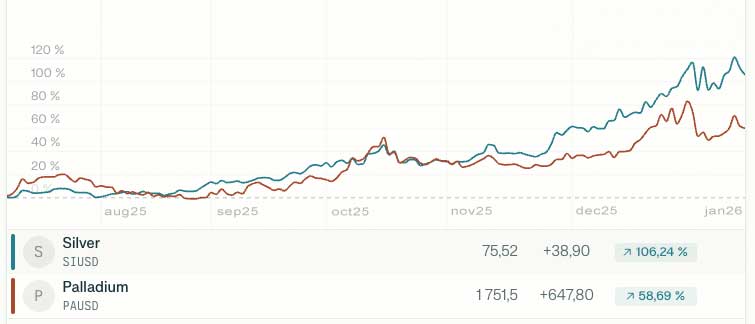
Drivers of recent silver price increases
Silver has shifted from being primarily a monetary/precious metal to being heavily driven by industrial demand, which now accounts for over half of global consumption. Several technology trends are reinforcing this.
- Solar photovoltaics: Industrial analysis indicates global industrial silver consumption hit around 700 million ounces in 2024, with the photovoltaic market a leading driver and some estimates putting PV silver demand growth above 25% year‑on‑year. New high‑efficiency cell technologies can use up to 50% more silver per kilowatt compared to older designs, amplifying the effect of capacity additions.
- Electrification and EVs: Electric vehicles and their charging infrastructure use significantly more silver than internal‑combustion vehicles, with some estimates suggesting roughly two to three times higher silver content per vehicle when all electronics and power devices are considered.
- AI and data centers: AI accelerators, high‑end GPUs and dense server hardware are boosting demand for advanced interconnects, power electronics and passive components, all of which rely on silver’s conductivity; industry commentary increasingly highlights AI as a major new driver of silver demand.
On the supply side, silver mine output and recycling have not kept pace with this industrial growth, contributing to a sustained market deficit and supporting higher prices.
Drivers of palladium price behavior
Palladium’s story is more tightly linked to automotive catalysts, where it has been the dominant metal in gasoline autocatalysts for emissions control.
- Historical surge: From around 2018 onward, palladium prices rose sharply as tightening emissions standards, supply constraints (especially from Russia) and high gasoline vehicle sales pushed demand above readily available supply, with prices more than doubling relative to platinum.
- Emerging substitution and EV impact: As palladium became very expensive, automakers began substituting platinum into tri‑metal gasoline catalysts, reducing palladium loadings by hundreds of thousands of ounces annually. At the same time, the growing market share of battery electric vehicles – which do not use palladium autocatalysts – is gradually eroding structural demand.
As a result, while palladium remains critical for many current gasoline and hybrid platforms, demand from autocatalysts is forecast to decline over the medium term, and price volatility may remain high as markets balance substitution, EV uptake and supply responses.
Drivers of tantalum price increases
Tantalum is a classic “small volume, high importance” technology metal, with a large share of its demand coming from electronics, especially capacitors.
- Electronics and capacitors: Reports highlight that increased purchasing from consumer electronics, capacitor manufacturing and semiconductor sectors has tightened spot availability, with tantalum prices reaching levels such as roughly 476 USD/kg in the USA and over 580 USD/kg in Japan during 2025. Progress in 5G, advanced smartphones, laptops and high‑density power management increases the need for high‑performance tantalum capacitors.
These factors mean that when demand from AI servers, automotive electronics or aerospace rises quickly, price spikes are amplified, as seen in recent quarters where strong electronics and defense demand combined with logistical and regulatory bottlenecks.
Drivers of gold price trends
Gold remains primarily a monetary and investment metal, but technology still plays a role in its demand profile.
- Macro and investment demand: Global uncertainty, inflation concerns and central‑bank buying remain core drivers of gold prices, with multi‑year forecasts pointing to sustained investment interest through at least the mid‑2020s.
- Electronics and connectors: In electronics, gold’s role as a corrosion‑resistant, low‑resistance contact and bonding metal underpins steady demand from connectors, semiconductors and high‑reliability terminations, although this is a smaller share of total global gold demand compared with investment and jewelry.
From a passive‑component perspective, higher gold prices mainly push manufacturers toward thinner plating, alternative finishes or partial substitution where reliability requirements allow, but macro forces rather than electronics alone dominate the gold price trajectory.
Outlook for future price trends and implications for passives
Looking ahead, several themes stand out for the four metals most relevant to passive components:
- Silver: With industrial use already more than half of total demand and strong growth forecast in solar, EVs and AI‑related electronics, multiple analyses suggest silver could continue to outperform gold over the medium term, with ongoing deficits making sharp pullbacks less likely unless there is a major macro slowdown. For passive components, this supports the case for continued silver‑thrifting in terminations, more aggressive adoption of base‑metal alternatives, and possibly higher price floors for silver‑rich technologies such as some ferrite beads and thick‑film systems.
- Palladium: As platinum substitution in autocatalysts advances and BEV market share rises, forecast automotive palladium demand is expected to decline gradually, even though autocatalysts still represent a large share of total demand today. This could cap long‑term price growth compared with the previous decade, but supply disruptions or delays in EV adoption could still cause price spikes; high‑reliability MLCC and termination applications will likely remain exposed to episodic volatility, reinforcing the push toward nickel‑based systems.
- Tantalum: Strong growth in AI hardware, 5G, defense, aerospace and high‑end electronics, combined with constrained, regulation‑sensitive supply, points to a structurally tight market with an upward price bias and periodic spikes when demand surges. Passive component suppliers will likely continue to expand capacity in targeted tantalum capacitor lines while pricing high‑reliability and high‑density products at premiums, so OEMs should expect tantalum to remain a relatively expensive but often irreplaceable option.
- Gold: Gold’s trajectory will continue to be dominated by macro and investment factors, but as long as prices remain elevated, connector and component manufacturers will maintain pressure to minimize gold usage via thinner plating and alternative finishes, particularly outside of harsh‑environment and mission‑critical sectors.
For the passive components industry, these trends mean that raw‑material risk is now a long‑term design parameter: engineers and sourcing teams should expect sustained efforts to reduce exposure to silver, palladium and gold in standard products, while recognizing that tantalum‑based solutions will likely remain strategically important — and strategically priced — for high‑performance and high‑reliability designs.
Guidance for purchasing and supply‑chain teams
Purchasing and supply‑chain functions also need to adapt their strategies:
- Expect more selective, product‑specific increases instead of blanket adjustments; suppliers tend to focus on parts where metal content is highest, demand is strongest, or margins are lowest.
- Secure multi‑sourcing where technically acceptable: approving multiple passive components suppliers, reduces exposure to one company’s pricing and allocation decisions.
- Consider total cost of ownership: in some cases, staying with a premium, well‑documented series may still be the better choice when engineering support, reliability data and stable supply are factored in, even if unit price is higher.
- Communicate forward demand for critical series used in AI servers, EV platforms, industrial drives and telecom infrastructure, so that suppliers can factor this into capacity planning and allocation decisions.
Over time, closer collaboration between engineering and purchasing – including early discussion of cost targets and risk tolerance – can reduce surprises when the next round of metal‑driven adjustments appears.
Source
This article is based on recent official notices and industry communications from passive component suppliers, combined with independent market and supply‑chain analysis, and is adapted from publicly available press releases and market reports.
References
- Tantalum capacitor prices rise over 10% amid AI demand surge
- Tantalum capacitor rally on AI – Panasonic price hikes
- Pulse Electronics raises ferrite bead prices
- Price hikes spread in passive components as Yageo’s Pulse raises ferrite bead prices
- Passive components price hikes in 2026 – causes, scope and industry outlook
- https://silverinstitute.org/silver-demand-forecast-to-expand-across-key-technology-sectors/
- https://www.cmegroup.com/openmarkets/metals/2025/Silver-is-Rising-The-Key-Factors-Fueling-Demand.html
- https://www.metal.com/en/newscontent/103049858
- https://auronum.co.uk/substitution-wars-how-platinum-is-winning-back-the-autocatalyst-market/
- https://www.imarcgroup.com/tantalum-pricing-report
- https://www.sfa-oxford.com/market-news-and-insights/sfa-palladium-how-low-can-it-go/
- https://goldsilver.com/industry-news/article/is-now-the-best-time-to-buy-silver-silver-2025-2030-forecasts/
- https://theoregongroup.substack.com/p/can-silver-hit-150-in-2026
- https://www.goldcore.com/blog/will-silver-prices-soar-in-2025-due-to-ai
- https://www.sbcgold.com/blog/silver-set-to-outpace-gold-in-2025-as-industrial-demand-surges/
- https://www.heraeus-precious-metals.com/dam/jcr:f53c0dbe-fbbf-4114-a25a-dd71d2f4b194/Palladium_Standard%202024.pdf
- https://www.cmegroup.com/articles/2024/why-palladium-matters-to-the-growth-of-the-platinum-market.html
- https://www.bullionvault.com/gold-news/infographics/ai-gold-precious-metal-price-forecasts
- https://beadelectronics.com/blog/gold-plating-alternatives-for-electronics-manufacturing
- https://goldinvest.de/en/silver-in-the-electrification-boom-solar-e-cars-ai-driving-demand-until-2030/
- https://www.cnbc.com/2025/11/29/silver-hit-record-highs-in-2025-and-still-has-further-to-run.html