











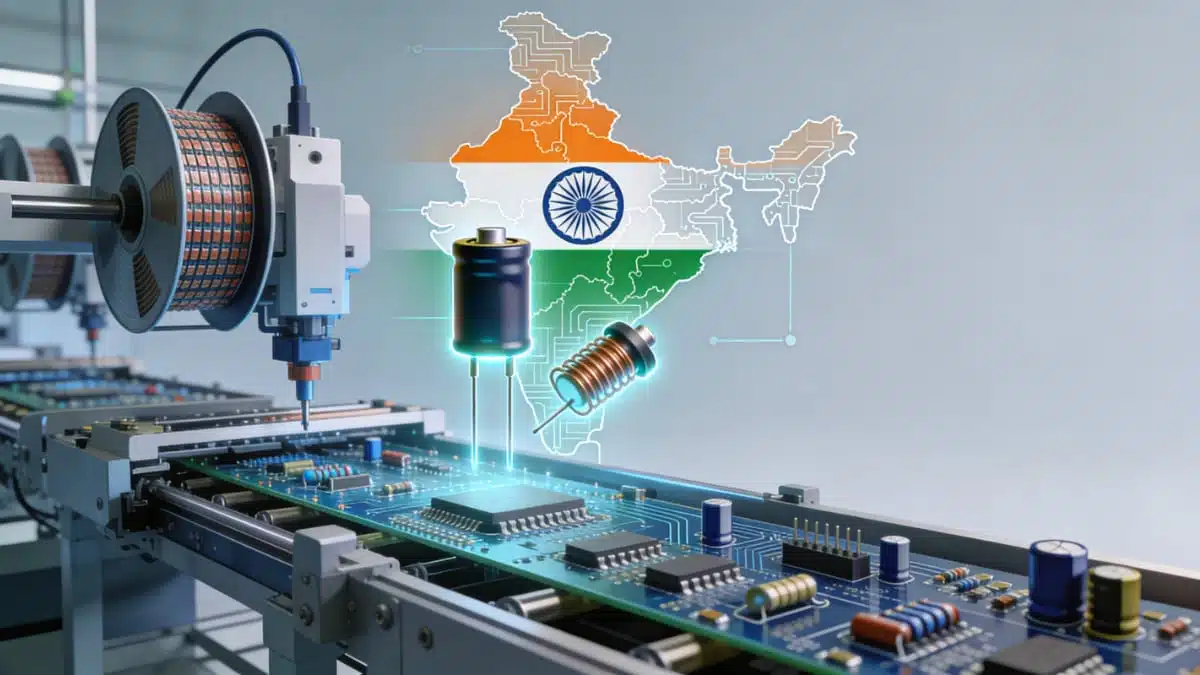
India has approved 29 new projects under the Electronics Components Manufacturing Scheme (ECMS), unlocking investments of around ₹71.0 billion, i.e. roughly US$751 million to expand domestic electronics production and strengthen the component supply chain.
The latest approvals add to 46 earlier projects, taking the ECMS pipeline to 75 proposals with planned investments of over ₹610.0 billion, i.e. roughly US$6.7–7.0 billion and more than 65,000 direct jobs once fully implemented.
For the passive components community, this tranche is notable because it explicitly targets capacitors, resistors, inductors and associated materials, moving India further away from a pure assembly model toward deeper value‑chain localization. India’s electronics manufacturing output, which stood at around 125 billion USD in the year ending March 2025, is expected to rise toward a 500 billion USD ambition by 2031 with ECMS and other incentive schemes playing a central role.
ECMS Approvals: Scope And Scale
The 29 newly approved ECMS projects span 16 product categories, including mobile, telecom infrastructure, consumer, automotive, strategic electronics and IT hardware, and are expected to generate production output worth about ₹845.2 billion, i.e. roughly US$8.9–9.0 billion and create roughly 14,246 direct jobs. Together with the earlier batches, ECMS is evolving into a broad‑based component manufacturing program rather than a device‑centric initiative.
A key highlight is the increasing emphasis on components and materials that traditionally sit early in the value chain: passive components, laminates, metallized films, flexible PCBs, connectors, relays, antennas, heat sinks and capital equipment for electronics manufacturing. This mix directly influences the availability, lead time and cost structure of passive components sourced out of India.
First Tantalum SMD Capacitor Plant And Other “Firsts”
Among the approved projects are several first‑of‑their‑kind facilities for the Indian market. The latest ECMS tranche includes India’s first surface‑mount passive plant for tantalum‑based capacitors, alongside new investments in inductors, resistors, laminates and metallized films. While the government has not yet disclosed which specific applicant will operate the tantalum capacitor line, this move is strategically important for high‑reliability and high‑capacitance‑per‑volume applications in telecom, industrial, defence and automotive electronics, where tantalum capacitors have historically been imported.
The same approval round also covers India’s first flexible PCB manufacturing facility and the first rare‑earth permanent magnet plant based on oxide processing. Flexible PCBs are increasingly used for compact, high‑density assemblies where passives, ICs and sensors coexist on folded or 3D‑shaped boards. Rare‑earth magnets underpin motors, actuators and power electronics systems, making them critical upstream infrastructure for dynamic and inductive components.
Companies Relevant To Passive Components
Several ECMS beneficiaries in this tranche directly operate in the passive components segment or supply critical upstream materials:
- Vishay Components India
Vishay will lead new domestic projects in passive components, reinforcing local supplies of capacitors and related products. For buyers accustomed to importing these parts, local manufacturing should in time improve availability and reduce logistics‑related risk. - Vishay Precision Transducers India
This unit is slated to manufacture resistors and precision transducers. Precision resistors and transducer assemblies are vital for measurement, sensing and instrumentation, where tight tolerances and stability are key selection criteria. - TDK India
TDK will manufacture inductors in India under ECMS support. Inductors are core elements in power conversion, filtering, energy storage and EMI suppression, and localized production provides an alternative sourcing base to traditional East Asian hubs. - Dhruv Industries
Dhruv Industries will produce metallized films for capacitors, addressing one of the bottlenecks in film capacitor supply. Metallized film is a critical, often imported, input for AC, DC‑link and EMI suppression capacitors used across industrial, automotive and power electronics. - Syrma Strategic Electronics, Syrma Components and Ratnaveer Precision Engineering
Syrma Strategic Electronics will manufacture flexible printed circuit boards, while Syrma Components and Ratnaveer Precision Engineering will produce copper‑clad laminates. Flexible PCBs and laminates underpin the substrates on which resistors, capacitors and inductors are mounted, directly affecting the design and reliability of passive networks. - O/E/N India, Permanent Magnets Ltd, BG Electrical and Electronics India, SFO Technologies India
These companies have received approvals in relay and magnet projects. Relays sit adjacent to passives in protection and control circuits, while magnets intersect with inductive components, motors and electromagnetic assemblies in power and automotive applications. - Lohum Cleantech
Beyond its role in energy storage, Lohum Cleantech will establish India’s first rare‑earth permanent magnet facility based on oxide processing. Rare‑earth magnets are fundamental for high‑performance motors and drives, which in turn rely on robust passive components in their power electronics front ends.
Connectors and mechanical interface hardware suppliers such as Molex India, Terminal Technologies, SFO Technologies India, Amphenol FCI India, and antenna and heat‑sink producer VVDN Technologies also feature in the list.
Implications For Global Passive Component Supply Chains
From a passive components perspective, the cumulative effect of these approvals is a gradual rebalancing of global capacity with India emerging as a complementary manufacturing hub. With domestic tantalum SMD capacitors, inductors, precision resistors, metallized films, laminates and flexible PCBs, India is building the prerequisites for vertically integrated passive component production rather than isolated assembly lines.
For international OEMs, EMS providers and distributors, this offers several potential advantages: reduced dependency on single‑region sourcing, improved resilience to logistics disruptions and more options for regionalized manufacturing strategies. For Indian design houses and system integrators, it unlocks the possibility of tighter design‑for‑manufacturability cycles with component and PCB partners located in the same geography.
Policy makers have framed these approvals around four strategic priorities: strengthening domestic design capabilities, localizing supply chains, implementing Six Sigma‑level quality standards and developing a skilled workforce via targeted training initiatives. If executed as planned, these priorities could make India not just a low‑cost assembly location but a meaningful contributor to global technology roadmaps in passive and magnetic components.
References
- TelecomLead – India approves 29 electronics manufacturing proposals worth $751 mn, boosting Dixon Technologies, Lohum Cleantech, Molex India and others.
- VisionIAS – Ministry of Electronics and Information Technology (MeitY) approvals and ECMS overview.
- Press Information Bureau – Electronics Components Manufacturing Scheme (ECMS) background note.
- ANI News – Third tranche of ECMS approved with Rs 41,863 crore investment covering 22 applications.
- Electronics For You – India Clears 29 Electronics Proposals, Boosts Manufacturing Ecosystem Growth.
- Economic Times Telecom – Centre greenlights ₹7,104 crore investment in 29 electronics manufacturing proposals.telecom.economictimes.
- India Briefing – India advances electronics manufacturing with new ECMS approvals.
- Drishti IAS – Electronics Components Manufacturing Scheme (ECMS).
- CorpWhizz – India’s ECMS Pipeline Expanded, 29 New Proposals Approved.
- News Station – Government Approves 29 New Proposals Under ECMS to Boost Electronics Manufacturing.