











This paper provides a comprehensive overview of passive component requirements in ADAS architectures, illustrated with detailed camera and radar system examples.
The article is based on a technical white paper released by YAGEO Group in May 2026, authored by Alexander Nebel, Technical Marketing Manager EMEA.
Introduction
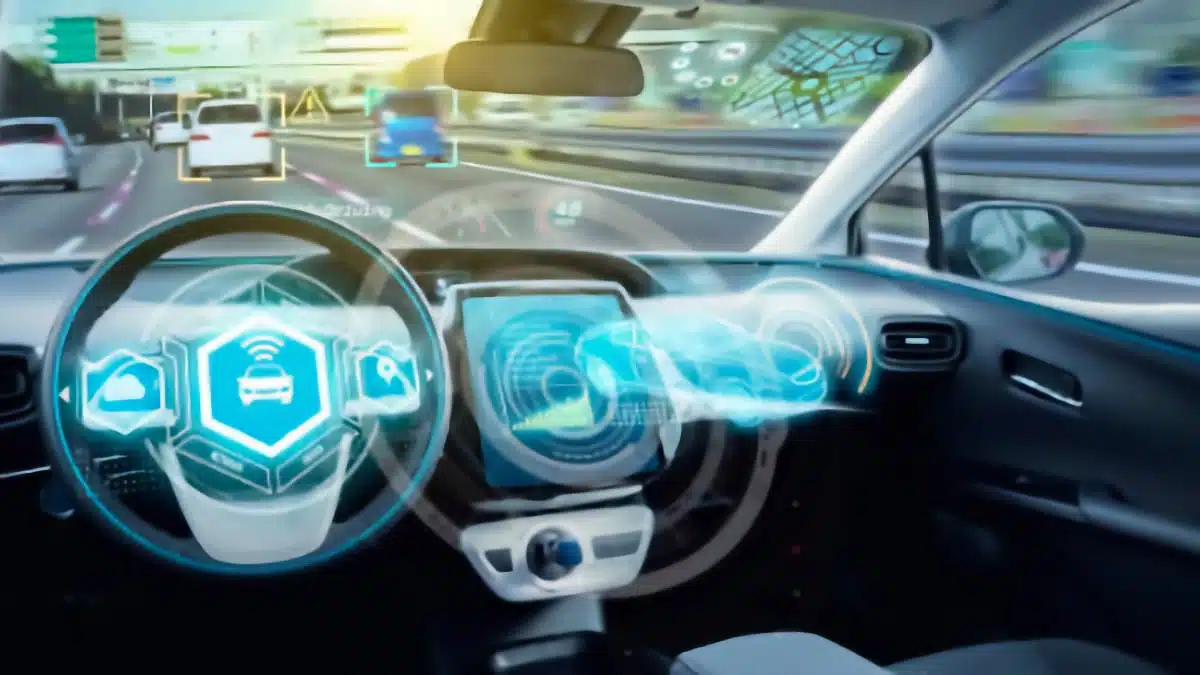
Advanced Driver Assistance Systems are rapidly transitioning from premium features to mandatory safety equipment in modern vehicles, with global production reaching approximately 300 million ADAS units annually.
The electronic architecture behind these intelligent systems relies heavily on high-performance passive components that ensure stable power delivery, signal integrity, and electromagnetic compatibility under harsh automotive conditions.
ADAS (Advanced Driver Assistance Systems) are designed to support drivers in real time. They enhance safety, comfort, and driving efficiency by reducing human error, still the leading cause of road accidents.
These systems combine:
- Cameras
- Radar
- Lidar
- Ultrasonic sensors
- Electronic Control Units (ECUs)
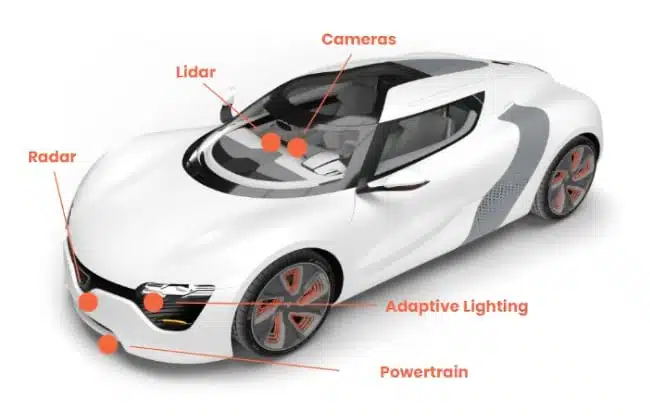
The Growing Role of ADAS Electronics
ADAS combines cameras, radar, lidar, ultrasonic sensors, and Electronic Control Units to interpret vehicle surroundings, warn drivers, and intervene when necessary. As vehicles progress from Level 1 assisted driving to Level 5 full autonomy, electronic complexity increases dramatically:
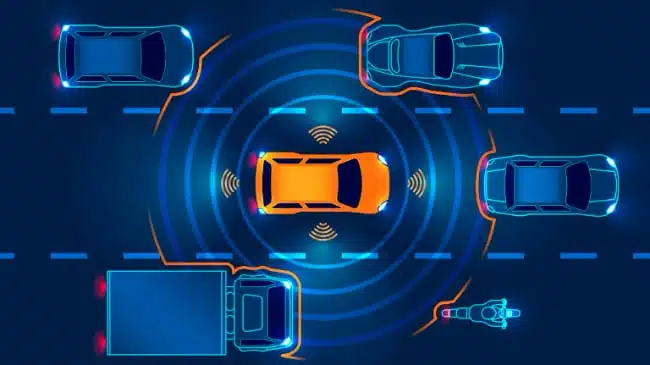
- Level 2 vehicles typically integrate around 17 sensors
- Level 5 vehicles may require 50 or more sensors to fully replace the human driver
This progression drives exponential growth in electronic nodes, power rails, data rates, and system reliability requirements. The ADAS market is projected to grow from roughly $30–35 billion today to over $100 billion within the next decade, driven by regulation, consumer demand, and the clear path toward higher autonomy levels.
Why Passive Components Matter in ADAS
When discussing ADAS, attention often focuses on processors, AI algorithms, and sensor fusion software. However, none of these can function without the silent enablers: resistors, capacitors, inductors, filters, and protection devices.
Critical functions provided by passive components:
- Stable voltage regulation under load dump and cold crank conditions
- Signal integrity maintenance at high data rates
- EMI suppression in noisy vehicle environments
- Long-term reliability across -40°C to +125°C (or higher)
- Compliance with AEC-Q200 automotive standards
Without robust passive component selection, even the most advanced processor cannot operate reliably. As ADAS architectures become denser and more power-hungry, passive component selection directly influences efficiency, thermal behavior, EMI performance, and lifetime durability.
ADAS Camera Architecture: A System-Level View
To understand how passive components enable safe ADAS operation, examining a typical automotive camera module provides valuable insight. An ADAS camera consists of four primary functional blocks, each with distinct electrical challenges:
- Input Stage
- DC-DC Conversion
- Digital Processing
- Input/Output Interface
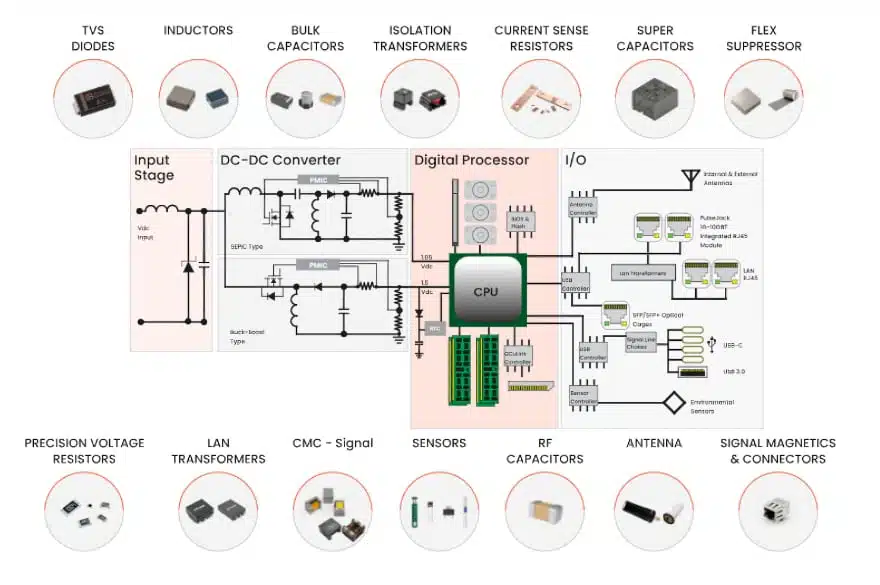
1. Input Stage – The First Line of Defense
The input stage protects camera electronics from harsh automotive conditions including voltage spikes, reverse polarity, load dumps, and EMI from surrounding systems.
Key components:
- TVS diodes for transient suppression
- Filter inductors and chokes to limit current surges
- Bulk and MLCC capacitors to smooth supply ripple
Without robust protection at this stage, downstream integrated circuits remain vulnerable to catastrophic failure. YAGEO Group provides automotive-qualified TVS diodes, inductors (MPXV series), and capacitors including MLCC and polymer capacitor technologies designed specifically for these environments.
2. DC-DC Converter – Powering Intelligence
Once stabilized, the raw vehicle voltage must be converted into multiple regulated rails. A scalable 2-MP automotive camera reference design (Texas Instruments TIDA-050035) illustrates the complexity:
| Parameter | Specification |
|---|---|
| Input Voltage | 4V to 18.3V |
| Output Rails | 1.2V, 1.8V, 2.8V, 3.3V |
| Switching Frequency | 2.3 MHz |
| Architecture | 3 buck converters + 1 LDO |
These converters rely heavily on:
- Power inductors for energy storage
- Low-ESR capacitors (MLCC, polymer, aluminum) for filtering
- Precision resistors for feedback and current sensing
Passive component quality directly influences efficiency, heat generation, ripple suppression, and long-term reliability. In high-density ADAS modules, this becomes a decisive design parameter.
3. Digital Processor – The Brain of the System
The digital processor performs image signal processing, AI-based object recognition, data compression, and high-speed memory interfacing. This block demands extremely clean power and excellent signal integrity.
Supporting components include:
- High-frequency MLCCs for decoupling
- Precision thin-film resistors for biasing and feedback
- Ferrite beads for switching noise suppression
- EMI suppression materials (flex suppressor sheets)
At multi-megahertz switching speeds and high data rates, passive layout and component selection can determine whether a system passes EMC testing or fails.
4. I/O Stage – Reliable Communication
The final stage interfaces the camera with the vehicle network, guaranteeing signal integrity, ESD protection, EMI compliance, and impedance matching. Components such as common-mode chokes, transformers, capacitors, and protection devices ensure reliable data transmission without radiating or receiving unwanted noise.
Radar Systems: Similar Passive Component Dependence
Short-range radar systems, such as the Texas Instruments AWR1642 platform, demonstrate similar reliance on passives. These systems provide detection up to 80 meters (35 cm resolution) or 20 meters at 4.3 cm resolution for applications including Blind Spot Detection, Lane Change Assist, and Cross Traffic Alert.
A typical SRR design integrates:
- 2 programmable LDOs
- 20+ capacitors
- Precision resistors
- EMI suppression elements
Even in highly integrated single-chip radar solutions, passive components remain indispensable.
Market Opportunity and Scale
A single ADAS node may include approximately 30–35 passive components. With 300 million ADAS devices produced annually and an average passive cost estimation of $0.10 per component, the potential market size approaches $1 billion per year today and $2 billion annually within the next decade.
YAGEO Group’s Automotive-Qualified Portfolio
ADAS applications require components that are small in size, cost-efficient, highly reliable, SMD-compatible, and AEC-Q200 certified. YAGEO Group, integrating brands such as KEMET, Pulse, and XSemi, offers a broad automotive-qualified portfolio across 14 product categories:
- TVS diodes
- MLCC capacitors
- Polymer and aluminum capacitors
- Power inductors
- Current sense resistors
- Ferrite beads
- Common-mode chokes
- Transformers
- Antennas
- Supercapacitors
The company’s strength lies not only in individual components but in system-level understanding, supporting engineers from concept to validation.
Design-in Notes for Engineers
When selecting passive components for ADAS applications, consider the following:
- Temperature range: Ensure components are rated for -40°C to +125°C or higher, depending on installation location (under-hood vs. cabin)
- AEC-Q200 qualification: This automotive standard ensures components meet stringent reliability requirements including thermal cycling, moisture resistance, and mechanical shock
- Low ESR/ESL: Especially critical for high-frequency decoupling and power supply filtering to minimize ripple and improve transient response
- EMI performance: Choose components with appropriate self-resonant frequencies and use ferrite beads/common-mode chokes strategically to suppress conducted and radiated emissions
- Component layout: At multi-megahertz switching frequencies, PCB layout becomes as critical as component selection—minimize loop areas and use proper grounding techniques
- Long-term reliability: Automotive lifecycles demand 15+ years of operation; select components with proven automotive heritage and appropriate derating
Source
This article is based on a technical white paper released by YAGEO Group in May 2026, authored by Alexander Nebel, Technical Marketing Manager EMEA. The paper provides a comprehensive overview of passive component requirements in ADAS architectures, illustrated with detailed camera and radar system examples.
References
- YAGEO Group, “Electronics Behind Intelligence: Enabling Safe and Reliable ADAS Architectures” white paper, May 27, 2026
- YAGEO Group automotive applications page: https://yageogroup.com/applications/automotive
- YAGEO Group corporate website: https://yageogroup.com