
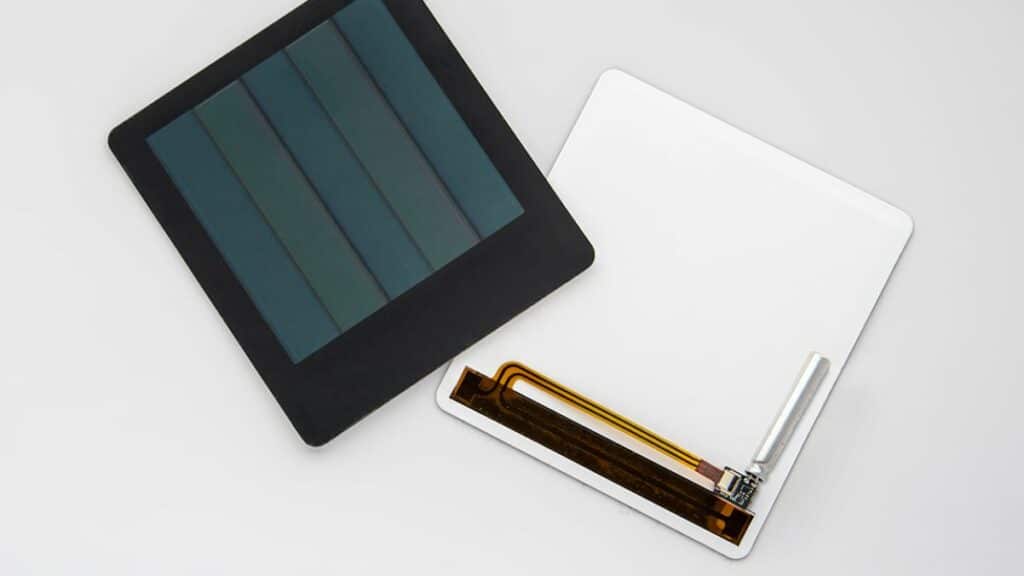
Nichicon introduced SCBE2500A000400X Self-Charging Battery board that combines a lithium titanate rechargeable cell with an integrated light-energy harvesting concept to support low-power electronics without regular battery replacement.
For engineers working on sensors, controls and energy‑harvesting nodes, it sits at the intersection of rechargeable storage, backup power and passive‑style energy buffering, making it a natural comparison point to today’s ultra‑thin prismatic supercapacitors.
Key features and benefits
- Integrated self‑charging concept that brings together ambient‑light harvesting and rechargeable energy storage on a compact board, simplifying evaluation of maintenance‑free power architectures in IoT devices.
- Lithium titanate battery chemistry with a nominal 2.4 V / 4 mAh cell, offering long cycle life and robust low‑temperature behavior compared to conventional lithium‑ion cells, according to the manufacturer.
- Long‑term harvested energy potential, with Nichicon indicating that under 500 lux continuous indoor illumination the SCB concept can accumulate up to 15 000 mAh of charge over 10 years, illustrating the focus on always‑installed low‑power nodes.
- Pulse‑capable output behavior specified at 80 mA continuous discharge current at 20 °C and short‑time pulse currents up to 400 mA, supporting typical RF transmission or sensor‑activation peaks.
- Wide operating temperature range from −30 °C to +60 °C, relevant for commercial, industrial and building‑automation environments where energy storage must remain functional at lower temperatures.
- Board‑level module with plug‑and‑play connection, intended as both an evaluation platform and a potential subsystem in low‑volume deployments.
Typical applications
The Nichicon SCBE2500A000400X is aimed at low‑power electronics that remain in sleep for most of their lifetime and only wake periodically to measure, process or transmit small amounts of data. Representative use cases include:
- Wireless environmental, occupancy or condition‑monitoring sensors in buildings and factories.
- Building‑automation controls, smart switches and access systems where cabling is costly and battery replacement is undesirable.
- IoT beacons, asset tags and small data loggers powered primarily from indoor light, with modest duty cycles.
- Evaluation platforms for energy‑harvesting projects where designers want to explore maintenance‑free nodes before committing to custom hardware.
The SCB board proposes a lithium titanate rechargeable battery alternative to supercapacitor thin prismatic cells. Prismatic supercapacitors can offer thin, board‑level pulse energy where the node is cycled often—such as in industrial sensors with rapid burst activity, wearables or compact power supplies. The Nichicon SCB board, by contrast, is more attractive when the mission profile demands accumulating harvested energy over many hours or days to avoid primary‑cell replacement, and where a small module can be accommodated instead of an ultra‑thin device.
Technical highlights
The SCBE2500A000400X board is specified as a compact self‑charging module that demonstrates Nichicon’s lithium titanate energy‑storage concept. Key parameters from the manufacturer include:
| Parameter | Value (typical) |
|---|---|
| Product | SCBE2500A000400X |
| Chemistry | Lithium titanate rechargeable battery |
| Nominal voltage | 2.4 V |
| Nominal capacity | 4 mAh |
| Operating temperature | −30 °C to +60 °C |
| Continuous discharge current | 80 mA at 20 °C |
| Pulse discharge current | 400 mA (short‑time) |
| Reference illumination | 500 lux, 24 h |
| Harvested charge indication | 15 000 mAh over 10 years (reference) |
For design‑in, it is important to view these numbers in the context of the full system: usable runtime depends not only on nominal capacity, but also on real ambient illumination, average load current, sleep/leakage currents and the chosen duty cycle.
Design‑in notes for engineers
From a design perspective, the SCBE2500A000400X should be treated as a harvested‑energy subsystem rather than a simple battery:
- Start from the full energy budget. Compare the expected harvested energy under realistic indoor lux levels against the average current consumption of the node; the nominal 4 mAh rating alone does not guarantee maintenance‑free operation.
- Use realistic illumination profiles. Offices, warehouses or equipment cabinets rarely match the ideal 500 lux, 24‑hour reference; consider daily and seasonal light variations in the target installation.
- Account for sleep and leakage currents. In ultra‑low‑power nodes, leakage of regulators, sensors, radios and pull‑ups can dominate consumption and should be minimized to benefit from the SCB concept.
- Treat pulse loads separately. Despite 400 mA pulse capability, it is good practice to place local decoupling capacitors near RF modules and fast digital loads to control voltage droop and EMI.
- Compare with prismatic supercaps by mission profile. If the application primarily needs seconds or minutes of hold‑up and extremely high pulse current in an ultra‑thin form factor, Supercaps remain a very strong option; if it needs longer average runtime with lower self‑discharge from harvested light, the LTO board becomes compelling.
- Verify temperature and lifetime in context. The −30 °C to +60 °C operating range is suitable for many industrial and building applications, but detailed lifetime and cycling behavior at your specific temperature and duty cycle should be confirmed from the official Nichicon datasheet.
- Consider mechanical placement as an electrical parameter. Because performance depends on received light, enclosure design, window proximity and shadowing become part of the power‑budget calculation.
Source
This article is based on Nichicon’s official product information for the SCBE2500A000400X Self‑Charging Battery board and related manufacturer documentation, complemented with publicly available data to place the product in the context of modern ultra‑thin energy‑storage components.
References
- Nichicon SCBE2500A000400X product page
- Nichicon SCB / lithium titanate rechargeable batteries overview

