
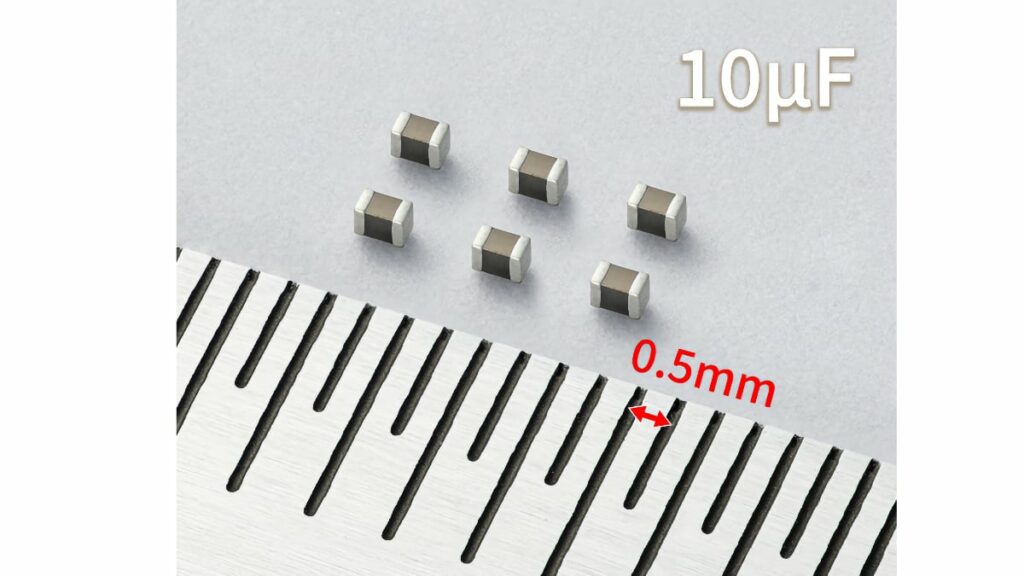
Kyocera has developed what it describes as the world’s first 10 µF multilayer ceramic chip capacitor (MLCC) in the EIA0201 size (0.6 × 0.3 mm), targeting space‑constrained smartphones and wearable devices.
The MLCC ceramic capacitor combines extremely thin dielectric layers with a high layer count to deliver large capacitance in a footprint where 10 µF was previously considered impractical, opening further options for decoupling and local energy storage close to advanced ICs.
Key features and benefits
- Ultra‑miniature footprint: EIA0201 size (0.6 × 0.3 mm) enables designers to increase total capacitance density or reduce PCB area in crowded RF and digital sections according to the manufacturer.
- High capacitance class: 10 µF in this size class allows consolidation of multiple smaller capacitors into a single device, simplifying placement and potentially reducing mounting costs.
- Advanced thin‑layer construction: Several hundred dielectric and internal electrode layers with thicknesses of 0.5 µm or less are used, supporting high capacitance in a very small volume while maintaining electrical performance according to Kyocera’s description.
- Reliability‑driven process: Development focused on material technology (dielectric formulation, internal electrode composition) and process control (sheet forming, printing, lamination, firing) combined with detailed defect analysis, aiming to maintain quality despite aggressive miniaturization.
- Support for future high‑stress applications: The technology platform is intended to extend toward higher temperature and higher electric‑field operation, which is relevant for automotive and semiconductor‑related equipment in later generations.
Example size and capacitance positioning
| Parameter | Typical value / note |
|---|---|
| Package size | EIA0201 (0.6 mm × 0.3 mm) |
| Capacitance class | 10 µF in 0201 size |
| Construction | Several hundred ceramic and internal electrode layers |
| Individual layer scale | Dielectric layer thickness ≤ 0.5 µm according to Kyocera |
Exact voltage rating, tolerance and temperature characteristics should be confirmed in the manufacturer’s datasheet once the commercial part numbers are published.
Typical applications
The initial focus for the 10 µF 0201 MLCC is in mobile and communication equipment, with a roadmap toward more demanding sectors:
- Smartphones and tablet PCs, including application processors, RF transceivers and PMIC input/output decoupling.
- Wearable devices such as smartwatches and fitness trackers, where extreme PCB density and height limitations make 0201 decoupling attractive.
- Communications modules and IoT edge nodes requiring compact RF front ends and power management stages.
- Future extensions into automotive electronics (for example, infotainment, ADAS domain controllers, connectivity modules) as higher temperature and reliability versions are introduced.
- Semiconductor‑related systems and data‑center/AI server platforms once the ultra‑thin dielectric technology is adapted for higher field and temperature stress, according to Kyocera’s roadmap information.
In practice, a single 10 µF 0201 capacitor can be used very close to IC pins where only minimal land pattern area is available, complementing larger case‑size capacitors placed slightly further away in the power distribution network.
Technical highlights
The development of a 10 µF MLCC in EIA0201 required a combination of material science and process engineering improvements.
Thin‑layer dielectric and electrode technology
- Kyocera reports stacking several hundred dielectric and internal electrode layers, each with a thickness on the order of 0.5 µm or less, to reach the targeted capacitance.
- At these thicknesses, even a single conduction path between layers can cause a short circuit failure, so uniformity of ceramic layers, electrode printing and lamination becomes critical.
- Achieving such thin layers typically involves optimized ceramic slurry formulation, precise tape casting or sheet forming, and high‑resolution internal electrode printing to avoid defects and edge overlaps.
Process and analysis flow
- The company highlights the need to jointly develop material and process technologies: dielectric materials, sheet forming processes, internal electrode materials, printing conditions, lamination parameters and firing profiles are tuned together.
- Analytical technologies such as short‑circuit failure analysis and microstructure evaluation are used to identify root causes of defects and feed lessons back into process standards.
- According to Kyocera, repeated fundamental evaluations down to around 0.1 µm‑scale coatings were performed to establish internal standards and process windows designed to prevent defect occurrence rather than just screening out failures.
Cross‑functional project organization
- The development team comprised engineers from three main departments: Development, Production Engineering and Manufacturing.
- The Development department focused on new product design, creation of elemental technologies and analytical methods.
- The Production Engineering department worked on new production methods and equipment start‑up, while the Manufacturing department concentrated on stabilizing mass production and quality.
- This cross‑departmental approach is positioned as necessary to bring such an aggressive miniaturization project from concept to high‑volume production.
Design‑in notes for engineers
For practical design‑in of a 10 µF 0201 MLCC, engineers should consider both the opportunities and the constraints of operating at this miniaturization level.
- Derating and operating conditions
- Check the recommended DC voltage derating relative to the rated voltage (especially for X5R/X6S/X7R‑class dielectrics), since capacitance loss under bias can be significant in high‑k, ultra‑thin structures.
- Review the specified operating temperature range and any guidance for high‑temperature use, particularly if evaluating future automotive‑grade versions.
- Placement strategy in PDN
- Use the 10 µF 0201 close to high‑pin‑count ICs where only tiny land patterns fit between balls or pins, complementing larger case sizes (0402/0603 and above) used for bulk decoupling.
- Combine several units in parallel if layout allows, to reduce effective ESL and ESR and to improve transient response in high‑speed digital or RF SoCs.
- PCB layout and assembly
- Follow the manufacturer’s recommended land pattern and soldering profile to avoid mechanical and thermal stress on the extremely small body.
- Pay attention to pad symmetry and stencil design to minimize tombstoning and skew during reflow, which become more critical at 0201 scale.
- Reliability and quality considerations
- As dielectric layers are very thin, adherence to the specified board flex, vibration and thermal cycling limits is important to prevent mechanical cracking.
- For long‑life or safety‑critical systems (for example, automotive domains), confirm screening methods and reliability data, such as accelerated life testing, insulation resistance and failure modes, according to the manufacturer’s documentation.
- Roadmap awareness
- Kyocera indicates plans to extend this ultra‑thin layer technology to products capable of withstanding higher temperatures and electric fields, which may become relevant for next‑generation automotive and industrial platforms.
- Early evaluation in consumer designs can help engineering teams gain experience with the technology before adopting future, higher‑stress versions in automotive or data‑center designs.
Example application positioning table
| Use case | Role of 10 µF 0201 MLCC |
|---|---|
| Smartphone application processor core rail | Local decoupling close to BGA pins in tight areas |
| Wearable PMIC output | Space‑saving output smoothing in narrow layouts |
| RF transceiver supply rail | Local energy storage with minimal loop area |
| Future automotive infotainment SoC | High‑density decoupling around fine‑pitch packages |
Source
This article is based on information from Kyocera’s official technical/project story describing the development of a 10 µF MLCC in EIA0201 size, complemented by related MLCC technical pages and catalog information provided by the manufacturer.
References
- Developer Interview – Behind the Development of Kyocera’s EIA0201 Model 10 µF Product MLCC
- Kyocera MLCC product overview
- Kyocera Capacitor Catalog (PDF)
- The Road to Thinner MLCCs and New Product Development
- Development of Highly Reliable MLCC – Evaluation and Analysis Technology Visualizes Areas of Deterioration

