
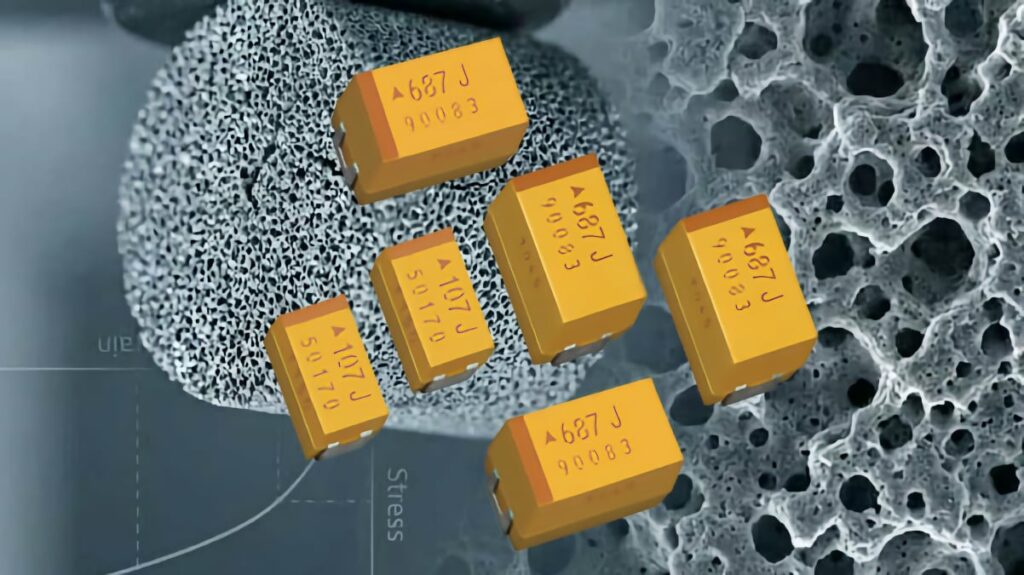
This article, authored by Vladimir Azbel, Ph.D., a semiconductor process reliability engineer consultant, delves into the intricate process of miniaturizing tantalum capacitors, exploring the challenges and underlying physics involved.
Tantalum capacitors have been aggressively miniaturized for decades by pushing powder surface area and optimizing formation conditions. In practice this means higher specific capacitance (CV/g) powders, finer particles, and lower sintering temperatures for a given electrical rating.
This strategy works only up to the point where the metallic framework of the anode can still safely conduct and dissipate heat. Beyond that point further miniaturization degrades structural stability and reliability even though the nameplate capacitance and voltage remain unchanged.
In addition to the static geometry of interparticle necks, the article also shows that formation conditions—especially current control under high ψ—are decisive for dielectric quality and long‑term reliability.
These results build directly on earlier work relating specific capacitance (CV/g) to formation physics in tantalum capacitors, where the practical window for CV/g is constrained not only by dielectric growth limits but also by the electro‑thermal regime during anodization. The ψ = d/X parameter and the Δ = Qrem / Qgen thermal indicator together provide a structural and process‑level framework that refines this picture for highly miniaturized anodes.
Why identical ratings are not structurally equivalent
The usual miniaturization mindset is “more capacitance in less volume” and is often expressed through relations that tie capacitance to specific surface area and dielectric thickness. Those relations correctly describe charge storage but completely ignore how current flows through the porous metallic network of the anode.
This leads to a fundamental question: Is there a structural limit to miniaturization at which the metallic framework can no longer sustain stable operation, even though the data sheet rating stays the same?
The work summarized here compares tantalum anodes with identical electrical ratings (10 µF, 25 V) but made from powders with very different CV/g values. When the capacitors are stripped down to bare anodes, it becomes clear that identical ratings can correspond to very different internal geometries.
Three anode designs, one rating, very different necks
To explore the physical limits of miniaturization, three tantalum capacitor designs were selected, all rated 10 µF, 25 V:
- CC6 (CWR06)
- CC1
- MC1
After removal of encapsulation and external elements, the anodes were examined structurally. Table 1summarizes the key parameters.
Table 1 – Tantalum anodes with 10 µF, 25 V rating but different powders
| Anode type | Powder CV/g (approx.) | Interparticle neck size X (µm) |
|---|---|---|
| CC6 | ~10,000 | ~1.5 |
| CC1 | ~17,000 | ~0.9 |
| MC1 | ~25,000 | ~0.45 |
To keep the same capacitance in a smaller volume, higher surface area powders are used and sintering temperatures are lowered, which systematically shrinks the interparticle neck size X. The dielectric thickness d after formation remains roughly constant (about 0.15 µm in this study), meaning the total metallic cross‑section available for current transport shrinks as miniaturization proceeds.
The fraction of the neck occupied by oxide is estimated to be:
- ~10–15% for CC6 and CC1
- up to ~30% for MC1
In other words, MC1 achieves the same 10 µF, 25 V rating with a much thinner metallic “bridge” between particles and a significantly larger oxide fraction inside each neck. DCL and Mechanical Drift Index (MDI) data show that MC1 also exhibits the strongest irreversible structural changes under stress.
Mechanical Drift Index as a structural stability indicator
Mechanical Drift Index (MDI) is used here as a quantitative measure of accumulated irreversible structural changes in the anode under electrical stress. It captures how the porous structure physically “drifts” in response to localized heating and energy dissipation.
The comparison shows:
- Anodes with larger necks (CWR06/CC6) have low MDI and high structural stability.
- MC1 anodes, with the smallest necks, show the highest MDI values and most pronounced structural degradation.
These observations directly link shrinking metallic cross‑section to reduced structural stability, despite identical electrical ratings. In practice, this means that not all 10 µF/25 V tantalum capacitors are structurally equivalent; the microstructural design matters for long‑term reliability.
The ψ = d/X “double constriction” model
To capture the structural effect in a compact form, the analysis introduces a dimensionless parameter:
ψ=dX\psi = \frac{d}{X}where dd is the dielectric (Ta₂O₅) thickness and XX is the characteristic interparticle neck size.
Physically, ψ represents the fraction of the neck cross‑section occupied by dielectric. A low ψ means the neck is predominantly metallic, while a high ψ means the oxide consumes a large portion of the cross‑section and constricts the current path.
Under miniaturization at constant rating, two trends act simultaneously:
- Geometric constriction (“bottom‑up”): higher CV/g powders reduce particle size and neck size X.
- Electrical constriction (“top‑down”): formation voltage requirements increase with dielectric thickness d.
As a result, ψ rises from about 0.1 for CWR06 to about 0.33 for MC1. At ψ ≈ 0.33, up to one‑third of the neck cross‑section is filled by dielectric, and the remaining metallic pathway becomes highly constricted. The effective conductive cross‑section decreases nonlinearly as ψ increases, which strongly localizes current flow.
From constricted necks to localized overheating
In this framework, the interparticle necks act as dominant resistive elements of the metallic framework. As ψ grows, the local neck resistance increases and power dissipation (approximately Wa=I2RneckW_a = I^2 R_{\text{neck}}) becomes concentrated in smaller regions.
This leads to:
- Local overheating in constricted necks.
- Accumulation of irreversible microstructural changes (high MDI).
- Progressive degradation of the Ta–Ta₂O₅ interface, expressed as increased DCL and reduced breakdown voltage.
The degradation chain can be written conceptually as:
CV/g ↑ → ψ ↑ → Rₙₑcₖ ↑ → Wₐ ↑ → MDI ↑ → DCL ↑ / BDV ↓
In other words, beyond a critical ψ the anode behaves as a structurally overloaded system that cannot safely dissipate the generated heat, even if the nominal electrical stress remains within rating.
Why formation is the decisive stage
The structural contradiction associated with miniaturization manifests most critically during formation, when currents are several orders of magnitude higher than under normal operating conditions. Local heat generation in the neck region scales approximately as W∼I2Rneck, so even moderate geometric changes can significantly alter the thermal regime.
For example, a 16% reduction in neck diameter reduces the metallic cross‑section by roughly 30%, which increases local resistance by about 40% and leads to a comparable rise in locally generated heat at constant formation current. As oxide replaces metal inside the neck during anodization and the oxide fraction approaches about 30% of the neck cross‑section, the remaining metallic pathway becomes strongly constricted and prone to overheating.
Conventional formation protocols with fixed current steps do not account for this evolving geometry. As a result, high‑CV/g powders with small initial necks, and high‑voltage designs where a large fraction of the neck is converted to oxide, may experience localized overheating and defect generation in the dielectric even when the nominal formation conditions appear acceptable.
Formation current as a structural control parameter
In this context, formation current is not a fixed recipe number but a parameter that must adapt to the evolving structure of the anode to avoid local overheating. As formation voltage increases and the conductive pathway inside each neck becomes progressively constricted by growing Ta₂O₅, the current required for stable, defect‑free oxide growth should decrease.
A practical way to formalize this is through an electro‑thermal balance model expressed via the ratio Δ=Qrem/Qgen, where Qrem is the heat removed from the anode and Qgen is the heat generated in the neck network. By dynamically correcting the formation current to maintain Δ above a safe threshold, the same anode volume can reach higher formation voltages without crossing the structural overheating limit implied by ψ.
Thus, electro‑thermal current control becomes an extension of the ψ = d/X structural criterion: ψ defines how close the geometry is to the limit, while Δ defines whether the real formation process respects that limit in time.
Thermal model as an engineering tool
To turn these structural insights into a practical engineering tool, the work implements an anode thermal model via a unified calculation table.
The model ties together three groups of parameters:
- Input parameters: anode geometry and key process conditions (powder type, electrolyte, formation current, sintering temperature and time).
- Structural characteristics: derived quantities such as interparticle neck size X, effective surface area, and oxide thickness d.
- Thermal risk indicators: calculated neck resistance, local power dissipation, and a thermal risk indicator Δ defined as the ratio of heat removal to heat generation (Δ = Qrem / Qgen).
In practice, the same calculation framework can be used not only to assess overheating risk, but also to synthesize a safe formation profile. For a given anode and powder, the model can determine the maximum allowable current as a function of formation voltage or time such that Δ=Qrem/Qgen remains above unity throughout the process. Implemented as a calculation table or software tool, this enables adaptive, electro‑thermal formation control without changes to production equipment, while extracting more voltage capability from the existing powder and anode design window.
Within a fixed anode volume, technology changes (powder, sintering, formation) can be mapped directly to structural changes and then to thermal stability. This allows engineers to quantify how far a given design is from the overheating limit before committing to a powder or process window.
Defining the structural limit of miniaturization
By correlating ψ with MDI, a structural limit of miniaturization emerges. At critical ψ values, around 0.33 in the MC1 case, the anode enters a metastable regime characterized by:
- Insufficient metallic cross‑section to sustain stable heat removal.
- Elevated MDI indicating accumulated microstructural damage.
- Instability at the Ta–Ta₂O₅ interface, with increased leakage and reduced breakdown voltage.
Experimental data show that the smallest‑neck design (MC1) is the most vulnerable to these effects. ψ therefore serves as an integral criterion of structural conductivity and stability, marking how close a design is to the structural limit.
An important outcome is that the structural limit of miniaturization is reached before the surface area limit of the powder. From a design standpoint, this means that simply increasing CV/g does not guarantee a safe path to smaller case sizes at the same rating.
It is important to note that this structural limit is primarily a formation‑stage limitation. Under normal operating conditions, currents are several orders of magnitude lower than during formation, so even when roughly 30% of the neck cross‑section is occupied by oxide, the remaining conductive pathway is usually sufficient for stable operation—provided the oxide has been grown without thermally induced defects. The real bottleneck is therefore the electro‑thermal regime during anodization, not the steady‑state operating current once a high‑quality dielectric has been established.
Key takeaways for tantalum capacitor design
The results demonstrate that miniaturization of tantalum capacitors under constant rating is governed by a fundamental structural constraint. This constraint is not defined by the ability to grow dielectric, but by the ability of the remaining metallic framework to sustain stable current transport and thermal balance.
Key findings:
- Structural criterion: ψ = d/X is a concise quantitative measure of proximity to the structural limit, suitable for early assessment of degradation risk.
- Link to prior formation physics: The ψ‑based structural limit and electro‑thermal Δ indicator complement existing formation‑physics approaches to specific capacitance, clarifying how far high‑CV/g powders and advanced formation recipes can be pushed before structural overheating becomes the dominant constraint.
- Predictive approach: Combined analysis of neck geometry and MDI allows identification of structurally unstable designs and supports rational selection of powder type and sintering conditions.
- Engineering tool: The anode thermal model, implemented as a calculation table or software tool, provides a quantitative link from process parameters to local overheating risk via Δ = Qrem / Qgen.
- Formation control: Adaptive formation current based on an electro‑thermal balance model translates the ψ structural criterion and the Δ = Qrem / Qgen thermal indicator into a concrete process control lever, enabling higher formation voltages in miniaturized anodes without crossing the overheating limit.
In practice, this means that the path to extreme miniaturization runs not only through new powders and geometries, but also through smarter electro‑thermal control of the formation process itself.
These structural and electro‑thermal constraints are consistent with industry experience that practical gains in specific capacitance are ultimately bounded by formation‑stage dielectric quality rather than by powder surface area alone.
For reliability‑critical applications, tantalum capacitor selection and design should be viewed as a structural optimization problem, not only an electrical one. Balancing surface development with preservation of conductive pathways inside the metallic framework is essential to maintain long‑term stability under rated conditions.
References
- P. Lessner, Specific Capacitance and Formation Physics in Tantalum Capacitors.
- V. Azbel, Mechanical Drift as an Indicator of Structural Degradation in Tantalum Capacitor Anodes under Reverse Bias Stress, Passive Components Blog.
- V. Azbel, From Capacitance to Reliability: Structural Constraints in Tantalum Capacitor Anodes, DOI: 10.5281/zenodo.19557411.
- V. Azbel, Virtual Program for Calculating the Risk of Overheating in the Manufacture of the Anode of a Tantalum Capacitor, DOI: 10.5281/zenodo.19482660.

