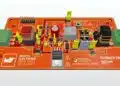










Kyocera AVX presents Antenna Integrator Studio (AIS) is a browser-based tool for selecting antennas and optimizing their integration into a PCB layout.
For design engineers, the value is in faster early-stage decisions: it combines placement constraints, antenna selection, and performance metrics in one workflow.
What AIS does
Kyocera AVX AIS is presented as a design aid for wireless products where antenna placement is often one of the hardest parts of the layout phase. The video shows how the tool helps engineers move from a board outline to candidate antenna recommendations with less trial and error.
The workflow is intended to support projects in IoT, automotive electronics, and industrial devices. In practice, that means it is aimed at teams that need to balance RF performance, mechanical constraints, and time-to-market.
Workflow overview
The tutorial starts with the PCB definition, which can be viewed and adjusted in both 2D and 3D. The example board is set to 125 mm by 45 mm, and restricted zones are added to represent component keep-outs or other placement constraints.
A second stage defines the antenna requirements. In the example, two antennas are needed: one for 5G and one for GPS, which shows that AIS is not only for single-antenna products but also for multi-radio designs.
Board and constraint setup
The video shows the following setup steps:
- Define the PCB shape and dimensions.
- Add restricted zones for placement-sensitive areas.
- Use those zones to reflect nearby components, such as microcontrollers or other layout limitations.
This is useful because antenna performance often changes significantly when metal, digital noise sources, or enclosure boundaries are nearby. A tool that forces these constraints into the early layout stage can reduce later redesigns.
Antenna selection logic
For the 5G antenna, the tutorial selects linear polarization, sets clearance to any, and chooses radio protocol and region settings. For the GPS antenna, right-hand circular polarization is selected, GNSS is chosen as the protocol, and the band selection is narrowed to GPS only.
That filtering matters because it keeps the design search focused on antennas that actually match the application rather than presenting a generic catalog list. For purchasing and design teams, that can shorten the gap between an electrical requirement and a usable part shortlist.
Antenna selection parameters
| Parameter | Example in video | Practical meaning |
|---|---|---|
| Polarization | Linear for 5G, RHCP for GPS | Must match the intended wireless system. |
| Clearance | Any | Gives flexibility for on-ground or off-ground placement. |
| Protocol | 5G, GNSS | Limits the antenna search to relevant radio families. |
| Region | EMEA, North America | Helps match deployment markets. |
| Optimization metric | Efficiency | Prioritizes the best radiated performance in the final recommendation. |
Optimization and results
The key optimization metric in the example is efficiency, although the tool also offers price and return loss as selectable decision criteria. Once launched, AIS automatically positions both antennas while respecting the configured restrictions and returns recommended Kyocera AVX antenna solutions.
The video also shows that the recommendation view includes supporting resources such as adaptation circuits, datasheets, DXF files, S-parameters, and simulation files. For engineers, this is important because an antenna is rarely selected on a part number alone; the surrounding implementation data often determines whether the design will work first time.
What can be reviewed
- Efficiency in percent or decibels.
- Peak gain.
- Return loss.
- 3D radiation patterns at different frequencies.
The ability to adjust frequency and inspect how the pattern changes is especially useful during early RF validation. It gives a practical view of how the antenna behaves across the band instead of relying on a single nominal point.
Design-in notes for engineers
AIS appears most useful when the team already knows the target radio function but still needs to make a robust mechanical and RF choice. In that situation, the tool can help compare candidate antennas against real placement constraints before the PCB is frozen.
A few practical takeaways stand out:
- Use the board outline and keep-out zones early, not after layout is nearly finished.
- Separate antenna selection by protocol and region to avoid wasting time on unsuitable parts.
- Review supporting files such as S-parameters and DXF data before committing to prototype build.
- Treat efficiency, return loss, and radiation pattern as complementary checks rather than a single pass/fail criterion.
For procurement teams, the mention of online sampling also matters. It suggests the workflow can move from virtual selection to prototype sourcing without leaving the manufacturer ecosystem.
Conclusion
AIS is a browser-based antenna selection and integration tool that combines PCB layout constraints, RF requirements, and result visualization in one workflow. Based on the tutorial, it is designed to reduce guesswork in antenna placement and help engineers move more quickly toward a validated prototype.
Source
This article is based on the KYOCERA AVX AIS tutorial video and its transcript, which describe the tool’s workflow, configuration options, optimization outputs, and related supporting files.