






This article, written by Vladimir Azbel, Ph.D., a semiconductor process reliability engineer consultant, delves into the significance of the metallic skeleton in tantalum anodes and explores the trade-offs between their performance and reliability in tantalum capacitors.
Maximizing of tantalum capacitor capacitance values within a fixed anode volume requires increasing specific surface area, which inherently reduces the characteristic interparticle neck size (X). At the same time, higher formation voltages increase dielectric thickness (d).
This work shows that these coupled effects lead to a critical increase in the structural parameter ψ = d/X, progressively constraining the conductive pathway of the metallic skeleton.
Using a physics-based thermal model /2/, it is demonstrated that this structural constriction results in a non-linear increase in local resistance and heat generation, ultimately triggering thermal instability and failure.
The analysis establishes that while capacitance is governed by surface area development, reliability is controlled by the structural integrity of the conductive network.
Introduction
In a tantalum capacitor design, the engineering objective is typically straightforward: maximize capacitance within a given case size and rated voltage.
This paradigm is often implicitly expressed as:
Process → Capacitance → Reliability
However, practical experience shows that capacitors with similar capacitance and ratings can exhibit significantly different leakage current (DCL) and breakdown voltage (BDV) behavior. Some devices remain stable, while others become failure-prone under stress.
This discrepancy indicates that capacitance alone does not fully describe the functional state of the anode. The origin of this inconsistency lies in porous materials.
While the manufacturing process defines nominal conditions (powder, pressing, sintering, formation), the resulting anode is a distribution of structural states, including variations in:
- interparticle neck geometry
- effective conductive cross-section
- internal stress distribution
This leads to a fundamental principle of powder metallurgy:
Even for a fixed process, the resulting structure is a distribution of states: neck geometry, effective conductive cross‑section, internal stresses, and local defects vary throughout the anode.
Process ≠ Structure
The tantalum anode is a porous sintered body. In such materials, we must distinguish between:
- The structure: actual network of pores and metallic interparticle necks, their sizes, and distribution.
- The process: powder grade, pressing, sintering, formation conditions.
Electrical behavior is governed not by process labels, but by the actual conductive network formed inside the anode.
Beyond the Classical Capacitance Model
The relation proposed by Lessner /1/ describes capacitance formation:
with
C – capacitance,
Vr – rated voltage,
Vol – anode volume,
A/Vol – internal surface area per volume,
d – dielectric oxide thickness,
K – relative dielectric constant,
ε₀ – permittivity of free space.
This equation correctly defines the required surface area to achieve a given capacitance. However, it is blind to the structural conditions required for stable current transport.
In practice:
- Increasing capacitance → requires higher A/Vol → leads to smaller neck size (X ↓)
- Increasing voltage → requires thicker oxide → increases d
Thus, two opposing structural trends emerge simultaneously:
- reduction of X (geometric thinning of the conductive skeleton)
- increase of d (dielectric consumption of the conductive path)
The Double Constriction Effect
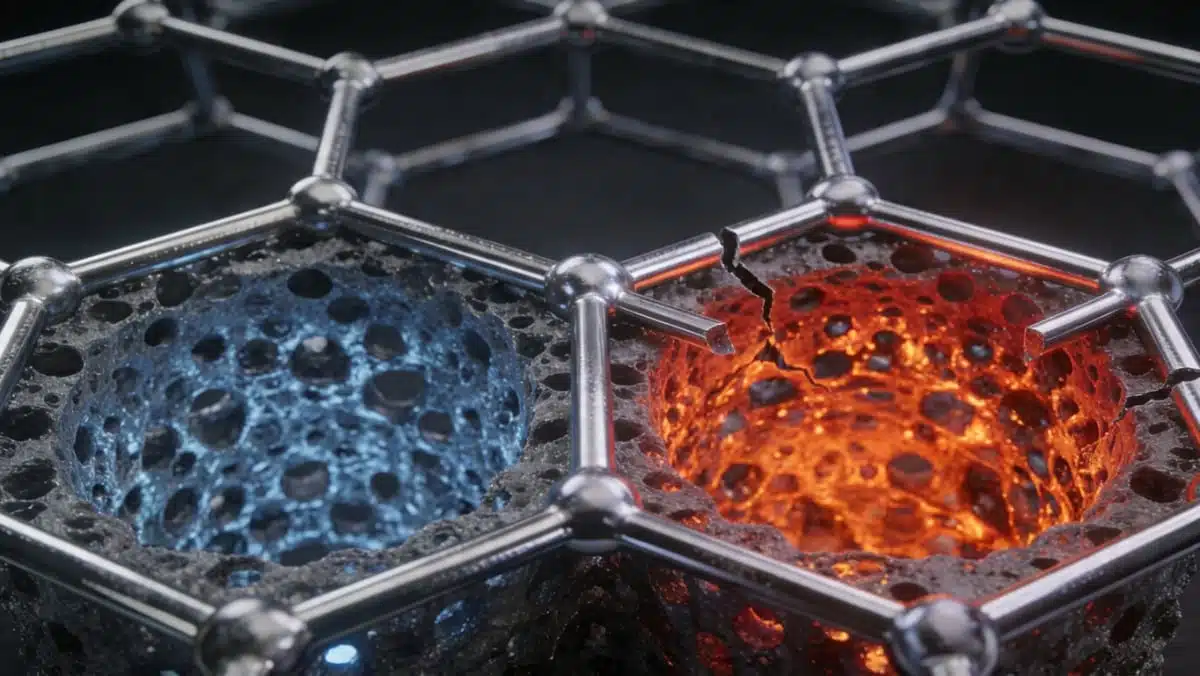
These two trends act in the same direction, creating a double constriction of the metallic skeleton:
- geometric constriction (X ↓)
- dielectric constriction (d ↑)
To quantify this interaction, a dimensionless structural parameter is introduced:
where
d – dielectric oxide thickness,
X – characteristic interparticle neck size.
ψ measures how much of the neck has been “eaten” by oxide relative to its original size. As capacitance is increased (by higher A/Vol → smaller X) and rated voltage is raised (→ larger d), ψ grows and the conductive pathway becomes progressively more constrained. Thus, as ψ increases, the effective metallic cross‑section shrinks, causing:
- Higher local electrical resistance in the neck.
- Stronger localization of current.
- Enhanced local heat generation.
ψ thus forms a bridge from geometrical design parameters (CV/g, formation voltage) to the physical mechanisms of thermal instability and failure.
Structural Meaning of ψ
Unlike Equation (1), which treats A/Vol and d independently, ψ links them through the physical geometry of the conductive channel.
As capacitance and voltage increase:
- A/Vol ↑ → X ↓
- d ↑
- therefore ψ ↑
This leads to:
- increased local resistance (Rₙₑcₖ)
- current localization
- enhanced local heat generation (Wₐ)
Thus, ψ acts as a bridge between design parameters and failure physics.
Experimental Evidence
Experimental data confirm that increasing capacitance leads to structural refinement:
- Powder level: BET increases nonlinearly with CV/g
- Sintered anodes: capacitance correlates with reduced neck size
This establishes a key structural relationship:
A/Vol↑→X↓
Capacitance growth is therefore achieved by thinning the conductive network, not by neutral structural scaling.
Physical Mechanism: Hot Spot Formation
The interparticle neck in the porous structure acts as a bottleneck for current transport. During anodization, part of its cross‑section is consumed by oxide growth. The effective metallic radius can be approximated as:
As ψ grows, the remaining metallic core shrinks. According to Joule’s law, local heat generation in the neck region is:
In first order, heat generation is inversely proportional to the square of the effective cross‑section. Even modest leakage currents can thus produce significant localized heating when ψ approaches critical values.
This leads to classical hot spot behavior:
- Local temperature rise increases dielectric conductivity.
- Current concentrates even more into the hot region.
- Additional heating accelerates degradation.
- Dielectric breakdown follows.
This leads to a positive feedback loop:
temperature rise → increased conductivity → current concentration → further heating → dielectric breakdown
This is the hot spot mechanism linking structure to failure.
Reliability Thresholds
Based on experimental observations and thermal modeling, three regimes can be defined:
Stable Region (ψ < 0.25)
- uniform current distribution
- effective heat dissipation
- stable BDV and low DCL
Critical Region (ψ ≈ 0.25–0.30)
- high thermal sensitivity
- latent instability
- DCL fluctuations under stress
Failure Region (ψ > 0.30)
- severe current localization
- overheating
- high probability of dielectric breakdown
Design Implications
Although ψ is not directly specified in datasheets, its implications are clear:
- highest CV in smallest case size → structurally aggressive design
- combination of high capacitance + high voltage → increased ψ
- margin in volume or derating → improved structural stability
Thus, conventional reliability practices (derating, thermal margin) gain a structural interpretation.
Thermal Model as a Design Tool
To translate structural effects into engineering parameters, a thermal model of the anode is used /2/.
The model links:
structure → Rneck → heat generation → thermal balance (Δ) → reliability
This enables:
- early-stage design evaluation
- overheating risk prediction
- optimization of BET vs. X vs. formation voltage
Importantly, this approach allows designers to move from empirical trial-and-error to predictive structural design.
Conclusion
Equation (1) remains valid for describing capacitance formation, but it does not capture the structural limitations governing current transport. This work shows that capacitance optimization inherently drives:
- reduction of interparticle neck size (X ↓)
- increase of dielectric thickness (d ↑)
These effects act simultaneously, progressively constraining the conductive pathway of the metallic skeleton. The introduction of ψ = d/X provides a quantitative measure of this constraint and establishes a direct link between structure and failure physics. As ψ increases, local resistance and heat generation rise, leading to thermal instability and dielectric breakdown.
A key outcome of this work is the identification of structural reliability regimes, enabling early detection of overheating risk before electrical testing. The proposed approach transforms the classical capacitance relation into a structure-aware reliability framework, supported by thermal modeling and physical interpretation.
Final Statement
Reliability is not a purely electrical outcome — it is a structural property of the anode.
References
[1] P. Lessner, “Specific Capacitance and Formation Physics in Tantalum Capacitors”
https://www.philiplessner.com/blog/8
[2] V. Azbel, “Virtual Anode Thermal Model”
DOI: 10.5281/zenodo.19482660