
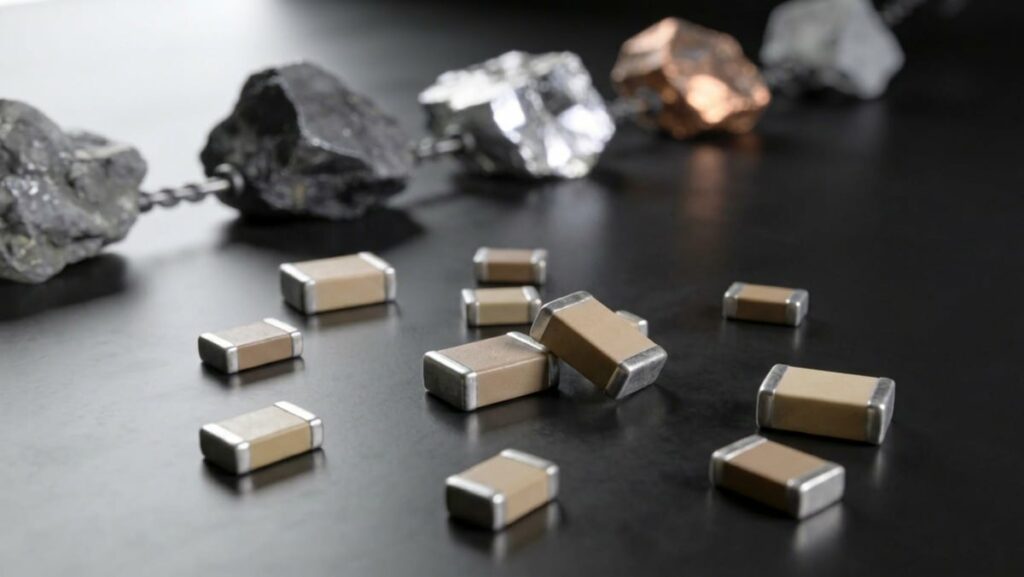
Japan-based Murata Manufacturing, the world’s leading supplier of multilayer ceramic capacitors, is moving to structurally separate its China-related rare earth supply chain from the rest of its global operations over the next three years.
This strategic shift comes amid rising geopolitical risks and tightening Chinese export controls on critical minerals and dual-use materials.
Strategic Supply Chain Realignment
According to recent reports, Murata plans to establish distinct rare earth material supply chains for the U.S. and China, effectively ring‑fencing its China-based operations from its broader global business. The initiative aims to reduce exposure to regulatory and geopolitical shocks while maintaining stable component deliveries to key customers in smartphones, data centers, automotive, and industrial markets.
Murata has been working on this dual‑track strategy since around 2020, when President Norio Nakajima began steering the company toward supply chain structures better aligned with diverging U.S.–China policy environments. The current acceleration reflects heightened concern over China’s use of rare earth export controls as strategic leverage.
Qualification of Non‑Chinese Rare Earth Sources
As part of its decoupling plan, Murata is actively evaluating rare earth materials sourced outside China, including mining and refining routes controlled by non‑Chinese entities. This multi‑year process involves:
- Identifying and auditing alternative mining projects and refining partners outside China
- Verifying refining process stability, quality, and long‑term capacity commitments
- Securing downstream customer approval for MLCCs made with new material sources
Murata expects this full qualification cycle to take roughly three years, though internal statements indicate the company is working to compress timelines where possible. At the same time, executives acknowledge that fully replacing Chinese-origin rare earths may not be technically or economically feasible in the near term, given China’s dominant position in refining and magnet‑grade material production.
Impact on Murata’s China Business and Competitive Landscape
Murata’s pivot comes as its revenue exposure to China is already trending downward. China’s share of the company’s total revenue has reportedly fallen from about 60% in 2021 to just under half in the latest fiscal year, partly due to smartphone and electronics production shifting to other Asian locations. Despite this decline, China remains a core manufacturing hub for iPhones and other high‑volume applications that depend heavily on Murata’s MLCC portfolio.
Competitive pressure from Chinese MLCC manufacturers is also intensifying. Murata continues to hold a leading position in high‑end MLCC technologies and maintains a technological lead estimated at around a decade versus key Chinese rivals, but management has warned that this gap could narrow. Contributing factors include active recruitment of experienced engineers from Japanese and Korean component makers by Chinese competitors, as well as strong domestic policy support for local supply chain build‑out.
Broader Japan–U.S. Critical Materials Cooperation
Murata’s actions are unfolding against a backdrop of wider Japanese and U.S. efforts to secure non‑Chinese sources of critical minerals, including rare earths, lithium, and copper. Reports indicate that the two governments are preparing joint initiatives to develop upstream mining and midstream refining capacity, with participation from major Japanese trading houses such as Mitsui & Co. and Mitsubishi Materials.
These programs build on over a decade of Japanese policy experience in diversifying rare earth supply, including partnerships with producers in Australia and Southeast Asia. For downstream component manufacturers like Murata, this emerging ecosystem of allied supply is expected to provide additional options as they redesign their material sourcing strategies away from single‑country dependence.
Implications for the MLCC and Electronics Industry
Murata currently supplies roughly 40% of the global MLCC market, making its supply chain decisions systemically important for electronics manufacturing. MLCCs are critical to power management and signal integrity in devices ranging from smartphones and notebooks to servers, EVs, and advanced driver‑assistance systems, so any disruption in rare earth inputs can have cascading effects across multiple end markets.
By proactively restructuring its rare earth supply chains and qualifying alternative sources, Murata is seeking to:
- Reduce vulnerability to sudden export restrictions and licensing delays
- Improve long‑term visibility on material costs and availability
- Align more closely with customer and governmental requirements on supply chain resilience and national security
For OEMs and EMS providers, Murata’s three‑year roadmap provides a clearer planning horizon for product design, sourcing strategies, and inventory risk management in an era of persistent geopolitical uncertainty.
Source
This article is based on information from TrendForce News coverage of Murata Manufacturing’s rare earth supply chain strategy, which cites reporting from Financial Times and Nikkei, complemented by additional publicly available analysis on global rare earth supply dynamics and Japan–U.S. critical minerals cooperation.
References
- TrendForce – MLCC Giant Murata Reportedly to Decouple China Rare Earth Supply in 3 Years as Risks Rise
- Financial Times – Apple supplier Murata starts US–China rare earths decoupling
- Nikkei – Japan to provide rare-earth refining tech to Malaysia
- S&P Global / Platts – Rare earth supply bottlenecks set to persist in 2026
- EU Parliament Think Tank – China’s rare-earth export restrictions
- TrendForce – China’s Rare Earth Export Restrictions Sound Alarm for Global Tech Industry

