
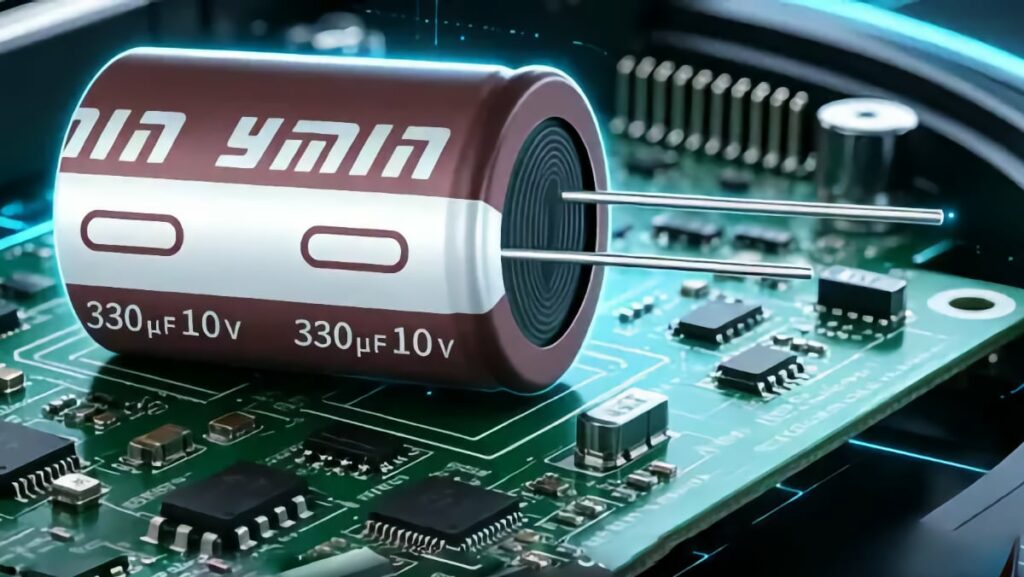
High‑speed cordless vacuum cleaners and robot sweepers are pushing their brushless motors and motor control electronics to the limit, especially on the DC‑link bus of the drive board. YMIN’s LMM, LK and NPX low‑ESR aluminum electrolytic capacitors target exactly this node, addressing chronic field failures caused by ripple heating, vibration and aggressive miniaturisation in smart home appliances.
Key features and benefits
- Designed for high‑frequency brushless motor drives: LMM, LK and NPX series are positioned as DC‑link capacitors on motor drive boards for high‑speed brushless motors in vacuum cleaners, robot sweepers and similar smart appliances, where switching frequencies can reach the hundreds of kilohertz and ripple currents are high.
- Low ESR electrolyte system: The series use a new electrolyte formulation that reduces equivalent series resistance and lowers capacitor case temperature rise by approximately 15–20 degrees Celsius under extreme high‑ripple load compared to conventional solutions, improving lifetime and reducing dry‑out risk.
- High ripple current capability: Typical application data quoted by the manufacturer shows ESR values in the tens of milliohms and ripple current ratings up to several amperes RMS at 100 kilohertz and 105 degrees Celsius, enabling the capacitors to handle bus ripple and motor start/stop surge currents in the 10 ampere plus range without excessive voltage droop or self‑heating.
- Shock‑resistant construction: Thickened leads and a reinforced internal mechanical structure are used to withstand the high‑frequency vibration environment such as handheld vacuum cleaners and robot sweepers; the manufacturer reports zero failures and minimal parameter drift in high‑frequency vibration testing, addressing typical field issues such as lead breakage and internal core loosening.
- Miniaturised radial packages: The recommended parts offer high capacitance density in small radial cans, with typical 330 microfarad devices in case sizes down to 6.3 by 11 millimetres, allowing designers to meet thin and compact PCB requirements without sacrificing energy storage on the DC bus.
Typical applications
YMIN positions the aluminum electrolytic capacitors specifically for high‑speed smart appliance drives, but the underlying feature set is relevant to a broader range of compact motor control designs.
- High‑speed cordless vacuum cleaner motor drives on the DC‑link bus, where repeated start/stop and variable speed operation drive high ripple and surge currents.
- Robot sweeper and robotic vacuum cleaner motor control boards, including brushless suction motors and fan stages, which combine high mechanical vibration with stringent space constraints.
- High‑speed hair dryers and other premium smart home appliances using compact high‑RPM brushless motors, with similar DC‑link and vibration profiles.
- Other compact high‑frequency inverter stages in consumer products where designers need small, low‑ESR radial aluminum electrolytics for DC‑link or bulk decoupling under vibration, according to the manufacturer’s application guidance.
In a typical motor drive, these components sit directly on the DC bus after rectification or battery connection, where they absorb ripple, stabilise bus voltage and provide instantaneous energy during motor events such as start, stop, reversal and stall.
Technical highlights
The press release provides a consolidated example for one representative value (330 microfarad) across the three series, illustrating how the mechanical format and performance parameters map to different design trade‑offs.
Example series data (330 µF class)
| Series | Rated voltage (V) | Capacitance (µF) | Case size D×L (mm) | ESR at 100 kHz (mΩ) | Ripple current at 105 °C (mA RMS) |
|---|---|---|---|---|---|
| LMM | 50 | 330 | 8 × 16 | 44 | 415 |
| LK | 50 | 330 | 10 × 12.5 | 40 | 875 |
| NPX | 35 | 330 | 6.3 × 11 | 40 | 2600 |
According to the manufacturer, all three series use low‑ESR electrolytes, but differ in voltage rating, can geometry and ripple capabilities, allowing designers to trade height, diameter and voltage margin for ripple performance and layout fit.
Low ESR and thermal behaviour
- The low ESR electrolyte reduces conduction losses in the capacitor, which in turn reduces internal power dissipation and case temperature rise under high ripple loading.
- YMIN reports that under comparable “extreme full load” ripple conditions, the case temperature rise of the recommended capacitors is approximately 15–20 degrees Celsius lower than that of conventional aluminum electrolytic capacitors used in the same vacuum cleaner motor drive design, which directly supports longer service life and improved stability of capacitance and ESR over time.
In practical terms, lower ESR means the DC‑link voltage remains more stable during high‑current events such as motor start, stop and stall, reducing the risk of microcontroller resets due to bus voltage sag.
Vibration robustness and mechanical design
- To address lead breakage and internal movement under vibration, the capacitors employ thickened leads combined with a reinforced internal core fixing and lead soldering process, which helps maintain mechanical integrity and electrical parameters during high‑frequency vibration exposure.
- The manufacturer notes that these construction measures led to zero failures and extremely low parameter drift during high‑frequency vibration testing in actual appliance projects, where previous standard capacitors suffered from lead fractures and internal loosening.
In handheld vacuum cleaners and robot sweepers, this is particularly relevant because the motor and body vibration can excite the capacitor leads and internal structures at the switching frequency and at mechanical resonance frequencies.
Miniaturisation and capacitance density
- The LMM, LK and NPX series use what YMIN describes as high‑capacity density miniaturised packaging; for example, a 50 volt, 330 microfarad LK device is given as 10 by 12.5 millimetres, while an LMM device with the same rating is listed in an 8 by 16 millimetre can, and an NPX 35 volt, 330 microfarad device fits into a 6.3 by 11 millimetre can according to the press release.
- This allows designers of thin, lightweight PCBs to fit DC‑link bulk capacitance into areas that previously could not accommodate conventional radial capacitors, helping maintain energy storage without sacrificing core component placement such as MOSFETs and control ICs.
The manufacturer positions this as a way to directly replace failed standard capacitors with smaller, lower‑loss parts in existing layouts of vacuum cleaner motor drives.
| Series | Example designation (per press release) | Notes |
|---|---|---|
| LK | 50 V / 330 µF / 10 × 12.5 | Radial lead, low ESR, high ripple capability, compact height |
| LMM | 50 V / 330 µF / 8 × 16 | Narrower diameter, suitable where board height is acceptable but width is constrained |
| NPX | 35 V / 330 µF / 6.3 × 11 | Very small can, high ripple current figure quoted in release, suited to lower bus voltages |
YMIN indicates that these series have been verified in production‑level designs for premium smart home appliances from brands such as Dreame, and recommends that engineers refer to the corresponding series datasheets and product pages for the full range of voltage, capacitance, tolerance and case size combinations.
For procurement, the company points to their website, authorised distributors and associated channels such as the supplier centre of major catalogues for detailed ordering information and sample requests.
Design‑in notes for engineers
For design engineers and component engineers working on high‑speed brushless motor drives, the key value of these capacitors is in solving three interacting problems on the DC‑link: ripple heating, vibration robustness and layout miniaturisation.
- Clarify DC‑link operating conditions: Quantify bus voltage, normal operating ripple current at the switching frequency and expected surge currents (start, stop, reversal, stall), then select the voltage rating and series (LMM, LK, NPX) that align with those conditions according to the manufacturer datasheet.
- Use ripple and ESR figures at realistic frequencies: The example data and Q&A in the press release reference ESR values in the tens of milliohms around 100 kilohertz and ripple current capabilities quoted at 105 degrees Celsius; when designing, ensure that calculations use the manufacturer’s specified frequency and temperature dependencies for ESR and ripple, not just 120 hertz base values.
- Check thermal margins at full load: Even with low ESR, high‑speed appliances can run the DC‑link capacitor close to its ripple rating; use the manufacturer’s thermal resistance and ripple curves to verify that case and core temperatures remain within the specified 105 degrees Celsius limit under worst‑case duty cycles.
- Account for vibration and mounting: The reinforced structures and thicker leads are designed to reduce failures in vibration tests, but PCB layout, soldering quality and mechanical fixing still matter; consider additional mechanical support such as glue dots or clamps where the motor or fan causes significant chassis vibration.
- Optimise geometry for layout: The three series differ in diameter and height for the same capacitance; LMM and LK provide alternative geometries at 50 volts, while NPX offers smaller cans at lower voltage, so placement can be tuned to fit around inductors, transformers and heat sinks without sacrificing capacitance.
- Plan for field reliability and replacements: The press release emphasises use as drop‑in replacements for standard capacitors that failed due to heat and vibration; in redesign or cost‑down projects, it may be advantageous to standardise on one of these series for the entire product family, verifying that service and spare parts can be supported over the product lifetime.
When in doubt about specific ratings or derating guidelines, engineers should consult the latest version of the YMIN datasheet and series overview documentation rather than extrapolate from the example figures given in the press release.
Source
This article is based on a manufacturer news release describing YMIN low‑ESR aluminum electrolytic capacitors for vacuum cleaner and robot sweeper motor drive boards, complemented by information from the corresponding YMIN product pages and series overviews provided on the same website.
References
- YMIN news article: Are the capacitors on your vacuum cleaner/robot sweeper motor drive board constantly failing? YMIN low‑ESR aluminum electrolytic capacitors solve heat generation, vibration, and space constraints.
- YMIN LK series radial lead aluminum electrolytic capacitors product page
- YMIN aluminum electrolytic capacitor product overview

