

Passive Components Blog has released the Annual Automotive Passive Components Technology Dossier, a 36‑page comprehensive analysis about automotive passive components and how these devices evolved in period from May 2025 to May 2026.
Overview
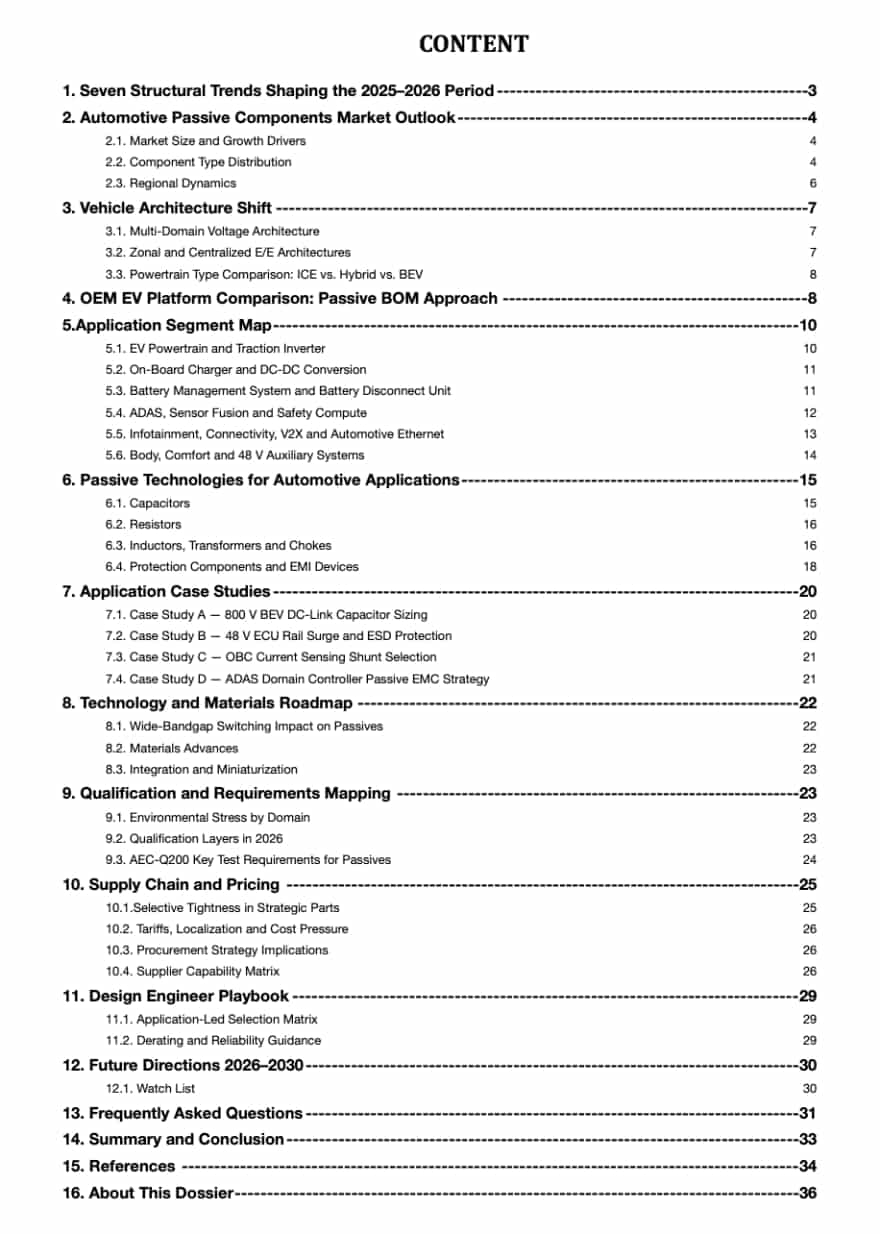
The Automotive Passive Components Technology Dossier is a comprehensive annual report focused on the fast-changing role of passive electronic components in automotive applications across the latest 12-month period. It explains how capacitors, resistors, inductors, transformers, EMC filters, and circuit protection devices are evolving from commodity support parts into strategic enablers of electric powertrains, ADAS, zonal electronics, infotainment, connectivity, battery systems, and 48 V architectures.
Unlike component-type dossiers that are organized primarily around capacitor, resistor, or inductor technology families, this dossier is structured by automotive application segment. That makes it particularly useful for engineers, sourcing teams, technical marketing, and product managers who need to understand which passive technologies matter most in traction inverters, on-board chargers, DC-DC converters, battery management systems, battery disconnect units, radar and camera modules, vehicle networking, and body electronics.
The report maps the latest automotive passive component trends over the past year, including the continued migration toward 800 V platforms, the impact of SiC and GaN wide-bandgap semiconductors on passive requirements, rising ADAS and domain-controller passive density, the increasing importance of functional safety and qualification, and the divergence between general-purpose passives and high-value automotive-grade segments. It also reviews key component stress factors such as voltage, temperature, vibration, EMI, thermal cycling, low ESL/ESR requirements, current sensing accuracy, and surge / transient robustness.
The dossier combines:
- Market and technology trend analysis for automotive passive components across the latest 12 months.
- Application-focused mapping of passive component requirements by vehicle subsystem.
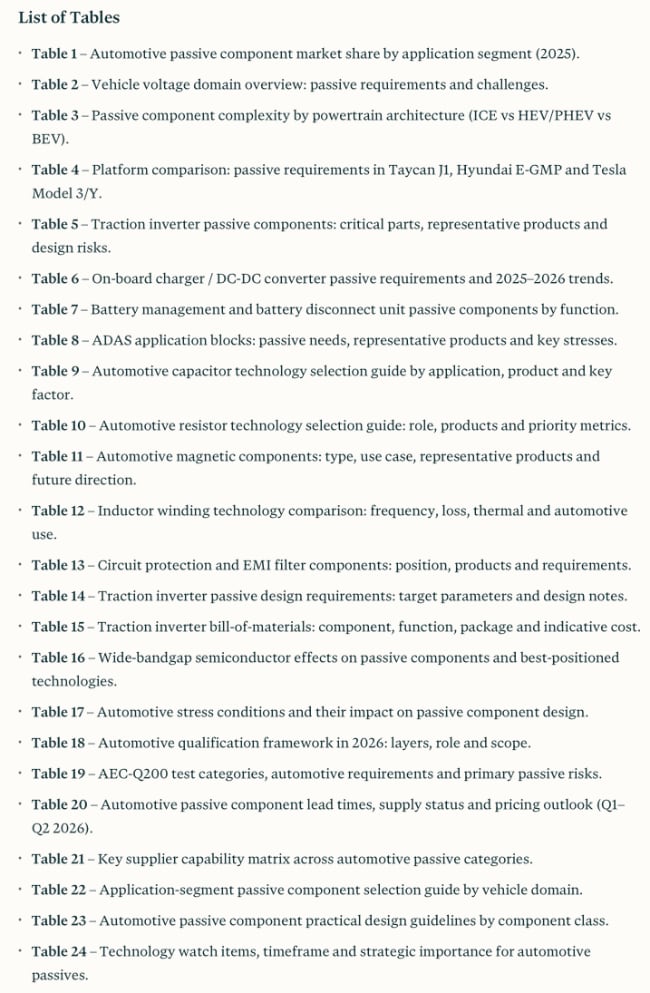
- Comparative tables of best-fit capacitor, resistor, magnetic, EMC, and protection technologies.
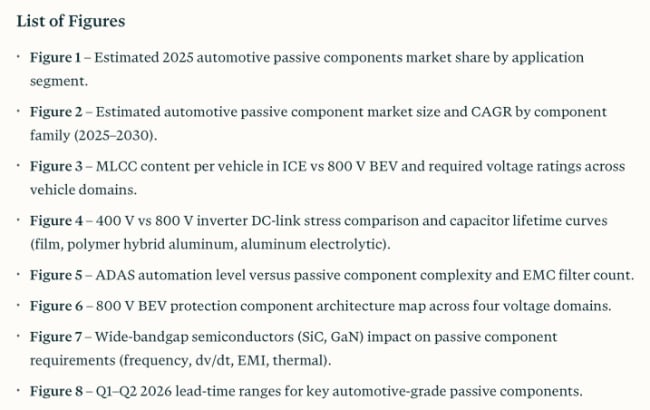
- Figures and visual summaries for EV architecture, ADAS complexity, wide-bandgap impact, supply-chain lead times, and automotive protection structures.
- Guidance on qualification, reliability, and forward-looking technology directions through 2026–2030.
What the dossier covers
Seven structural trends shaping automotive passive components requirements
- 800 V vehicle platforms and higher power OBC/DC‑DC stages are driving up voltage, ripple, and lifetime demands on DC‑link capacitors, magnetics, and protection devices.
- SiC and GaN wide‑bandgap semiconductors are increasing switching frequency and dv/dt, forcing lower‑ESL/ESR passives, better EMC filters, and new magnetic materials.
- ADAS, automated driving, and zonal/domain controllers are sharply increasing decoupling, filtering, current‑sense, and ESD/EMI passive density per ECU.
- Battery systems (BMS, BDU, contactors, pyroswitches) are creating new, safety‑critical roles for shunts, film capacitors, HV fuses, varistors, TVS, and PPTC devices.
- Automotive Ethernet, radar, camera, LiDAR, V2X and high‑speed links are pushing RF passives, CMCs, ferrites, and ultra‑low‑ESL capacitors to tighter specs.
- Qualification, reliability, and lifetime (AEC‑Q, ISO, LV standards, board‑level stress) are increasingly differentiating automotive‑grade passives from commodity parts.
- Supply chain, lead‑time, and supplier capability dynamics are reshaping which vendors can reliably support EV, ADAS, and next‑generation automotive programs.
Who should read it
- Automotive hardware and system architects responsible for EV powertrain, OBC/DC‑DC, BMS/BDU, ADAS, and zonal/controller architectures.
- Power, EMC, and hardware design engineers selecting capacitors, magnetics, resistors, EMC parts, and protection devices for automotive platforms.
- Component engineers, sourcing teams, and technical purchasers who need independent insight into automotive‑grade passives, lead times, and supplier positioning.
- Product managers and technical marketing staff at passive component manufacturers and distributors who want an application‑driven view of automotive demand.
Why it stands apart
Unlike generic market reports that stop at high-level market sizing, the Passive Components Technology Dossier:
- It is structured by automotive application domain (EV powertrain, OBC/DC‑DC, BMS/BDU, ADAS, networking, body/48 V) rather than by component type, reflecting how OEMs actually design vehicles.
- It connects market, technology, and qualification trends into concrete passive requirements and selection tables for each subsystem, rather than treating passives generically.
- It integrates the latest 12‑month EV, ADAS, WBG and supply‑chain developments into one dossier, providing an independent, component‑agnostic reference that can be used by both designers and decision‑makers.
Availability
The Annual Automotive Passive Components Technology Dossier is available now at 699 EUR exclusively from passive-components.eu as a paid download.
To learn more about other available dossiers and purchase your copy, visit the Technology Dossiers page on the passive-components.eu blog.

