
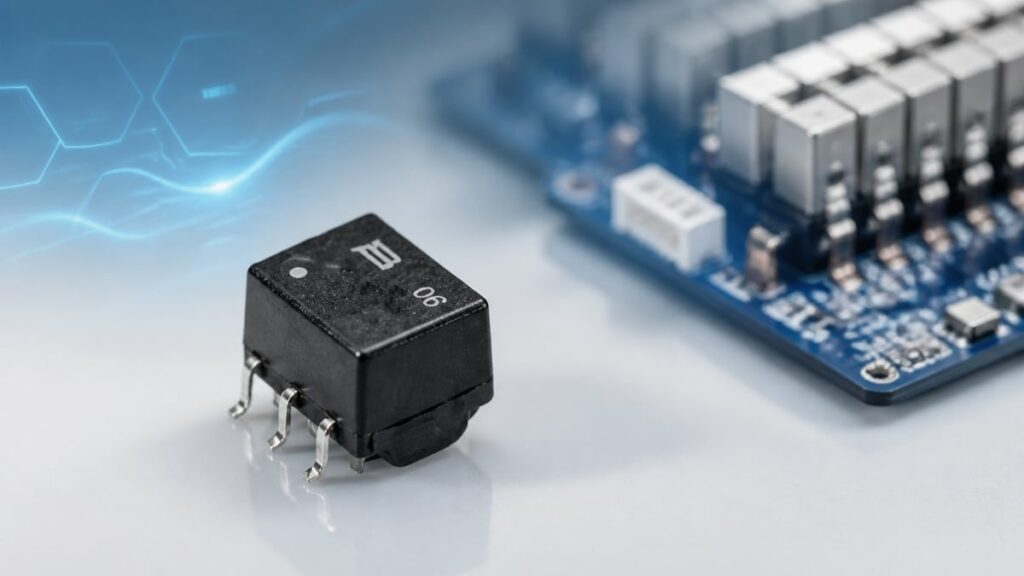
Bourns releases SM91572AL, a dedicated AEC‑Q200 compliant BMS signal transformer that combines functional insulation with integrated common mode chokes to simplify high‑voltage battery communication layouts.
Battery management systems in hybrid, electric vehicles and stationary energy storage are under pressure to deliver robust, noise‑immune communication between battery modules while meeting strict isolation and automotive reliability requirements.
This article summarizes the key features, use cases and design‑in considerations for engineers and component buyers evaluating this magnetic component for IsoSPI and daisy‑chain BMS implementations.
Key features and benefits
- Single‑channel functional insulation transformer designed specifically for battery management system communication paths in high‑voltage packs.
- Integrated common mode chokes built into the same magnetic component, eliminating separate choke parts and reducing the external filtering requirements for BMS communication lines.
- Pin auto‑termination to support robust signal handling and help prevent floating or unused pins from degrading communication integrity in noisy environments.
- Hi‑Pot rating of 3000 VAC for dielectric withstand, supporting isolation tests typically required in automotive and energy storage applications according to manufacturer datasheet.
- Working voltage specified as 1000 VDC, supporting battery packs in the hundreds of volts range with appropriate creepage and clearance design at system level.
- Automotive grade construction and qualification, compliant with AEC‑Q200 and RoHS Directive 2015/863 requirements according to manufacturer documentation.
- Optimized to work with popular BMS IC families from Analog Devices (LTC6804‑1, LTC681x), NXP (MC33771/MC33772) and Texas Instruments (BQ79616), helping shorten design cycles for IsoSPI and daisy‑chain interfaces.
- Reduction of bill‑of‑materials due to integration of common mode chokes, contributing to PCB area savings and a more compact BMS interface section.
Typical applications
The SM91572AL signal transformer is aimed at BMS communication and isolation rather than power conversion, and fits naturally in designs such as:
- Battery management systems for hybrid and electric powertrain systems, where multiple battery modules communicate over isolated serial links.
- High‑voltage traction battery packs in passenger cars, commercial vehicles and off‑highway equipment with centralized or distributed BMS architectures.
- Energy storage battery packs (stationary ESS, UPS, industrial battery banks) that use daisy‑chained monitoring ICs and require robust isolation between segments.
- BMS‑controlled charger interfaces where transformer‑isolated communication between pack and charger is implemented over serial links such as IsoSPI.
In these systems, the transformer provides the isolation barrier for high‑voltage battery segments while the integrated common mode chokes suppress noise that can otherwise disturb high‑speed serial communication over twisted pairs or PCB traces.
Technical highlights
The following table summarizes key technical points explicitly stated in the manufacturer release. For full, up‑to‑date values and tolerances, always refer to the official datasheet.
| Parameter | Value / Description |
|---|---|
| Model | SM91572AL |
| Function | Single‑channel functional insulation transformer |
| Integrated function | Common mode chokes in the same magnetic package |
| Hi‑Pot test level | 3000 VAC according to manufacturer datasheet |
| Working voltage | 1000 VDC according to manufacturer datasheet |
| Qualification | AEC‑Q200 automotive grade |
| Environmental compliance | RoHS Directive 2015/863 compliant |
| Target IC compatibility | LTC6804‑1, LTC681x, MC33771/MC33772, BQ79616 |
From a practical perspective, a Hi‑Pot of 3000 VAC indicates that the insulation system has been verified to withstand a significant test voltage applied between primary and secondary for a specified time without breakdown according to manufacturer procedure. A working voltage of 1000 VDC means the part is intended to operate with up to that DC potential across the isolation barrier under normal conditions, but system designers must still ensure creepage, clearance and PCB layout match their applicable safety standards.
The use of integrated common mode chokes is notable for high‑noise environments typical of automotive and energy storage systems, where fast switching in inverters, DC‑DC converters and relays can inject common mode disturbances onto communication lines. Keeping the chokes physically close to the transformer helps maintain tight coupling of the communication path and can reduce the loop area exposed to interference.
Design‑in notes for engineers
When integrating the SM91572AL into a BMS communication path, a few practical design considerations can help achieve robust performance.
- Place the transformer as close as practical to the associated BMS IC pins and connector to minimize the length of high‑impedance signal traces and reduce susceptibility to noise.
- Exploit the integrated common mode chokes by avoiding redundant discrete chokes unless required by specific EMC test constraints, thereby simplifying layout and reducing parasitic elements.
- Follow the recommended application schematics from Analog Devices, NXP and Texas Instruments reference designs for LTC681x, MC33771/MC33772 and BQ79616 to ensure the transformer connections and pin auto‑termination are used correctly.
- Respect the specified working voltage and Hi‑Pot limits in the overall insulation coordination analysis, including creepage and clearance distances on the PCB, conformal coating and spacing to other high‑voltage elements.
- Consider worst‑case transients, surge and fault conditions in the battery pack, and verify that system‑level protection (TVS devices, filters, shielding) complements the isolation provided by the SM91572AL rather than overstressing it.
- Plan for validation in full vehicle or pack EMC testing, where radiated and conducted emissions and immunity are checked; the integrated chokes and transformer are central components in maintaining communication integrity under such tests.
For engineers migrating existing IsoSPI or daisy‑chain designs that used discrete transformers and separate common mode chokes, the SM91572AL offers a path to reduce part count while keeping isolation and EMI performance under control, but pinout and footprint changes must be reviewed carefully during PCB redesign.
Source
This article is based on information provided in an official Bourns new product release for the SM91572AL automotive grade BMS signal transformer and associated technical documentation on the manufacturer website.
References
- Bourns SM91572AL automotive grade BMS signal transformer press release
- Bourns official website – magnetics and automotive product information

