
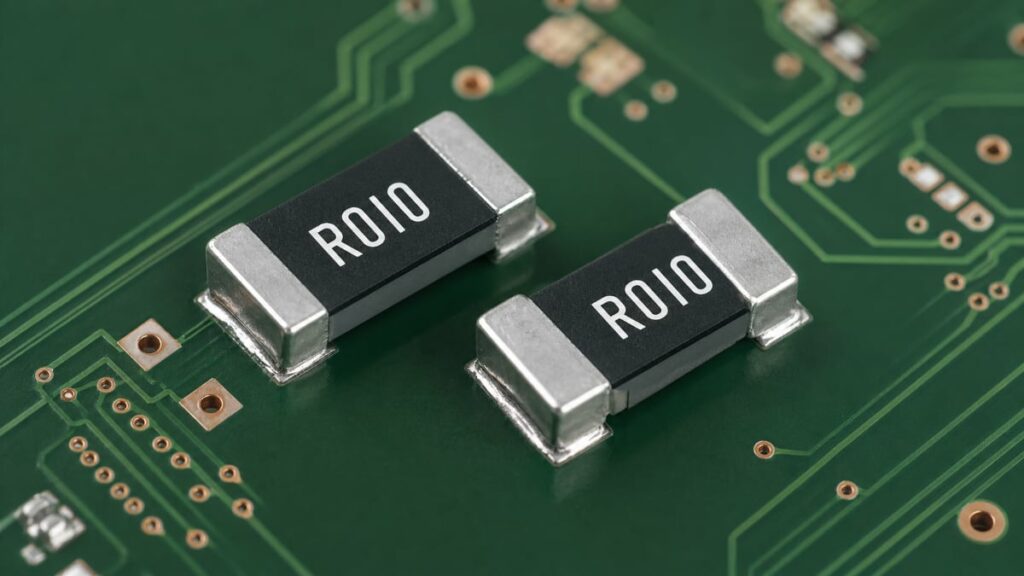
Stackpole Electronics has expanded its CSSU high‑power metal alloy current sense resistor series with new 0.5 mΩ and 20 mΩ values in the familiar 2512 SMD package.
These additions give power electronics designers more flexibility to optimize measurement accuracy, losses, and board space in high‑current circuits.
Key features and benefits
- High power handling in 2512 footprint
The CSSU series is rated up to 5 W in a standard 2512 surface‑mount package, allowing designers to sense large currents without moving to oversized or custom footprints. - Very low resistance option: 0.5 mΩ
The new 0.5 milliohm value minimizes voltage drop and power dissipation in the shunt, which helps improve overall efficiency in high‑current rails and battery paths. - Higher resistance option: 20 mΩ
The added 20 milliohm value increases the sense voltage for a given current, easing the requirements on measurement circuitry and improving resolution in lower‑current ranges. - Metal alloy current sensing technology
The metal alloy construction is designed for low TCR, stable resistance over time, and robust performance under thermal and mechanical stress typical of power electronics. - AEC‑Q200 qualification
AEC‑Q200 qualification makes the CSSU series suitable for automotive ECUs and other applications where formal reliability and stress testing is required. - Support for high power density designs
Being able to dissipate up to 5 W in a 2512 footprint allows higher power density and can reduce the need for parallel shunts or larger packages.
Typical applications
The CSSU current sense resistor series targets demanding current sensing tasks in modern power and battery systems. Typical uses include:
- Battery management systems (BMS) in EVs, industrial battery packs and energy storage systems, where accurate shunt measurement is needed for charge and discharge control.
- Automotive electronics, including ECUs, power distribution modules, on‑board chargers and DC‑DC converters that must meet automotive qualification standards.
- Motor drives and motion control, where phase and bus current monitoring is essential for protection and control loops.
- Industrial power supplies and DC‑DC converters, from server and telecom supplies to industrial automation PSUs.
- Renewable energy equipment such as inverters and charge controllers, where high DC currents and elevated temperatures are common.
- General high‑current power control systems that need compact, reliable current sensing in the main power path.
Technical highlights
The press release emphasizes the following core technical aspects of the CSSU current sense resistor series:
- Package size: 2512 SMD footprint, supporting up to 5 W power dissipation according to the manufacturer.
- Resistance values: Expanded range now includes 0.5 mΩ and 20 mΩ options; additional values are available in the broader CSSU portfolio as per the datasheet.
- Power rating: 5 W continuous power capability in 2512, enabling design‑ins where significant current and associated heat must be managed.
- Technology: Metal alloy current sense element designed for low resistance, low TCR and long‑term stability in power electronics environments.
- Qualification: AEC‑Q200 qualified series, supporting use in automotive and other high‑reliability applications.
- Stability and robustness: The product family is described as combining low resistance, low TCR and excellent long‑term stability, which is important when shunt value drift would impact current measurement accuracy.
In practice, low resistance values such as 0.5 mΩ are used where the designer wants to minimize measurement losses and voltage drop on the bus, while values like 20 mΩ are often chosen when higher measurement voltage is needed for precise sensing or when operating currents are lower. Exact derating curves, TCR values and resistance range should be taken from the manufacturer’s datasheet.
Example selection table
The following illustrative table shows how the two new resistance values map to typical current ranges and sense voltages. Actual limits and ratings must be verified against the manufacturer datasheet and application conditions.
| CSSU value | Typical current range example | Sense voltage behavior (qualitative) | Typical use focus |
|---|---|---|---|
| 0.5 mΩ | High currents (tens to hundreds of amps, depending on layout and cooling) | Very low voltage drop, minimized measurement losses | Main battery bus, high‑current DC link |
| 20 mΩ | Lower to moderate currents where resolution matters more than minimal drop | Higher sense voltage for a given current | Precision sensing, lower‑current rails |
Design‑in notes for engineers
- Define current range and power budget early
Start by estimating peak and continuous current through the shunt and the allowable voltage drop. Use the CSSU 5 W rating in combination with ambient temperature and PCB thermal design, as documented by the manufacturer, to select a safe value. - Choose resistance to balance losses vs. measurement resolution
Use lower resistance values like 0.5 mΩ for high‑current paths where efficiency and bus voltage integrity are critical. Consider higher values like 20 mΩ when working with lower currents or when the measurement circuitry benefits from a larger sense voltage. - Check AEC‑Q200 and application environment
If the design is automotive or subject to similar stress profiles, take advantage of the AEC‑Q200 qualification and verify that the chosen CSSU variant and mounting meet the requirement profiles for shock, vibration and temperature cycling. - Layout for thermal performance and accuracy
Place the CSSU resistor to allow good copper area for heat spreading, and route Kelvin sense connections (where applicable) to minimize error due to track resistance. Observe manufacturer guidance on pad design and solder fillet to achieve the claimed 5 W performance. - Consider measurement front‑end design
Ensure that the downstream measurement circuitry (op amp or dedicated current sense IC) is designed for the expected sense voltage range and common‑mode voltage. The new 20 mΩ option can help when sense voltage is otherwise too small for robust measurement. - Consult datasheet for detailed limits
For exact resistance range, tolerance, TCR values, pulse handling and derating, refer to the latest CSSU series datasheet and application notes. This is especially important when pushing the component towards the upper end of its power and temperature envelope.
Source
This article is based on information provided in the official Stackpole Electronics press release announcing the expansion of the CSSU high‑power metal alloy current sense resistor series, complemented by general engineering context for current sensing design.
References
- Stackpole CSSU series press release – expansion with 0.5 mΩ and 20 mΩ values
- Stackpole Electronics official website

