






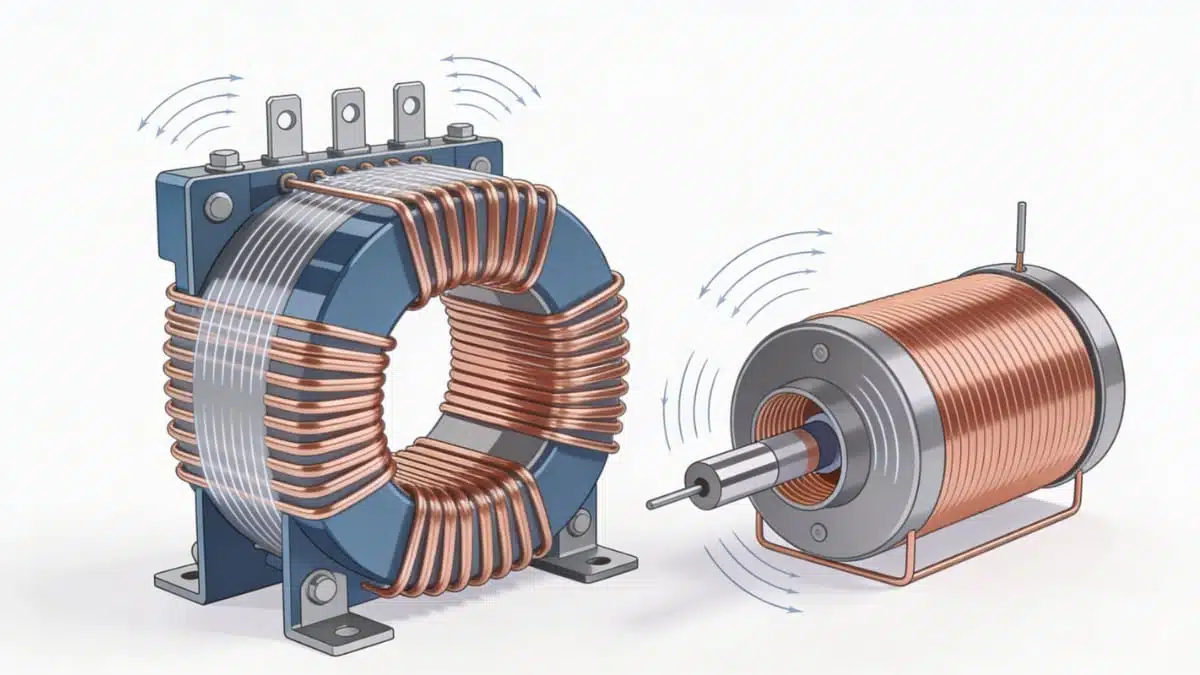
This article provides a practical introduction to how transformers and solenoids work, their key equations, parasitic effects, and typical applications for design engineers and advanced students.
Transformers and solenoids use magnetic fields for different purposes: transformers couple electrical circuits, while solenoid actuators convert electrical input into mechanical motion. This article explains their operating principles, key equations, winding effects and practical limits, with design and selection guidance for engineers working on power supplies, signal interfaces, valves and locking mechanisms.
Key Takeaways
The ideal relationships provide a starting point, but practical selection depends on magnetic, electrical, thermal and mechanical limits.
- A transformer’s induced voltage ratio follows its turns ratio, while its load-current ratio is inverse. These relationships require consistent winding polarity and current-reference conventions.
- Impedance referred from secondary to primary scales with the square of the primary-to-secondary turns ratio. Resistance and inductance follow that rule; an equivalent capacitance scales inversely.
- Applied winding volt-seconds determine the change in core flux. Ending a voltage pulse does not automatically reset flux or magnetizing current.
- Leakage inductance, interwinding capacitance and AC winding loss depend strongly on construction. Improving one parameter can worsen another.
- Solenoid selection requires force or torque over the required travel, not holding force alone. Coil temperature, duty cycle, supply tolerance and the return mechanism determine operating margin.
- DC solenoid drivers need a controlled current-decay path. Peak-and-hold control can reduce holding losses, while a higher-voltage clamp can shorten release time.
What is a transformer?
A transformer transfers electrical energy between magnetically coupled winding circuits using changing magnetic flux. It can step voltage up or down, provide a nominally unchanged voltage, transform impedance or provide electrical isolation when its construction and insulation are designed for that purpose.
The following discussion concerns conventional two-winding transformers. An autotransformer uses a shared winding and does not provide galvanic isolation. Mains-frequency power transformers, switched-mode power-supply transformers, signal transformers and current transformers share basic laws but have different loss, bandwidth, insulation and reset requirements. A flyback magnetic component requires separate treatment because its intended function includes energy storage. [1]
Ideal transformer and basic equations
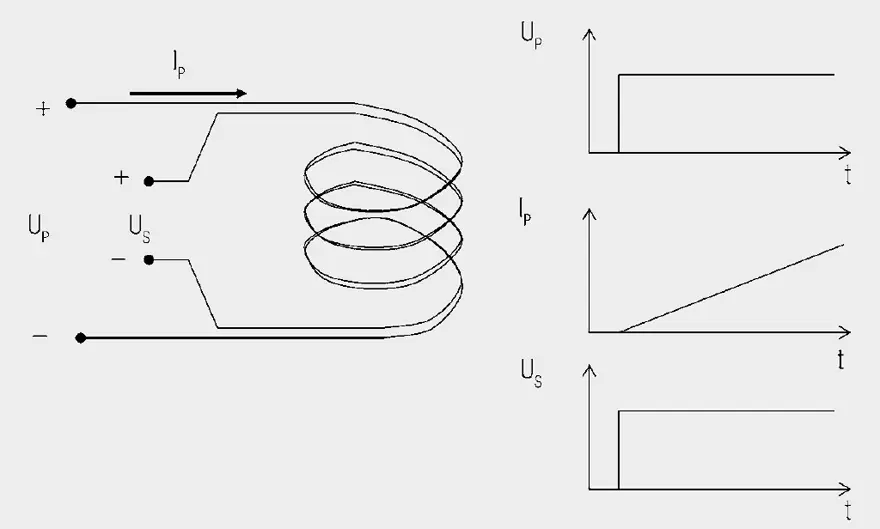
Begin with the nominal 1:1, open-secondary arrangement in Figure 1. An ideal transformer has perfect coupling, no losses and no magnetizing-current requirement; a more useful first practical model adds a finite magnetizing inductance across its primary.
Let NP and NS denote the primary and secondary turn counts. Define the primary-to-secondary turns ratio a by Eq. (1).
Let Φ be the shared core flux in webers, t the time in seconds, and uP and uS the induced winding voltages in volts. With both voltages referenced in corresponding winding-polarity directions, Faraday’s law gives Eq. (2). These are winding-voltage relations; resistance and leakage-voltage drops must be included when relating them to loaded terminal voltages. [1]
Because both windings link the same changing flux in the ideal model, Eq. (2) produces the voltage transformation in Eq. (3). This relationship is not restricted to sinusoidal excitation.
In the finite-inductance model, Lm is the primary-referred magnetizing inductance in henries and im is its current in amperes. For an approximately linear magnetic circuit, neglecting winding resistance and core loss, Eq. (4) relates the applied winding voltage to magnetizing-current slope.
A constant voltage pulse therefore produces an approximately linear current ramp while Lm remains approximately constant. Near saturation, this approximation fails and current can rise much more rapidly. With the secondary open, the simplified lossless model draws only magnetizing current; a real transformer also draws current associated with core loss and has winding loss. No useful power reaches an open secondary. [1, 2]
Current, power and impedance transformation
Connecting a load causes secondary current and an additional primary load-current component. The current transformation follows from opposing load ampere-turns, while the ideal transformer conserves instantaneous power.
For a secondary load resistance RL in ohms, the load current iS follows Eq. (5). Figure 2 shows the loaded arrangement.
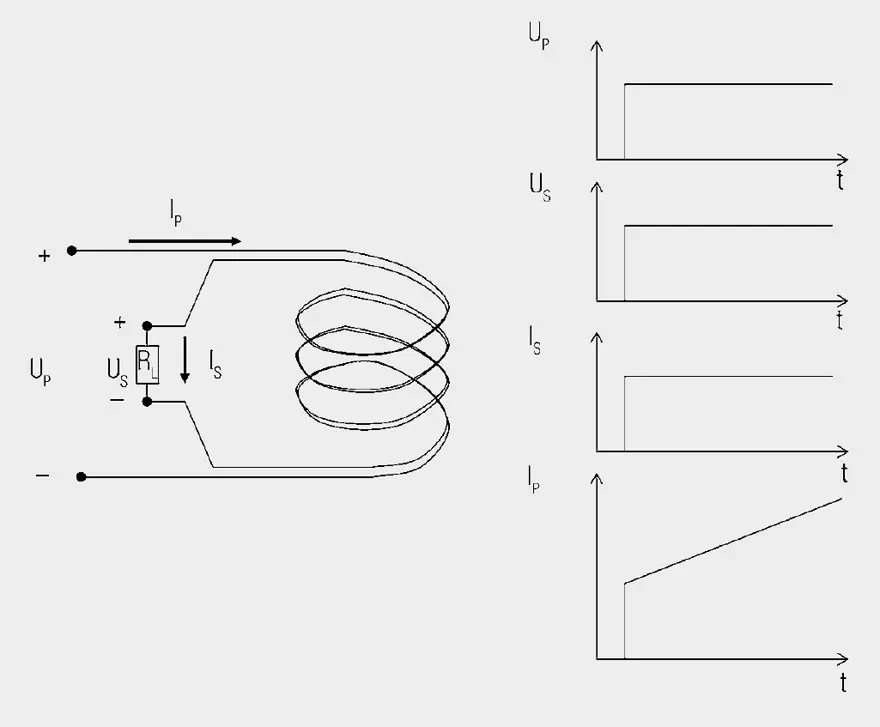
Define iP as current entering the primary’s positive voltage terminal and iS as current leaving the corresponding secondary terminal towards the load. The primary-referred load current i′S and total primary current then follow Eq. (6) for the lossless model with finite Lm.
For the ideal transformer element alone, im is zero. Its primary and secondary instantaneous powers pP and pS, in watts, satisfy Eq. (7).
When finite magnetizing inductance is included, instantaneous input power also includes energy entering or leaving that inductance. In periodic lossless steady state, average input and output powers remain equal. In a real transformer, average input power additionally supplies winding, core and other losses. [1]
Let ZS be an impedance connected to the secondary and Z′S its equivalent referred to the primary, both in ohms. Equation (8) gives the impedance transformation.
Consequently, a secondary resistance RS, inductance LS or capacitance CS has the primary-referred equivalent in Eq. (9). Primes indicate referred equivalents, not physical component changes.
The capacitance rule is inverse because capacitive impedance is inversely proportional to capacitance. Equation (9) applies to an element represented entirely on one side of the ideal transformer; a physical interwinding capacitance bridges the isolation boundary and cannot generally be replaced by the same simple one-sided transformation.
For conventional power transfer and many signal applications, magnetizing current should be low enough to meet efficiency, waveform and regulation requirements. It should not be minimised without considering the converter topology: flyback converters intentionally use magnetizing energy, and resonant converters may require a specified magnetizing inductance.
Deeper look at magnetization and MMF
A magnetic-circuit model connects the electrical equations to core geometry and material properties. Magnetomotive force, or MMF, establishes the magnetic field, while reluctance describes the relationship between MMF and flux in a simplified magnetic path.
For a uniform core section, let l be magnetic path length in metres, A the cross-sectional area in square metres, µ the absolute permeability in henries per metre, µ0 the permeability of free space and µr the dimensionless relative permeability. Reluctance ℜ, in amperes per weber, is given by Eq. (10). [1]
The common analogy treats MMF like voltage, flux like current and reluctance like resistance. Its limitation is important: reluctance does not dissipate power as an electrical resistance does. Real cores also exhibit nonlinearity, hysteresis and frequency-dependent behaviour.
Example of core reluctance
Retain the original illustrative core with l = 5 cm = 0.05 m, A = 1 cm² = 0.0001 m² and µr = 5000. Using µ0 ≈ 4π × 10−7 H/m in Eq. (10) gives Eq. (11).
The original estimate of approximately 80,000 A/Wb is therefore appropriate. This is a uniform, ungapped, approximately linear model, not a measured property of a particular core. An intentional gap, imperfect core mating surfaces, temperature and operating flux can change effective reluctance substantially. [1, 2]
Flux from Faraday’s and Ampère’s laws
For a winding with N turns and winding voltage u, Faraday’s law determines flux change. Including initial flux Φ(t0) at initial time t0 avoids the ambiguity of an indefinite integral.
For a single winding carrying current i in the linear reluctance model, MMF ℱ, flux and inductance are related by Eq. (13).
Equations (12) and (13) are complementary, not contradictory. Applied winding voltage dictates how flux changes; the magnetic circuit determines the net ampere-turns needed to support that flux. For a loaded transformer, use the algebraic sum of all winding MMFs rather than the current of one winding alone. [1, 2]
Phase relationship in the magnetizing branch
Under sinusoidal steady-state excitation, flux lags winding voltage by 90°. In a linear, lossless magnetizing branch, magnetizing current is proportional to flux and also lags voltage by 90°. This branch exchanges reactive energy with the source but consumes no average real power. [1]
A real unloaded transformer consumes real power because of core and winding losses. Its total no-load current is therefore not a purely reactive sinusoid, and saturation or hysteresis can distort the waveform. The 90° statement should not be applied indiscriminately to switching waveforms or total primary current.
MMF balance in a loaded transformer
With the current references used in Eq. (6), primary and secondary load ampere-turns oppose each other. Their small residual supports the magnetizing flux, as expressed by Eq. (14).
- The applied winding voltage largely determines the core-flux waveform.
- Secondary load current creates opposing ampere-turns.
- The source supplies additional primary current so that net ampere-turns remain consistent with the required core flux.
At a fixed winding-voltage waveform, magnetizing current is therefore approximately independent of load in the simplified model. Real winding drops, source impedance, temperature and nonlinear core behaviour introduce departures. Primary current is a waveform or phasor sum, not a simple arithmetic addition of RMS magnitudes. [2]
DC bias, flux walk and saturation
Uncompensated DC ampere-turns can offset the core operating point and reduce available saturation margin. However, DC in an individual winding is not automatically a fault: rectified converter waveforms can contain average current components whose ampere-turns cancel between windings. The relevant quantity is net core MMF, together with the winding volt-second history. [2]
Let Ae be effective core area in square metres, B flux density in teslas, ΔB its change over a voltage pulse and ton the pulse duration. For approximately constant winding voltage, Eq. (15) follows from Faraday’s law.
For periodic steady-state operation with switching period T, flux must return to its initial value each cycle. The corresponding winding-voltage condition is Eq. (16).
Symmetric bipolar drive can satisfy Eq. (16), but symmetry is not the only solution. A unipolar forward converter uses a reset interval with opposite winding voltage. Check start-up, overload, transient and fault conditions as well as steady-state operation. In flyback converters, the magnetic component intentionally stores energy and is commonly designed with a gap; conventional simultaneous load-ampere-turn cancellation does not describe its complete switching cycle. [1, 2]
Reducing magnetizing current: core and frequency
For a fixed applied voltage and pulse duration, increasing magnetizing inductance reduces the magnetizing-current excursion. Shortening the voltage pulse also reduces the excursion, but neither measure removes the need for a reset path or a loss calculation.
A high-permeability core can increase inductance relative to an otherwise comparable air-core winding, as illustrated in Figure 3. More turns can also increase inductance, but add conductor length, resistance, winding capacitance and manufacturing constraints.
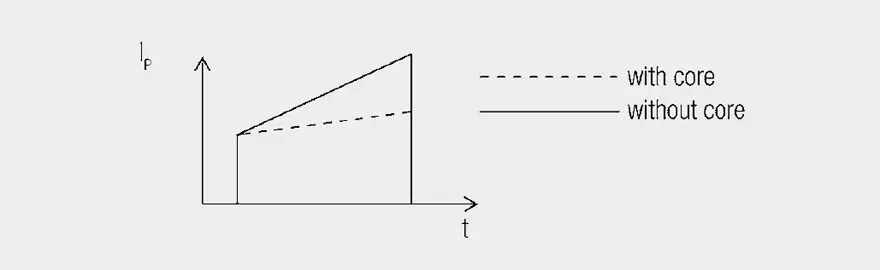
For constant voltage and approximately constant Lm, magnetizing-current change Δim during the pulse is given by Eq. (17).
At unchanged voltage, duty ratio, turns and inductance, increasing switching frequency shortens each pulse and reduces current excursion. Figure 4 illustrates the frequency dependence. Current does not automatically return to its original value at the end of a pulse: an appropriate reverse voltage or other defined demagnetisation interval is required. With zero voltage across an ideal inductance, current remains constant. [1, 2]
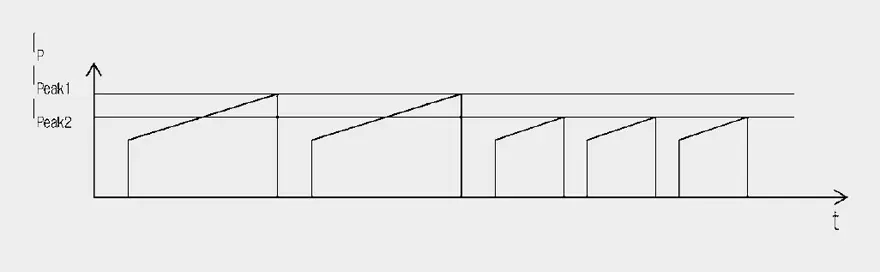
Higher frequency can reduce the required volt-seconds per cycle, but it also changes core loss, AC winding loss and parasitic behaviour. Select frequency, core material, turn count and winding construction together rather than assuming that higher frequency always improves efficiency.
Parasitic effects
The practical transformer model also includes leakage inductance, interwinding capacitance, capacitance within each winding and winding resistance. These elements influence switching transients, common-mode current, signal bandwidth and resonances, and become increasingly important as edge rates and operating frequency rise. [1]
Leakage inductance from winding geometry
Not all magnetic flux links all windings. The energy associated with incomplete coupling appears in an equivalent circuit as leakage inductance, whose value must always be identified with a measurement connection and reference winding.
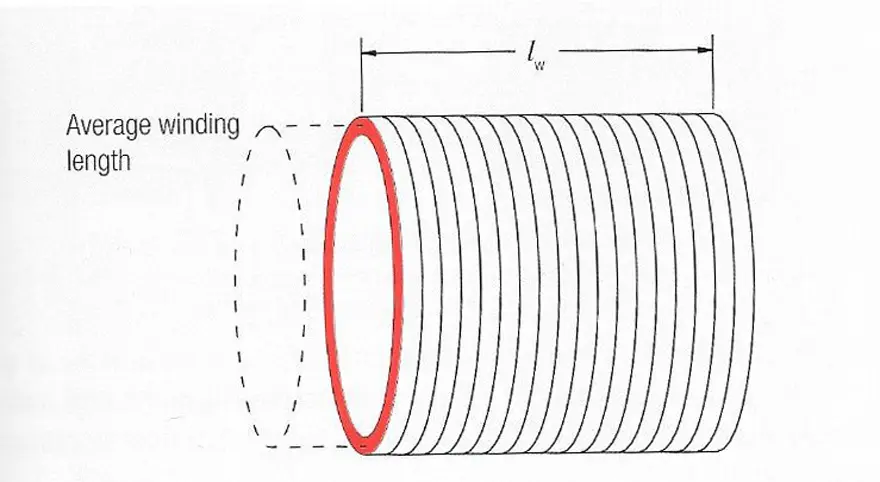
For an idealised long solenoid of winding length lW, cross-sectional area A and N turns, Eq. (18) estimates self-inductance. It assumes a sufficiently uniform internal field and an appropriate effective permeability; an open-ended magnetic rod does not necessarily provide the bulk material permeability assumed by this expression.
Adding a concentric second winding creates a region between the windings where load-related magnetic fields do not cancel. In the thin-winding, long-coil approximation, the interwinding-region area Aleak can be represented by Eq. (19), where MLT is mean length of turn and Hins is radial insulation thickness, both in metres.
Equation (19) is a geometrical illustration, not a complete leakage-inductance formula. Finite winding thicknesses H1 and H2, end effects, layer arrangement, winding breadth and the actual magnetic return path also matter.
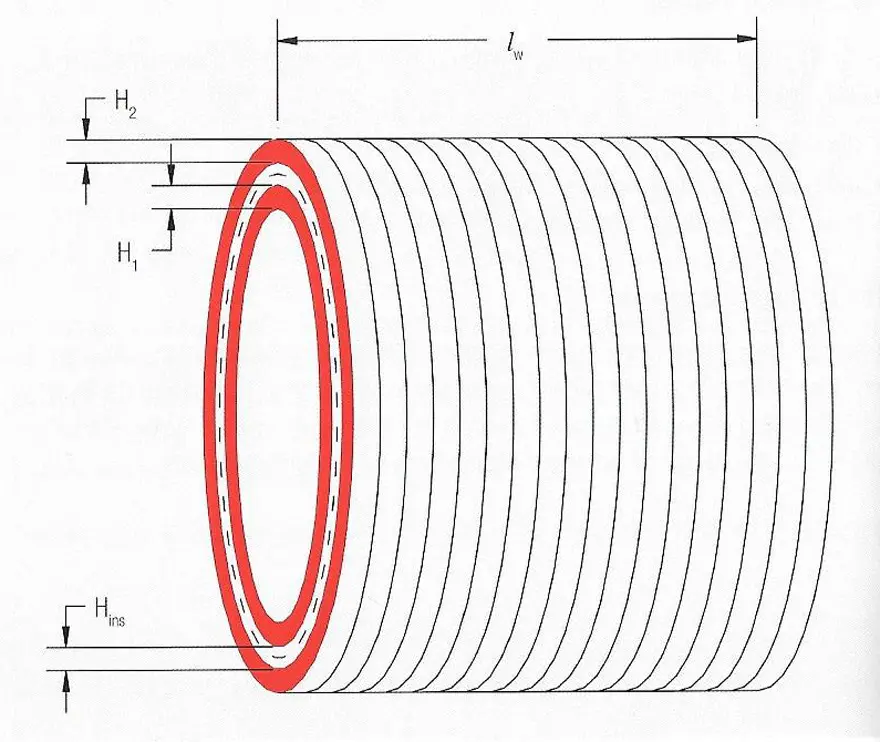
In tightly coupled, high-permeability transformers, winding geometry usually dominates leakage inductance because much of the leakage-field energy lies in non-magnetic regions. Treating leakage as completely independent of core material or gap is too strong: magnetic shunts, gap fringing, finite permeability and unusual constructions can change the field distribution. [2]
- Greater winding breadth can reduce leakage by spreading ampere-turns over a longer field path.
- Reduced separation and suitable interleaving can improve coupling, subject to insulation requirements.
- In power SMPS, leakage can cause commutation delay, ringing and switch overvoltage. In signal transformers, it can limit high-frequency transfer.
- Do not always target the smallest possible leakage: some resonant circuits deliberately incorporate a specified leakage inductance.
Coupling and winding capacitances
Transformer capacitances form a distributed network rather than a single universal capacitor. A lumped model can nevertheless explain first-order common-mode coupling and resonances when its connection and frequency range are clearly defined.
Interwinding coupling capacitance
Interwinding capacitance is the electric-field coupling between primary and secondary conductors. A parallel-plate model provides intuition: larger facing area and thinner insulation tend to increase capacitance. Increasing separation or reducing overlap can reduce capacitance, but often increases leakage inductance. [1]
For an effective interwinding capacitance CPS in farads and voltage difference vPS in volts, the corresponding displacement current iCM is approximated by Eq. (20).
Equation (20) explains why fast switching edges can produce appreciable common-mode current even when the transformer provides DC isolation. Actual current paths also depend on shields, heatsinks, PCB capacitance, chassis connections and the winding voltage distribution.
Capacitance within a winding
Turn-to-turn and layer-to-layer capacitances couple conductors at different potentials. Their terminal-equivalent value depends on winding order and voltage distribution, so it does not necessarily increase monotonically with layer count. Sectioned windings and suitable progressive or Z-winding arrangements can reduce effective capacitive coupling, but must be assessed together with leakage, conductor length and insulation.
These capacitances influence self-resonance, ringing, common-mode noise and the useful bandwidth of voltage, current and data transformers. Use a frequency-dependent or distributed model when a simple lumped model no longer reproduces the measured response. [1]
Practical winding structures
Concentric, split, sandwich and interleaved constructions trade coupling against capacitance, winding loss, insulation complexity and manufacturability. Figure 7 retains the original comparison of winding arrangements.
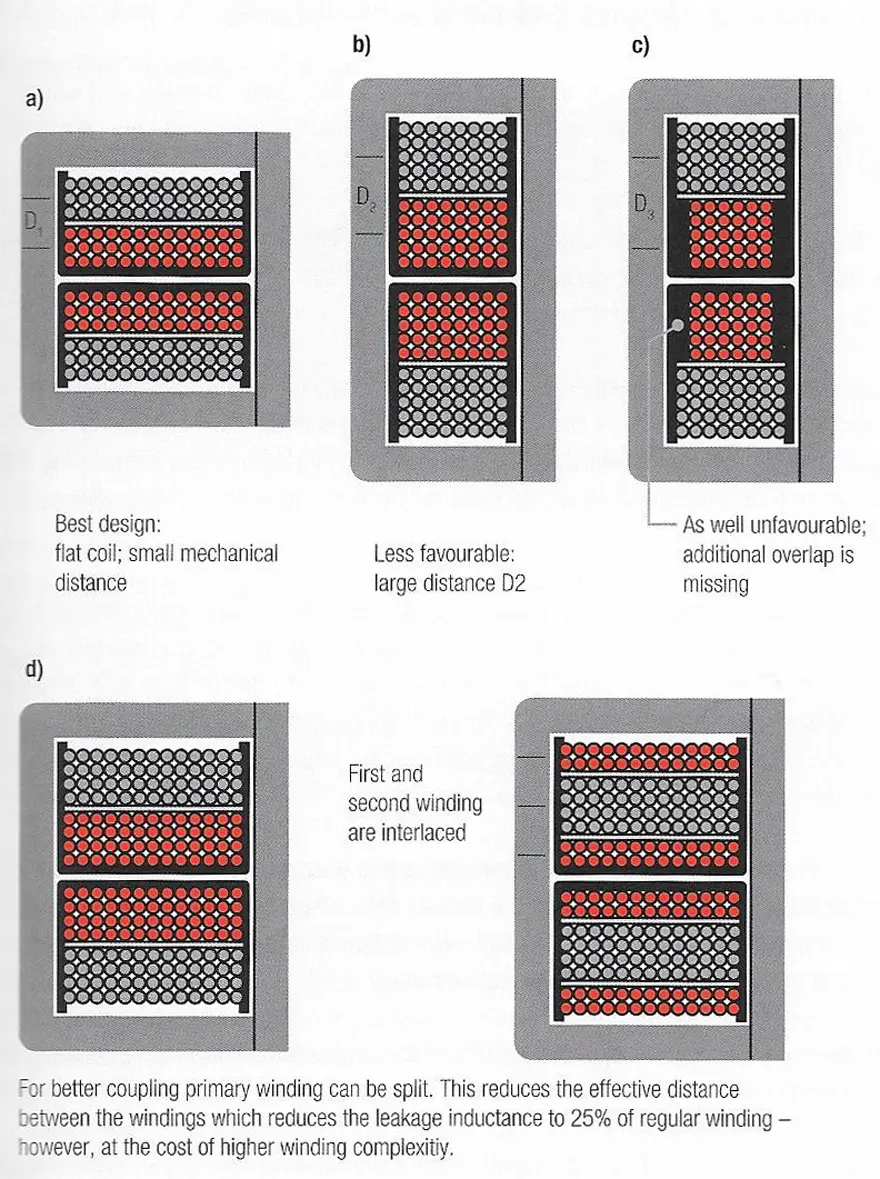
In a primary–secondary–primary sandwich, the primary is divided into two correctly connected sections around the secondary. This reduces the leakage-field build-up compared with an otherwise comparable unsplit arrangement. It can be interpreted as increasing effective winding breadth in a simplified field model, but it does not literally double the physical winding length or guarantee a fixed leakage reduction. [2]
Interleaving can increase primary-to-secondary facing area and capacitance. It also introduces additional insulation interfaces. Creepage, clearance, solid insulation, terminations and winding-to-core insulation still require explicit assessment; close coupling is not evidence of safety compliance.
Planar transformers use PCB or other flat conductors to achieve controlled, repeatable geometry and low-profile assemblies. Their broad conductors and layer stacks still require AC-loss, capacitance and gap-fringing analysis. A planar structure is not inherently lower-loss or lower-capacitance than a wire-wound alternative. [2]
Copper loss, core loss and temperature
DC winding resistance alone is insufficient for high-frequency loss prediction. Skin effect changes current distribution within a conductor, while proximity fields from neighbouring turns and gap fringing can increase current crowding and local heating. Conductor thickness, strand construction, layer count and interleaving must be matched to the current waveform. [2]
Core loss depends on material, flux excursion, waveform, frequency and temperature. Use material data or a loss model applicable to the actual excitation rather than applying a sinusoidal loss curve blindly to a switching waveform. Thermal validation must include winding hot spots and the final assembly’s cooling conditions. [1]
Measuring and modelling the practical transformer
Start with a model containing the ideal turns ratio, magnetizing inductance, core-loss representation, leakage inductance, winding resistance and relevant capacitances. Select its complexity according to the question: low-frequency regulation, switching transients and broadband signal integrity do not require identical models.
- Measure open-circuit winding inductance with the other windings open, recording test frequency, excitation amplitude and temperature.
- Estimate primary-referred total leakage from primary inductance with the secondary shorted through a low-inductance connection. Use a suitable frequency range where winding resistance, magnetizing effects and capacitance do not dominate the result.
- Measure DC winding resistance and account for operating temperature when estimating conduction loss.
- Measure interwinding capacitance using a defined connection, commonly with each winding’s terminals joined together. Record shield and core connections.
- Use impedance sweeps to identify resonances and validate the fitted capacitance model. A single resonance does not uniquely identify every distributed capacitance.
- Correlate the model with operating waveforms, temperature rise and EMI measurements before releasing the design.
Solenoids
A solenoid is a helical coil that produces a magnetic field when current flows. In actuator terminology, a solenoid normally means an assembly combining a coil, magnetic frame and movable armature or plunger to produce linear motion or rotary output. [3]
Working principle
In a conventional reluctance actuator, energising the coil attracts the ferromagnetic armature towards a position of lower magnetic reluctance. The resulting motion can operate a valve, latch, switch or other mechanism. A spring, gravity or an external mechanism commonly provides the return movement after excitation is removed.
Increasing current or turn count can increase available magnetic excitation, but actuator force is also strongly dependent on air gap, pole geometry, saturation and temperature. Adding turns while keeping the same supply voltage can increase resistance and reduce current, so turn count alone is not a reliable force-improvement rule. Compare the manufacturer’s force–stroke curves at the intended electrical and thermal conditions. [3, 4]
Ordinary unpolarised pull-type solenoids do not reverse their attraction direction simply because coil polarity is reversed. Push versions typically transmit the same magnetic attraction through a different mechanical arrangement. Latching and other polarised designs can require specified pulse polarity.
Types of solenoid
Supply type, frame geometry, output motion and operating mode are separate classification axes. A linear actuator may, for example, be DC-powered, C-frame and spring-return at the same time.
- AC laminated solenoid: uses laminated magnetic parts and a coil designed for the specified AC supply. Its performance must be read from the relevant force–stroke and electrical data rather than inferred from the AC label alone. [5]
- DC C-frame solenoid: uses an open C-shaped magnetic frame, a coil and a movable plunger. It is used in mechanisms such as dispensing, switching and locking assemblies. [4]
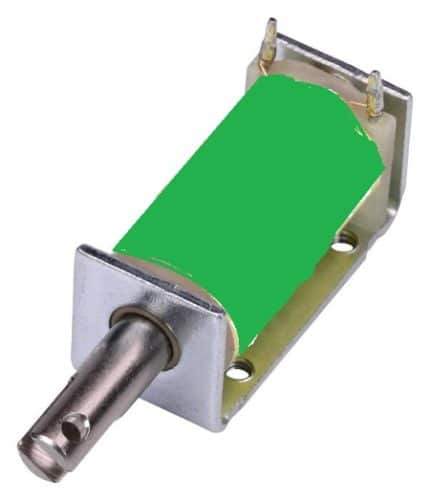
The original article also illustrates a DC D-frame solenoid in Figure 9. D-frame and box-frame terminology describes magnetic-frame construction rather than establishing an AC supply rating. Use the particular manufacturer’s drawing and coil specification; do not substitute AC and DC coils on the basis of frame appearance.
A linear solenoid provides translation of a plunger or output rod, as illustrated in Figure 10. Its useful output is the force available throughout the required stroke after allowing for spring force, friction and external load. Holding force at the seated position is not the same as pull-in force at the start of travel. [4]
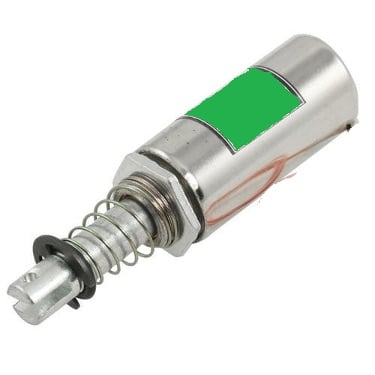
A rotary solenoid provides angular output instead of linear travel. Its internal mechanism is design-dependent, so torque–angle characteristics, return arrangement and permitted rotation are more useful selection criteria than a single generic description of a rotating disc.
Monostable solenoids normally return when coil excitation is removed. Latching or bistable designs retain a position without continuous coil power and use a defined pulse sequence to change state. Proportional solenoids are designed for controlled force over a specified operating range and require the intended current-control method. [3]
Applications: solenoid valves
A solenoid valve uses armature motion to open, close or otherwise control a fluid passage. In a spring-return arrangement, energisation moves the armature against the spring and de-energisation permits the spring to restore the default state.
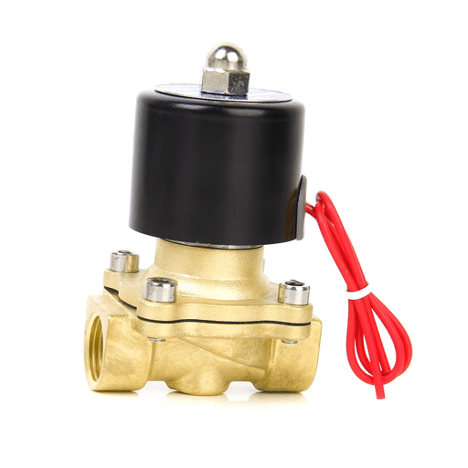
The default state is design-dependent: normally closed and normally open valves behave differently when power is removed. Select the complete valve for the fluid, pressure, temperature, required flow and switching duty; selecting the coil voltage alone does not establish valve suitability.
Applications: solenoid locks
A solenoid lock uses plunger motion to engage or release a locking mechanism. Electronic access systems can command the coil, but the actuator’s actual locked state depends on its mechanical arrangement and whether it is spring-return or latching. [4]
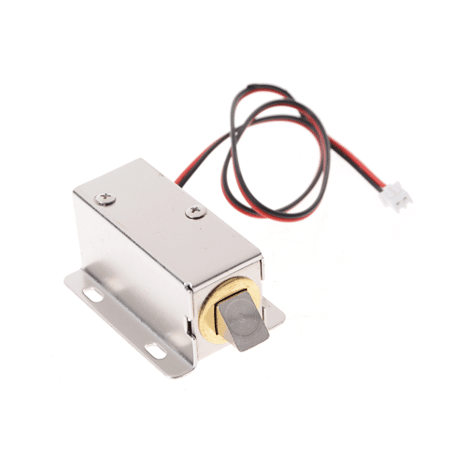
The coil current creates the magnetic field that moves the armature. Specify whether loss of power must release or retain the mechanism, and validate the complete assembly against mechanical loads, wear and applicable access or machinery requirements.
Current control, heating and duty cycle
Coil resistance rises as the winding heats. Under fixed-voltage drive, this reduces current and can reduce operating margin. A closed-loop current driver can compensate for resistance changes within its voltage and thermal limits, but it does not make the coil immune to overheating. [3]
For many spring-return DC actuators, a higher initial current is used to pull in the armature, followed by a lower holding current after seating. Peak-and-hold PWM control can reduce holding dissipation. The required peak current, pull-in interval, holding current and ripple depend on the particular solenoid and load.
Thermal duty cycle is the fraction of an operating cycle for which the coil is energised. It is not the same as the PWM duty ratio used inside an energised interval. Respect both the permitted energisation duty and maximum continuous on-time, together with mounting and ambient-temperature conditions. [4]
Turn-off protection and release time
A solenoid is an inductive load: its current cannot be interrupted instantaneously without generating voltage. A DC driver therefore needs an intentional current-decay path, such as a freewheeling diode, a suitably rated clamp or a controlled bridge circuit. [3]
A diode across the coil limits turn-off voltage but allows current to decay relatively slowly, which can delay mechanical release. A Zener or TVS clamp, or a suitable bridge fast-decay mode, applies a larger opposing voltage and can shorten current decay. Check switch voltage stress, clamp pulse energy, repetition rate and EMI in the complete circuit.
Electrical current-decay time is only part of release time: spring force, friction, residual magnetism, fluid pressure and mechanism travel also matter. Do not apply a simple unidirectional DC freewheel-diode circuit across an AC-powered coil.
Design and selection checklist for transformers and solenoids
Compare components against a defined operating envelope rather than a nominal voltage or inductance alone. Catalog parts simplify sourcing when their published limits fit the application; custom parts are appropriate when winding ratios, isolation construction, parasitics or mechanical interfaces cannot be met by standard products.
Transformer electrical and thermal requirements
- Specify topology, voltage waveforms, frequency range, duty-ratio limits, turns ratio, output power and start-up or fault conditions.
- Check magnetizing inductance and tolerance at stated test conditions, maximum volt-seconds, peak flux, saturation margin and the required reset mechanism.
- Compare primary-referred leakage inductance, winding resistance, interwinding capacitance and their measurement definitions.
- Evaluate RMS and peak winding currents, AC winding loss, core loss, temperature rise and the cooling conditions assumed by the supplier.
- For signal transformers, prioritise impedance, bandwidth, insertion loss, return loss, distortion and pulse fidelity at the specified source and load impedances.
- For current transformers, verify burden, excitation current, accuracy, saturation and reset. Provide a suitable burden or protective arrangement so the secondary is not inadvertently left open during operation.
Solenoid mechanical and driver requirements
- Specify linear stroke or rotation angle, force or torque throughout travel, spring load, friction, orientation and required operating life.
- Check pull-in and holding requirements at minimum supply and maximum winding temperature, not only under cold nominal conditions.
- Compare coil resistance and tolerance, rated supply type, allowed current, duty cycle, maximum on-time and mounting or heatsinking conditions.
- Select peak-and-hold, simple on/off or bidirectional pulse drive according to the actuator type.
- Validate turn-off clamp stress, release time, acoustic behaviour, EMI and fault response in the assembled mechanism.
Qualification, safety and purchasing
- Distinguish working voltage, dielectric test voltage, impulse requirements and the intended insulation function. A dielectric test rating alone does not establish a safe continuous working voltage.
- Confirm creepage, clearance, insulation system, winding-to-core separation, temperature limits and the safety requirements of the final equipment.
- Verify the scope of any supplier recognition or approval for the exact part and construction; component documentation does not replace end-product assessment.
- For custom parts, control the drawing, winding order, wire and insulation specifications, critical parasitic limits, inspection methods and acceptance tests.
- For alternate sourcing, compare test conditions, mechanical fit and approved construction as well as nominal electrical values. Require traceability and supplier change notification for controlled designs.
Conclusion
Transformers and solenoid actuators share electromagnetic principles but require different design priorities. Transformer performance follows from turns ratio, winding volt-seconds and MMF balance, with practical limits set by saturation, losses, leakage, capacitance and insulation.
Solenoid performance depends on the magnetic circuit and its mechanical load throughout travel. Reliable selection therefore combines force–stroke or torque–angle data with hot-coil current, thermal duty, driver protection and release-time measurements. For both component classes, the final decision should follow application-specific modelling, supplier documentation and prototype validation.
FAQ
These questions address common design and component-selection decisions.
A transformer transfers electrical energy between magnetically coupled winding circuits using changing magnetic flux. A solenoid actuator uses a magnetic field to move an armature and produce mechanical output. Both depend on winding current, magnetic geometry and material properties, but transformers are primarily selected for electrical transfer, while actuators require force or torque over a specified travel.
An ideal transformer requires no magnetizing current. A practical first-order model adds a finite magnetizing inductance across the primary, which draws excitation current even with the secondary open. A real transformer also draws current associated with core loss. Keeping these models separate avoids confusing ideal turns-ratio equations with the no-load behaviour of a physical component.
Using the primary-to-secondary turns ratio, a secondary impedance referred to the primary is multiplied by the turns ratio squared. Resistance and inductance therefore increase by that factor, while an equivalent capacitance is divided by it. This transformation applies to elements represented on one side of the ideal transformer, not directly to a physical capacitance bridging its windings.
Winding voltage integrated over time determines the change in magnetic flux. For periodic steady-state operation, the net winding volt-seconds over a complete cycle must be zero so flux returns to its starting value. Ending a drive pulse does not automatically provide reset. The circuit needs an appropriate reverse-voltage interval or other defined demagnetisation mechanism to avoid cumulative flux walk.
Closer winding spacing, greater winding breadth and suitable interleaving can reduce leakage inductance. However, closer conductors and greater facing area often increase interwinding capacitance. Increasing separation or reducing overlap can reverse that trade-off. Select the construction against the actual transient, bandwidth, common-mode noise and insulation requirements rather than trying to minimise every parasitic independently.
Compare available force throughout the required stroke, not holding force alone. Include spring force, friction, orientation and external load, and check the coil at minimum supply and maximum operating temperature. Also verify duty cycle, maximum on-time and mounting conditions. For rotary solenoids, use the equivalent torque-versus-angle data and validate the complete return mechanism.
Many spring-return DC solenoids need greater current to complete pull-in than to remain seated. Peak-and-hold control supplies the initial operating current, then reduces current to limit holding dissipation. Current feedback can compensate for winding-resistance changes within the driver’s limits. The required current levels and timing must be validated for the actual actuator, temperature and mechanical load.
Yes. A freewheeling diode across a DC coil limits turn-off voltage but lets current decay relatively slowly, which can delay armature release. A suitable higher-voltage clamp or bridge fast-decay mode can shorten current decay, at the cost of greater electrical stress. The final release time also depends on the spring, friction, residual magnetism and mechanism travel.
How to design and validate a basic power transformer
This procedure applies to initial power-transformer design and prototype validation. It is not a substitute for topology-specific calculations or end-product safety assessment.
Develop and validate a power-transformer design from operating requirements to a controlled component specification.
- Define electrical requirements
Specify input and output voltages, voltage waveforms, topology, frequency range, duty-ratio limits, power, peak and RMS currents, ambient conditions and the required insulation function.
- Select core material and size
Choose a material and core geometry appropriate to the excitation waveform, flux excursion, loss budget, winding space and cooling conditions. Include temperature and manufacturing tolerances.
- Determine turns and reset requirements
Calculate turns from the worst-case winding volt-seconds and permitted flux excursion. Set the turns ratio for the required conversion, then verify reset, start-up, overload and any intentional energy-storage requirement.
- Choose conductors and insulation
Select conductors using RMS current, AC-loss estimates and temperature-rise limits. Define the bobbin, wire insulation, interwinding barriers, terminations, creepage and clearance for the intended equipment requirements.
- Optimise winding geometry
Compare concentric, split and interleaved arrangements against leakage inductance, interwinding capacitance, AC winding loss and manufacturability. Preserve the required insulation at every interface.
- Build an application-specific model
Include magnetizing inductance, core loss, leakage inductance, winding resistance and relevant capacitances. Use a nonlinear magnetic model where saturation or operating-point changes affect the result.
- Prototype and measure
Measure turns ratio, open-circuit inductance, short-circuit inductance, winding resistance and capacitance with documented connections and test conditions. Check operating waveforms, switching stress, losses and temperature rise in the final assembly.
- Iterate and qualify
Refine material, turn counts, conductor arrangement and insulation from measured results. Confirm electrical, thermal, EMI and safety requirements, then release a controlled construction drawing and acceptance-test specification.
Further Reading
These Passive Components Blog articles extend the magnetic-circuit, loss and measurement topics introduced here.
- How Transformer Works — A simulation-led introduction to flux, MMF and transformer action.
- Transformer Behavior – Current Transfer and Hidden Feedback — A more detailed discussion of current transfer and magnetic-circuit interpretation.
- Transformer Calculation, Losses and Leakage Inductance — Practical equivalent circuits, parameter measurements and application-dependent transfer behaviour.
- Winding Losses in Transformers and Inductors — Further discussion of conductor geometry, skin effect and proximity fields.
- Magnetic Fields in Inductors: Ampère’s Law, Flux Density, Saturation and Air Gaps — Background on field quantities, magnetic materials and air-gap effects.
References
The following technical documents support the operating principles and practical guidance in this article. Undated documents are identified as such rather than assigned an inferred publication year.
- Lloyd H. Dixon, Magnetics Design 1 – Introduction and Basic Magnetics, Texas Instruments/Unitrode, SLUP123, undated seminar text; hosted edition carries a 2001 copyright notice.
- Lloyd H. Dixon, Magnetic Field Evaluation in Transformers and Inductors, Texas Instruments/Unitrode, SLUP171, publication year not stated in the document text.
- David Vaseliou and Luis Cordova, Using Motor Drivers to Drive Solenoids, Texas Instruments, SLVAE59A, 2019, revised April 2022.
- Johnson Electric, Ledex Open Frame Solenoids, manufacturer catalog and design considerations, publication year not stated.
- Johnson Electric, Dormeyer Linear Solenoids – AC Laminate, manufacturer technical overview, undated.