
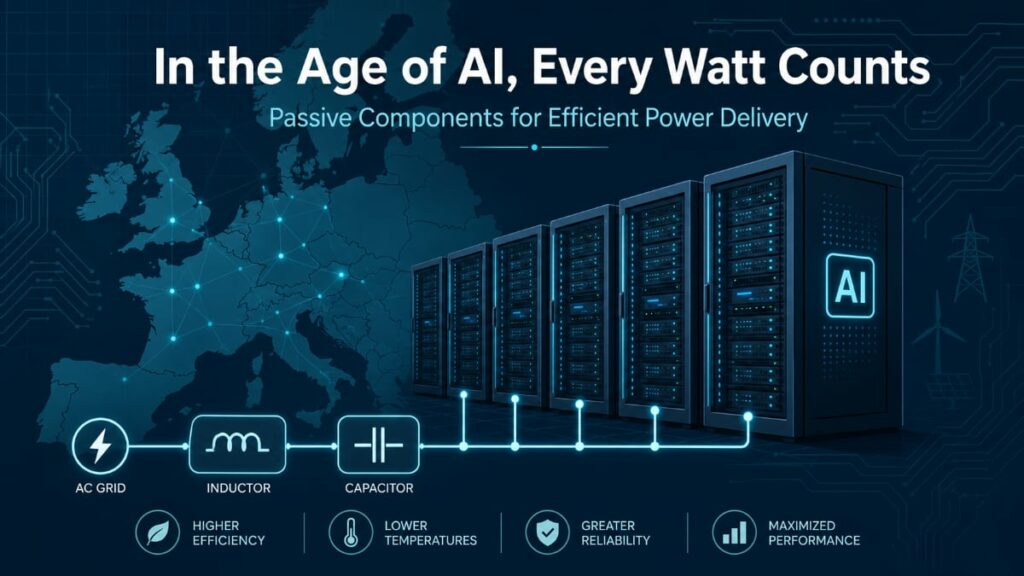
At GITEX AI Europe 2026 in Berlin, Würth Elektronik eiSos shifted the AI discussion away from models and parameters toward a more fundamental question: Can Europe’s physical hardware infrastructure keep up with AI demand?
In a conversation with moderator Massimo Marioni, Fortune editor, Alexander Gerfer, CTO of Würth Elektronik, argued that
“The AI bottleneck is not software, but power supply and the components that make it possible.”
He emphasized that while public attention focuses on the “brain” of AI—the models and GPUs—“a brain without circulation is just inert silicon,” highlighting that the most important innovations are often the ones no one sees, such as inductors and capacitors delivering power directly to where computing takes place.
Artificial intelligence is reshaping Europe’s digital and industrial landscape, but the real bottleneck to AI scaling is increasingly the power infrastructure rather than the models or GPUs. As data‑center and edge‑AI workloads grow, passive components move from being “hidden” design elements to strategic levers for efficiency, sustainability and competitiveness.
AI, Power Demand and Infrastructure Pressure
The International Energy Agency’s “Energy and AI” analysis reports that data centers consumed around 415 TWh of electricity in 2024, about 1.5% of global demand, with expectations of almost doubling to about 945 TWh and just under 3% by 2030—more than Japan’s current electricity consumption. AI workloads, especially agent‑based and reasoning‑intensive applications, are a major driver of this growth, requiring significantly more compute and energy per query than simple text prompts.
New generation capacity and grid expansion take years, while AI demand grows month by month. This mismatch forces a shift in focus: hardware‑level efficiency “as close to the chip as possible” becomes critical, and even small improvements in power conversion losses have macro‑scale impact. According to Würth Elektronik’s estimate based on IEA data, a 1% reduction in data‑center power‑conversion energy use corresponds to the electricity supply of roughly two to four million European households.
From Hidden Components to Strategic Assets
Public attention often stays on the “brain” of AI—the models and the GPUs—but a brain without circulation is just inert silicon. The real “circulation system” is the power delivery network: inductors, capacitors, filters and their layout around the processor. These passive components determine how efficiently energy is moved from the grid and power shelves into the chips that perform AI computation.
In this context, the selection and design of passive components shifts from cost‑driven optimization to strategic risk and efficiency management. Material choices for inductors/magnetics, ESL/ESR performance of capacitors, current handling, frequency capability and thermal behavior all translate directly into operating expenditure at data‑center scale. The message from Würth Elektronik’s GITEX AI Europe 2026 discussion is clear:
“The most important innovations are often the ones no one sees.”
High‑Frequency and Vertical Power Delivery
One highlighted trend is the move to higher switching frequencies and vertical power delivery architectures. Würth Elektronik points to components that support switching frequencies up to 40 MHz with significantly reduced losses, enabling power stages that can be placed directly above or below the chip to minimize parasitic losses. Integrated passive modules combining inductors and filters into compact units are designed for server racks with power loads exceeding 100 kW.
For the passive components industry, this implies:
- Growing demand for high‑frequency inductors and transformers with low core and copper losses, optimized for multi‑MHz operation.
- Stronger emphasis on compact, integrated passive assemblies that support dense, vertical power‑delivery topologies in AI servers.
- More stringent requirements on capacitors for high‑density decoupling, ultra‑low ESL/ESR and stable performance under high ripple currents and fast transients at elevated temperatures.
Designers and manufacturers of MLCCs, polymer/tantalum capacitors and power inductors are therefore pushed toward products that can sustain higher switching frequencies, reduced losses and 3D integration within power‑delivery stacks.
Edge AI: Spreading the Load, Changing the Component Mix
Not every AI workload belongs in large, centralized data centers. Moving processing closer to where data is generated—in factories, vehicles, medical devices and connected infrastructure—reduces latency and cuts energy use by avoiding unnecessary traffic to the cloud, while improving data protection for sensitive information.
For these edge‑AI applications, Würth Elektronik offers compact power‑supply modules, EMC and shielding solutions, wireless modules (BLE, Wi‑Fi, LoRa), fanless thermal‑management components and sensor technology for signal processing. This points to a broader market trend: edge AI drives demand for robust yet compact magnetics, EMI filters, shielding materials and precision analogue passives that can deliver high efficiency and reliability in harsh industrial environments. Passive components must now serve both hyperscale data‑center power shelves and distributed industrial nodes.
Europe’s Position and the Role of Passive Components
Panel data referenced at GITEX AI Europe 2026 show that the EU currently accounts for only about 5% of global computing capacity, compared with around 74% for the US and 14% for China. However, Europe’s strength lies in industrial AI—predictive maintenance, autonomous factories, smart grids and robotics—where power electronics, precision manufacturing and decades of industrial data provide a distinctive advantage.
In these fields, efficient physical building blocks—advanced passive and power electronic components—become indispensable, regardless of where the largest foundation models are trained. Implement Consulting estimates that widespread AI adoption could boost EU economic output by about 8%, or 1.2–1.4 trillion euros, over ten years. Achieving this potential will depend heavily on efficient, sovereign AI infrastructure built on European expertise in components and power electronics.
For passive‑component manufacturers and designers, this is both an opportunity and a responsibility. AI infrastructure must be rethought “from the ground up,” with sustainability and efficiency designed into every watt delivered to the silicon. The companies that provide the most efficient inductors, capacitors, EMC solutions and power modules for both data‑center and industrial AI will sit at the core of the emerging AI hardware supply chain.
Conclusion
In the age of AI, every watt counts—and the biggest levers often lie in components that rarely make headlines. From high‑frequency, vertically integrated power delivery in data centers to robust passives enabling Europe’s industrial AI systems, the passive component industry is becoming a central player in how far and how sustainably AI can scale. For designers and suppliers, the priority is clear: efficiency must start at the component level, and every incremental improvement can translate into millions of households’ worth of saved energy.
Source
Based on “GITEX AI Europe 2026: In the Age of AI, Every Watt Counts,” Würth Elektronik eiSos Group, Press Center, 10 July 2026.
Further reading on Passive Components Blog:
- AI Hardware Development and Its Consequences for Passive Electronic Components
- AI Hardware Passive Components Dossier – technology dossier landing page
- Samsung Three Pillars MLCC Strategy for AI Hardware Topology
- Murata Publishes Power Delivery Guide for AI Servers
- Passive Components in 2026: From Invisible Commodity to Design Parameter

