

Hydra, the traditional film capacitor producer, has developed a new proprietary gel filler for its cylindrical protected film capacitors that combines the advantages of traditional oil impregnation with those of dry, resin-filled designs.
The novel Hydra proprietary gel material targets improved dielectric strength, better thermal behavior, enhanced moisture protection, and cleaner failure modes in wide range of power film capacitors such as power factor correction, motor run and filter capacitors.
Key features and benefits
Hydra’s new filler is a proprietary mixture based on vegetable oil, additives and isocyanate, resulting in a soft gel-like resin that can be processed on existing production equipment. The gel is used to fill the free volume between the metallized polypropylene winding and the metallic case in Hydra protected capacitors, replacing conventional oil, nitrogen gas or soft resin fill.
Key functional benefits include:
- High dielectric strength (about 10 kV/mm), similar to oil-filled designs, significantly higher than nitrogen filling.
- Improved heat dissipation compared to nitrogen gas-filled capacitors, reducing hot-spot temperature and helping extend expected service life.
- Hermetic, low-permeability barrier against moisture ingress, protecting metallized polypropylene layers from oxidation and related capacitance loss.
- RoHS-compliant composition, free of PCBs and other restricted substances, with reduced environmental impact in case of catastrophic failure.
- Process compatibility with existing Hydra production lines, using a pump-and-filter filling setup with gel preheating to approximately 60–80 °C for efficient filling.
From a design perspective, the gel filler allows manufacturers and users to retain the electrical robustness of oil-filled capacitors while moving closer to the handling, safety and environmental profile of “dry” capacitors.
Typical applications
The novel gel filler is used in Hydra’s protected capacitors, specifically in applications where high reactive power, elevated ambient temperatures, and long service life are required.
Typical application areas include:
- Low-voltage power factor correction (PFC) banks using three-phase cylindrical capacitors (for example, PRB series capacitors around 20–40 kvar and 440–525 V class).
- Motor run capacitors, especially S2 safety class devices operating in harsh environments (compressors, pumps, HVAC units).
- AC filter capacitors in industrial drives and power electronic equipment where heating and moisture are critical lifetime drivers.
- General-purpose protected film capacitors in industrial power distribution panels and compact control cabinets.
In these circuits, the filler choice directly influences operating core temperature, insulation strength to case/ground, tolerance to humidity, and behavior in abnormal events such as overvoltage, overtemperature or mechanical damage.
Film capacitor manufacturing heritage
HYDRA is the leading manufacturer of passive components with over 120 years of experience within the field of film capacitors. Main office is in the Czech Republic with also 50% of the production and with production in Vietnam with more focus on the Asian market.
Product portfolio of Hydra protected capacitors includes capacitors for power factor correction capacitors (PFC), filter and motor capacitors.
The active part of protected capacitor is a cylindrical winding made by metallized polypropylene film, housed in a metallic case which mechanically isolates it from the external environment. The winding is placed into the metallic case and, before it is hermetically closed, the empty space is filled with a material whose main purpose is to protect the polypropylene winding from the external agents.
The novel Hydra gel was developed in response to a customer request for a dry capacitor design that would also be sufficiently technically (thermally) resistant.
Technical Background and Benefits
Insulation robustness
The filling material, being responsible for ground insulation, must have excellent dielectric strength. Oil and gel filled capacitors offer stronger ground insulation compared to nitrogen-filled capacitors. This is particularly relevant when:
- The capacitor case is connected to protective earth and subject to high transient over-voltages.
- The design must meet insulation coordination requirements and withstand test voltages defined by standards for PFC, motor and filter capacitors.
The gel filler combines the excellent cooling and insulating properties of the oil with advantages of dry impregnation. The material is liquid but has a low permeability. It keeps its properties at lower temperatures (minus 45 ° C).
Thermal conductivity and life stability
The better the thermal conductivity of the filler, the more heat will be dissipated, optimizing capacitor’s life.
Filling the space between the capacitive element and the metallic case with nitrogen, the internally generated heat will hardly be dissipated, because the thermal resistance of nitrogen is higher than the one of oil or resin. This is like what happens in a house with double glazing: the internal temperature increases because of the air between the 2 glasses, being an excellent insulator, an unwanted feature. Higher working temperature means a shorter life span for the capacitor.
The thermal conductivity of oil and gel is much higher, granting an excellent dissipation of the heat generated while the capacitor is operating. The risk of overheating is therefore reduced to the minimum, to obtain the maximum life span of the capacitor. To get an idea of the differences, the thermal conductivity of nitrogen is 0.026 W/(m*K), oil’s is 0.15 W/(m*K) and gel’s is 0.17 W/(m*K): the advantage in using oil or gel is evident.
When selecting PFC or motor capacitors for compact panels and cabinets, internal hot-spot temperature is often more critical than ambient. The gel filler’s higher thermal conductivity compared to nitrogen filling can:
- Reduce the temperature difference between hot spot and case.
- Improve correlation between measured case temperature and actual dielectric temperature.
- Offer a few degrees Celsius lower hot-spot temperature compared to nitrogen-filled units at the same electrical loading, according to self-heating tests.
For design engineers, this may translate into:
- Higher permissible reactive power density in a given can size.
- Additional margin when operating close to the upper ambient temperature limit.
- Potentially longer expected service life at a given load profile.
However, thermal modeling and life estimation should always use the specific service conditions and the lifetime curves from the relevant Hydra datasheet.
Moisture protection and dielectric stability
Moisture is a key degradation driver for metallized polypropylene capacitors, accelerating oxidation of metallization and increasing dielectric losses over time. The Hydra gel filler forms a continuous, low-permeability barrier around the winding, limiting moisture diffusion from outside the case.
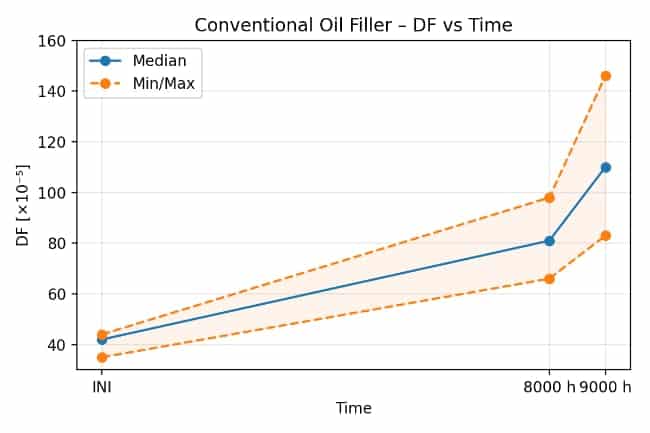
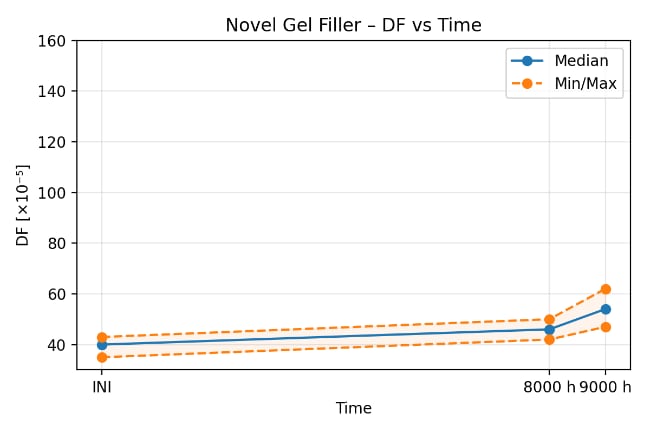
In long-term tests on Hydra power factor correction capacitors with gel filling, dissipation factor values after thousands of hours of accelerated life tests remain similar or lower than for comparable oil-filled units. This indicates stable dielectric behavior and good insulation properties over time under thermal and electrical stress, according to the manufacturer’s test data.
For installations with:
- High humidity (for example, compressors, refrigeration units, outdoor cabinets).
- Strong temperature cycling causing breathing and condensation.
The low-permeability gel barrier can help stabilize capacitance and loss factor over life.
A motor run test results on 2 µF, 450 VAC S2 capacitors operated at about 70 °C and high humidity show:
- Capacitance drift within approximately ±5% after 400,000 cycles.
- No visible mechanical defects on case or terminals.
- Passing high-voltage AC/DC requalification tests after endurance.
For field applications, this suggests that HYDRA gel-filled capacitors are suitable for demanding humidity and temperature conditions, provided other design constraints (voltage, harmonics, switching, etc.) are respected.
Safety, environmental aspects and RoHS
The Hydra gel is free of PCBs and other dangerous substances. Gel-filled capacitors are fully compliant with the RoHS Directive. This ensures they do not contain hazardous substances exceeding permitted concentration limits, specifically Heavy Metals (Lead, Mercury, Cadmium), Flame retardants (Polybrominated biphenyls, Polybrominated diphenyl ethers) and Phthalates (DEHP, BBP, DBP, DIBP). The risk of potential leakage is minimal. The gel filler is not as dangerous as oil if a malfunction occurs.
The improved filler also contributes to safer behavior in catastrophic failures. Engineers designing for worst-case scenarios (blocked fan, overvoltage, incorrect connection, missing disconnector, etc.) can benefit from:
- Reduced risk of flammable liquid ejection compared to oil filling.
- Cleaner failure mode, simplifying enclosure design and post-failure cleanup.
- Low leakage risk, and in case of mechanical destruction, a significantly cleaner failure mode than oil-filled units.
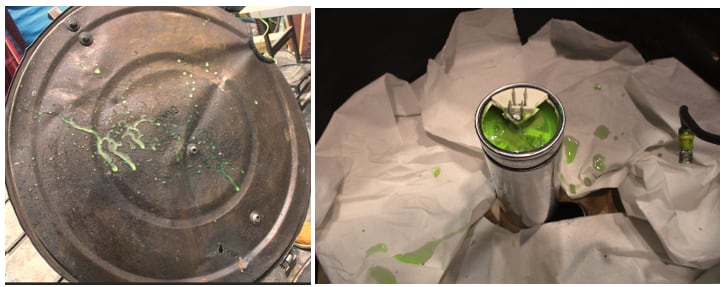
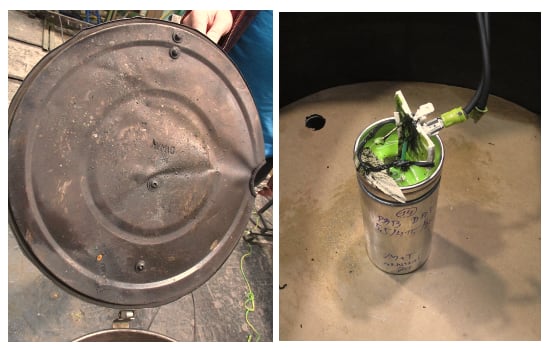
Destruction tests on motor capacitors without safety disconnectors demonstrate that oil-filled units scatter droplets of oil around the test area after explosive disruption, while gel-filled samples leave the surroundings essentially clean. For system designers, this can reduce secondary pollution risk in case of misuse, internal fault or mechanical damage.
Test Results
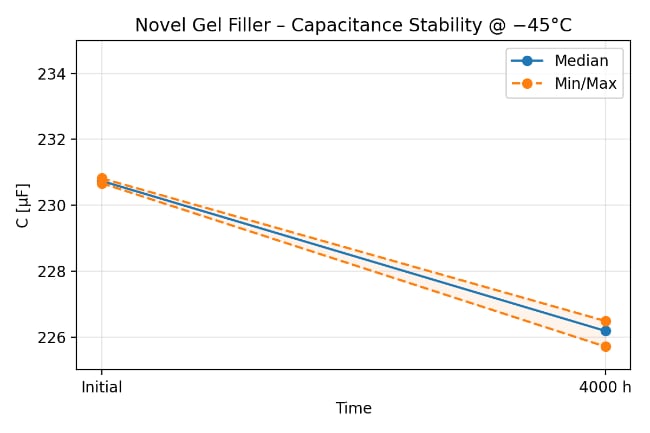
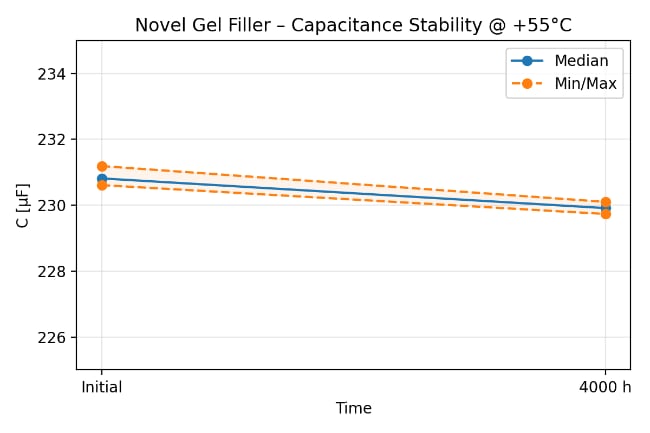
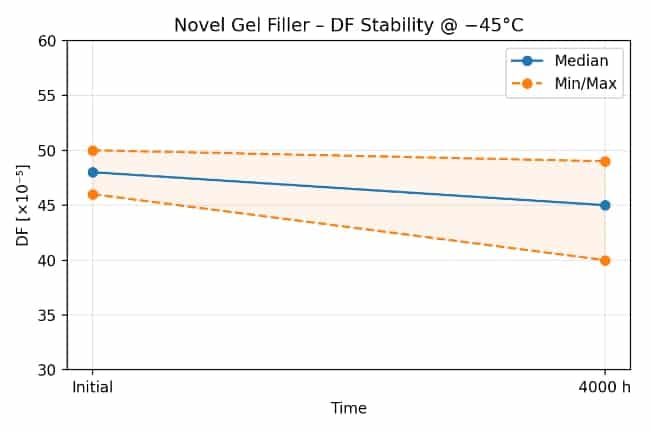
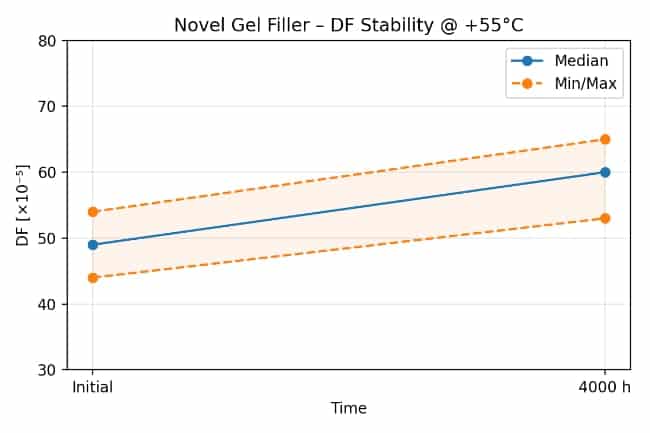
Capacitance stability at -45 / +55C 4000hrs
The power factor correction capacitor type PRB DPMd 40 / 525IIID / M2099 (three phase, 40 kvar, 525 V) was tested in a climate chamber. Capacitance and DF losses were compared at ambient temperature of 55°C and -45°C showing great stability across the temperature range.
Results
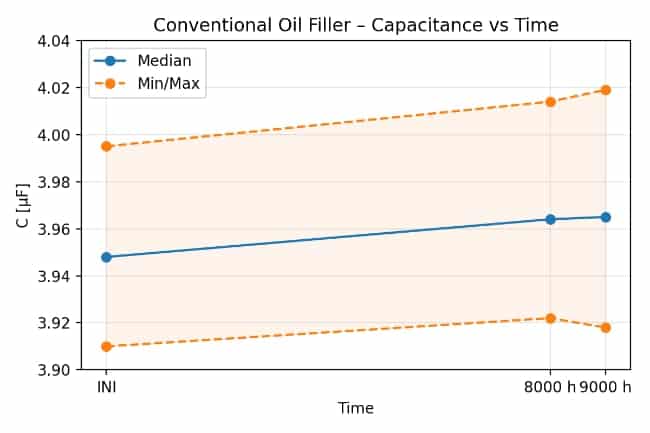
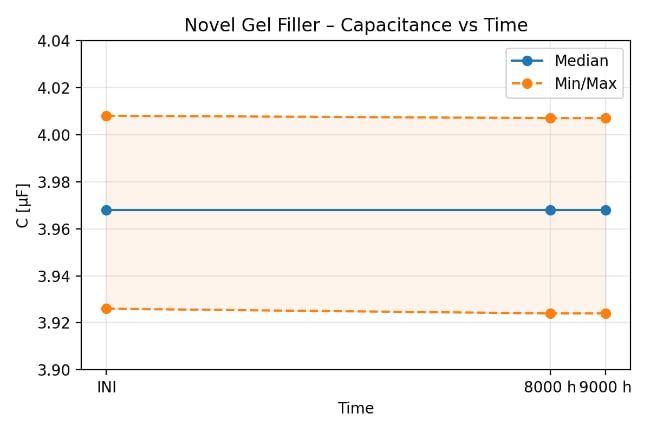
Capacitance and DF stability 85C 9000hrs – Comparison of Conventional Oil Filler with the New HYDRA Gel
The new filler results are quite impressive compared to traditional oil filling. Capacitors filled with Hydra gel show similar or even lower dissipation factor values after thousands of hours of testing at 85C life test (see the results below). This indicates that the insulation properties of the gel filler remain stable even after accelerated lifetime testing and exceeds capabilities of the conventional filler material.
Self-heating test
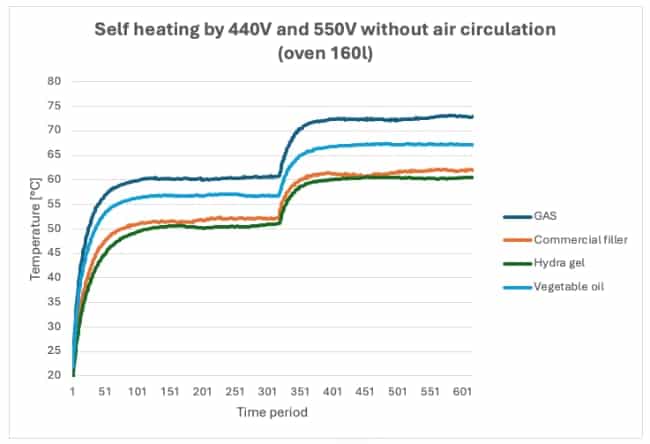
The heat conductivity of the new filler (cooling properties) can be verified at self-heating test of capacitor. The tested unit is put into the oven, and the temperature is controlled by thermocouples. Because nitrogen is a good thermal insulator, nitrogen-filled capacitors tend to run hotter internally, analogous to the insulating effect of air in a double-glazed window. In contrast, oil and gel fill the gap between winding and case with a thermally better medium, reducing the temperature rise at the dielectric hot spot. The test capacitors were filled by three different fillers:
Test parameters:
- test capacitor: PFC capacitors type PRB DPMd 20 / 440D / 2099 (three phase, 20 kvar, 440 V) with various fillers
- load voltage: 1.25*Un =550V
- test duration: 96 hours
Results
The thermocouple is located inside the capacitor close to the hot spot and measures internal test capacitor temperature. The better the thermal conductivity of the filler, the more heat will be dissipated, optimizing capacitor’s life. The lower the internal temperature, the better.
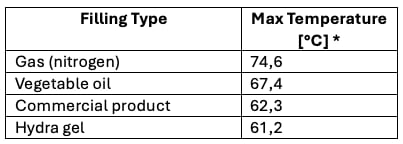
* Note: thermocouple is located inside the capacitor close to the hot spot
Destruction test
The destruction test was performed to compare the environmental pollution caused by the capacitor when exploded because handled incorrectly. The test samples of motor capacitor (S2) were manufactured without a safety disconnector so that differences in the behaviour of the filling during explosive disruption could be observed.
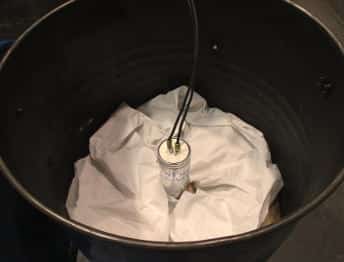
Results
After the oil-filled test specimen exploded, numerous oil droplets were scattered throughout the test barrel (top image below). In contrast, the area around the gel-filled specimen remained clean (bottom image).
Summary
Hydra has introduced a proprietary soft gel filler for its protected metallized polypropylene film capacitors that combines oil-like dielectric strength and cooling with the safer handling and environmental profile of dry designs. The gel, based on vegetable oil, additives and isocyanate, fills the gap between winding and metal can to improve insulation robustness, heat dissipation, moisture protection and failure cleanliness in PFC, motor run and filter capacitors. Long‑term tests on PRB three‑phase PFC units and S2 motor run capacitors demonstrate stable capacitance and low dissipation factor over wide temperature ranges and thousands of hours at 85 °C, with performance matching or exceeding conventional oil‑filled capacitors. Self‑heating measurements confirm lower internal hot‑spot temperatures for gel‑filled units versus nitrogen‑filled designs, directly supporting higher reactive power density or longer life in compact cabinets. Destruction tests further show that, unlike oil‑filled parts which scatter droplets, gel‑filled capacitors fail with minimal leakage and contamination, enhancing system safety and easing enclosure design.
Conclusion
Hydra’s novel gel filler effectively closes the gap between traditional oil‑impregnated and dry resin/nitrogen‑filled film capacitors by delivering high dielectric strength, better thermal conductivity and robust moisture sealing together with RoHS‑compliant, low‑pollution failure behavior. For design engineers specifying PFC, motor run or AC filter capacitors in thermally and environmentally demanding applications, the gel‑filled Hydra range offers a practical path to increase reliability and power density while reducing environmental and safety risks associated with oil‑filled solutions.
Source
This article is based on the manufacturer’s technical and test information about Hydra’s new gel filler for protected capacitors, including descriptions of material composition, long-term testing, self-heating measurements and destruction tests, as provided in the official press material and datasheets.
References
- Hydra official press material on gel filler for protected capacitors
- Hydra power factor correction capacitors overview
- Hydra motor run capacitors overview

