




This article provides technical insights into four innovations shaping next‑generation high‑speed systems that was presented by Samtec in its blog.
Introduction
As signaling rates push beyond 100 Gbps per lane and approach 448 Gbps, system designers face challenges in electrical loss, thermal management, and reproducible validation. Four complementary technologies — Glass Core Technology (GCT), Nitrowave cable assemblies, optical transceivers, and co‑packaged connectivity — provide a toolkit for addressing these hurdles. Each targets a different segment of the signal path, collectively improving signal integrity, reliability, and manufacturability.
Glass Core Technology (GCT)
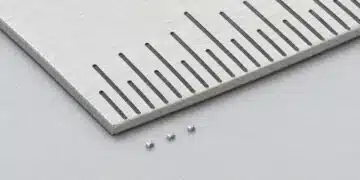
Glass substrates are transitioning from experimental to production‑ready. Their low dielectric constant reduces insertion loss, while thermal expansion closely matches silicon, improving reliability in die‑to‑package connections. Through‑glass vias and redistribution layers enable high‑density fan‑out, critical for advanced packaging and co‑packaged optics.
Engineering insight: At 448 Gbps, even picosecond mismatches matter. Using glass substrates can reduce equalization complexity, simplify channel design, and stabilize manufacturing tolerances.
Nitrowave Cable Assemblies
High‑frequency test environments demand cables that maintain predictable propagation delay under flexure. Nitrowave assemblies deliver phase stability, low insertion loss, and tight tolerance up to 110 GHz. Their construction ensures consistent results across labs, eliminating variability that can obscure true device performance.
Engineering insight: Two labs testing the same SerDes may see divergent results if cables differ. Phase‑stable designs remove this variable, saving time and reducing troubleshooting cycles.
Optical Advancements
Electrical channels are reaching practical limits, making optics essential for extending bandwidth. Halo optical transceivers achieve extremely low bit error rates at 112 Gbps PAM4, while supporting pluggable integration with interchangeable copper options.
Engineering insight: Optics should offload long‑reach, high‑loss paths, allowing equalization to remain within the ASIC or short‑channel package. This reduces power consumption and complexity while maintaining low BER at higher symbol rates.
Co‑Packaged Connectivity
Co‑packaging redefines where electrical‑to‑optical conversion occurs. By placing transceivers or short copper channels closer to the ASIC, designers reduce electrical path lengths, improving eye height and simplifying routing. These designs demand careful thermal management and mechanical alignment but enable higher per‑lane rates and tighter integration.
Engineering insight: Co‑packaging shifts complexity rather than eliminating it. Designers must consider serviceability, substrate integration, and long‑term thermal paths to ensure reliability.
Complementary Ecosystem
| Technology | Contribution |
|---|---|
| Glass Core Technology | Reduces loss, improves thermal match, supports dense redistribution layers |
| Nitrowave cables | Provides stable, reproducible measurement paths across labs |
| Optical transceivers | Extends bandwidth beyond electrical limits, reduces equalization load |
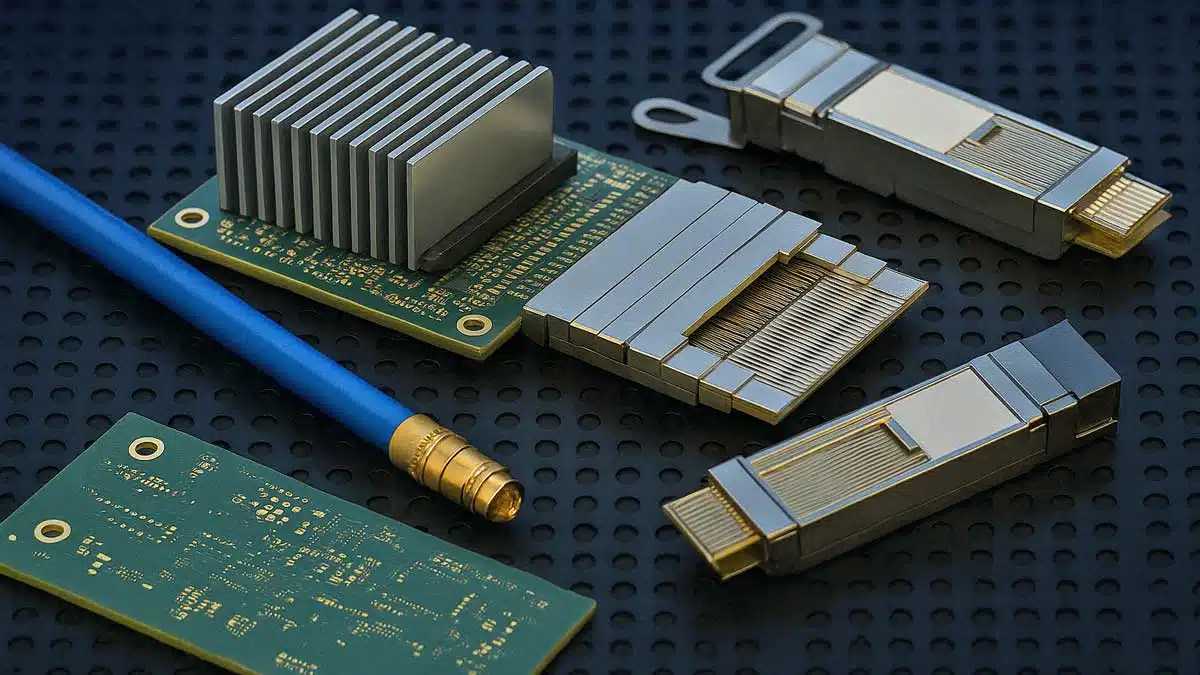
| Co‑packaged connectivity | Shortens electrical paths, enables higher lane rates and tighter integration |
Forward‑Looking Notes
These technologies are not isolated solutions but part of a broader ecosystem. Material innovation, cable engineering, optics, and packaging converge to deliver measurable improvements in system performance. As designs scale from 224 Gbps to 448 Gbps per lane, lessons learned in test environments and pilot deployments will inform mainstream adoption.
Conclusion
These four technologies illustrate how material innovation, cable engineering, optics, and packaging converge to address challenges in high‑speed system design. Their combined use improves signal integrity, reliability, and overall system performance.
Source: Samtec Blog – “Top Samtec Technologies for 2025”