
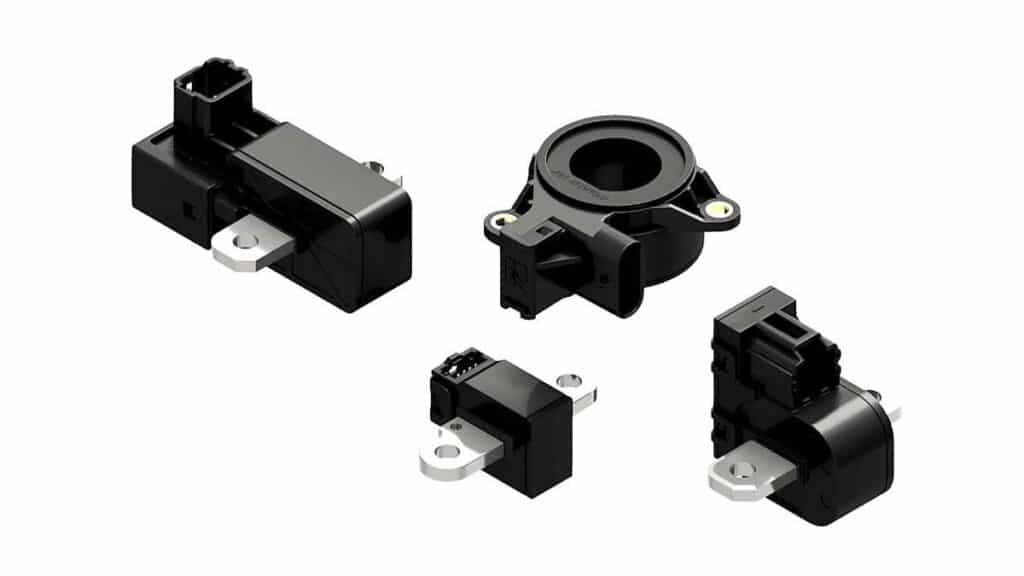
Littelfuse releases a new family of six open-loop hall-effect current sensors that delivers accurate, isolated current measurement with analog or digital outputs for next-generation electric and hybrid vehicles.
Littelfuse, Inc., a diversified industrial technology manufacturing company empowering a sustainable, connected, and safer world, announced the release of six new automotive current sensors designed to enhance electric and hybrid vehicle performance, efficiency, and functional safety. (View the video in English, Chinese, and Japanese)
The new Littelfuse automotive qualified sensors provide precise, isolated current measurement across battery-management, motor-control, and pyro-fuse safety systems. Utilizing open-loop hall-effect technology, the sensors deliver reliable performance in compact, bus-bar-mounted form factors. Output configurations include analog-voltage and digital (CAN/LIN) communication, giving system designers flexibility in integrating with existing EV architectures.
As EV and hybrid systems evolve, engineers face growing demands for high accuracy, fast response, and compliance with functional-safety standards. This new current-sensor family helps OEMs and Tier 1 suppliers meet those challenges by offering scalable, ASIL-capable solutions that simplify design while improving efficiency, safety, and overall system reliability.
High-Accuracy, Scalable Design
Across the automotive qualified product family, nominal current ranges extend up to ±1500 A, with best-in-class total-error performance and minimal thermal drift. Models featuring CAN 2.0B communication include AUTOSAR E2E Profile 1A diagnostics and ASIL-C-capable current measurement, enabling integration into safety-critical systems such as battery control or disconnect units.
Product Families and Key Differentiators
- Battery-Management Sensors – CH1B02xB, CH1B032B, CH1B040B
High-accuracy analog or CAN-based current measurement up to ±1500 A for BMS, dc link, and HV junction boxes. - Motor-Control Sensors – CH1B02xM, CH1P01xM
Compact, low-noise, ratiometric-analog devices up to ±1500 A (±900 A for CH1P01xM) supporting fast-switching inverter applications. - Pyro-Fuse Trigger Module – CH1B050P
Intelligent, fast-response design directly triggers the pyro-fuse within microseconds—more than three times faster than conventional architectures.
Applications
- Battery management systems (BMS)
- Motor inverters
- HV junction boxes
- Power relay assemblies
- Starter generators
- Dc/dc and ac/dc converters
- Pyro-fuse and battery disconnect modules
Complementary System Integration
Littelfuse current sensors complement its portfolio of high-voltage circuit-protection and power-control components—including fuses, contactors, thyristors, and TVS diodes—to create complete system-level solutions for electric- and hybrid-vehicle design.

