
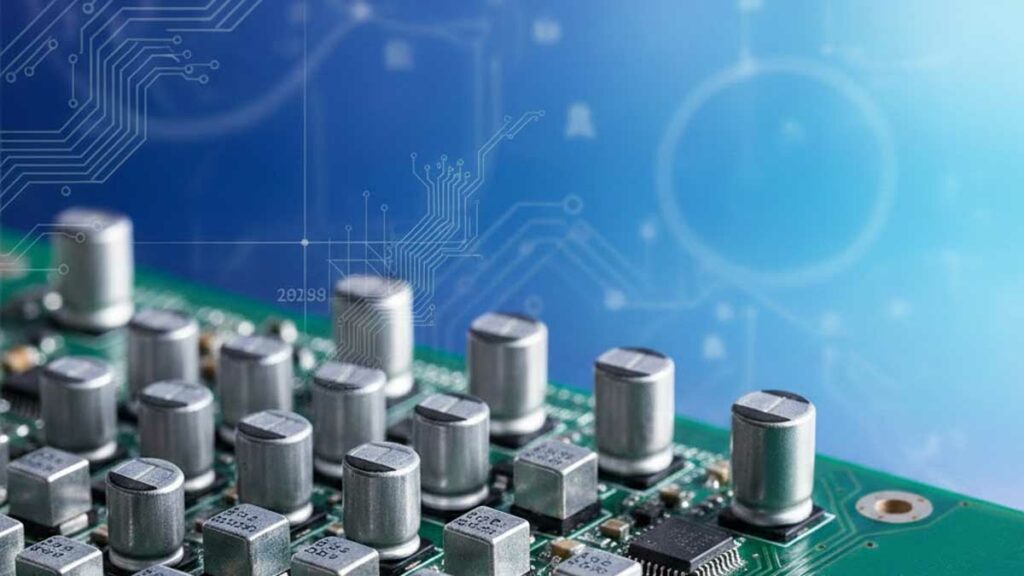
The latest market outlook from Astute Analytica highlights conductive polymer capacitors as a core enabling technology for AI servers, EV powertrains and advanced automotive ECUs over the next decade.
With rapid growth projected from 4.89 billion USD in 2025 to 12.08 billion USD by 2035, these components are moving from niche to mainstream in high‑reliability power electronics and digital systems.
Key trends in the global market
The global conductive polymer capacitor market is projected to grow from 4.89 billion USD in 2025 to 12.08 billion USD by 2035, corresponding to a CAGR of about 10.62% over the forecast period. This growth is primarily linked to the power density requirements of AI data centers and the electrification and digitization of vehicles. The industry is also seeing a structural transition away from traditional liquid electrolytics towards solid and hybrid polymer technologies in both computing and automotive applications.
Asia‑Pacific currently dominates production capacity at around 72%, while North America leads demand on the AI and high‑performance computing side. Automotive and electronics (consumer and industrial) form the largest end‑user segments, with additional demand from IT and telecommunications, power and energy, healthcare and aerospace and defense.
Why conductive polymers are displacing legacy electrolytics
The core technical driver behind polymer adoption is the combination of ultra‑low equivalent series resistance (ESR) and improved reliability under thermal and electrical stress. Typical ESR values in the 3–9 mΩ range enable stable support of fast load steps, such as 1,000 A/µs current transients in advanced GPU and FPGA power rails, where conventional liquid electrolytics struggle with heating and voltage droop. For AI servers, a single system may use 300–600 aluminum polymer capacitors to buffer power for GPUs rated up to about 1,200 W per chip.
In addition to ESR, endurance and temperature capability are steadily improving. Panasonic’s KX series SP‑Cap offers 5,500 hours at maximum rated temperature of 125 °C with ESR as low as 9 mΩ and a maximum height of 1.9 mm, while Nichicon’s GXC series targets 4,000 hours at 135 °C with significantly higher permissible ripple currents than previous generations. For harsh environments, new moisture‑resistance testing at 85 °C and 85% relative humidity for 1,000 hours is becoming a benchmark for industrial‑grade polymer products.
Market structure by technology and form factor
Product types and anode materials
Aluminum‑based conductive polymer capacitors dominate the market by both product type and anode material, each segment representing roughly 77.8% share in the latest breakdown. Solid polymer aluminum, hybrid aluminum electrolytic, and conventional electrolytic constructions all coexist under this umbrella, giving designers a wide choice of cost, performance and reliability points within the same basic technology.
Tantalum and niobium polymer capacitors remain important in specific niches.
Shapes, capacitance and voltage ranges
On the mechanical side, chip‑shaped devices hold more than 71% of the market, reflecting the pervasive move to surface‑mount assembly and dense layouts. Leaded and large can shapes remain relevant for bulk power, industrial and some automotive applications where board height or mounting constraints favor them.
The 100–150 µF capacitance range stands out with the largest single share at about 37.04%. In practice, these values are widely used as modular building blocks for parallel arrays in high‑speed digital power delivery, where multiple mid‑value parts in parallel reduce ESL and loop inductance better than a single large capacitor. Voltage ratings between 25 V and 100 V account for roughly 61.89% of the market, aligning with common intermediate bus voltages in data centers and many industrial systems.
At the low‑voltage end, the below‑25 V segment is experiencing the fastest demand growth, tied to USB Power Delivery ecosystems (5, 9, 15 and 20 V profiles) and 12 V automotive cockpit electronics. Polymer dielectrics are most economical and technically manageable below about 35 V, reinforcing this sub‑25 V segment as a volume sweet spot for mass‑market applications.
Application hotspots: AI servers, EVs and beyond
AI data centers and high‑performance computing
Modern AI server racks are projected to reach around 50 kW per rack by 2027, with Open Rack V3 power shelves targeting up to 180 kW outputs on high‑voltage DC distribution and an intermediate 54 V bus to cut conduction losses. In such systems, polymer capacitors are used extensively on 12 V and 48–54 V intermediate rails to stabilize rapid load transients from AI accelerators, which can ramp hundreds of amps per microsecond.
This step‑change in power density, combined with AI workloads consuming roughly five times more power per server than general‑purpose nodes, magnifies the role of ultra‑low‑ESR polymer capacitors. Their ability to handle high ripple currents in compact footprints is critical when data center power demand in the U.S. alone is tracked at about 176 TWh, with forecasts rising to around 325 TWh by 2028.
EV zonal architectures and automotive ECUs
Electrified vehicles are another major growth engine, with an EV now integrating on the order of 10,000–22,000 capacitors, compared with roughly 3,000 in a conventional internal combustion vehicle. As automotive platforms migrate to zonal ECU architectures and 48 V mild‑hybrid systems, polymer capacitors are increasingly deployed in zone controllers, powertrain inverters and cockpit electronics.
New automotive‑grade polymer and hybrid polymer capacitors are being qualified for operation from −55 °C up to as high as 150 °C, with some products tested to withstand up to 2,000 V in powertrain use cases. In addition, hybrid polymer aluminum series such as Nichicon GXC cover 25–63 V with capacitances from 33–470 µF and leakage currents in the tens of microamperes, aligning with 12 V and 48 V automotive nets. This capability is crucial as the automotive ECU market is projected toward values above 11 billion USD by 2033, and as Automotive Ethernet links reach 10 Gb/s requiring robust decoupling and filtering on high‑speed PHYs.
USB‑C chargers, industrial systems and consumer electronics
In the consumer and industrial domains, the combination of USB‑C Power Delivery standardization and compact, high‑efficiency GaN power stages is a strong catalyst for polymer adoption. GaN‑based chargers and adapters switch at high frequencies and require capacitors that maintain capacitance at elevated temperatures while dissipating heat efficiently; layered aluminum polymer constructions are noted for better thermal behavior than molded tantalum in such use cases.
Industrial electronics, 5G infrastructure and telecommunications gear also rely on polymer capacitors for filtering, energy storage and smoothing circuits, which collectively represent a major application segment capturing around 36.89% of demand. In these systems, polymer parts are often favored where high ripple, long life at elevated temperature and stable impedance characteristics over frequency are critical design priorities.
Design‑in notes for engineers
Selecting between aluminum, tantalum and hybrid polymers
For most new high‑reliability power designs, aluminum polymer capacitors will be the default choice due to their balance of low ESR, high ripple capability, cost and favorable sourcing profile. They are particularly suitable as output capacitors in DC‑DC converters, intermediate bus filtering on 12–54 V rails, and decoupling on high‑current digital loads.
Tantalum and niobium polymer capacitors may still be attractive where high volumetric efficiency at lower voltages is essential and the application is well understood from a derating and surge perspective. Hybrid polymer aluminum capacitors provide an intermediate option, offering improved ripple and ESR over standard electrolytics while retaining some of the voltage headroom and robustness of liquid designs; these devices are increasingly used in automotive environments up to 63 V, particularly in 48 V subsystems. Specific voltage and ripple ratings should always be confirmed against the manufacturer datasheet for the exact series and case size under consideration.
ESR, capacitance and parallelization strategy
In practical PCB design, the very low ESR of modern polymer series (down into the 3–5 mΩ range for some chip types) allows designers to meet transient response requirements with fewer parallel parts than with conventional electrolytics. However, the inductive component of impedance still favors using multiple capacitors distributed physically close to the load. The dominance of the 100–150 µF range in market statistics reflects this practice: arrays of mid‑value parts give good control over loop inductance and layout‑driven impedance.
When dimensioning the power delivery network for GPUs, FPGAs or high‑end CPUs, it is often effective to combine several 100–150 µF polymer capacitors with smaller MLCCs to shape impedance over a wide frequency band. The parallel configuration also improves redundancy: the failure of a single capacitor has a smaller impact on overall capacitance and ESR, which is important in systems where uptime and graceful degradation are key. Target ESR and total capacitance should be calculated from the transient load profile and validated in simulation and hardware measurements.
Thermal management, endurance and derating
Endurance figures such as 4,000 hours at 135 °C or 5,500 hours at 125 °C should be interpreted in the context of realistic operating temperatures in the application. In many server or telecom systems, actual capacitor body temperatures will be significantly below the specified maximum, resulting in much longer expected lifetimes when extrapolated via typical acceleration models. For automotive under‑hood locations or tightly packed AI accelerators, however, designers should assume higher self‑heating due to ripple and proximity to hot components.
Voltage derating remains important even for polymer capacitors. Although some series are tested at high surge voltages (for example up to 2,000 V in specific automotive powertrain applications), typical design practice is to operate well below the nameplate voltage to account for transients, aging and temperature effects. For 12 V automotive lines, capacitors rated 16–25 V are commonly used to provide adequate margin against load dump and jump‑start events, while 48 V systems often rely on 63 V or similar ratings. Exact derating guidance should follow the manufacturer’s application notes and qualification data for the chosen series.
Layout, case sizes and miniaturization
Miniaturization trends highlighted in the market report, such as Murata’s ECAS series achieving 4.5 mΩ ESR with up to 470 µF in a D‑case (around 7.3 × 4.3 mm, low profile), underline the importance of careful layout. Low‑profile packages with heights around 1.2–1.9 mm are particularly suitable for high‑density boards, blade servers and ultrabooks where z‑height is constrained. At the same time, these components should be placed as close as possible to power pins of high‑current ICs to minimize inductive parasitics.
For high‑current rails (up to approximately 1,000 A in AI processors), distributing multiple chip capacitors around the load and along the power planes can significantly improve transient behaviour. Designers should also consider mechanical aspects: chip‑shaped polymer capacitors offer good automated assembly characteristics but still require appropriate land patterns and soldering profiles to avoid cracking or delamination, especially in automotive applications with high vibration and wide temperature excursions. Exact pad design, reflow conditions and board support recommendations can be found in the relevant manufacturer datasheets and mounting guidelines.
Supply chain and purchasing considerations
From a purchasing perspective, the average capacitor lead times is reported of about 19 weeks as of late 2025 across technologies, with aluminum snap‑in capacitors extending to around 27 weeks and polymer tantalum lead times lengthening by roughly 8–10 weeks due to AI infrastructure demand. These figures indicate that critical polymer series for data center and automotive programs should be forecast and secured early in project planning.
At the same time, major manufacturers are investing heavily in capacity expansion: for example, Murata has announced around 305 million USD (about 45 billion JPY) of investment in MLCC and polymer production in China, with typical factory build‑out timelines of 18–36 months. This suggests that supply constraints may gradually ease, but procurement teams should still consider multi‑sourcing across vendors such as KEMET YAGEO, KYOCERA AVX, Vishay, Panasonic, Nippon Chemi‑Con, Murata, TAIYO YUDEN and others where cross‑qualified equivalents exist.
Source
This article summarizes and interprets the findings of a recent conductive polymer capacitor market report and press release issued by Astute Analytica, with additional commentary aimed at design engineers and component purchasers. Exact numerical values and segmentation details referenced here are as reported in that source or in the associated market study material.
References
- Latest Conductive Polymer Capacitor Market Projected to Reach US$ 12.08 Billion by 2035 | Astute Analytica (GlobeNewswire)
- Astute Analytica – Conductive Polymer Capacitor Market (industry report overview)

