
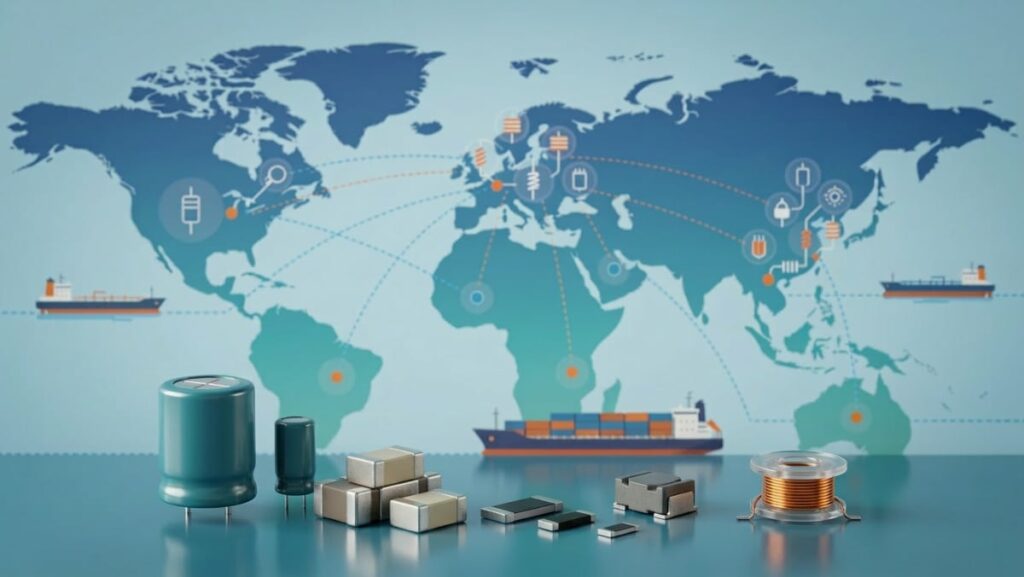
This article, based on multiple sources, study how the current Middle East conflict, through its impact on oil, petrochemicals and logistics, is potentially influencing costs, risks and regionalization in the passive components supply chain. Updated 23rd March 2026.
The renewed conflict in the Middle East is reshaping global energy and petrochemical flows, with implications that reach beyond the semiconductor fabs currently in the spotlight. Passive components—capacitors, resistors, inductors and circuit protection devices—sit downstream of the same energy, chemical and logistics networks, and are therefore exposed to many of the same structural pressures.
So far the impact on passives has been manageable, but a mix of higher energy prices, tighter petrochemical markets and shifting trade lanes is quietly changing how—and where—these essential components are manufactured and supplied. At the same time, aluminum price volatility and higher aluminum foil costs are beginning to surface in the aluminum capacitor chain, with Taiwanese and Japanese manufacturers reportedly moving to raise prices.
Oil, Gas and the Petrochemical Backbone of Passives
The conflict has underlined how central the Middle East remains to oil and gas supply, particularly via the Strait of Hormuz. Rising crude and gas prices are pushing up energy and feedstock costs for chemical producers worldwide, especially in Europe and Asia.
For the passive components industry, many critical materials trace back to these petrochemical chains:
- Epoxy and polyimide resins used in FR‑4 and high‑speed PCB laminates that host most SMD passives.
- Polyurethane, epoxy and other encapsulation systems used in molded inductors, power resistors, film capacitors and relays.
- Engineering plastics for component housings, terminals and power modules.
Market data already show conflict‑linked moves. In the US, polyurethane resin prices rose about 8.9% in a single week in March 2026 as higher naphtha‑based feedstock and energy costs fed through to isocyanates and polyols. European epoxy producers are facing similar cost pressure, with analysts expecting March pricing to reflect higher oil and gas input costs. For the passive components value chain, that translates into more expensive laminates, encapsulants and molded parts.
Bromine, Flame Retardants and Regional Exposure
The conflict also intersects with specialized materials. Helium and bromine are often cited as examples where Middle East and nearby producers play an outsized role in electronics materials.
Although classic polybrominated flame retardants targeted by RoHS (such as PBB and PBDE) have been phased out of compliant mass production, bromine‑based systems have not disappeared entirely; they remain widely used as reactive flame retardants in PCB laminates and some plastics, while many passive component bodies themselves have migrated toward low‑halogen or halogen‑free formulations.
Bromine and brominated flame retardants particularly relevant for passives:
- Widely used in PCB laminates, housings, connectors and some molded component bodies to meet flammability standards.
- Produced at scale around the Dead Sea in Israel and Jordan, with exports into global flame‑retardant and chemical markets.
ICL, for example, highlights brominated flame retardants as a core solution for electrical and electronic applications, including PCBs and connectors. Jordan Bromine operates as a major bromine producer with a global reach from the Dead Sea. While bromine prices in Israel have been relatively stable and producers are signaling resilience, market observers note that geopolitical tension increases the risk of future volatility.
For passive components, the dependence is mostly indirect—through laminate and compound suppliers—but the concentration of upstream bromine production in a sensitive region is an exposure that purchasing and risk teams are now monitoring more closely. Nevertheless this does not impact passive component mould resins that already replaced the bromine flame retardants with more RoHS friendly materials.
Polymers, Resins and Coatings: Tighter Markets, Not Collapse
Polymer and resin markets are an early barometer for downstream industries. Recent reports indicate:
- Polymer trade to the Americas from Asia and the Middle East has slowed, with some suppliers temporarily suspending offers as they reassess freight and risk.
- In Europe, higher oil and gas prices are shaping epoxy and related resin pricing as producers seek to pass through part of their increased cost base.
- Gulf and Middle East producers of polymers and intermediates face uncertainties around gas feedstock and port logistics, but major long‑term disruptions have not materialized so far.
For passive components, this suggests firmer prices and possible lead‑time extensions for:
- Epoxy systems used in laminates and potting compounds.
- Polyurethanes and other encapsulants used in power and industrial components.
- Coatings and specialty resins used for conformal coatings and high‑reliability passives.
This is a story of tighter markets and higher volatility rather than broad‑based shortages: regional imbalances, freight frictions and a more variable cost base that needs to be reflected in contracts.
Aluminum Prices and Aluminum Capacitors
Beyond oil‑linked polymers, the recent spikes in aluminum prices and foil costs are an additional cost driver for aluminum capacitors, especially in Taiwan and Japan, and may translate into selective price hikes or tighter quotes from these suppliers.
Over the past year, LME aluminum prices have rebounded to multi‑year highs and are expected to remain elevated or volatile into 2026 as the market shifts toward tighter supply–demand balances. This is now visible upstream in aluminum foil, where rising foil quotations are pushing Taiwanese and Japanese aluminum capacitor manufacturers to implement price increases and adjust contract terms. For buyers, this means that can‑type aluminum capacitors face an additional cost‑push factor beyond energy, logistics, and labor, with a higher risk of selective price hikes, shorter quote validity, and tighter allocation on specific high‑volume or large‑can product lines. In design and sourcing decisions, aluminum capacitor users should therefore anticipate less pricing visibility for 2026, consider alternative suppliers or technologies where feasible, and review buffer‑stock strategies for critical series that are heavily exposed to aluminum foil costs.
Helium, Semiconductors and Knock‑On Effects for Passives
The latest escalation also introduces a new chokepoint that sits one step upstream of passive components: helium supply to advanced semiconductor fabs. Qatar normally accounts for roughly one‑third of global helium production, and the shutdown of its Ras Laffan helium plants—combined with shipping disruption around the Strait of Hormuz—has abruptly removed a significant share of the market at a time when AI and high‑performance computing are driving steep growth in helium demand from leading‑edge logic and memory lines. For the passive components industry, the impact is initially indirect but material: any sustained helium shortage that forces fabs in Korea, Taiwan or the US to slow wafer starts, prioritize high‑margin devices or delay capacity ramps will translate into slower unit growth for servers, AI accelerators, networking, storage and advanced automotive electronics, and with it a softer pull on the associated MLCC, resistor, inductor and protection content per box. If the disruption is prolonged, the sector could see a repeat of past patterns: localized shortages and allocation on certain high‑reliability or automotive ICs, program delays at EMS and Tier‑1s, and a more volatile ordering cadence for passives as customers re‑schedule builds and adjust buffers around IC availability rather than passive manufacturing constraints.
Logistics, Freight and Lead Times
Beyond materials, logistics are a key transmission channel. The conflict has increased risk premiums on shipping routes in and around the Persian Gulf and Red Sea, prompting route and schedule adjustments.
Scenario analyses highlight:
- Elevated oil prices and insurance premiums likely persisting for at least several weeks even in short conflict scenarios, keeping transport costs above prior levels.
- Shipping disruptions and higher freight rates potentially lasting a few months if vessels continue to avoid high‑risk corridors or port operations are periodically interrupted.
Passive components are typically shipped by ocean because of their relatively low value density. Any rise in bunker fuel costs, freight rates or transit times has a tangible effect on landed cost, particularly for high‑volume, low‑margin lines such as chip resistors and commodity MLCCs. So far, the response has been cautious: some exporters have held back offers while reassessing costs, and some buyers have delayed purchases to see where prices settle.
Demand‑Side Trends: Data Centers and Electrification
On the demand side, the conflict interacts with existing secular drivers. Analysts warn that sustained high energy prices could lift operating costs for AI data centers, which are significantly more power‑intensive than conventional facilities. This may slow some projects, but it also reinforces investment in energy efficiency and power management within those same facilities.
At the same time, higher energy costs and renewed focus on energy security tend to support:
- Electrification of transport and industry.
- Factory and building automation and efficiency upgrades.
- Grid modernization, renewables integration and storage.
These are all applications that rely heavily on power film capacitors, current‑sense resistors, magnetics, filters and surge protection devices. In aggregate, the environment remains supportive for passive components demand, even if the geographical distribution of projects shifts.
Regionalization: APAC, Europe and the Americas
A central theme in broader electronics coverage is regionalization—less reliance on single long, global chains and more emphasis on regional clusters. Analysts see the conflict reinforcing existing moves toward:
- Greater use of regional energy and chemical suppliers where feasible.
- A more balanced manufacturing network, with APAC, Europe and the Americas each serving a larger share of local demand.
- Increased dual sourcing and geographical diversification for key materials and components.
For passives, this points to:
- Incremental expansion of MLCC, resistor and inductor capacity closer to major automotive and industrial hubs in Europe and North America, complementing established Asian capacity.
- More local sourcing of laminates, plastics and encapsulants where regulatory and cost conditions allow.
- Design and qualification strategies that deliberately include suppliers in multiple regions to reduce exposure to any single route or hotspot.
This is evolution rather than abrupt relocation: Asia will remain a dominant base, but new investments and AVL strategies are increasingly region‑conscious.
Practical Steps for Stakeholders
Across the passive components chain, the focus is on resilience and transparency rather than alarm.
For manufacturers:
- Map materials in depth: Trace resins, flame retardants, copper foils and gases back to origin to understand indirect exposure to Middle East‑linked feedstocks and chokepoints.
- Engage chemical suppliers early: Regular dialogue with epoxy, polyurethane and laminate producers can provide early warning on supply or pricing shifts.
- Prepare alternates: Qualify second‑source laminates, encapsulants or plastics (including different flame‑retardant chemistries) to reduce dependence on specific regional production bases.
For OEMs, EMS and distributors:
- Classify passives by criticality and risk: Identify safety‑relevant and high‑reliability parts versus easily substitutable commodities; align inventory and sourcing strategies accordingly.
- Coordinate with PCB and semiconductor strategies: Passives share upstream materials and logistics with boards and ICs; risk assessments should be integrated rather than siloed.
- Maintain balanced buffers: Calibrated buffer stocks for critical passives, combined with flexible sourcing, can offer protection without tying up excessive capital.
A Measured, Long‑Term Challenge
For passive components, the Middle East conflict is not (today) a standalone crisis, but it is a clear signal that energy, chemicals and logistics risks are now a permanent part of the planning landscape. Companies are dealing with higher and more volatile input costs and some freight friction, but the sector continues to operate and supply customers globally.
The more important consequences are likely to be structural: a gradual push toward regionalization, diversified sourcing of specialized materials, and closer integration of supply‑chain risk into product design. For an industry that has already weathered past cycles of volatility, the current environment is an opportunity to refine proven tools—dual sourcing, flexible design‑in, collaborative planning—and build a more resilient foundation for the next phase of electronics growth.
References
- EE Times – Middle East Conflict is Rewiring Global Supply Chains
- Digitimes – Aluminum foil costs push capacitor prices higher in Taiwan and Japan
- Z2Data – How the Iran Conflict Is Rippling Across Global Supply Chains
- ChemAnalyst – Middle East Conflict Sparks 8.9% Surge in U.S. Polyurethane Resin Prices
- ICIS – Middle East conflict-driven cost surge to shape EU epoxy March trend
- Plasteurope – Middle East conflict shakes petrochemicals sector
- ICIS – War in the Middle East cools polymer trade in the Americas
- Discovery Alert – analysis on UAE polymer export risks
- ICL Group – Sustainable Flame Retardants Based on Bromine
- Jordan Bromine – corporate information and market positioning
- ChemAnalyst – Israel’s Bromine Price Stabilize Amid Geopolitical Tensions
- CNBC – Iran war: Energy prices, material access threaten semiconductor supply chain
- Logistics Viewpoints – Supply Chain Scenario Analysis: Global manufacturing impacts of a short vs. prolonged U.S.–Iran conflict
- Fortune – Iran war cuts off helium from Qatar, and shortages will start to bite in a few weeks, threatening chip supply chains that fuel the AI boom
- Caixin Global – Qatar Helium Shutdown Adds New Risk to Chip Supply Chain
- MarketScreener / bne IntelliNews – Helium shortage threatens semiconductor industry

