







Modern missile airframes combine multiple RF subsystems into an extremely confined volume, forcing engineers to solve complex filtering, coexistence and survivability challenges at the passive component level.
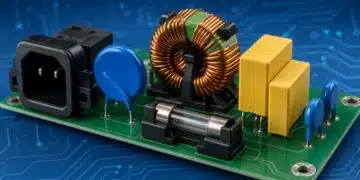
This article based on Knowles edited blog news reviews the seven RF subsystems typically found in a missile and adds a component‑centric perspective on the filters, capacitors, inductors and related passive networks that make reliable operation possible.
Overall RF subsystem landscape in missiles
Missile guidance and control increasingly rely on multi‑mode RF architectures that blend radar seekers, altimeters, proximity sensing, satellite navigation, datalinks, identification friend or foe (IFF) and electronic warfare capabilities within a single airframe.
Each subsystem operates at different frequencies, uses different waveforms and imposes specific demands on the surrounding passive networks, yet they all compete for space, power budget and electromagnetic cleanliness inside the nose and fuselage.
For designers of RF filters and passive components, this convergence translates into stringent requirements on miniaturization, thermal robustness, shock resistance and long‑term stability.
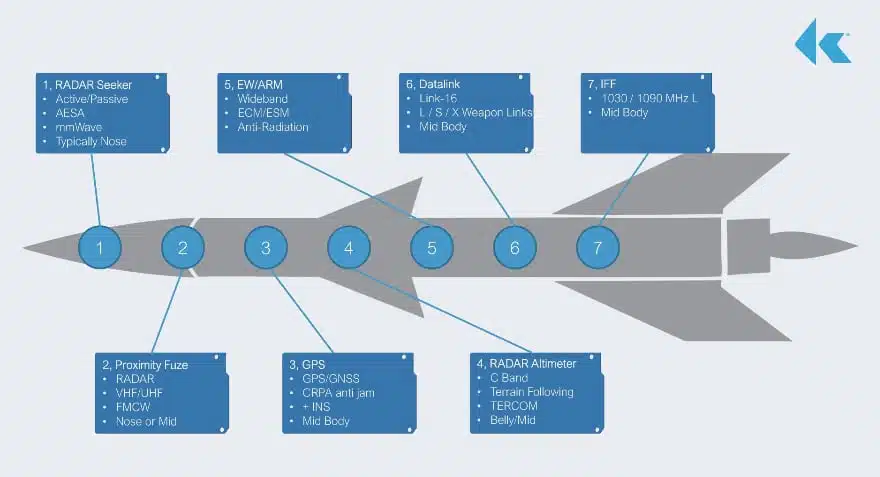
Key RF subsystems and their passive needs
1. Radar seekers
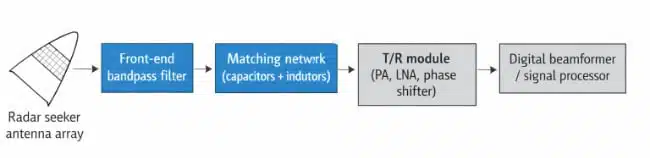
Active electronically scanned array radar seekers have replaced many mechanically scanned architectures and now use hundreds or thousands of transmit modules to achieve inertia‑free beam steering and high‑resolution target discrimination. With a shift towards Ka band and millimetre‑wave operation, narrow beams and tight side‑lobe control depend strongly on low‑loss, high‑Q front‑end filters, matching networks and decoupling components.
Typical passive component requirements in radar seekers include:
- Bandpass and preselector filters with low insertion loss and high out‑of‑band rejection to separate target echoes from clutter and hostile countermeasures.
- Phase‑stable capacitors and inductors in matching networks to preserve beamforming accuracy across temperature and over service life.
- Compact, thermally stable RF filters that fit into each transmit/receive module without degrading SWaP.
2. Altimeters
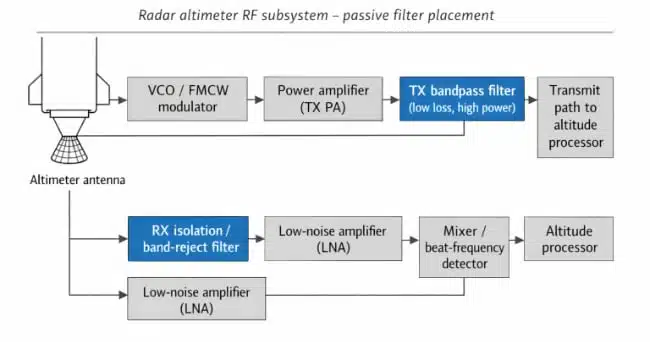
Missile altimeters commonly use C‑band frequency‑modulated continuous‑wave radar as a ground‑facing system in conjunction with navigation sensors to deliver precise altitude information through beat frequency processing. In this architecture, transmit and receive paths share a compact front‑end, so any leakage from transmit to receive can produce erroneous altitude readings or desensitize the receiver.
Key passive roles in altimeter subsystems include:
- Transmit‑path filters that suppress out‑of‑band emissions while maintaining low loss and adequate power handling.
- Receive‑path filters that provide high rejection of residual transmit energy with minimal insertion loss to preserve sensitivity.
- High‑stability capacitors and resonators that keep beat‑frequency processing consistent across temperature cycles and over long‑term storage.
3. Proximity fuzes
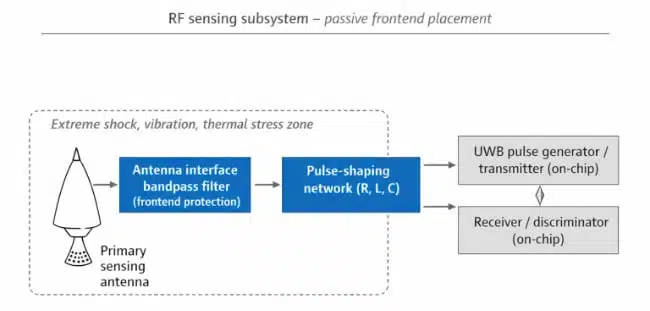
Proximity fuzes use miniaturised short‑range radar sensing to determine the optimal detonation moment, often relying on ultra‑wideband pulse trains and pulse‑position modulation. Much of the signal processing can now reside on‑chip, but off‑chip filters at the antenna interface remain important to control out‑of‑band interference and protect the receiver.
From a passive component perspective, proximity fuzes demand:
- Extremely small, mechanically robust RF filters able to tolerate thousands of g at launch, vibration, thermal shock and high‑g manoeuvres.
- Stable capacitors and inductors in pulse‑shaping networks that preserve waveform fidelity and timing.
- Package and termination systems optimised for survivability near the missile nose, where mechanical stress is highest.
4. GPS and GNSS navigation
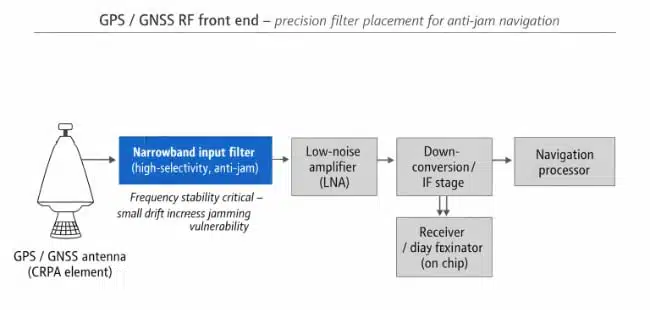
Missile GPS or GNSS subsystems face constant jamming threats, as very weak satellite signals must coexist with strong emitters such as ground‑based jammers operating with kilowatts of power. Anti‑jamming technologies such as specialised codes and controlled reception pattern antennas require high selectivity and stable filters on each antenna element to maintain performance.
Passive components in the navigation front‑end must provide:
- Narrowband filters with steep skirts to admit only the desired satellite bands while rejecting nearby interference.
- Dielectric and resonator structures with excellent frequency stability over temperature, since small drift can open vulnerabilities to jamming.
- Low‑noise, low‑loss matching networks that minimise degradation of overall system noise figure.
5. Datalinks
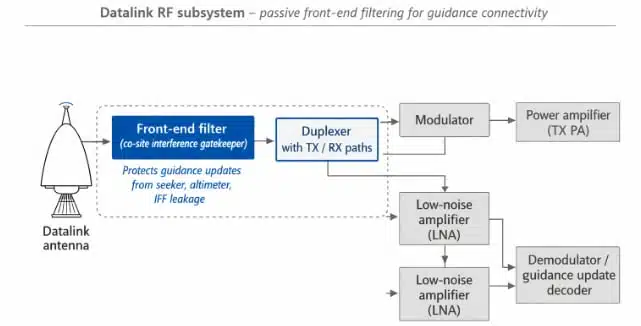
Missile datalinks provide connectivity after launch for in‑flight retargeting, cooperative engagement, seeker cueing and mid‑course guidance updates. Although the onboard receiver may be comparatively straightforward, the surrounding platform environment often contains strong emissions from seekers, altimeters and IFF transponders that can leak into the datalink path.
Critical passive aspects in datalink design include:
- Front‑end filters acting as gatekeepers between guidance updates and a noisy electromagnetic environment, providing adequate isolation from co‑site interference.
- Duplexing and channelisation filters that allow simultaneous transmit and receive operation where required.
- Stable matching networks that maintain linearity and dynamic range for weak signals from distant platforms.
6. IFF transponders
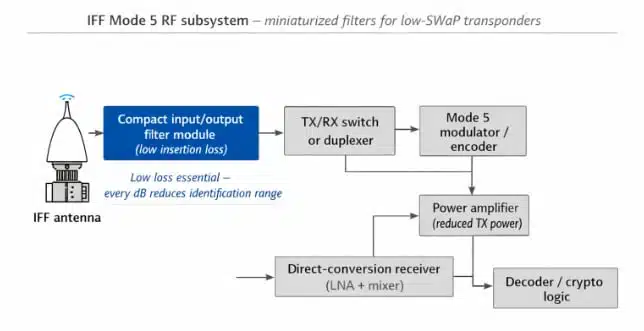
Modern identification friend or foe hardware trends towards miniaturised, low‑SWaP Mode 5 transponders suitable for unmanned aerial vehicles, loitering munitions and other autonomous platforms with no space for traditional box‑level units. Architectures are moving from superheterodyne receivers to direct‑conversion designs to reduce size and power consumption.
Passive component requirements in IFF subsystems include:
- Compact filters with low insertion loss suited to reduced transmit power, since every decibel of loss directly reduces identification range.
- High linearity and good isolation in front‑end filters to prevent self‑interference in direct‑conversion architectures.
- Reliable capacitors and inductors that maintain performance under repeated thermal and mechanical stress in small form factors.
Electronic warfare receivers
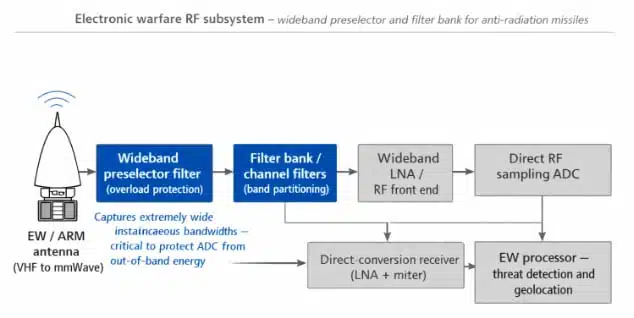
Electronic warfare capabilities allow missiles to operate in congested electromagnetic environments, particularly where adversaries manipulate the spectrum to disrupt communications, radar and navigation. Anti‑radiation missiles must cover an enormous spectral range from VHF through millimetre‑wave frequencies and detect, characterise and geolocate multiple emitters across very wide instantaneous bandwidths.
Passive components in these EW subsystems typically provide:
- Wideband preselector and filter‑bank solutions that protect analogue‑to‑digital converters from overload while rejecting out‑of‑band energy.
- Highly repeatable, temperature‑stable filters compatible with direct RF sampling front‑ends.
- Robust, compact components designed to operate across broad frequency ranges without excessive size or complexity.
Summary table: RF subsystems and passive roles
| Subsystem | Approximate RF role | Key passive functions |
|---|---|---|
| Radar seeker | High‑resolution target detection and tracking | Low‑loss bandpass filtering, phase‑stable matching networks, miniaturised front‑end filters |
| Altimeter | Precise altitude measurement via FMCW radar | Isolation between transmit and receive, low‑loss filters, temperature‑stable resonators |
| Proximity fuze | Short‑range radar‑based detonation timing | Ultra‑robust miniaturised filters, pulse‑shaping networks, stress‑resistant packages |
| GPS/GNSS | Satellite navigation and guidance | Narrowband high‑selectivity filters, frequency‑stable dielectrics, low‑noise matching |
| Datalink | In‑flight communication and retargeting | Front‑end isolation filters, duplexers, linear matching networks in noisy environments |
| IFF | Platform identification via Mode 5 transponder | Compact low‑loss filters, high isolation in direct‑conversion front‑ends |
| Electronic warfare | Wideband threat detection and geolocation | Wideband preselectors, filter banks, temperature‑stable components suitable for direct RF sampling |
Technical highlights: filtering challenges and component choices
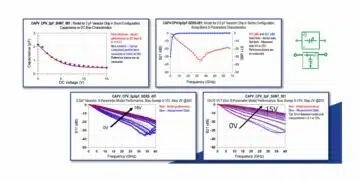
Missile RF subsystems introduce a range of filtering challenges driven by spectral coexistence, adjacent‑band operation and strong self‑generated emissions. Since no single filter technology spans the full spectrum from low VHF up to millimetre‑wave frequencies, designers must combine lumped LC filters, ceramic filters, thin‑film structures, waveguide and cavity filters and integrated on‑chip solutions to cover all bands efficiently.
From a passive component technology standpoint, key considerations include:
- Selection of suitable dielectric and substrate materials for high‑Q filters and capacitors at microwave and millimetre‑wave frequencies.
- Trade‑offs between discrete lumped components and integrated substrates or modules, depending on available space and required performance.
- Long‑term stability and repeatability of filter frequency responses across temperature cycles, vibration and long storage periods typical of missile systems.
Design‑in notes for engineers
For design engineers and component specifiers, the following practical notes can help translate subsystem requirements into concrete passive component choices:
- Prioritise frequency stability in navigation and EW filters, using dielectric systems and resonators specified for tight tolerance over operating temperature.
- Evaluate insertion loss budgets carefully in altimeters and IFF transponders, where small losses directly impact altitude accuracy or identification range.
- For proximity fuzes and nose‑mounted sensors, pay particular attention to mechanical robustness of packages and terminations, as these locations experience the highest shock and vibration.
- Consider modularising filter and matching networks into compact RF subassemblies to simplify layout in crowded missile noses and reduce coupling between adjacent subsystems.
- Work closely with component manufacturers to match ceramic and thin‑film technologies to specific frequency bands, power levels and environmental profiles encountered in missile missions.
Source
This article is based on an official manufacturer blog post about RF subsystems in modern missiles and related product information, adapted and extended for a passive components‑focused engineering audience.