
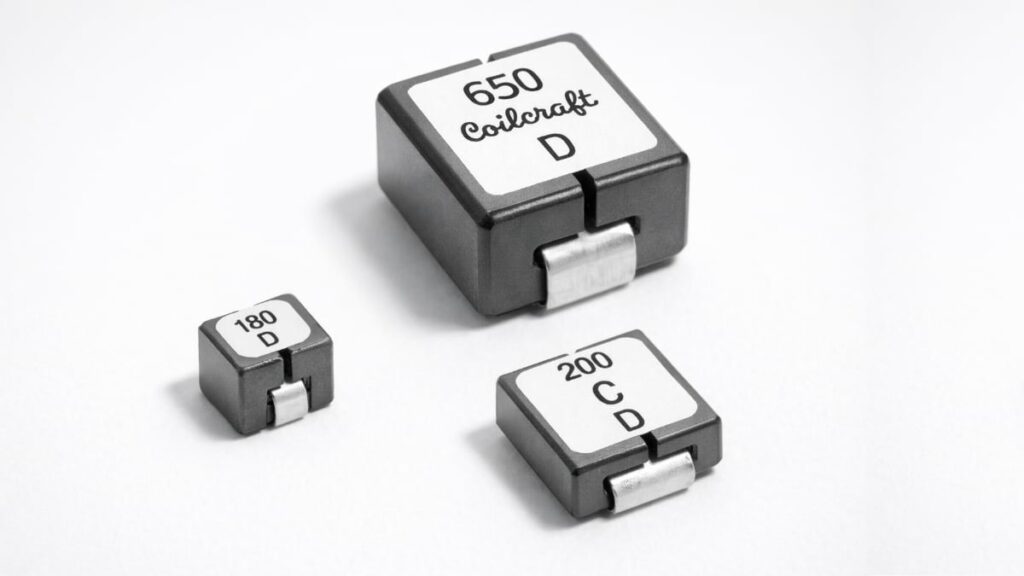
Coilcraft has introduced a family of high-current wirewound ferrite beads designed specifically for power line EMI filtering in applications that must meet CISPR 25 automotive EMC limits.
These surface-mount wirewound ferrite beads components target conducted and radiated emissions from 30 MHz up to 3 GHz on high-current rails, while maintaining low losses and robustness suitable for automotive and other demanding environments.
Key features and benefits
- High-current power line filtering
Designed for DC power rails in the 5 A to 50+ A range, allowing EMI suppression directly on high-current supply lines without resorting immediately to bulky common-mode chokes or off-board filters. According to Coilcraft’s product documentation, these parts are positioned for high current power line EMI filtering in that current window. - Optimized for CISPR 25 EMC compliance
The beads provide broadband impedance in the 30 MHz to 3 GHz band that aligns with typical conducted and radiated emission measurement ranges in CISPR 25, making them suitable as part of an EMC strategy for automotive and transportation ECUs where this standard is referenced. Coilcraft explicitly states that the series is optimized for CISPR 25 EMC compliance across this frequency band. - Wirewound surface-mount construction
These are wirewound ferrite beads, not thick-film multilayer chip ferrites, which typically means higher inductance per volume and lower DC resistance for a given current rating. Coilcraft highlights that the wirewound construction delivers broadband impedance characteristics across frequency, DC current, and temperature. - AEC-Q200 qualified
The high-current ferrite bead series is AEC-Q200 qualified, indicating that it has passed the environmental stress tests required for automotive passive components such as temperature cycling, mechanical shock, vibration, and humidity exposure. This simplifies use in automotive-qualified designs and helps align with OEM and Tier-1 requirements. - Broadband EMI suppression
Wirewound ferrite beads generally provide a combination of inductive impedance and loss across a wide frequency range, so they can help attenuate both narrowband clock harmonics and broadband switching noise present on power rails. Coilcraft’s broader wirewound ferrite bead family is described as providing superior broadband performance compared to traditional chip ferrite beads, which carries over to these high-current parts.
Typical applications
High-current ferrite beads like these are intended to sit in series with power rails and supply lines that experience significant DC current while requiring strict EMI control. Coilcraft positions them primarily for EMI noise cancellation on high-current power lines.
Typical use cases include:
- Automotive ECUs and modules
Power entry filtering for engine control units, body control modules, ADAS controllers, infotainment systems, and other automotive electronics that must comply with CISPR 25 and AEC-Q200 requirements. - DC/DC converters and on-board power supplies
Series EMI filters on high-current outputs of buck/boost converters, point-of-load regulators, and auxiliary power rails in automotive, industrial, and telecom systems. - Battery and power distribution units
Noise suppression on battery supply feeds, high-current distribution buses, and sub-systems in EVs and hybrid vehicles, where the combination of high current and stringent EMC limits drives the need for robust ferrite solutions. - Industrial and transportation electronics
High-current control units, motor drives, and industrial controllers that must pass EMI testing similar to automotive environments, even if not strictly CISPR 25, can also benefit from these high-current ferrite beads.
In many applications, these beads will be part of a wider EMI filter structure including decoupling capacitors, common-mode chokes, and possibly transient suppression components.
Technical highlights
Coilcraft’s high-current ferrite bead family is organized as an EMI product line for high-frequency noise cancellation and power line noise suppression. The family overview describes “high current ferrite beads designed for high frequency EMI noise cancellation” and “optimized for CISPR 25 EMC compliance, 30 MHz to 3 GHz,” with AEC-Q200 qualification.
To illustrate the type of specification parameters designers can expect, the table below summarizes key attributes as described in Coilcraft’s high-current ferrite bead documentation. Exact numerical values (impedance, DCR, current ratings, and case sizes) should always be taken from the specific part datasheet.
| Parameter | Description (per Coilcraft documentation) |
|---|---|
| Frequency range | Optimized for EMI suppression from 30 MHz to 3 GHz |
| Construction | Wirewound ferrite bead, surface-mount package |
| Current range | Designed for high-current lines, from approximately 5 A up to 50+ A |
| Qualification | AEC-Q200 qualified for automotive environments |
| Function | High-frequency EMI noise cancellation on power lines |
According to Coilcraft’s general wirewound ferrite bead materials information, these devices leverage ferrite cores with high permeability to provide significant impedance to high-frequency noise while maintaining relatively low DC resistance so that the DC path stays efficient. This is particularly important when placing the bead in series with high-current rails.
Because exact ratings vary between series (for example, Coilcraft’s SLZ series high current ferrite beads), engineers should always refer to the individual product pages and datasheets for specific impedance curves, DCR values, current ratings, and recommended operating temperature limits. Coilcraft indicates that exact values are given in the manufacturer datasheets for each series and part number.
Design-in notes for engineers
For design engineers and EMC specialists, wirewound high-current ferrite beads can be powerful but must be used with an understanding of their behavior over frequency, current, and temperature. Coilcraft’s educational materials on wirewound ferrite beads and EMI components provide guidance on selection and application.
Placement and circuit topology
- Place the bead as close as practical to the noise source or the interface where EMI must be controlled, for example at the power entry of an ECU or at the output of a DC/DC converter.
- Pair the bead with appropriate high-frequency decoupling capacitors to form an effective low-pass filter; impedance versus frequency curves should be considered together, not in isolation.
- In automotive environments, consider both conducted and radiated paths; beads alone may not be sufficient, but they can significantly reduce high-frequency components that excite harness resonances.
Component selection strategy
- Choose the bead based on its impedance curve in the target EMI band (here 30 MHz to 3 GHz), prioritizing high impedance where your product fails or is close to limits.
- Verify the current rating and apply a derating margin appropriate for your design (for example, operating at a fraction of the rated current to account for temperature rise and tolerance).
- Check DC resistance and evaluate voltage drop and efficiency impact, especially in high-current rails; wirewound construction helps minimize DCR but it is not negligible.
Thermal and environmental considerations
- Ensure that the chosen bead’s operating temperature range and AEC-Q200 qualification are compatible with the expected ambient and self-heating conditions in the end application.
- In under-hood or other high-temperature automotive environments, verify that worst-case temperature rise at maximum current remains within safe limits as specified by the manufacturer.
EMC compliance workflow
- Use the beads as part of an iterative CISPR 25 compliance process: measure emissions, identify problematic bands, and then select or adjust beads to attenuate the problematic frequencies.
- Coilcraft’s emphasis on optimization for CISPR 25 means the impedance characteristics have been tuned to be effective in the 30 MHz to 3 GHz band where many automotive issues appear; nevertheless, real-world harness and layout effects must be validated experimentally.
Source
This article is based on an official Coilcraft press release about new high-current ferrite beads optimized for CISPR 25 EMC compliance, complemented by the related Coilcraft product overview and educational materials on high-current and wirewound ferrite bead families. All numerical ratings and detailed specifications should be confirmed against the manufacturer datasheets for the specific series and part numbers mentioned on the Coilcraft website.
References
- Coilcraft High Current Ferrite Beads – product family overview
- Coilcraft SLZ Series High Current Ferrite Beads – example series detail
- Coilcraft SLZ4040 Series High Current Ferrite Beads – series information
- Coilcraft EMI – wirewound ferrite beads and chokes overview
- Coilcraft Wirewound Ferrite Beads – general product and application information
- Coilcraft educational note: Wirewound Ferrite Beads – Outperforming Traditional Chip Ferrite Beads
- Coilcraft educational note: A Guide to AEC-Q200 Qualified Components

