


Passive Components Blog
No Result
View All Result
  • Home
  • News
    • All
    • Aerospace & Defence
    • Antenna
    • Applications
    • Automotive
    • Capacitors
    • Circuit Protection Devices
    • electro-mechanical news
    • Filters
    • Fuses
    • Inductors
    • Industrial
    • Integrated Passives
    • inter-connect news
    • Market & Supply Chain
    • Market Insights
    • Medical
    • Modelling and Simulation
    • New Materials & Supply
    • New Technologies
    • Non-linear Passives
    • Oscillators
    • Passive Sensors News
    • Resistors
    • RF & Microwave
    • Telecommunication
    • Weekly Digest
    Stackpole RNAN aluminium nitride thin-film chip resistors in 0603, 0805, 1206 and 2512 package sizes for precision high-power electronics

    Stackpole RNAN AlN Thin-Film Resistors Reach 6 W

    binder angled M12-A midmount panel-mount PCB connector for centric board mounting, showing compact front-facing industrial connector geometry

    binder Adds Midmount M12-A PCB Connectors for Slim Sensors

    Bourns PST065 and PST10 Series compact incremental potentiometers with hollow shafts for rotary position feedback

    Bourns Expands Compact Incremental Potentiometer Offering

    Wk 35 Electronics Supply Chain Digest

    Samsung MLCC Revenue Seen Above KRW 8T by 2027, Murata EOL Actions Reshape Supply

    ROHM SDR01 high anti-surge thick-film chip resistor in 1005 metric 0402 package with 0.33 W rated power

    ROHM Introduces Anti-Surge 0402 Resistors Rated at 0.33 W

    ECIA Industry Pulse Q3 2026 chart showing passive components, semiconductors and electro-mechanical component market sentiment and lead-time pressure

    ECIA Industry Pulse Moderates as Passive Lead Times Tighten

    LG Innotek Demonstrates FC-BGA Substrates With Embedded Silicon Capacitors for AI Power Delivery

    On-Chip 3D-Printed Copper Microinductors: A New Route to Compact RF Electronics

    Trending Tags

    • Ripple Current
    • RF
    • Leakage Current
    • Tantalum vs Ceramic
    • Snubber
    • Low ESR
    • Feedthrough
    • Derating
    • Dielectric Constant
    • New Products
    • Market Reports
  • Knowledge Blog
  • Dossiers
    • AI Hardware Dossier
    • Automotive Dossier
    • Industrial Robotics Dossier
    • Power Converter Dossier
    • Capacitor Dossier
    • Resistor Dossier
    • Inductor Dossier
    • Circuit Protection Dossier
  • Suppliers
    • Who is Who
  • PCNS
    • PCNS 2025
    • PCNS 2023
    • PCNS 2021
    • PCNS 2019
    • PCNS 2017
  • Events
  • Home
  • News
    • All
    • Aerospace & Defence
    • Antenna
    • Applications
    • Automotive
    • Capacitors
    • Circuit Protection Devices
    • electro-mechanical news
    • Filters
    • Fuses
    • Inductors
    • Industrial
    • Integrated Passives
    • inter-connect news
    • Market & Supply Chain
    • Market Insights
    • Medical
    • Modelling and Simulation
    • New Materials & Supply
    • New Technologies
    • Non-linear Passives
    • Oscillators
    • Passive Sensors News
    • Resistors
    • RF & Microwave
    • Telecommunication
    • Weekly Digest
    Stackpole RNAN aluminium nitride thin-film chip resistors in 0603, 0805, 1206 and 2512 package sizes for precision high-power electronics

    Stackpole RNAN AlN Thin-Film Resistors Reach 6 W

    binder angled M12-A midmount panel-mount PCB connector for centric board mounting, showing compact front-facing industrial connector geometry

    binder Adds Midmount M12-A PCB Connectors for Slim Sensors

    Bourns PST065 and PST10 Series compact incremental potentiometers with hollow shafts for rotary position feedback

    Bourns Expands Compact Incremental Potentiometer Offering

    Wk 35 Electronics Supply Chain Digest

    Samsung MLCC Revenue Seen Above KRW 8T by 2027, Murata EOL Actions Reshape Supply

    ROHM SDR01 high anti-surge thick-film chip resistor in 1005 metric 0402 package with 0.33 W rated power

    ROHM Introduces Anti-Surge 0402 Resistors Rated at 0.33 W

    ECIA Industry Pulse Q3 2026 chart showing passive components, semiconductors and electro-mechanical component market sentiment and lead-time pressure

    ECIA Industry Pulse Moderates as Passive Lead Times Tighten

    LG Innotek Demonstrates FC-BGA Substrates With Embedded Silicon Capacitors for AI Power Delivery

    On-Chip 3D-Printed Copper Microinductors: A New Route to Compact RF Electronics

    Trending Tags

    • Ripple Current
    • RF
    • Leakage Current
    • Tantalum vs Ceramic
    • Snubber
    • Low ESR
    • Feedthrough
    • Derating
    • Dielectric Constant
    • New Products
    • Market Reports
  • Knowledge Blog
  • Dossiers
    • AI Hardware Dossier
    • Automotive Dossier
    • Industrial Robotics Dossier
    • Power Converter Dossier
    • Capacitor Dossier
    • Resistor Dossier
    • Inductor Dossier
    • Circuit Protection Dossier
  • Suppliers
    • Who is Who
  • PCNS
    • PCNS 2025
    • PCNS 2023
    • PCNS 2021
    • PCNS 2019
    • PCNS 2017
  • Events
No Result
View All Result
Passive Components Blog
No Result
View All Result

Samsung Electro-Mechanics’ MLCC is focusing AI and Automotive Markets

21.5.2024
Reading Time: 6 mins read
A A

Samsung Electro-Mechanics is expanding its existing IT business by continuously introducing new technologies and new products for MLCC ceramic capacitors, its core business, and developing core technologies.

The company plans to focus on growth businesses such as servers and automotive based on the technology it has acquired in the IT field.

RelatedPosts

Samsung MLCC Revenue Seen Above KRW 8T by 2027, Murata EOL Actions Reshape Supply

Samsung Electro-Mechanics Secures KRW 1.0722 Trillion AI Server MLCC Supply Contract

Samsung Introduces Ultra‑compact, High‑Capacitance MLCCs for AI Edge and Wearable designs

Samsung Electro-Mechanics also plans to aggressively target industrial product markets such as AI servers and robots for factory automation, which are emerging megatrend markets, based on its high-reliability technology for automotive and ultra-high-capacity technology for IT.

Samsung Electro-Mechanics is preparing for the transition to future growth markets by improving its corporate structure in response to changes in the electronics industry.

Accelerating improvement in corporate structure focusing on new businesses beyond smartphones such as automotive, AI and servers- Focus on growth businesses such as servers and automotive with cutting-edge technologies such as ultra-small and ultra-high capacitance. Aiming to reach KRW 1 trillion for automotive MLCCs in 2024

Automotive MLCC market to grow from KRW 4 trillion in 2023 to KRW 9.5 trillion in 2028

Specifically, it aims to achieve KRW 1 trillion in automotive MLCC sales in 2024 through expanding its automotive product lineup and differentiated technology.

MLCC, Advanced Technology as Thin as a Human Hair

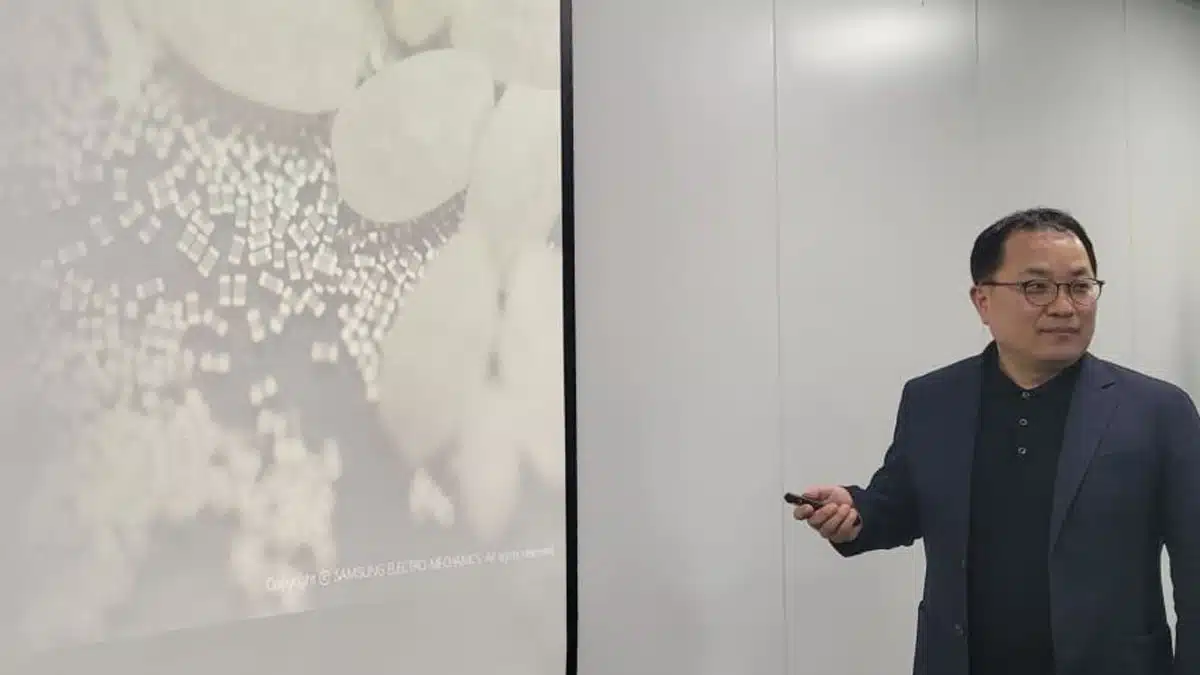
MLCC (Multi-Layer Ceramic Capacitor) is a component that stores electricity and stably supplies electricity to active components such as semiconductors (APs, ICs) as needed to enable semiconductors to operate smoothly. It also plays a role in eliminating signal interference (noise) in electronic products.

MLCCs are used not only in smartphones, but also in products containing semiconductors and electronic circuits, such as televisions, home appliances, and electric vehicles.

The size of the product varies from 0.4mm*0.2mm (the thickness of a human hair is about 0.3mm) to 5.7mm*5.0mm, which is thinner than a human hair and barely visible to the naked eye. The latest smartphones contain about 1,000 and electric vehicles contain about 18,000 to 20,000.

Although it is the smallest electronic component, it is a high-tech product with 500~600 layers of dielectric and electrodes inside and is a high-value component worth hundreds of millions of won when filled into a 300ml wine glass.

MLCCs Require the Most Sophisticated Technologies at the Micro Level

MLCCs have a competitive advantage in that they can store large amounts of electricity while maintaining a small size, so it is essential to have particulate material technology such as dielectrics and manufacturing technology that can stack layers uniformly without interference.

At the nanotechnology level, the technology with the highest barrier to entry is semiconductors, but at the microtechnology level, MLCC has the highest barrier to entry.

MLCCs are made by alternating layers of ceramic and metal (nickel). They are made by a process in which raw material with various additives is printed as thin as paper, stacked, cut to the required size, and heat treated like baking ceramics.

Which substances are added to the ceramic material and how much of each substance is added determines the characteristics of MLCCs. This ceramic raw material technology is the know-how of MLCC manufacturers and is the core technology of MLCC.

In addition, the more inner layers (ceramic and nickel) are stacked, the more electricity can be accumulated, so the micro-control manufacturing technology to make them thin and small is also very important.

Another factor that determines the quality of MLCCs is temperature, as the alternating layers of ceramic and nickel are baked at a high temperature of over 1,000°C. However, it is not easy to achieve the right temperature because ceramic and nickel bake at different temperatures.

Even if it is baked at the right temperature, it will not function properly if microscopic cracks are formed in the thin inner layer. Therefore, it is important to check the quality and appearance, including the electrical properties, for internal cracks, even if there is no visible damage on the outside.

MLCC “More than 10,000 MLCCs in a car”: The Scale of Automotive MLCCs is Growing

Although automotive MLCCs play a similar role to IT MLCCs, they are used in different environments than IT products and require a high level of reliability and durability because they are closely related to people’s lives.

For high-end automotive MLCCs, they need to operate reliably in extreme environments such as high temperatures (over 150℃) and low temperatures (minus 55℃), impact situations such as bending strength, and high humidity (85% humidity).

To meet the harsh testing environment of automobiles, materials that can withstand high temperature and high voltage must be developed, and microstructure design technologies that enhance vibration and moisture resistance must be employed.  

Compared with IT products, automotive MLCCs require longer life, have higher technological difficulty, and take about three times longer to develop. They are also high-value-added products that cost more than three times as much.

Automotive MLCCs have high quality and manufacturing standards, such as the need to obtain AEC-Q200 certification, a reliability testing standard for automotive electronic components, and must pass strict inspection by each customer before they can be produced.

Electric vehicles are expected to grow at a double-digit rate in 2024 and hybrid vehicles, which are also growing steadily, are expected to have a positive impact on automotive MLCC demand, as they require up to twice as many MLCCs as internal combustion engines. At the same time, as the penetration rate of ADAS continues to increase, the adoption rate of Lv.2 and above is expected to exceed 40% in 2024, thus maintaining the high growth outlook for the automotive MLCC market.

According to market research firm TSR, the automotive MLCC market is expected to grow significantly from KRW 4 trillion in 2023 to KRW 9.5 trillion in 2028.

Samsung Electro-Mechanics Aims to Achieve KRW 1 trillion in Automotive MLCC Sales with Core Raw Material Technology

Samsung Electro-Mechanics is focusing on increasing the share of MLCCs for industrial and automotive applications. Samsung Electro-Mechanics began producing industrial and automotive MLCCs in 2016, and in 2018 the company built a dedicated automotive production line in Busan to promote the MLCC business in earnest.

Samsung Electro-Mechanics is strengthening its technological competitiveness by developing and manufacturing core raw materials for MLCCs in-house.

There are extremely few companies that can directly develop and internalize raw materials, the core technology of MLCC. Samsung Electro-Mechanics has recently built a new raw material plant exclusively for automotive purposes at its Busan business site and started operation from 2020.

Recently, Samsung Electro-Mechanics has been focusing on developing automotive MLCCs in line with the growth of the EV and ADAS markets. In particular, at the shareholders’ meeting held in March this year, Samsung Electro-Mechanics CEO Chang Duckhyun stated that the company has set a goal of achieving KRW 1 trillion in automotive MLCC sales.

Samsung Electro-Mechanics is expanding its automotive product lineup to ensure high capacity, bending strength, high temperature and high pressure based on the company’s competitiveness in material technology and process technology. In 2020, the company developed three types of MLCCs for automotive powertrain and two types of MLCCs for braking systems, and in 2021, it developed two types of MLCCs for ADAS. This is followed by an expansion of 13 types of MLCCs for automotive powertrain in 2022. In 2024, the company will expand its market share by introducing two types of MLCCs for ADAS with the world’s highest capacity in the 16V class and an automotive MLCC for electric vehicles that can withstand a high voltage of 1000V.

Samsung Electro-Mechanics operates its business sites in Suwon and Busan for R&D and production of new models and raw materials, and its production bases in Tianjin, China and the Philippines for mass production.

Related

Source: Samsung Electro-Mechanics

Recent Posts

Stackpole RNAN aluminium nitride thin-film chip resistors in 0603, 0805, 1206 and 2512 package sizes for precision high-power electronics

Stackpole RNAN AlN Thin-Film Resistors Reach 6 W

15.9.2026
1
Bourns PST065 and PST10 Series compact incremental potentiometers with hollow shafts for rotary position feedback

Bourns Expands Compact Incremental Potentiometer Offering

14.9.2026
3

Samsung MLCC Revenue Seen Above KRW 8T by 2027, Murata EOL Actions Reshape Supply

11.9.2026
32
ROHM SDR01 high anti-surge thick-film chip resistor in 1005 metric 0402 package with 0.33 W rated power

ROHM Introduces Anti-Surge 0402 Resistors Rated at 0.33 W

11.9.2026
13
ECIA Industry Pulse Q3 2026 chart showing passive components, semiconductors and electro-mechanical component market sentiment and lead-time pressure

ECIA Industry Pulse Moderates as Passive Lead Times Tighten

10.9.2026
28

LG Innotek Demonstrates FC-BGA Substrates With Embedded Silicon Capacitors for AI Power Delivery

10.9.2026
34

Emerging Capacitor Markets in Fusion Energy

10.9.2026
46
Murata DLW32SH_MF 1210 surface-mount common mode choke coil with metal terminals for automotive CAN FD signal-line noise suppression

Murata Introduces Common Mode Chokes for Automotive CAN FD up to 150°C

10.9.2026
22
onsemi solid-state transformer concept for 800 V HVDC AI data center power conversion with SiC modules, DC-link capacitors and high-frequency magnetics

Solid-State Transformers for 800 V AI Data Centers: Passive Component Design Considerations

9.9.2026
97

Upcoming Events

Sep 16
17:00 - 18:00 CEST

Designing a 5 kW, 800 V-to-50 V PSFB Converter for Next-Generation Data Centers

Sep 29
16:00 - 17:00 CEST

Cybersecurity 2026

Nov 24
16:00 - 17:00 CET

Component selection with the WE REDEXPERT® DC-DC Converter Designer Tool

View Calendar

Popular Posts

  • Buck Converter Design and Calculation

    0 shares
    Share 0 Tweet 0
  • LLC Resonant Converter Design and Calculation

    0 shares
    Share 0 Tweet 0
  • Boost Converter Design and Calculation

    0 shares
    Share 0 Tweet 0
  • Flyback Converter Design and Calculation

    0 shares
    Share 0 Tweet 0
  • Earthing Systems and IEC Classification Explained

    0 shares
    Share 0 Tweet 0
  • MLCC and Ceramic Capacitors

    0 shares
    Share 0 Tweet 0
  • Resistor Symbols

    0 shares
    Share 0 Tweet 0
  • Capacitor Charging and Discharging

    0 shares
    Share 0 Tweet 0
  • Audio Capacitors: Choosing Capacitors for Crossover Circuits

    0 shares
    Share 0 Tweet 0
  • Capacitor Symbols

    0 shares
    Share 0 Tweet 0

Newsletter Subscription


Passive Components Blog

© 2015–2026
All rights reserved

  • Home
  • Privacy Policy
  • EPCI Membership & Advertisement
  • About

No Result
View All Result
  • Home
  • Knowledge Blog
  • Dossiers
  • PCNS

© 2015–2026
All rights reserved