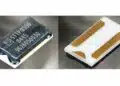
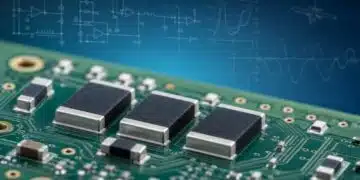


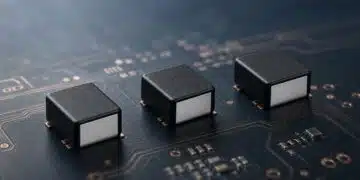




Samsung Electro-Mechanics has introduced a new range of ultra-high-voltage MLCCs in 1210 (3.2 × 2.5 mm) size for xEV high-voltage powertrains, targeting on-board chargers (OBCs) and inverter systems in modern electric vehicles.
These Samsung Electro-Mechanics MLCC capacitors combine 1000–1500 V ratings with C0G/X8G temperature characteristics and capacitance values up to 33 nF, enabling higher power density and improved reliability in compact designs.
Key features and benefits
- High voltage ratings up to 1500 V
- Coverage across 1000 V, 1250 V and 1500 V classes supports 800 V inverter buses and high-voltage OBC topologies such as CLLC resonant converters.
- Automotive-grade high-temperature C0G/X8G dielectrics
- C0G parts specified from −55 °C to +125 °C with 0 ± 30 ppm/°C capacitance change offer very stable capacitance and low loss over the typical automotive ambient and under-hood range.
- X8G parts specified from −55 °C to +150 °C with 0 ± 30 ppm/°C support use near hot power devices or in tightly packed power modules.
- Miniaturized 1210 (3.2 × 2.5 mm) footprint
- Provides high voltage and nF-range capacitance in a relatively small case size, enabling compact layouts in power modules and high-density OBC boards.
- Extended capacitance range for high-voltage C0G/X8G
- New parts expand the manufacturer’s high-voltage C0G/X8G line-up to 1.2 nF–33 nF at 1000–1500 V, bridging a gap where designers previously had to rely on film capacitors or larger MLCCs.
- Options with fail-safe design
- Several part numbers are offered with “Fail Safe Design” structures, intended to improve behavior under insulation breakdown and help protect the system.
- Targeted at xEV powertrain reliability
- Designed and mass-produced using proprietary ceramic, electrode miniaturization and ultra-precise layering processes to address the growing MLCC count and reliability requirements in electrified vehicles.
- Support for custom designs
- The manufacturer explicitly offers technical support and samples for customer-specific designs, which can be useful for platform-level automotive projects.
Typical applications
These ultra-high-voltage MLCCs are aimed at xEV high-voltage domains and can replace or complement film capacitors in certain functions where size reduction and board-level integration are beneficial.
Typical functions include:
- CLLC resonant tanks in on-board chargers (OBCs)
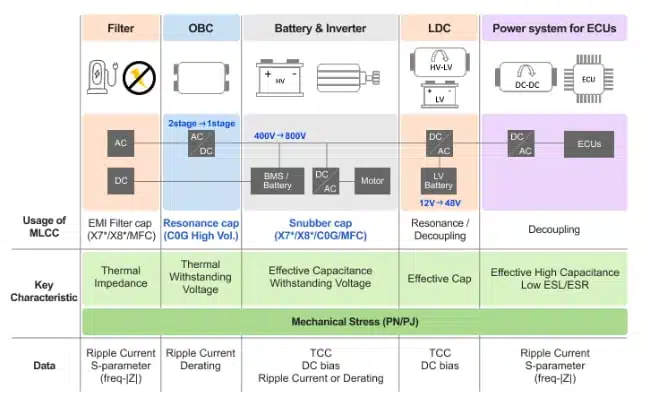
- Used as resonant capacitors in high-frequency CLLC stages of next-generation OBCs with output power above 22 kW, where high voltage rating and low-loss dielectric are critical for efficiency and thermal performance.
- 800 V-class traction inverter systems
- Deployed around inverter power modules for snubber networks and local decoupling on DC-link and half-bridge nodes.
- Snubber capacitors for fast switching devices
- Used to suppress switching noise and voltage overshoot when SiC or fast IGBT switches are turned on or off by providing a controlled, low-inductance path for transient energy.
- General high-voltage nodes in xEV powertrains
- Applicable anywhere a compact, stable, high-voltage capacitor is required, such as high-voltage measurement conditioning, auxiliary DC–DC stages, or EMI-optimized layouts in the HV domain.
Because these devices are ceramic MLCCs with C0G/X8G characteristics, they are best suited for positions where low loss, stable capacitance and predictable temperature behavior are more important than very high bulk capacitance.
Technical highlights
The current line-up described in the press release focuses on four 1210-case MLCCs with specific capacitance and voltage combinations. These parts together extend the C0G/X8G MLCC portfolio to cover 1000–1500 V with capacitances from 1.2 nF up to 33 nF in a 1210 case size.
Product overview table
| Part number | Size (inch/mm) | Capacitance | Rated voltage | TCC | Design type |
|---|---|---|---|---|---|
| CL32G122KVV3PN# | 1210 / 3.2×2.5 | 1.2 nF | 1500 V | X8G | Fail Safe Design |
| CL32C103JXV3PN# | 1210 / 3.2×2.5 | 10 nF | 1250 V | C0G | Fail Safe Design |
| CL32C223JIV3PN# | 1210 / 3.2×2.5 | 22 nF | 1000 V | C0G | Fail Safe Design |
| CL32C333JIV1PN# | 1210 / 3.2×2.5 | 33 nF | 1000 V | C0G | Normal Design |
Design-in notes for engineers
When designing these ultra-high-voltage MLCCs into xEV systems, a few practical considerations can help avoid issues and get the most benefit from their capabilities.
Electrical and thermal considerations
- Respect voltage derating practices
- Even though the parts are rated up to 1000–1500 V, it is common in automotive power designs to operate MLCCs with a margin below the maximum rated voltage, especially in applications with repetitive transients or high dv/dt.
- Consider AC ripple and resonant conditions
- In CLLC resonant converters, the capacitor experiences AC voltage and current superimposed on a DC offset. Check ripple current limits and loss behavior in the datasheet to ensure the MLCC does not overheat in steady-state operation.
- Check capacitance stability over temperature and bias
- The C0G/X8G characteristics mean temperature-related capacitance drift is very small, which is ideal for stable resonant frequencies. Any DC bias dependency at these voltage levels should be verified in the datasheet graphs.
- Pay attention to thermal environment
- In inverter power modules or OBC primary stages, local temperatures can approach the upper limit of X8G parts. Use thermal simulation or measurement to ensure junction and case temperatures stay within specified limits.
Layout and mechanical integration
- Minimize ESL and loop area
- For snubber applications, place the MLCC as close as possible to the switch terminals or module pins, with short, wide traces to minimize parasitic inductance and maximize the effectiveness of overvoltage suppression.
- Combine multiple capacitors if needed
- To achieve specific snubber or resonant values or to distribute current, consider using multiple MLCCs in parallel, observing spacing rules for high-voltage clearance and creepage.
- Manage mechanical stress
- Large ceramic capacitors in 1210 size can be susceptible to board flex cracking. Use proper pad design, controlled solder fillets and PCB support to reduce mechanical stress during assembly and vehicle operation.
- Check fail-safe versus normal design
- Where insulation integrity is safety-critical (for example, at the isolation barrier in OBCs), verify whether a Fail Safe Design version is available with the required capacitance and voltage, and review the datasheet description of its behavior under fault conditions.
Qualification and documentation
- Verify automotive qualification status
- For serial production in xEV platforms, confirm the appropriate automotive qualification standard (e.g. AEC-Q200 or manufacturer-specific testing) in the datasheet or via the manufacturer’s support channels.
- Align with system-level standards
- High-voltage components in OBC and inverter systems often need to comply with standards such as ISO/IEC high-voltage safety and insulation requirements. Ensure the MLCC’s rated voltage, test conditions and insulation properties align with the system-level design rules.
- Leverage manufacturer support
- Since Samsung Electro-Mechanics offers technical support and samples for customer-specific designs, design teams can engage early for modeling data, SPICE models, reliability data and lifetime estimations that may not be fully detailed in the press release.
Source
This article is based on information provided in the Samsung Electro-Mechanics product news release describing ultra-high-voltage MLCCs for xEV high-voltage powertrains, complemented by the associated product and datasheet links on the manufacturer’s website.
References
- Samsung Electro-Mechanics product news: Ultra-High-Voltage MLCCs for xEV High-Voltage Powertrains
- Samsung Electro-Mechanics product page – CL32G122KVV3PN#
- Samsung Electro-Mechanics product page – CL32C103JXV3PN#
- Samsung Electro-Mechanics product page – CL32C223JIV3PN#
- Samsung Electro-Mechanics product page – CL32C333JIV1PN#