







Passive Components Blog
No Result
View All Result
  • Home
  • NewsFilter
    • All
    • Aerospace & Defence
    • Antenna
    • Applications
    • Automotive
    • Capacitors
    • Circuit Protection Devices
    • electro-mechanical news
    • Filters
    • Fuses
    • Inductors
    • Industrial
    • Integrated Passives
    • inter-connect news
    • Market & Supply Chain
    • Market Insights
    • Medical
    • Modelling and Simulation
    • New Materials & Supply
    • New Technologies
    • Non-linear Passives
    • Oscillators
    • Passive Sensors News
    • Resistors
    • RF & Microwave
    • Telecommunication
    • Weekly Digest

    Passive Components for Industrial Automation and Robotics (Dossier Report 08/26)

    Advanced Electronics Markets Reshape Capacitor Demand for 2026/2027

    Panasonic Introduces Metallized Polypropylene Film Capacitors for Industrial and Automotive DC Applications

    Zowie Targets Embedded AI/HPC PDNs With Ultra-Thin Double-Sided MLPC Capacitors

    Modelithics CapV MVP Library: Measurement-Based Models for Varactor Chip Simulation

    Single Pair Ethernet for Humanoid Robot In-Robot Networks

    Panasonic Thick-Film Current Sense Resistors: Cost-Effective Alternatives to Metal Shunts

    Wk 31 Electronics Supply Chain Digest

    Bourns Transformer and Inductor Target 600 W GaN Cycloconverters

    Trending Tags

    • Ripple Current
    • RF
    • Leakage Current
    • Tantalum vs Ceramic
    • Snubber
    • Low ESR
    • Feedthrough
    • Derating
    • Dielectric Constant
    • New Products
    • Market Reports
  • VideoFilter
    • All
    • Antenna videos
    • Capacitor videos
    • Circuit Protection Video
    • Filter videos
    • Fuse videos
    • Inductor videos
    • Inter-Connect Video
    • Non-linear passives videos
    • Oscillator videos
    • Passive sensors videos
    • Resistor videos

    Current Sense Transformers: Ferrite vs Nanocrystalline Cores for Accurate Current Measurement

    EMC Design Fundamentals: Safe Use of Varistors and Common Mode Chokes in Mains and Data-Line Filters

    Ferrite versus Nanocrystalline Power Inductor Cores: Turns, Gap and Size

    KYOCERA AVX Presents Antenna Integrator Studio Tutorial for Antenna Placement and RF Design

    Power Design Simulation Tools for Faster Inductor Selection and Loss Optimization

    EMC‑Compliant PCB and Connector Design Guidelines

    Why Isolated DC/DC Power Supplies Fail Late, Würth Elektronik Podcast

    Designing 800 V DC EMC Filters: Calculation, Simulation and Measurement

    Current Sense Transformer Datasheet and Design‑in Guide

    Trending Tags

    • Capacitors explained
    • Inductors explained
    • Resistors explained
    • Filters explained
    • Application Video Guidelines
    • EMC
    • New Products
    • Ripple Current
    • Simulation
    • Tantalum vs Ceramic
  • Knowledge Blog
  • Dossiers
    • AI Hardware Dossier
    • Automotive Dossier
    • Industrial Robotics Dossier
    • Power Converter Dossier
    • Capacitor Dossier
    • Resistor Dossier
    • Inductor Dossier
    • Circuit Protection Dossier
  • Suppliers
    • Who is Who
  • PCNS
    • PCNS 2025
    • PCNS 2023
    • PCNS 2021
    • PCNS 2019
    • PCNS 2017
  • Events
  • Home
  • NewsFilter
    • All
    • Aerospace & Defence
    • Antenna
    • Applications
    • Automotive
    • Capacitors
    • Circuit Protection Devices
    • electro-mechanical news
    • Filters
    • Fuses
    • Inductors
    • Industrial
    • Integrated Passives
    • inter-connect news
    • Market & Supply Chain
    • Market Insights
    • Medical
    • Modelling and Simulation
    • New Materials & Supply
    • New Technologies
    • Non-linear Passives
    • Oscillators
    • Passive Sensors News
    • Resistors
    • RF & Microwave
    • Telecommunication
    • Weekly Digest

    Passive Components for Industrial Automation and Robotics (Dossier Report 08/26)

    Advanced Electronics Markets Reshape Capacitor Demand for 2026/2027

    Panasonic Introduces Metallized Polypropylene Film Capacitors for Industrial and Automotive DC Applications

    Zowie Targets Embedded AI/HPC PDNs With Ultra-Thin Double-Sided MLPC Capacitors

    Modelithics CapV MVP Library: Measurement-Based Models for Varactor Chip Simulation

    Single Pair Ethernet for Humanoid Robot In-Robot Networks

    Panasonic Thick-Film Current Sense Resistors: Cost-Effective Alternatives to Metal Shunts

    Wk 31 Electronics Supply Chain Digest

    Bourns Transformer and Inductor Target 600 W GaN Cycloconverters

    Trending Tags

    • Ripple Current
    • RF
    • Leakage Current
    • Tantalum vs Ceramic
    • Snubber
    • Low ESR
    • Feedthrough
    • Derating
    • Dielectric Constant
    • New Products
    • Market Reports
  • VideoFilter
    • All
    • Antenna videos
    • Capacitor videos
    • Circuit Protection Video
    • Filter videos
    • Fuse videos
    • Inductor videos
    • Inter-Connect Video
    • Non-linear passives videos
    • Oscillator videos
    • Passive sensors videos
    • Resistor videos

    Current Sense Transformers: Ferrite vs Nanocrystalline Cores for Accurate Current Measurement

    EMC Design Fundamentals: Safe Use of Varistors and Common Mode Chokes in Mains and Data-Line Filters

    Ferrite versus Nanocrystalline Power Inductor Cores: Turns, Gap and Size

    KYOCERA AVX Presents Antenna Integrator Studio Tutorial for Antenna Placement and RF Design

    Power Design Simulation Tools for Faster Inductor Selection and Loss Optimization

    EMC‑Compliant PCB and Connector Design Guidelines

    Why Isolated DC/DC Power Supplies Fail Late, Würth Elektronik Podcast

    Designing 800 V DC EMC Filters: Calculation, Simulation and Measurement

    Current Sense Transformer Datasheet and Design‑in Guide

    Trending Tags

    • Capacitors explained
    • Inductors explained
    • Resistors explained
    • Filters explained
    • Application Video Guidelines
    • EMC
    • New Products
    • Ripple Current
    • Simulation
    • Tantalum vs Ceramic
  • Knowledge Blog
  • Dossiers
    • AI Hardware Dossier
    • Automotive Dossier
    • Industrial Robotics Dossier
    • Power Converter Dossier
    • Capacitor Dossier
    • Resistor Dossier
    • Inductor Dossier
    • Circuit Protection Dossier
  • Suppliers
    • Who is Who
  • PCNS
    • PCNS 2025
    • PCNS 2023
    • PCNS 2021
    • PCNS 2019
    • PCNS 2017
  • Events
No Result
View All Result
Passive Components Blog
No Result
View All Result

YAGEO Presents Single-Phase Common Mode Chokes for Industrial EMI Suppression

1.7.2026
Reading Time: 7 mins read
A A

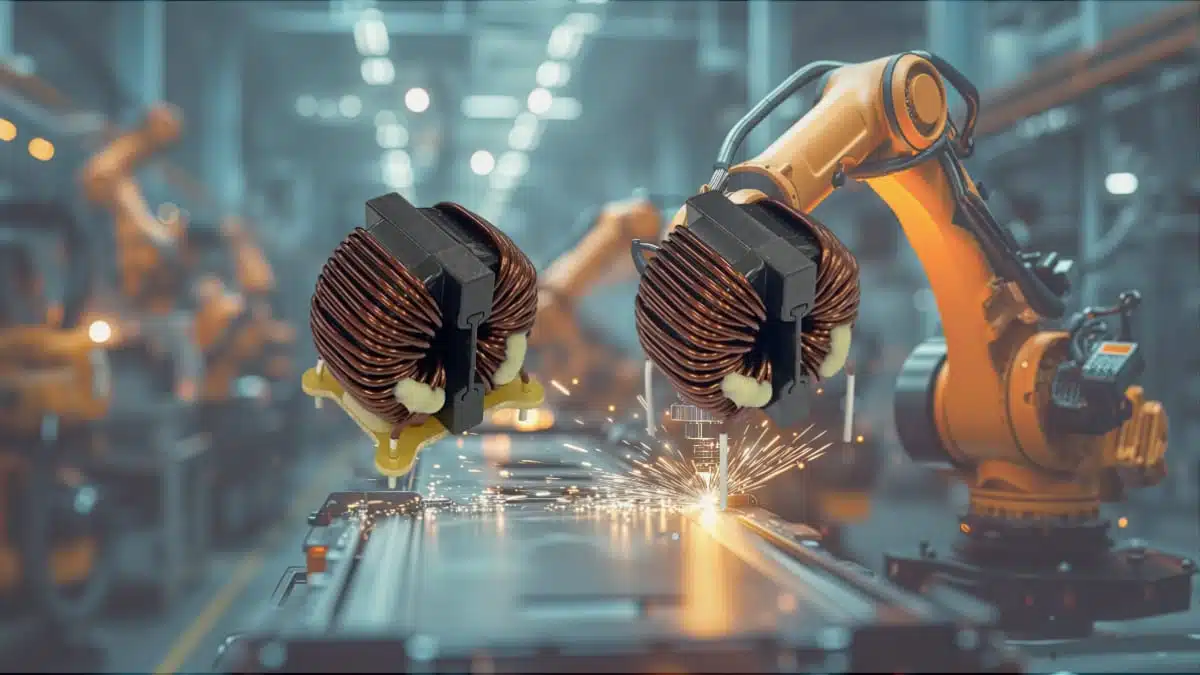
YAGEO Group’s SCF‑X and SCT‑X single‑phase common mode chokes are EMI filter components for industrial power systems that must meet stringent EMC requirements without sacrificing efficiency or board space.

The YAGEO single‑phase common mode chokes combine a wide inductance and current range with two core material options, giving design engineers a single platform for both high‑performance and cost‑optimized conducted noise suppression in single‑phase AC and DC applications.

RelatedPosts

YAGEO Extends Automotive CAN and CAN-FD Common-Mode Chokes

YAGEO Releases SMD 0402 Pt Temperature Sensors for Space‑Constrained Designs

YAGEO Extends Automotive Tantalum Polymer Capacitors for AI and ADAS Controllers

Key features and benefits

  • Rated for industrial single-phase grids up to 500 VAC/VDC, suitable for typical mains‑connected power supplies, inverters and control systems in industrial environments.
  • Current range from 1 A to 22 A, covering low‑power control electronics up to higher‑power single‑phase drives and conditioners.
  • Very wide inductance range from 0.07 mH to 95.26 mH, allowing precise EMI tuning across low and higher frequency regions using standard parts rather than custom chokes.
  • Two core material systems in one family: nanocrystalline SCF‑X for strong broadband attenuation; SCT‑X with high‑heat‑resistant Mn‑Zn ferrite (10HT) for cost‑effective, targeted noise suppression.
  • Low DC resistance (0.64 mΩ to 65.26 mΩ) to minimize conduction losses and heat generation, which is critical in tightly packed power supplies and inverters.
  • Operating temperature range from −40 °C to +130 °C, supporting continuous operation in harsh industrial environments, control cabinets and HVAC systems.
  • Compact toroidal construction with UL 94 V‑0 rated base and cap, improving PCB integration, mechanical robustness and fire safety compliance.
  • 116 part numbers across multiple core sizes (12, 17, 23 and 31 mm), giving purchasing and design teams a broad but coherent catalog for platform‑wide standardization.

Typical applications

The SCF‑X and SCT‑X single‑phase common mode chokes are positioned for conducted EMI suppression in industrial and building‑related power electronics where compliance with EMC standards and reliable long‑term operation are key.

Typical application areas include:

  • Industrial equipment and factory automation controllers.
  • Industrial inverters and single‑phase motor drives.
  • Switched‑mode power supplies and power conditioners for machinery and tooling.
  • Single‑phase power converters and front‑end EMI filters in rectifier stages.
  • Air conditioning and HVAC systems with electronic control and variable‑speed compressors.
  • Robotics and motion control systems requiring compact, high‑performance EMI filtering.

In practice, these chokes are used in common‑mode filter stages at the AC input or DC bus interface to suppress noise that couples symmetrically onto line and neutral, helping designs pass conducted emission tests without large external filters or custom magnetics.

Technical highlights

Electrical ratings and ranges

  • Rated voltage: up to 500 VAC/VDC.
  • Rated current range: 1 A to 22 A.
  • Inductance range: 0.07 mH to 95.26 mH.
  • DC resistance (DCR): 0.64 mΩ to 65.26 mΩ.
  • Operating temperature range: −40 °C to +130 °C.

These ranges make the family suitable for single‑phase mains levels used in many industrial regions and allow scaling from small loads to larger single‑phase equipment without changing platform or layout.

Core materials and construction

  • SCF‑X: nanocrystalline core technology for strong broadband EMI suppression across a wide frequency spectrum, beneficial when conducted noise spans from tens of kilohertz into the megahertz region.
  • SCT‑X: proprietary 10HT Mn‑Zn ferrite core material with high heat resistance and high saturation flux density (Bs), optimized for cost‑effective suppression in defined frequency bands and elevated temperature environments.
  • Toroidal construction: compact footprint, low stray fields and straightforward integration into PCB or chassis‑mounted EMI filters.
  • UL 94 V‑0 rated base and cap: supports safety compliance and reduces risk in fire‑critical or safety‑relevant designs.

Platform overview

ParameterSCF‑X / SCT‑X family
Voltage ratingUp to 500 VAC/VDC
Current range1 A – 22 A
Inductance range0.07 mH – 95.26 mH
DCR range0.64 mΩ – 65.26 mΩ
Operating temperature−40 °C to +130 °C
Core sizes12 mm, 17 mm, 23 mm, 31 mm
Number of part numbers116
Core materialsNanocrystalline (SCF‑X), high‑heat Mn‑Zn ferrite 10HT (SCT‑X)

For detailed per‑part ratings, engineers should refer directly to the manufacturer’s product brief and datasheet information according to the manufacturer datasheet.

Design‑in notes for engineers

  • Select material based on EMI profile and cost targets
    • Use SCF‑X nanocrystalline variants when broadband EMI suppression is required, especially in designs with wideband switching spectra or aggressive switching edge rates.
    • Prefer SCT‑X ferrite variants when noise appears in narrower bands or when cost optimization is a priority, leveraging the high‑heat‑resistant 10HT ferrite and high Bs.
  • Match inductance and current to the line conditions
    • Start from the grid voltage (up to 500 VAC/VDC), nominal current and expected switching frequency to identify the required inductance value that meets conducted emission limits.
    • Ensure that the selected choke’s current rating and temperature range provide adequate margin under worst‑case load and ambient temperatures.
  • Consider DCR and thermal behavior early in the design
    • Low DCR values help reduce power loss and self‑heating; however, verify that total losses remain acceptable at maximum current, especially in sealed or high‑density enclosures.
    • The −40 °C to +130 °C operating range supports many industrial environments, but layout, airflow and nearby heat sources should be considered in the thermal model.
  • Use platform consistency to simplify layout and variants
    • With multiple core sizes and shared footprint approaches, the SCF‑X and SCT‑X series allow one PCB design to support several power levels by populating different part numbers.
    • This platform approach reduces re‑layout effort when moving from performance‑driven to cost‑optimized variants or when scaling current capability within the same product family.
  • Plan for EMC compliance and safety from the outset
    • Place the common mode choke near the mains or single‑phase input and coordinate its use with line filters, X/Y capacitors and surge protection devices.
    • Take advantage of the UL 94 V‑0 base and cap and toroidal construction when building safety‑critical filters for industrial drives, HVAC systems and robotics.
  • Leverage standardization for purchasing and lifecycle management
    • The broad but structured portfolio enables company‑wide preferred part lists and reduces the need for custom wound chokes.
    • Working within a single, well‑documented series supports long‑term availability, easier second‑source evaluation and clearer communication between design and procurement teams.

Source

This article is based on information from the YAGEO Group manufacturer press release and associated official product documentation for the SCF‑X and SCT‑X single‑phase common mode chokes, with all specific ratings and ranges taken according to the manufacturer datasheet.

References

  1. YAGEO Group SCF‑X & SCT‑X single-phase common mode chokes press/resource page
  2. SCF‑X & SCT‑X Single-Phase Common Mode Chokes Product Brief (PDF)
  3. YAGEO Group EMC products overview – similar products

Related

Recent Posts

Passive Components for Industrial Automation and Robotics (Dossier Report 08/26)

20.8.2026
58

Advanced Electronics Markets Reshape Capacitor Demand for 2026/2027

20.8.2026
60

Panasonic Introduces Metallized Polypropylene Film Capacitors for Industrial and Automotive DC Applications

19.8.2026
49

Single Pair Ethernet for Humanoid Robot In-Robot Networks

17.8.2026
81

Panasonic Thick-Film Current Sense Resistors: Cost-Effective Alternatives to Metal Shunts

17.8.2026
32

Bourns Transformer and Inductor Target 600 W GaN Cycloconverters

13.8.2026
66

Littelfuse Releases TVS Diodes for ISO 7637-2 Pulse 5b Load-Dump Protection

12.8.2026
67

Vishay Introduces Y1 SMD Ceramic Disc Safety Capacitors to Reduce EMI Filter Board Space

12.8.2026
62

YAGEO Extends Automotive CAN and CAN-FD Common-Mode Chokes

10.8.2026
50

Upcoming Events

Sep 10
11:00 - 12:00 CEST

Equipment models and model strategies for Space Missions

Sep 29
16:00 - 17:00 CEST

Cybersecurity 2026

Nov 24
16:00 - 17:00 CET

Component selection with the WE REDEXPERT® DC-DC Converter Designer Tool

View Calendar

Popular Posts

  • Buck Converter Design and Calculation

    0 shares
    Share 0 Tweet 0
  • Boost Converter Design and Calculation

    0 shares
    Share 0 Tweet 0
  • LLC Resonant Converter Design and Calculation

    0 shares
    Share 0 Tweet 0
  • MLCC and Ceramic Capacitors

    0 shares
    Share 0 Tweet 0
  • Earthing Systems and IEC Classification Explained

    0 shares
    Share 0 Tweet 0
  • Flyback Converter Design and Calculation

    0 shares
    Share 0 Tweet 0
  • MLCCs in the Age of AI: Q2 2026 Market Tightness

    0 shares
    Share 0 Tweet 0
  • Capacitor Charging and Discharging

    0 shares
    Share 0 Tweet 0
  • Audio Capacitors: Choosing Capacitors for Crossover Circuits

    0 shares
    Share 0 Tweet 0
  • Ripple Current and its Effects on the Performance of Capacitors

    3 shares
    Share 3 Tweet 0

Newsletter Subscription


Passive Components Blog

© EPCI - Leading Passive Components Educational and Information Site

  • Home
  • Privacy Policy
  • EPCI Membership & Advertisement
  • About

No Result
View All Result
  • Home
  • Knowledge Blog
  • Dossiers
  • PCNS

© EPCI - Leading Passive Components Educational and Information Site