
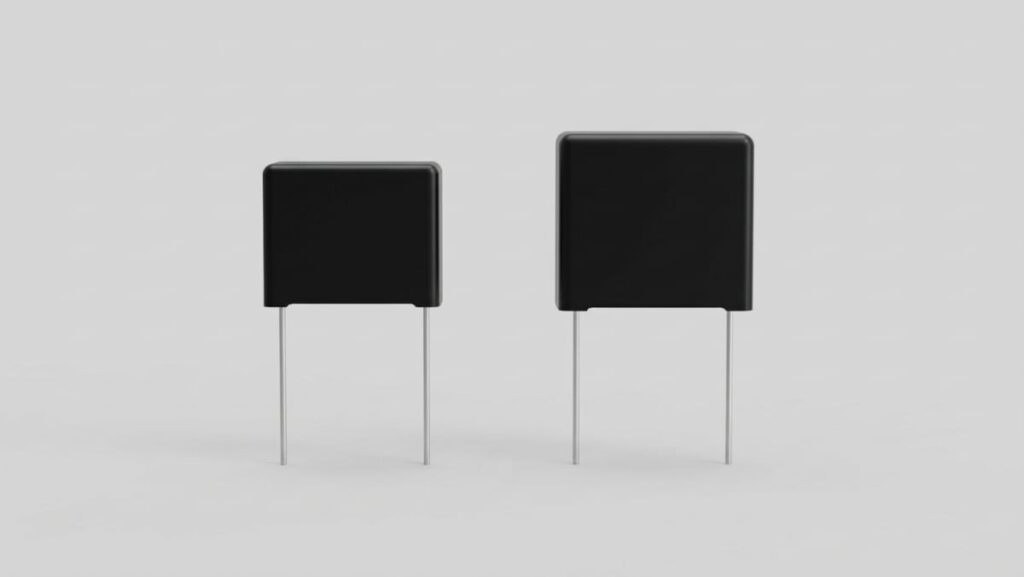
Panasonic has expanded its ECW‑FJ series of polypropylene film capacitors for automotive applications with new high‑voltage options aimed at DC/DC and AC/DC converter stages in xEV and other high‑stress environments.
The series targets designers who need stable capacitance, robust safety behavior, and long‑term reliability under high frequency, high current, temperature cycling, and humidity stress.
Key features and benefits
Panasonic’s ECW‑FJ series is a metallized polypropylene film capacitor line for automotive and other harsh‑environment power electronics. The parts are designed primarily for high‑frequency, high‑current DC/DC and AC/DC converter circuits in xEV powertrains and related systems.
Key characteristics (according to the manufacturer datasheet):
- Polypropylene film dielectric, metallized construction with integrated fuse function
- Operating temperature range: −40 °C to 110 °C
- Rated voltage options: 800 VDC and 1100 VDC, with newly added 600 VDC, 630 VDC, 700 VDC, and 1000 VDC variants
- Capacitance range: approximately 1 µF to 8 µF across the series
- Thermal shock resistance: −40 °C to 85 °C, 1 000 cycles
- Humidity resistance: 40 °C, 95% RH, rated voltage applied, 1 000 hours
Practical benefits:
- Polypropylene dielectric offers low dielectric losses and good frequency behavior, making these parts suitable for high‑frequency switching converters where ESR and dissipation factor matter.
- The integrated fuse function improves safety; under certain fault conditions, the capacitor can disconnect internally rather than failing short, supporting functional safety concepts in automotive power stages.
- Qualified thermal shock and humidity performance makes these parts attractive for under‑hood or battery‑adjacent locations where wide temperature swings and moisture are typical.
- A wide voltage and capacitance spread simplifies platform design; the same series can be used in multiple converter topologies and voltage classes, helping purchasing teams reduce vendor and series diversity.
Compared to many ceramic solutions at similar voltages, polypropylene film capacitors:
- Exhibit very stable capacitance over temperature and DC bias, aiding predictable control‑loop design.
- Typically have lower dielectric absorption and lower tanδ, which can reduce self‑heating at high ripple current.
- Are physically larger but provide robust self‑healing behavior under transient over‑voltage, which is beneficial in noisy automotive power networks.
Typical applications
The ECW‑FJ series is targeted at automotive and other high‑reliability power conversion roles where high DC voltages and significant ripple currents coexist.
Example application areas:
- xEV on‑board chargers (OBC) in AC input PFC stages and DC link functions on the high‑voltage (HV) bus
- DC/DC converters between HV traction battery and 12 V/48 V auxiliary systems
- Inverter and motor‑drive support circuits in traction inverters and e‑axles
- Auxiliary converters in battery management systems (BMS), HVAC, steering, and braking ECUs
- Industrial and infrastructure power supplies that demand automotive‑grade robustness, such as fast chargers, power conditioning systems, and UPS modules
In many of these locations, the capacitor is used for:
- DC link / bulk energy storage on the high‑voltage bus
- Snubber and resonant capacitors in high‑frequency switching stages
- EMI and ripple suppression in conjunction with common‑mode chokes and other filters
Technical highlights
While exact numeric values for every variant should be taken from the manufacturer datasheet, the key stresses addressed by the ECW‑FJ series are temperature cycling, humidity, and high‑frequency current.
Environmental and reliability performance
- Thermal shock test conditions (−40 °C to 85 °C, 1 000 cycles) are representative of harsh automotive temperature swings, e.g., cold starts in winter and high under‑hood temperatures after prolonged operation.
- Humidity test conditions (40 °C, 95% RH, rated voltage, 1 000 hours) simulate long‑term exposure to moisture, supporting usage in areas like wheel wells or chassis‑mounted power electronics where condensation and high humidity can occur.
Electrical performance implications
For designers, these specs translate into:
- Improved confidence in capacitance stability and insulation resistance over product life in severe climates.
- Reduced risk of film degradation or partial discharge under combined high humidity and high voltage stress.
- The ability to push switching frequencies higher (subject to datasheet limits) while still maintaining acceptable losses and self‑heating, thanks to the low‑loss polypropylene dielectric.
Design‑in notes for engineers
When designing‑in the ECW‑FJ polypropylene film capacitors into automotive or industrial power stages, consider the following aspects.
Electrical design considerations
- Verify ripple current and permissible self‑heating at your switching frequency and waveform; film capacitors can handle substantial ripple, but limits are case‑ and value‑dependent.
- Check dv/dt and peak current ratings for use as snubber or resonant capacitors, especially in fast‑switching SiC or GaN designs.
- Keep adequate voltage derating margin for transients and spikes on the DC bus; even with a high rated voltage (up to 1 100 VDC), system‑level protection and surge suppression are still required.
Mechanical and layout considerations
- Film capacitors are bulkier than MLCCs at comparable voltages; ensure enough PCB or bus bar real estate and mechanical support to handle vibration.
- Place high‑current film capacitors close to switching devices and minimize loop inductance using wide traces, copper pours, or laminated bus bars.
- If used in high‑vibration environments (e.g., near motors), consult the mechanical and vibration guidelines in the datasheet for mounting and support recommendations.
Reliability, safety, and compliance
- The integrated fuse function supports fail‑safe behavior, which can be valuable for ISO 26262‑oriented designs, but it does not replace system‑level fusing and protection.
- Thermal shock and humidity test data simplify qualification for under‑hood and battery‑compartment locations; incorporate these conditions into your DFMEA and validation plans.
- Always base qualification decisions on the latest datasheet and official reliability reports; production test conditions or screening options can change over time.
Conclusion
With the newly added 600 VDC, 630 VDC, 700 VDC, and 1 000 VDC options, Panasonic’s ECW‑FJ series gives design engineers a broader toolbox of automotive‑grade polypropylene film capacitors for high‑voltage DC/DC and AC/DC converter stages. The combination of integrated fuse function, tested thermal shock performance, and humidity robustness makes the series well‑suited to demanding xEV and industrial power electronics where reliability and stable capacitance over time are critical.
Source
This article is based on information from Panasonic Industrial Devices’ official “Line Extension ECW‑FJ Series Film Capacitors (For Automotive)” product news and the associated product family and documentation pages, complemented with general engineering context about polypropylene film capacitors.
References
- Panasonic: Line Extension ECW‑FJ Series Film Capacitors (For Automotive)
- Panasonic: ECW‑FJ Series Film Capacitors (For Automotive) product family page
- Panasonic: ECW‑FJ Series Film Capacitors (For Automotive) datasheet
- Panasonic: ECW‑FJ Series Film Capacitors (For Automotive) new product information PDF

