
TrendForce’s latest MLCC industry research reveals that the AI arms race among global cloud service providers (CSPs) is driving demand towards a select few high-end MLCC specifications.
This concentration of demand is likely to lead to structural shortages in the second half of 2026. Additionally, fresh data on aluminum electrolytic capacitors suggests potential parallel price hikes and supply tightening in AI power systems..
CSP in this article context refers mainly to hyperscale cloud service providers such as Google, AWS and Meta, which operate large‑scale data centers and cloud platforms and increasingly design in‑house AI accelerators instead of relying only on merchant GPUs.
AI race by CSPs and MLCC spec concentration
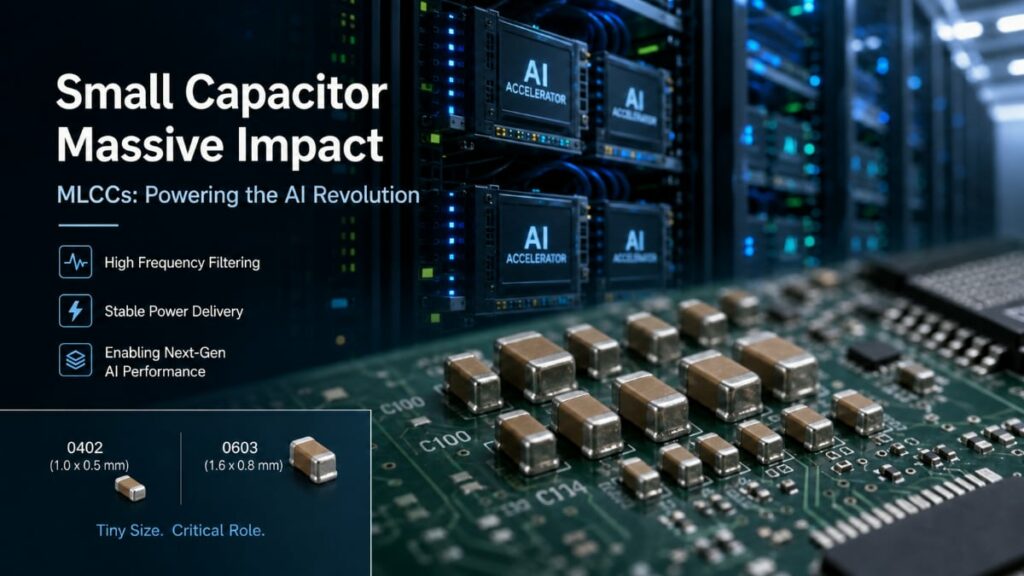
TrendForce reports that the ongoing AI “arms race” among global CSPs is accelerating the deployment of in‑house AI accelerators. These new ASIC platforms favor small‑form‑factor, high‑capacitance, high‑temperature‑resistant MLCCs, so demand is rapidly concentrating on a limited number of premium specifications such as X6S MLCCs in 0402 and 0603 packages.
BOM shift: from electrolytics to MLCC
Next‑generation AI accelerator platforms are undergoing significant BOM changes even during late qualification. On AMD’s MI450 platform, all aluminum electrolytic and tantalum capacitors were replaced with MLCC during validation, which dramatically increased MLCC content per board. As a result, the usage of 47 μF / 2.5 V X6S 0402 MLCCs surged from 1,440 units per board to 10,544 units, a 632% increase. On NVIDIA’s Vera Rubin platform, demand for 100 μF / 4 V X6S 0805 MLCCs rose from 320 units per board to 500 units.
Demand ramp in 2H26: Google, AWS, Meta
Entering 2H26, major in‑house AI ASIC platforms from key CSPs are expected to ramp production, including Google TPU V8t/i, AWS Trainium4 and Meta MTIA 400/450. This ramp will push demand for high‑capacitance, high‑temperature MLCC used in power delivery and decoupling of AI accelerators to a new peak.
MLCC supplier capacity: expansion is not enough
On the supply side, MLCC manufacturers are expanding capacity but still struggle to keep up with the speed of AI‑driven demand growth. Murata started mass production of advanced MLCC such as 47 μF / 2.5 V X6S 0402 and 100 μF / 2.5 V X6S 0603 at the end of 2025, with Samsung Electro‑Mechanics following in March 2026 and Taiyo Yuden and Kyocera also increasing output.
These specifications remain technologically challenging: they combine high capacitance, relatively low voltage, high‑temperature dielectric class (X6S) and very small sizes, which keeps yields under pressure and limits effective capacity expansion. Murata’s new Izumo facility is not expected to reach full production capacity until 2027, so it is unlikely to ease supply tightness in the current AI cycle.
Early signs of a tightening MLCC market
TrendForce already sees clear signs of tightening supply in high‑end MLCC. Book‑to‑bill ratios of major Japanese and Korean suppliers have risen steadily since April 2026, and lead times for certain high‑capacitance X6S MLCC have extended from about eight weeks to as long as twenty weeks.
Leading CSPs that have secured long‑term supply agreements (LTAs) are expected to receive priority allocation of constrained MLCC types. By contrast, ODMs and system vendors without locked‑in supply may face spot‑market price premiums and shipment delays on critical parts.
Buying and sourcing notes
From a procurement and supply‑chain perspective, TrendForce’s data suggests that high‑end MLCC for AI accelerators are entering a structurally tighter phase. CSPs with LTAs are already positioned as priority customers, so ODMs and system makers should not rely on short‑term spot sourcing for key X6S MLCC values.
Practical sourcing steps include:
- Advancing LTA discussions with major MLCC suppliers for the specific X6S values used in AI power trees.
- Increasing safety stock and bringing forward purchase orders into 3Q26 to buffer potential disruptions in 4Q26.
- Qualifying second sources and, where possible, alternative case sizes or value combinations to avoid single‑spec lock‑in.
TrendForce expects several demand drivers to converge between late 3Q and early 4Q26, potentially turning today’s risk into a visible market shortage for selected high‑end MLCC types. Buyers and sourcing teams that move early will be in a better position to support AI platform ramps without schedule slippage caused by passive components.
Aluminum electrolytic capacitors join the AI‑driven price upcycle
TrendForce also indicates that aluminum electrolytic capacitors are entering a similar price‑upcycle pattern as MLCCs and tantalum capacitors. Japan’s Nichicon, the world’s number‑two aluminum electrolytic capacitor supplier, has notified customers of across‑the‑board price hikes on aluminum electrolytic capacitor products, citing rising costs for aluminum foil, chemical materials and electricity, as well as capacity constraints amid strong demand.
According to reports summarized by TrendForce News, initial plans for 9–12% price adjustments at major Japanese suppliers Nichicon and Nippon Chemi‑Con have shifted toward increases in the 10–15% range, with Taiwanese aluminum‑capacitor makers expected to implement their own hikes gradually in June–July 2026. TrendForce links these moves not only to raw‑material inflation—roughly 30–40% higher chemical‑material costs and around 10% higher metal prices—but also to tightening supply‑demand dynamics as AI servers, high‑performance computing and power systems consume more high‑end aluminum electrolytic capacitors in their power supplies. For AI platforms such as NVIDIA’s Vera Rubin, Commercial Times notes that Japanese aluminum‑capacitor vendors are likely to allocate more capacity to AI‑related power systems as the platform ramps in 2H26, leaving non‑AI segments more exposed to lead‑time extensions and order re‑allocation.
For buyers, this means that AI‑driven tightness is no longer limited to very high‑end MLCCs: it is now visible in key aluminum electrolytic capacitor series as well. Sourcing strategies for AI power trees should therefore consider MLCC, tantalum and aluminum electrolytic capacitors together, with long‑term agreements, multi‑sourcing and earlier purchasing particularly important for high‑ripple, high‑voltage aluminum electrolytic positions in AI power supplies.
passive-components
What to expect in 2H26
In the second half of 2026, TrendForce anticipates that new AI platform ramps, higher MLCC content per board and yield‑limited high‑end production will interact to tighten supply further, leading to price increases and extended lead times for specific advanced MLCC, especially high‑capacitance X6S parts in 0402/0603.
At the same time, aluminum electrolytic capacitors are moving into their own AI‑driven upcycle, as Nichicon’s double‑digit price hikes and expected follow‑on moves by Taiwanese vendors in June–July 2026 signal tighter availability and higher costs for key AI power‑supply series.
For design engineers and buyers, this means that 2H26 risk management should treat MLCC, tantalum and aluminum electrolytic capacitors as a coupled constraint set in AI power trees, aligning AI product roadmaps and procurement strategies with realistic availability and pricing across all three technologies.
Source
This article is based on capacitor industry research published by TrendForce through its DRAMeXchange division and has been adapted into a popular‑technical format for a specialized blog on passive components.
References
- DRAMeXchange / TrendForce – CSP In‑House ASIC Boom Drives MLCC Specification Concentration; Structural Shortages of High‑End Specialty MLCCs May Emerge in 2H26
- AI Servers Demand is Driving Tantalum Capacitor Price Hikes
- NVIDIA Vera Rubin: Why One AI Rack Needs So Many More MLCC Capacitors

