

- News
- All
- Aerospace & Defence
- Antenna
- Applications
- Automotive
- Capacitors
- Circuit Protection Devices
- electro-mechanical news
- Filters
- Fuses
- Inductors
- Industrial
- Integrated Passives
- inter-connect news
- Market & Supply Chain
- Market Insights
- Medical
- Modelling and Simulation
- New Materials & Supply
- New Technologies
- Non-linear Passives
- Oscillators
- Passive Sensors News
- Resistors
- RF & Microwave
- Telecommunication
- Weekly Digest
- Video











- News
- All
- Aerospace & Defence
- Antenna
- Applications
- Automotive
- Capacitors
- Circuit Protection Devices
- electro-mechanical news
- Filters
- Fuses
- Inductors
- Industrial
- Integrated Passives
- inter-connect news
- Market & Supply Chain
- Market Insights
- Medical
- Modelling and Simulation
- New Materials & Supply
- New Technologies
- Non-linear Passives
- Oscillators
- Passive Sensors News
- Resistors
- RF & Microwave
- Telecommunication
- Weekly Digest
- Video

Inductors e-Blog
Designing a USB Type‑C Flyback Planar Transformer with Frenetic’s Planar Tool

Planar magnetics are becoming a key enabler for compact, high‑efficiency USB Type‑C power adapters and embedded power stages. This article...
Read moreDetailsMagnetics Design in High‑Frequency GaN Converters

Magnetics in High‑Frequency GaN Converters: Design Lessons for the 0.5–1 MHz Era This article summarizes key insights from a Frenetic...
Read moreDetailsTapped Inductor Buck Converter Fundamentals

This article based on video tutorial by prof. Sam Ben-Yaakov explains fundamentals, benefits and design notes related to tapped inductor...
Read moreDetailsPlanar vs Conventional Transformer: When it Make Sense
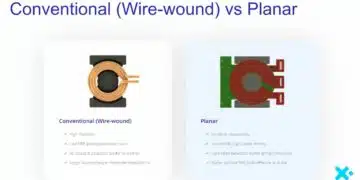
This article based on Frenetic webinar summarizes a practical design workflow using Frenetic AI, Frenetic Simulator and the new Planar...
Read moreDetailsModeling Fringing Field Losses in Inductors & Transformers
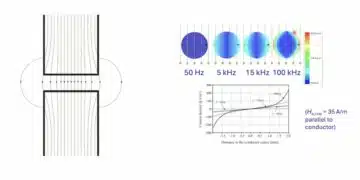
Fringing field effects at air gaps represent a significant but often underestimated source of additional winding losses in magnetic components....
Read moreDetailsWhy Power Inductors Use a Ferrite Core With an Air Gap

This post is based on edited tutorial video by Sam Ben-Yaakov that provides an educational content about power inductor design...
Read moreDetailsNanocrystalline Cores for Low‑Loss MHz Chip Inductors
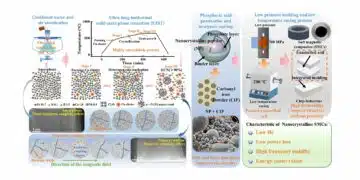
Researchers from State Key Laboratory of Digital Steel, Northeastern University, Shenyang, China developed high‑crystallinity Fe‑based nanocrystalline soft magnetic composites that...
Read moreDetailsTransformer-Based Power-Line Harvester Magnetic Design
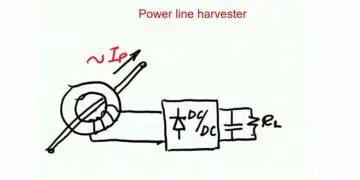
Power-line energy harvesting using current transformers offers an elegant way to power distributed electronics directly from existing AC conductors. This...
Read moreDetailsLLC Transformer: Designing a 2 kW LLC Transformer with Integrated Resonant Inductor

Designing an LLC transformer where the resonant inductance is fully integrated into the transformer leakage is a powerful way to...
Read moreDetailsThermal Modeling of Magnetics
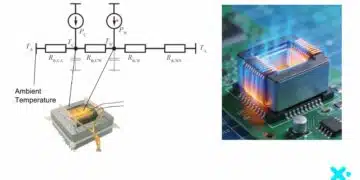
Accurate thermal prediction in magnetics is critical to avoid overheating, improve loss estimation and shorten design cycles. The Frenetic magnetic...
Read moreDetailsPopular Posts
-
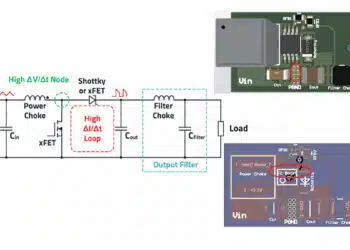
Boost Converter Design and Calculation
-
Buck Converter Design and Calculation
-
LLC Resonant Converter Design and Calculation
-
Flyback Converter Design and Calculation
-
MLCC and Ceramic Capacitors
-
Nvidia Vera Rubin: Why One AI Rack Needs So Many More MLCC Capacitors
-
Earthing Systems and IEC Classification Explained
-
Dual Active Bridge (DAB) Topology
-
MLCC Case Sizes Standards Explained
-
SEPIC Converter Design and Calculation



© EPCI - Leading Passive Components Educational and Information Site