

LeanBOM is an independent, engineer‑built web tool that lets designers and buyers search and compare nearly 300,000 capacitors across MLCC, tantalum, aluminium‑electrolytic and film technologies based on how they actually behave in the circuit, not just on nominal datasheet values.
Now in public beta, it opens the cross‑technology comparison view to all visitors free of charge and without registration, making realistic capacitor selection accessible to any engineering team.
Key features and benefits
- Working Conditions search focuses on the effective capacitance you really get at your DC bias voltage and operating temperature, taking into account DC‑bias capacitance loss and temperature coefficient effects.
- Derated voltage‑based qualification reflects how experienced engineers design margin in practice, qualifying parts on their derated voltage rather than the absolute maximum listed on the datasheet.
- Cross‑technology coverage spans MLCC, tantalum, aluminium‑electrolytic and film capacitors, enabling apples‑to‑apples comparisons between technologies for the same capacitance, voltage and temperature target.
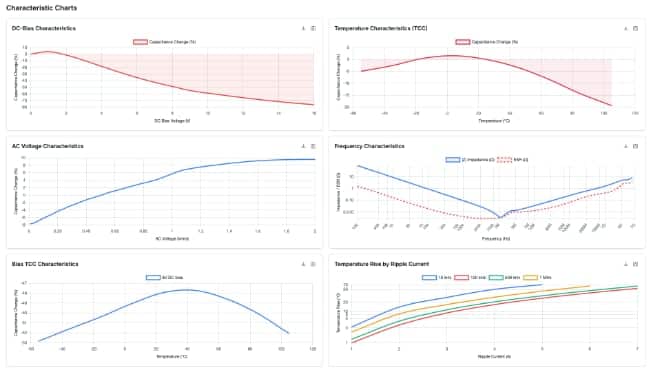
- Side‑by‑side comparison view shows candidate parts together with interactive characteristic curves for DC‑bias capacitance, temperature coefficient, impedance versus frequency, AC voltage behaviour, combined bias‑temperature effects and ripple current.
- Aluminium‑electrolytic lifetime calculator applies an Arrhenius temperature‑and‑ripple model so engineers can estimate service life at their own operating point across suppliers.
- No registration required for cross‑technology comparison, which lowers the barrier for quick feasibility checks and alternative‑part scouting during early design or troubleshooting.
In practice, this means engineers can start from the capacitance they need at the real operating point and immediately see which parts still deliver that value, instead of iterating through nominal values and over‑designing by trial and error.
Search modes and workflow
LeanBOM is structured around several search modes that mirror typical engineering and component‑engineering tasks.
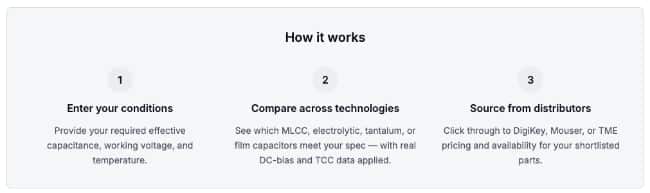
- Working Conditions — enter target effective capacitance, DC bias and temperature, and search across all four technologies for parts that still meet this requirement once bias and temperature derating are applied.
- Most Recommended — a curated matrix of widely used “go‑to” capacitor choices organised by standard capacitance values, voltages and case sizes for common tasks such as decoupling, supporting fast standardisation and part‑number reduction.
- Smallest Size — find the smallest footprint that fulfils a given capacitance / voltage / temperature requirement, useful for space‑critical designs and miniaturisation.
- Highest Voltage — identify the highest voltage rating available within a given case size when clearance or creepage constrain physical dimensions.
- Alternative Parts — provide a manufacturer part number to discover cross‑manufacturer second‑source options with matching specifications, supporting supply‑risk mitigation and dual‑sourcing policies.
- Recommended Values — round a target capacitance to the nearest standard E‑series value and display which concrete parts are actually available in that value range.
All search modes share professional filters familiar to component engineers, including AEC‑Q200 automotive qualification, manufacturer, dielectric and class‑1/class‑2 group shorthand, soft or flexible termination options, and quality presets for consumer, industrial and automotive applications.
From the bench, not the marketing department
LeanBOM is developed by Benjamin Blume, who has spent more than 20 years in passive components — including 14 years at Samsung Electro-Mechanics (SEMCO), latterly as Team Leader Application Engineering EMEA, and earlier as a Field Application Engineer at KOA Europe. The tool grew directly out of his component-engineering consultancy, where he helps electronics teams rationalise their BOMs, reduce part-number counts and cut supply risk without sacrificing functionality, quality or availability.
Every capacitor loses capacitance under DC bias, shifts with temperature or due to tolerance variation — but most selection tools still let you search only on the number printed in the datasheet. I built LeanBOM to answer the question an engineer actually has: which part, across any technology, still gives me the capacitance I need at my voltage and my temperature — and which one is smaller or easier to source. Opening the comparison up for free is about letting engineers judge that for themselves, in a couple of clicks, before they ever sign up.
— Benjamin M. Blume, founder of LeanBOM
Example: Working Conditions search
A typical workflow for an MLCC DC‑link or bulk decoupling capacitor might start by entering the required effective capacitance at the real DC bus voltage and ambient or hot‑spot temperature. LeanBOM then returns only those parts that meet or exceed this target after applying DC‑bias and temperature‑dependent capacitance changes, so the selected part delivers the intended energy storage in situ rather than just on paper.
Typical applications
LeanBOM is intended for component engineers, design engineers and electronics buyers who need to select and manage capacitors in a wide range of power and signal‑integrity contexts.
- Power conversion and decoupling
- Input and output decoupling in DC‑DC converters and on‑board regulators.
- DC link capacitors in motor drives, inverters and PFC stages, where bias and temperature significantly change effective capacitance.
- Automotive electronics
- AEC‑Q200‑qualified MLCC and tantalum capacitors in ECUs, ADAS modules and infotainment systems.
- Film and aluminium‑electrolytic capacitors in on‑board chargers and auxiliary power units.
- Industrial and embedded systems
- Industrial controllers, PLCs and sensor interfaces needing robust derating and long‑life aluminium‑electrolytic solutions.
- Film capacitors for EMI filtering, snubber networks and surge protection in harsh environments.
- Procurement and BOM management
- Buyers consolidating part numbers on mainstream, widely used parts and looking for cross‑manufacturer alternatives.
- Teams controlling BOM complexity while keeping sufficient technological diversity and supplier redundancy.
By exposing lifetime, bias behaviour and cross‑technology curves in one place, the tool supports informed trade‑offs between MLCC, tantalum, aluminium‑electrolytic and film for each functional block.
Technical highlights
LeanBOM’s cross‑technology comparison view is the core of the platform, designed around characteristic curves that engineers routinely consult, but rarely see aggregated across manufacturers and technologies.
Interactive characteristic curves
The comparison view places candidate parts side by side with six interactive curves:
- DC‑bias capacitance — shows the reduction in capacitance as DC voltage increases, critical for class‑2 MLCC and some tantalum parts.
- Temperature coefficient (TCC) — visualises capacitance change versus temperature, clarifying behaviour of class‑1 (e.g., C0G/NP0‑type) and class‑2 dielectrics at cold and hot extremes.
- Impedance versus frequency — highlights resonance behaviour and effective impedance at switching or clock frequencies, supporting decoupling and EMI design.
- AC voltage behaviour — indicates how capacitance and losses respond to AC amplitude, relevant for ripple‑rich and AC‑coupled applications.
- Bias‑TCC combination — combines DC bias and temperature effects, reflecting realistic operating corners instead of separate idealised cases.
- Ripple current — for aluminium‑electrolytic capacitors, shows allowable ripple current across frequency and temperature ranges.
For aluminium‑electrolytic parts, a dedicated lifetime calculator uses an Arrhenius temperature‑and‑ripple model to estimate service life at the user’s operating point, allowing comparison of expected lifetime across manufacturers and case sizes.
Supplier coverage
The current database 07/26 focuses on mainstream capacitor manufacturers and popular series rather than obscure or obsolete items, supporting practical second‑sourcing and standardisation.
| Technology | Key suppliers covered |
|---|---|
| MLCC | Murata, Samsung Electro‑Mechanics, Taiyo Yuden, TDK, Yageo |
| Aluminium‑electrolytic | Panasonic, Nichicon, Rubycon |
| Tantalum | Vishay, KEMET (Yageo Group), KYOCERA AVX |
| Film | TDK, Vishay, WIMA |
This mix provides coverage for most mainstream applications in consumer, industrial and automotive electronics according to the press release.
Availability and usage model
LeanBOM’s cross‑technology comparison view is available now at leanbom.com as a public beta service. Access to the comparison view is free of charge and does not require registration, enabling quick evaluations even for occasional users or early‑stage concept work.
LeanBOM also operates as part of a wider component‑engineering consultancy, offering BOM rationalisation, part‑number reduction and supply‑risk reduction services for teams that need more customised support.
Design‑in notes for engineers
- Start from effective capacitance, not nominal. Use the Working Conditions search with your actual DC bias voltage and operating temperature to identify parts that deliver the target effective capacitance in operation, especially for class‑2 MLCC.
- Apply realistic voltage derating. When checking candidate parts, consider the derated voltage margin rather than relying on maximum datasheet ratings; LeanBOM’s qualification approach mirrors that practice.
- Compare technologies side by side. For a given function (e.g., bulk decoupling or DC‑link energy storage), compare MLCC, tantalum, aluminium‑electrolytic and film options in one view to balance size, cost, lifetime and EMC behaviour.
- Use lifetime calculator for electrolytics. For aluminium‑electrolytic capacitors in hot or ripple‑rich environments, use the lifetime model to evaluate whether a smaller case size or alternative series still meets required service life.
- Exploit “Most Recommended” for standardisation. When rationalising a BOM, start with the Most Recommended matrix to converge on widely used, mainstream parts that simplify stocking and logistics.
- Leverage Alternative Parts for dual‑sourcing. Feed existing manufacturer part numbers into Alternative Parts search to surface cross‑manufacturer equivalents and build second‑source coverage without exhaustive manual catalogue checks.
- Check quality presets and AEC‑Q200 filters. Use automotive and quality presets to ensure that shortlisted parts meet the right qualification level (consumer, industrial or automotive) for each design segment.
For buyers and component engineers, these workflows can reduce part‑number sprawl, strengthen supply resilience and keep bills of materials manageable while maintaining functionality and quality.
Source
This article is based on information provided in the official LeanBOM press release and supporting details from the LeanBOM website, with technical descriptions adapted for an independent engineering audience.
About LeanBOM
LeanBOM is an independent, engineer-built capacitor search and comparison tool, currently in public beta, covering nearly 300,000 MLCC, tantalum, aluminium-electrolytic and film capacitors from the leading manufacturers. It helps design engineers, component engineers and electronics buyers select parts by their real behaviour under working conditions, compare technologies and manufacturers side by side, and keep their bills of materials lean. LeanBOM also offers independent component-engineering consulting in BOM rationalisation, part-number reduction and supply-risk reduction.
Media contact
Benjamin M. Blume, Founder, LeanBOM
Email: info@leanbom.com
Web: https://leanbom.com
References

