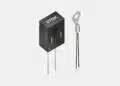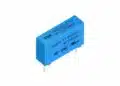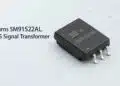


Galvanic isolation separates circuits without a direct conductive connection while allowing signals or power to cross an insulating barrier.
For design, component and purchasing engineers, this article compares optical, capacitive and magnetic methods, explains insulation classes and safety ratings, and sets out practical selection and integration checks for power electronics and isolated interfaces.
This article based on Würth Elektronik’s webinar video “Mastering Galvanic Isolation: Ensuring Safety in Power Electronics with Würth Elektronik products” explains the underlying standards, defines key insulation metrics, and compares major isolation technologies such as optocouplers, digital isolators, transformers, power modules, and capacitors.
Key Takeaways
Choose an isolation solution from the required safety function and operating conditions, not from its isolation test voltage alone.
- Galvanic isolation interrupts a conductive connection and can break ground loops, but parasitic or intentional capacitance still carries displacement current across the barrier.
- Functional insulation supports operation but is not a safeguard against electric shock. Basic, supplementary, double and reinforced insulation have distinct protective roles.
- Optocouplers, digital isolators, transformers and isolated DC/DC converters can provide different insulation classes. Verify the exact part, construction, certification and conditions of use.
- Clearance, creepage and solid insulation require separate assessment. Working voltage, transient stress, material properties, pollution degree, altitude and the applicable product standard all matter.
- X capacitors serve across-line filtering positions; appropriately approved Y capacitors can bridge safety insulation. PCB stitching capacitance requires its own insulation assessment.
- Complete the selection with timing, common-mode transient immunity, power sequencing, thermal and EMC checks. Component approval does not establish compliance of the finished equipment.
Galvanic isolation: background and motivation
Galvanic isolation separates electrical domains so that their conductors are not directly connected. Signals or energy cross the barrier through light, an electric field or a magnetic field rather than through a shared conductive path.
The original discussion is based on Würth Elektronik’s webinar on galvanic isolation in power electronics. Its application examples include isolated converter feedback, digital interfaces and isolated transceiver supplies; the associated application guidance provides additional component-selection context. [1, 2]
- User protection: provide the required insulation between hazardous circuits and accessible circuits or conductive parts.
- Ground-loop interruption: prevent a direct signal-ground connection from carrying potential-equalisation current between distributed equipment.
- Signal integrity: allow communication between circuits operating at different reference potentials.
- Disturbance management: limit the transfer of common-mode disturbances when combined with suitable circuit design, filtering, shielding and layout.
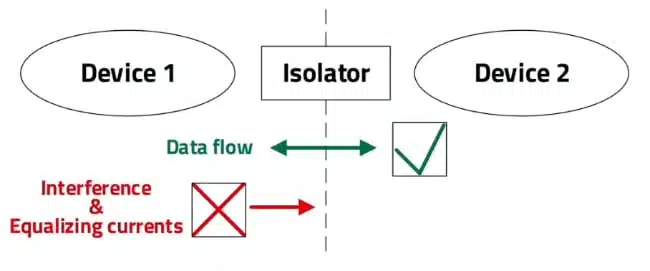
Figure 1 illustrates the intended separation of two communicating devices. It is a functional diagram, not a claim that every interference current is blocked: real barriers have finite insulation resistance and capacitance. [1, 6, 7]
Why current can still cross an isolation barrier
A changing voltage across the barrier drives displacement current through its effective coupling capacitance. Let CISO be the effective capacitance between the isolated domains in farads, vISO their instantaneous voltage difference in volts, t time in seconds and iCM the resulting common-mode current in amperes. A first-order lumped approximation is given by Eq. (1). [6, 7]
Equation (1) explains why fast switching edges can matter even when average power transfer is small. The actual current path includes component capacitance, PCB overlap, transformer windings, cables, shields, chassis and any intentional Y capacitor. Reducing barrier capacitance can reduce one coupling path, but successful EMC design requires control of the complete return-current network. [6, 7]
Application domains
Isolation is used for both information transfer and energy transfer. The required insulation class follows the hazards and accessibility of the connected circuits, not simply the application name. [1, 2]
Industrial automation and communication
CAN, SPI, RS-232 and RS-485 interfaces may connect sensors, actuators and controllers operating at different potentials. Isolation can interrupt ground loops and protect the controller-side domain, but the bus-side transceiver still needs an appropriate supply and protection against its external electrical environment. An isolated data path alone does not isolate a shared power or ground connection. [1, 7]
Power supplies and converters
UPS equipment, telecom power supplies, solar inverters and lighting converters may require separation between a power stage and its control or accessible output circuits. In an isolated SMPS, the transformer transfers power while an optocoupler or another isolated feedback method transfers control information. Both paths must satisfy their assigned insulation requirements. [1, 5]
Smart metering and EV charging
Metering and charging systems combine measurement, communication and power conversion. Define each isolation boundary individually: a measurement interface, an external communication port and an auxiliary power supply do not necessarily share the same working voltage, transient exposure or safety function. [1, 2]
Standards landscape
Insulation design involves basic safety publications, component standards and end-product standards. Establish the applicable end-product requirements first, then select components whose documented characteristics support that assessment. [2, 3, 4]
Basic safety publications
IEC 60664-1 addresses insulation coordination for equipment connected to low-voltage supply systems. The consolidated IEC 60664-1:2020+AMD1:2025 edition covers equipment rated up to 1 000 V AC or 1 500 V DC, applies to frequencies up to 30 kHz, and provides clearance, creepage, solid-insulation and electrical-test principles. Its stated application includes use up to 2 000 m above sea level, with guidance for higher altitudes. [3]
These limits are important for switching power electronics. Do not assume that one low-frequency spacing table resolves every insulation stress in a high-frequency converter. Apply the relevant product-standard requirements, including provisions for the actual waveform, frequency and installation environment. [3, 4]
Component standards
Component standards establish requirements for particular technologies and uses. IEC 60747-17:2020 addresses magnetic and capacitive couplers for basic and reinforced insulation, including insulation ratings, safety tests and lifetime assessment. Safety-capacitor documentation identifies the applicable IEC 60384-14 approvals and X or Y classifications. Neither a standard number nor a package description substitutes for the certificate and ratings of the exact selected part. [6, 8, 9]
End-product standards and application scope
IEC 62368-1 is an end-product safety standard for audio/video, information and communication technology equipment. IEC 62368-1:2023 is its fourth edition; IEC publishes a corrected version dated August 2025. It classifies energy sources and specifies safeguards against their associated hazards. It is not a universal safety standard for every industrial converter, solar inverter, EV charger or medical device. [4]
Use the product standard and edition applicable to the equipment and target market. A newer international publication does not, by itself, establish the required national adoption or certification transition date. Insulation coordination and component approval are inputs to the equipment assessment, not replacements for it. [3, 4]
Types of isolation
The coupling method and the insulation class answer different questions. Optical, capacitive and magnetic describe how information or energy crosses a barrier; functional, basic, supplementary, double and reinforced describe the insulation’s assigned role in the protective arrangement. [1, 6, 8]
- Functional insulation is necessary for correct operation but is not intended to provide protection against electric shock. Its presence does not establish whether the connected circuits are safe to touch.
- Basic insulation provides basic protection against electric shock. The complete equipment may require additional safeguards to remain safe under a single fault.
- Supplementary insulation is independent insulation provided in addition to basic insulation to protect against electric shock if the basic insulation fails.
- Double insulation comprises both basic and supplementary insulation.
- Reinforced insulation is an insulation system providing protection equivalent to double insulation under the applicable requirements. It need not be one homogeneous layer and is not defined merely by a visibly thick plastic barrier.
A fault in basic insulation must be considered within the complete protective arrangement. Double or reinforced insulation is one route to the required protection; basic insulation combined with other permitted safeguards is another equipment-dependent route. Do not select the insulation class from an informal description such as “low risk” or “mains product” alone. [4, 6]
Clearance, creepage and distance through insulation
These dimensions address different failure mechanisms. Check the component’s internal barrier, package geometry and installed PCB arrangement rather than treating any one distance as a complete isolation specification. [3, 6]
- Clearance is the shortest distance through air between conductive parts. Its assessment includes the required voltage withstand, transient exposure and relevant altitude conditions.
- Creepage is the shortest distance along an insulating surface between conductive parts. Working voltage, pollution degree and the material’s tracking behaviour influence the required distance.
- Distance through insulation is the thickness of solid insulation between conductive parts. Its acceptability depends on the material, construction, electrical stress and applicable qualification requirements, not thickness alone.
Insufficient clearance can permit air breakdown, while inadequate creepage can permit surface tracking. The comparative tracking index, or CTI, helps classify an insulating material’s resistance to tracking. Package material and PCB laminate are separate materials and may require different treatment. [3, 6]
Evaluate actual copper edges, pads, vias, connectors, mounting hardware and exposed layer edges. Slots or changes to the layer stack can alter the relevant paths, but their benefit must be established using the measurement rules of the applicable standard. Do not assume that solder mask or an unspecified coating provides a qualified safety barrier. [3, 7]
Comparison of isolation methods
Optical, capacitive and magnetic coupling offer different combinations of signal behaviour, power transfer, size and parasitic coupling. Table 1 compares the original technology groups while separating general capability from the rating of a specific implementation. [1, 5, 6, 7, 8]
Comparison table: isolation technologies
| Isolation method | Physical principle | Typical use | Insulation capability | Selection priorities |
|---|---|---|---|---|
| Optocoupler | Light transfers information across an insulating barrier | Converter feedback, status and digital interfaces | Functional or safety insulation, according to the part and approval | CTR or logic performance, LED drive, ageing, bandwidth and insulation ratings |
| Digital isolator | Encoded information crosses a capacitive or magnetic barrier | SPI, ADC and other digital interfaces | Basic or reinforced versions are available; verify the exact part | Timing, channel direction, default state, CMTI, supply sequencing and approvals |
| Isolated power module | A converter transfers power across an internal isolation barrier | Isolated transceiver and control supplies | Functional, basic or reinforced, depending on the documented construction | Working voltage, output power, regulation, derating, barrier capacitance and EMC |
| Transformer | Magnetic coupling between electrically separate windings | SMPS power transfer or appropriately designed signal coupling | Defined by the insulation system, construction and qualification | Volt-seconds, losses, temperature, leakage inductance, capacitance and insulation |
| Safety capacitor or PCB stitching capacitance | Electric-field coupling through a dielectric | Common-mode return paths and EMI filtering | Appropriately approved Y components or qualified PCB construction may bridge safety insulation | Safety class, voltage stress, touch current, capacitance and installed geometry |
Optocouplers
An optocoupler contains a light emitter, usually an LED, and a photodetector on the opposite side of an insulating barrier. The detector converts the received light into an electrical output. The barrier is an optical and dielectric construction; it should not be assumed to be an empty air gap. [5]
The original converter-feedback example remains a useful application. A secondary-side divider and error amplifier control the LED current; the detector transfers the resulting error information to the primary-side controller, which adjusts converter operation. This allows output regulation without a conductive feedback connection. [1, 5]
For a phototransistor optocoupler, current transfer ratio, or CTR, relates output collector current to input LED current under stated conditions. Design for the relevant spread and changes with operating point, temperature and ageing. CTR alone does not describe the feedback path: detector bias, parasitic capacitance, bandwidth and compensation also affect loop behaviour. [5]
Optocouplers can support analogue feedback and digital signalling, but the detector and output circuit must suit the task. A simple phototransistor device is not an accurate linear analogue isolator merely because its output varies with LED current. Safety capability likewise follows the selected device’s documentation rather than the optical principle alone. [5]
Digital isolators
Digital isolators encode logic information and transfer it across a capacitive or magnetic insulating barrier. In the capacitive implementation discussed in the original article, a transmitter modulates a high-frequency signal and a receiver reconstructs the logic state. Capacitive coupling is one implementation, not the definition of every digital isolator. [6, 8]
A representative application is an SPI connection between an ADC referenced to a high-voltage measurement domain and a low-voltage microcontroller. Select the channel count and directions for all required signals, and include propagation delay and return-path timing in the interface budget. Also provide the ADC-side supply without inadvertently reconnecting the isolated grounds. [1, 6]
Compare maximum data rate, pulse-width distortion, channel-to-channel skew, logic thresholds, supply ranges and output state during missing-input-power conditions. A high nominal data rate does not guarantee that a particular clocked interface will meet its setup and hold requirements. [6]
Common-mode transient immunity, or CMTI, describes the ability to maintain correct operation while the voltage between isolated reference domains changes rapidly. Compare guaranteed limits and test conditions, including transient polarity, temperature and supply voltage, rather than treating a typical CMTI value as a universal system limit. [6]
IEC 60747-17 includes lifetime safety factors, end-of-life testing and statistical lifetime assessment for magnetic and capacitive couplers. This is not an unconditional guarantee that every certified isolator will provide reinforced insulation for 30 years in every application. Use the exact device’s rated working voltage, temperature conditions and supported lifetime data. [8]
When to choose optocouplers versus digital isolators
The original selection rule remains useful when treated as a starting point rather than a technology limit. Compare actual devices against the signal, safety and supply requirements. [1, 5, 6]
- Start with a digital isolator for a compact multichannel logic interface requiring controlled propagation delay, channel matching or high data throughput.
- Start with a phototransistor optocoupler for conventional isolated converter feedback or a simple status interface where its CTR, drive current and response are suitable.
- For a low-channel-count digital link, compare both approaches. Channel count alone does not determine cost, power, area or reliability.
- For analogue information, distinguish feedback control from precision measurement. Compare the complete signal chain rather than assuming every optocoupler is linear or every digital solution is unsuitable.
Where both technologies meet the functional requirements, compare insulation documentation, thermal limits, power consumption, ageing allowance, EMC behaviour, availability and total implementation cost. [5, 6]
Isolated power modules
An isolated DC/DC module combines the circuitry needed to transfer energy across an internal isolation barrier. In a transformer-based module, the windings are magnetically coupled but have no direct conductive connection. The module still has coupling capacitance and can generate switching-related common-mode current. [1, 7]
In the original isolated RS-485 example, optocouplers isolate the data and control signals while a separate isolated power module supplies the bus-side transceiver. Both power and signal paths must preserve the intended boundary. A shared non-isolated supply or ground connection would bypass it. [1]
The standalone power-module example identified in the webinar provides functional insulation and must not be used as a basic or reinforced safeguard against hazardous voltage. This restriction applies to that implementation, not to every isolated DC/DC product. Select the required insulation class from the exact module’s documentation. [1]
Integrated signal-and-power isolation is another option. Würth Elektronik’s SN026 describes an RS-485 design using a reinforced digital isolator with an integrated isolated DC/DC converter. Its reported emissions performance is tied to the documented board, filtering, cable and test arrangement; integration does not eliminate EMC design or end-product safety assessment. [7]
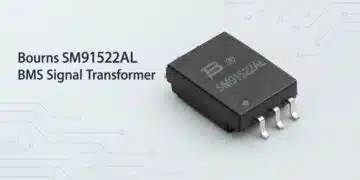
Transformers
A transformer with separate primary and secondary winding circuits can transfer energy magnetically while maintaining a galvanic barrier. In the isolated converter example, it transfers power while the feedback component carries control information. An autotransformer, which shares a conductive winding connection, does not provide that separation. [1, 2]
Safety capability depends on the complete construction: winding arrangement, wire insulation, bobbin, interwinding barriers, terminations, winding-to-core separation and manufacturing control. A transformer is not automatically safety-isolating because it has two windings or passes a dielectric withstand test. [1, 2, 4]
For power SMPS, compare turns ratio, magnetizing inductance, volt-second capability, leakage inductance, winding resistance, thermal rise and interwinding capacitance. For signal transformers, compare the required bandwidth and signal-transfer characteristics instead of assuming that a power-transformer specification is sufficient. [1, 2]
Interleaving or closer winding placement may improve magnetic coupling while increasing capacitive coupling or complicating insulation. Evaluate this trade-off using the actual switching waveform and insulation requirements. The relevant IEC 62368-1 insulation provisions form part of an AV/ICT equipment assessment, but transformer-specific construction requirements must also be addressed. [1, 4]
Capacitors and stitching capacitance
A capacitor has conductive electrodes separated by a dielectric. It can transfer AC displacement current while blocking a direct conductive path, apart from finite dielectric leakage. In an isolation design, this makes capacitance both a useful high-frequency return path and a route for unwanted common-mode current. [1, 7]
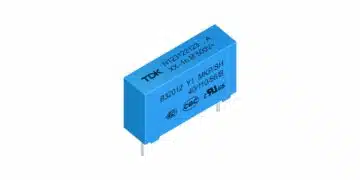
Separate the safety roles of X and Y capacitors. An X capacitor is used in an across-line filtering position, such as line to neutral; an X rating alone does not qualify a component to bridge a shock-protection barrier. A suitably approved Y capacitor can be used in positions where its failure could create an electric-shock hazard, subject to the applicable equipment requirements. [1, 9]
Y capacitors may connect line or neutral to protective earth, or bridge primary and secondary domains in an isolated supply. Select the required subclass and voltage ratings for the actual boundary. The required arrangement is not universally two Y capacitors in series: appropriately rated Y1 components can bridge double or reinforced insulation where the applicable requirements permit. [1, 9]
The selected capacitance also affects current across the barrier. Assess touch current and protective-conductor current where relevant, including the complete network and specified normal and fault conditions. Increasing capacitance to improve emissions is therefore not an unrestricted remedy. [4, 7]
PCB stitching capacitance is formed by controlled overlap between conductors in different layers. It can provide a high-frequency common-mode return path without a separate discrete capacitor. SN026 demonstrates this approach in a design intended to meet reinforced-isolation requirements, with an explicitly defined layer stack and overlap geometry. [7]
Ordinary overlapping copper is not automatically equivalent to an approved Y capacitor. Establish dielectric thickness, material, layer arrangement, internal and external insulation paths, manufacturing tolerances and applicable electrical tests. Changes to the PCB stack-up or supplier process can affect both safety and EMC performance. [7]
Integration into IEC 62368-1 equipment
For equipment within IEC 62368-1’s scope, assign the required safeguards to each energy-source boundary and evaluate every component crossing it. The assessment includes component construction and ratings, PCB geometry, accessible circuits and the complete protective arrangement. [4]
Map component evidence to the equipment requirements
- Capacitors: use the relevant component provisions, safety class, approvals, voltage ratings and installed arrangement. Check any permitted series configuration against the applicable requirements rather than assuming that series connection establishes reinforced insulation.
- Optocouplers: review component certification, rated insulation stress, package creepage and clearance, and conditions of use. Optical coupling does not remove the need for an end-product insulation assessment.
- Transformers: assess both their declared insulation system and the applicable construction requirements. Include winding-to-core and termination details, not only primary-to-secondary test voltage.
- Digital isolators: combine the exact device’s IEC 60747-17 documentation with the equipment requirements for the semiconductor barrier, package and installed PCB.
- Power modules and integrated signal-and-power devices: verify that the complete internal power and signal isolation paths have the required ratings and certification scope.
The original webinar identifies the insulation requirements in clause 5.4 and component provisions in Annex G as relevant integration routes. Apply the detailed provisions of the edition used for the equipment assessment; a clause reference is not an approval shortcut. CMTI and emissions performance remain separate engineering checks from dielectric safety. [1, 4, 6]
Comparison table: insulation function and protection
Table 2 separates the insulation definitions from the safety of the complete equipment. Application examples are illustrative and do not determine the required protective arrangement. [4, 6, 8]
| Insulation type | Protective role | Single-fault consideration | Typical design context |
|---|---|---|---|
| Functional | Supports correct operation; no assigned shock-protection safeguard | Does not establish protective separation under a fault | Ground-domain separation where shock protection is not required from this barrier |
| Basic | Provides basic protection against electric shock | The complete arrangement needs the additional safeguards required by the product standard | Part of an equipment-level protective arrangement |
| Supplementary | Independent insulation additional to basic insulation | Provides protection if the basic insulation fails | The additional insulation in a double-insulation system |
| Double | Basic and supplementary insulation together | Provides the prescribed protection through independent insulation functions | Separation requiring double insulation |
| Reinforced | An insulation system with protection equivalent to double insulation | Must meet the applicable reinforced-insulation requirements | Separation requiring reinforced insulation instead of double insulation |
Decision flow for isolator selection
Separate the safety decision from the signal and power decisions. A component must meet all three where they apply; meeting a data-rate target cannot compensate for an unsuitable insulation rating. [1, 6, 7]
- Define the boundary and its hazards. Determine whether the barrier provides functional separation or an assigned safeguard against electric shock.
- Identify every crossing path. Include data, feedback, power, shields, programming connections and intentional or parasitic capacitance.
- Select the signal method. Consider an optocoupler for suitable analogue feedback or status functions, and a digital isolator for compatible logic interfaces. Verify directionality and timing.
- Select the power method. Use a transformer-based converter, isolated module or integrated signal-and-power device whose documented insulation class matches the requirement.
- Resolve the physical and EMC design. Verify package and PCB insulation paths, coupling capacitance, return-current paths, filtering and protection.
- Validate the complete assembly. Confirm safety, signal integrity, start-up and fault behaviour, thermal performance and EMC under the intended operating conditions.
Design and selection checklist
Compare datasheet values only when their definitions and test conditions agree. Keep the safety evidence, electrical design assumptions and purchasing specification together so that an alternate component or manufacturing change does not silently invalidate the design. [5, 6, 7, 8]
Insulation ratings and operating stress
- Record the actual working-voltage waveform across the barrier, including DC offset, RMS value, repetitive peak stress and expected transients.
- Distinguish VIOWM, maximum working isolation voltage, from VIORM, maximum repetitive peak isolation voltage. Preserve whether each rating is expressed as DC, RMS or peak voltage.
- Distinguish VIOTM, transient isolation voltage, VIOSM, surge isolation voltage, and VISO, the short-duration isolation withstand rating used in the cited documentation. Check duration and waveform.
- Do not use a high short-duration test voltage as the allowable continuous working voltage or as proof of reinforced insulation.
- Confirm insulation class, pollution degree, material group, altitude, temperature limits and the relevant package and PCB distances.
- Check lifetime evidence for the actual voltage and temperature conditions. Do not turn a qualification lifetime into an unconditional service-life promise.
Signal integrity, supplies and disturbance immunity
- Specify channel count, direction, logic levels, propagation delay, skew, pulse-width distortion and interface timing margin.
- Verify behaviour during power-up, power-down, missing input power, undervoltage and disabled outputs. Select the default state required by the connected circuit.
- For optocouplers, include LED current, CTR range, detector operating point, temperature, ageing and response time.
- For isolated supplies, include load transients, available output power, regulation, efficiency, thermal derating and start-up demand.
- Compare CMTI with the expected voltage slew rate and its test conditions. Assess electrical fast transients, surge and system-level ESD separately where required.
- Validate conducted and radiated emissions with representative cables, loads, enclosure and grounding. Component-level ESD ratings and a reference-board emissions result do not certify the final system.
Catalog parts, custom magnetics and qualification
A catalog component is appropriate when its published ratings, geometry and approval conditions cover the operating envelope. Custom magnetics or a controlled PCB isolation construction may be needed when the required turns ratio, power, parasitic limits, mechanical arrangement or insulation paths cannot be achieved with a standard part. Custom construction transfers more specification and process-control responsibility to the design and manufacturing teams. [2, 7]
- Obtain the current datasheet, applicable certificates and conditions of acceptability for the exact ordering code.
- For custom transformers, control winding arrangement, wire and insulation materials, bobbin, terminations, dimensional limits and agreed acceptance tests.
- For PCB stitching capacitance, control the laminate, stack-up, dielectric thickness, conductor overlap, edge clearances and fabrication tolerances.
- For alternate sourcing, compare certification scope, test conditions, insulation construction and layout requirements as well as nominal electrical values.
- Agree production testing, traceability and supplier change notification for characteristics that affect the qualified barrier.
Conclusion
Galvanic isolation is a system boundary, not a promise of zero current or zero interference. Its safety function depends on the assigned insulation class, documented operating limits and the way every component and conductor crossing the boundary is implemented.
Optocouplers remain useful for converter feedback and suitable signal functions; digital isolators support controlled logic transfer; transformers and isolated converters transfer power; and qualified capacitive paths can manage common-mode current. Reliable selection combines those functions with insulation coordination, timing, thermal and EMC validation, followed by end-product assessment under the applicable safety standard.
FAQ
These answers address common design, safety and component-selection questions.
Galvanic isolation separates electrical domains without a direct conductive connection while allowing signals or power to cross through optical, capacitive or magnetic coupling. It can interrupt ground loops and form part of a protective arrangement against electric shock. Real barriers still have capacitance and finite insulation resistance, so isolation does not mean that every current or disturbance is blocked.
Basic insulation provides basic protection against electric shock. Double insulation combines basic insulation with independent supplementary insulation. Reinforced insulation provides protection equivalent to double insulation under the applicable requirements and need not be one homogeneous layer. The complete equipment must provide the required protection in normal operation and specified fault conditions; functional insulation is not an assigned shock-protection safeguard.
Start with the end-product standard applicable to the equipment and target market. IEC 60664-1 provides insulation-coordination principles, while component standards address particular barrier technologies. IEC 60747-17 covers magnetic and capacitive couplers for basic and reinforced insulation. IEC 62368-1 applies to audio/video, information and communication technology equipment, not automatically to every industrial or power-conversion product.
Optocouplers transfer information using light across an insulating barrier; digital isolators encode logic information and use capacitive or magnetic coupling. Phototransistor optocouplers are common in isolated converter feedback, while digital isolators suit many compact multichannel logic interfaces. Select actual devices using signal behaviour, timing, supply requirements, insulation documentation, ageing allowance and disturbance immunity rather than a fixed technology hierarchy.
Yes, if the exact module has the required documented insulation class, operating ratings and approval conditions. Other modules provide functional insulation only and must not serve as a safeguard against hazardous voltage. A short-duration isolation test voltage does not establish continuous working voltage or reinforced insulation. Check the complete power and signal boundary, including PCB layout and external connections.
Clearance is the shortest air path between conductors, creepage is the shortest path along an insulating surface, and solid insulation separates conductors through dielectric material. Their assessment depends on different stresses and construction details. Check working voltage, transients, pollution degree, material tracking behaviour, altitude and the applicable standard, including package geometry, PCB copper, exposed edges and manufacturing tolerances.
An appropriately approved Y capacitor can bridge safety insulation while carrying AC displacement current. An X rating alone does not qualify a capacitor for that role. The required Y class and arrangement depend on the boundary and applicable requirements. PCB stitching capacitance can serve a similar EMC function only when its dielectric construction, geometry and qualification satisfy the required insulation assessment.
How to choose and implement galvanic isolation
This procedure applies to selecting and integrating an isolation boundary. It complements, but does not replace, the detailed requirements and tests applicable to the finished equipment.
Select and validate a galvanic isolation boundary from requirements to equipment qualification.
- Define safety and operating requirements
Identify the applicable product standard and target market. Define the barrier function, working-voltage waveform, transient exposure, insulation class, pollution degree, altitude, temperature range and required operating life.
- Identify every signal and power path
List data, feedback, power, shields and service connections that cross the boundary. Specify channel directions, timing, analogue behaviour and isolated-side power demand. Check that no unintended conductive connection bypasses the barrier.
- Select suitable isolation components
Compare optocouplers, digital isolators, transformers and isolated converters against the required signal and power functions. Verify the exact insulation class, working and test-voltage ratings, certification scope and conditions of use for each selected part.
- Design the physical isolation boundary
Determine clearance, creepage and solid-insulation requirements using the applicable standards. Check packages, pads, vias, connectors, mounting hardware and PCB layer edges. Qualify any intentional capacitive bridge or stitching-capacitance construction.
- Integrate the component evidence
Map component certificates, ratings and construction details to the end-product assessment. Include transformer and PCB manufacturing specifications, approved materials, supplier change control and agreed production tests. Do not infer equipment compliance from component approval alone.
- Validate safety and functional performance
Test the assembled design under representative operating conditions. Confirm dielectric safety, timing, default states, power sequencing, thermal behaviour, common-mode immunity and EMC. Check specified fault conditions and complete the required qualification before release.
Further Reading
These Passive Components Blog articles provide additional background on capacitor behaviour, safety components and transformer construction. Apply numerical examples from other articles only within their stated design assumptions.
- How transformers and solenoids work — magnetic coupling, winding effects and the trade-off between leakage inductance and interwinding capacitance.
- Capacitor fundamentals — dielectric construction, charge storage and AC coupling.
- Safety capacitors in power electronics — background on X and Y applications and capacitor-technology selection.
- High-voltage transformer safety design: a case study — an application-specific illustration of insulation selection and winding construction.
References
Reference numbers in the article identify the following source documents. Component ratings and approval conditions must be checked against the current documentation for the exact selected part.
- Würth Elektronik Group, Mastering Galvanic Isolation: Ensuring Safety in Power Electronics with Würth Elektronik products, webinar, YouTube, 2026.
- Timur Uludag, ANP151: Mastering Galvanic Isolation: Ensuring Safety in High-Power Electronics with Würth Elektronik Products, application-note overview, Würth Elektronik, 2026.
- International Electrotechnical Commission, IEC 60664-1:2020+AMD1:2025 CSV: Insulation coordination for equipment within low-voltage supply systems — Part 1: Principles, requirements and tests, edition 3.1, IEC, 2025.
- International Electrotechnical Commission, IEC 62368-1:2023: Audio/video, information and communication technology equipment — Part 1: Safety requirements, edition 4.0, IEC, 2023; corrected version 2025.
- Eleazar Falco, ANO007: Understanding Phototransistor Optocouplers, application-note overview, Würth Elektronik, 2023.
- Artem Beliakov, ANS021: Ensuring Safety without Compromising Data Integrity: Critical Characteristics of Digital Isolators, revision ANS021a, Würth Elektronik, 2024.
- Artem Beliakov, SN026: Isolated RS-485 interface based on 4-channel digital isolator with integrated DC/DC converter, revision SN026a, Würth Elektronik, 2025.
- International Electrotechnical Commission, IEC 60747-17:2020: Semiconductor devices — Part 17: Magnetic and capacitive coupler for basic and reinforced insulation, edition 1.0, IEC, 2020; incorporating the January 2021 corrigendum.
- Vishay Intertechnology, New Vishay Intertechnology Y1 Safety Capacitors Require Up to 40 % Less Board Space, Enable Product Miniaturization, manufacturer technical announcement describing Y1 insulation-bridging capability, Vishay Intertechnology, 2026.