
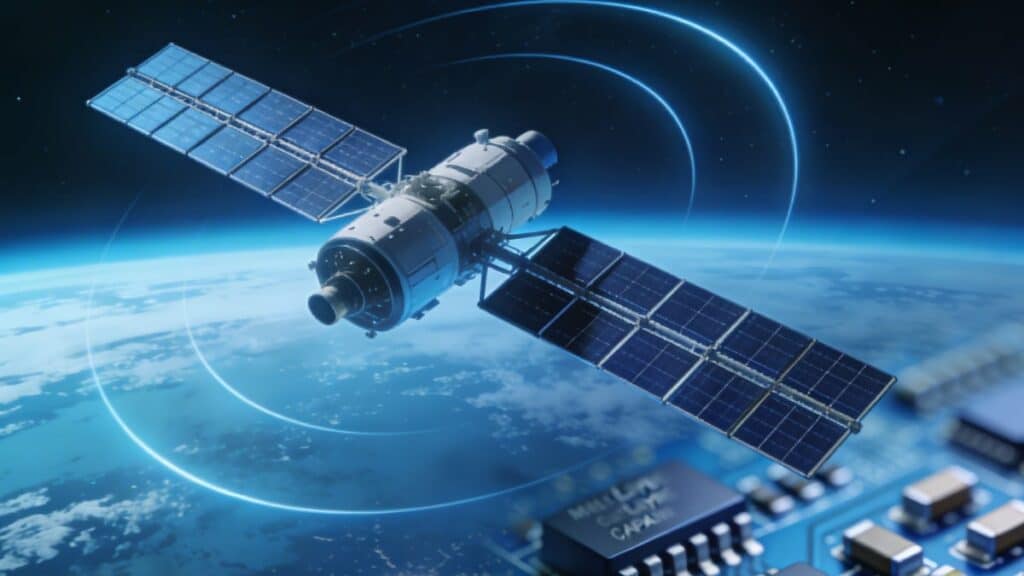
Samsung Electro-Mechanics is expanding its multilayer ceramic capacitor business into the low-Earth-orbit satellite sector, supplying high‑reliability MLCCs to a leading US private aerospace company as part of a broader shift beyond smartphones into automotive, industrial, AI server and space applications.
Expansion from Automotive and Industrial into Space
Industry sources indicate that Samsung Electro-Mechanics has begun volume supply of MLCCs for LEO satellites operated by the world’s largest private aerospace player, marking its first meaningful step into the space electronics market.
The company is leveraging the reliability, derating know‑how and process control it developed for automotive and industrial MLCCs to address the much harsher operating profile of satellite platforms.
The move builds on several years of portfolio migration away from low‑margin smartphone content toward higher‑value segments such as electric vehicles, ADAS, servers and industrial systems.
Automotive MLCC sales have already reached the KRW‑trillion scale, and the company is positioning space as a new high‑reliability growth pillar alongside automotive and AI servers.
Role of MLCCs in LEO Satellite Architectures
In satellite payloads and bus electronics, MLCCs are key passive components for power rail decoupling, filtering and signal integrity, directly impacting the stability of RF front‑ends, on‑board computers and power management modules.
A single communications satellite can integrate thousands of MLCCs distributed across power conversion, control, telemetry and transceiver boards, creating a structurally large content opportunity per unit.
Compared with consumer and even most automotive designs, satellite MLCCs must withstand extreme thermal cycling, vacuum conditions, radiation exposure and mechanical shock without performance drift over many years of operation.
Because satellites cannot be serviced once launched, component failure tolerance is effectively near zero, which pushes satellite OEMs to demand extended life testing, radiation characterization and stringent supplier qualification before design‑in.
High Barriers to Entry and Samsung’s Technology Position
The LEO satellite MLCC market features long design cycles, high qualification costs and tightly controlled approved‑vendor lists, which together create high barriers to entry for new suppliers.
Samsung Electro-Mechanics’ entry signals that it has cleared key customer audits and long‑term reliability validations, building on its track record in high‑temperature, high‑voltage and high‑vibration automotive MLCC platforms.
The company has invested in ultra‑high‑capacitance, high‑voltage and high‑temperature MLCC technology, including 16 V ADAS‑grade parts with world‑class capacitance density and devices rated up to the kilovolt class for EV and industrial power.
These material systems, multilayer structures and electrode designs are directly relevant to space applications, where derating, insulation resistance and long‑term capacitance stability under stress are critical.
Demand Drivers: LEO Constellations and Satellite Internet
The addressable market is underpinned by rapid expansion of LEO constellations for broadband satellite internet and global connectivity, with the installed base projected to grow from roughly tens of thousands of satellites to several tens of thousands over the next few years.
Market research cited in Korean and international reports projects the broader LEO satellite market to rise from around USD 200 billion to more than USD 300 billion by 2030, supporting long‑term demand for satellite‑grade components including MLCCs.
In parallel, LEO platforms are shifting from bespoke, low‑volume builds to more standardized, mass‑production‑style manufacturing, increasing the importance of both cost efficiency and supply stability from component vendors.
This environment benefits suppliers capable of combining high reliability with high‑volume, automated production, an area where Samsung Electro-Mechanics is already scaling capacity for automotive and AI‑server MLCCs at sites such as its Tianjin plant.
Strategic Fit Within Samsung Electro-Mechanics’ MLCC Roadmap
The reported LEO satellite wins are consistent with Samsung Electro-Mechanics’ stated strategy to rebalance its MLCC portfolio toward high‑margin, high‑reliability applications.
The company has repeatedly highlighted servers, EVs, ADAS, robotics and now aerospace as focus segments where miniaturization, high capacitance and extreme‑condition reliability can differentiate its offering.
Analysts expect a rising mix of such specialty MLCCs to drive higher average selling prices and margin expansion as demand from AI data centers, advanced vehicles and space infrastructure scales through the second half of this decade.product.
While Samsung Electro-Mechanics has not officially confirmed the name of the LEO satellite customer, industry coverage from Asia and Korea consistently points to a leading US private aerospace firm, reinforcing the strategic significance of the engagement.
Outlook: From MLCCs to Broader Space Electronics
Industry commentary suggests that initial MLCC supply for LEO satellites could open the door for Samsung Electro-Mechanics to expand into adjacent space‑grade components such as high‑reliability substrates over time.sem.
As constellations scale and architectures evolve, demand is likely to extend beyond basic decoupling into more specialized capacitor functions, including high‑frequency RF blocks and high‑voltage power stages, further increasing content per satellite.
The combination of automotive, industrial, AI server and now space programs positions Samsung Electro-Mechanics as a diversified MLCC supplier with exposure to several structural growth markets rather than relying on cyclical smartphone demand.
If current trends in LEO deployment and AI‑driven infrastructure spend continue, the company’s MLCC business is poised to benefit from a multi‑year upcycle supported by both volume growth and product mix upgrades.
Source
This article is based on information reported by Korean and international business media as well as Samsung Electro-Mechanics’ own public communications on its MLCC strategy and end‑market focus, consolidated and interpreted for a professional electronics audience.
References
- THE ELEC – Samsung Electro-Mechanics Supplies MLCCs for U.S. Low-Earth-Orbit Satellites
- DIGITIMES – Samsung Electro-Mechanics rumored to supply MLCCs to top private aerospace firm
- Alpha Biz – Samsung Electro-Mechanics Supplies MLCCs to U.S. Aerospace Company
- Samsung Electro-Mechanics – Automotive MLCC technology and growth focus
- Samsung Electro-Mechanics – Product news and MLCC portfolio updates
- Passive Components Blog – Samsung Electro-Mechanics focuses MLCCs on AI servers and automotive

