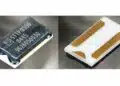




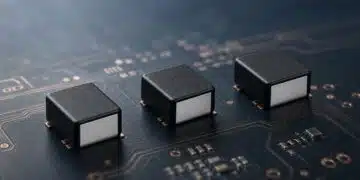






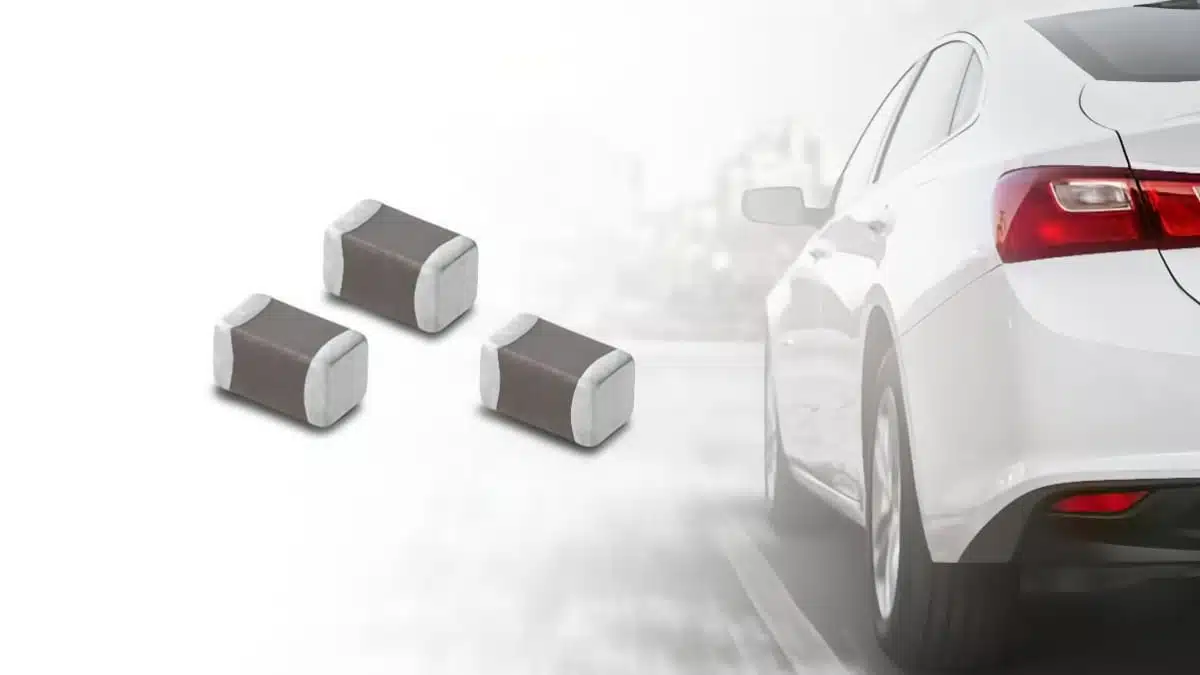
Murata has introduced GCJ21BD72A225KE02, an automotive‑grade soft‑termination multilayer ceramic capacitor (MLCC) that delivers World First 2.2µF at 100 V DC in a compact 0805‑inch (2.0 × 1.25 mm) package.
This Murata MLCC ceramic capacitor targets crowded powertrain and safety ECUs where designers need high capacitance, high voltage, and robust mechanical reliability in the smallest possible footprint.
Key features and benefits
- High capacitance in 0805 package – 2.2µF at 100 V DC in 0805 size, a rating that previously required 1206, enables aggressive downsizing of decoupling and smoothing networks in automotive power rails.
- Board space reduction – According to Murata, replacing a 1206 solution with this 0805 device can reduce board mounting area by approximately 51%, helping engineers free up PCB area for sensors, MCUs, and connectors.
- Higher capacitance in same footprint – Compared with Murata’s previous 100 V 0805 MLCC, this device provides about 2.2× higher capacitance, allowing fewer capacitors in parallel to reach a given total value.
- Soft‑termination structure – A compliant termination stack absorbs board flexure and vibration, reducing the risk of ceramic cracking after reflow and during vehicle lifetime. This is particularly beneficial on large or mechanically constrained boards in engine bay or chassis systems.
- Automotive‑grade reliability – The part is aimed at powertrain and safety applications, where temperature cycling, vibration and long operating life demand robust MLCC construction and process control.
- X7T temperature characteristic – The capacitor meets X7T characteristics per EIA, with an operating temperature range from −55 °C to +125 °C, making it suitable for typical automotive ECU environments.
- Advanced ceramic material design – Fine particle size and tight uniformity support both miniaturization and high capacitance at 100 V without sacrificing reliability, which is critical for 48 V and other elevated bus voltages in vehicles.
Typical applications
As vehicles move toward higher electrification, 48 V subsystems, and more complex AD/ADAS architectures, the demand for compact, high‑voltage MLCCs in control and power stages continues to grow. This 2.2µF / 100 V 0805 MLCC is positioned mainly for:
- Powertrain ECUs (engine, transmission, hybrid control units) requiring high‑voltage decoupling close to power devices.
- Safety‑critical ECUs such as braking, steering, and airbag controllers, where robust components help maintain long‑term stability under thermal and mechanical stress.
- AD/ADAS ECUs and domain controllers with dense power distribution networks operating from 48 V or other higher‑voltage rails.
- Local DC link and bulk decoupling in smaller DC‑DC converters or gate driver boards where 100 V rating provides sufficient margin.
- Noise suppression and stabilization on intermediate bus rails that must tolerate load steps and switching noise from power stages.
In many of these circuits the capacitor can serve as an input or output decoupling element in buck/boost stages, as a local energy reservoir near power MOSFETs or GaN devices, or as a smoothing capacitor across sensitive analog rails running off high‑voltage buses.
Technical highlights
The table below summarizes the key published parameters of the GCJ21BD72A225KE02, as stated in the Murata product release and related product page information.
| Parameter | Value / information |
|---|---|
| Series / family | GCJ automotive soft‑termination MLCC |
| Part number | GCJ21BD72A225KE02 |
| Capacitance | 2.2µF |
| Rated voltage | 100 V DC |
| Package size | 0805 inch (2.0 × 1.25 mm) |
| Temperature range | −55 °C to +125 °C |
| Temperature characteristic | X7T (per EIA standard) |
| Termination | Soft‑termination structure |
| Automotive focus | Powertrain and safety‑related ECUs |
X7T temperature characteristic means the capacitance is specified over the −55 °C to +125 °C range with a particular tolerance behavior that is suitable for many automotive power and control rails. For exact capacitance tolerance, derating, and class behavior over temperature and DC bias, designers should consult the detailed manufacturer datasheet and simulation tools.
Design‑in notes for engineers
When selecting and designing in this 2.2µF / 100 V 0805 MLCC, a few practical considerations can help ensure reliable performance in the target ECU:
- Check DC bias behavior – High‑value MLCCs at 100 V can exhibit significant capacitance reduction under DC bias, especially on high‑voltage rails. Always evaluate effective capacitance at the actual operating voltage using manufacturer curves or simulation tools.
- Consider temperature and ripple current – While the device is specified for −55 °C to +125 °C, real application stress combines temperature, ripple current, and mechanical load. Verify loss and self‑heating in worst‑case conditions.
- Leverage soft termination correctly – Soft‑termination improves tolerance to board flexure and vibration, but does not eliminate the need for sound PCB design. Avoid placing the capacitor too close to board edges, scoring lines, or heavy connectors where bending is concentrated.
- Use appropriate land patterns – Follow Murata’s recommended land pattern and soldering profile to maintain the designed stress relief in the soft‑termination structure and to minimize solder joint cracking.
- Plan for derating – Even with a 100 V rating, in automotive environments it is common to include a safety margin against transient overshoot and long‑term degradation. Selecting the part with appropriate voltage derating improves reliability.
- Evaluate parallel combinations – Thanks to the higher capacitance in 0805, fewer devices may be needed in parallel compared with previous 0805 or 1206 implementations. This can simplify layout and reduce BOM line items, but it is still important to review impedance and ESL requirements at the switching frequencies of interest.
- Check qualification and standards – For safety‑related ECUs, confirm that the specific part number meets the required automotive standards and internal OEM specifications according to the manufacturer datasheet and qualification reports.
For purchasing and component engineering teams, the migration from former 1206 2.2µF / 100 V solutions to this 0805 option can simplify footprint standardization and reduce board area, but it is important to track any changes in lead time, pricing, and second‑source strategy when introducing such a high‑performance MLCC.
Source
This article is based on information provided in Murata’s official product and event news release and the corresponding Murata product information pages for the GCJ21BD72A225KE02 automotive soft‑termination MLCC.