








Edgewater Research’s latest IP&E update indicates that the broad-based recovery across the market is still gaining traction, with Agentic AI now providing an additional driver of expansion for the overall AI TAM.
This June 2026 collection of news summaries, survey results, and channel market insights, covers Interconnect, Passives, and Electromechanical Components from Edgewater Research.
What’s Changed/What’s New?
- Demand reads remain constructive, with bookings, shipments, and 2Q B2B continuing to strengthen Q/Q.
- Near-term AI reads still robust; 2Q demand tracking ahead across US and Asian Cloud programs and incremental price realization.
- Agentic AI emerging as an additional infrastructure catalyst into CY27, driving incremental interconnect TAM opportunities across backplanes, board connectors, and cables with content per chip (CPU/LPU) estimated up to $300 vs. ~$100 in traditional architectures.
- FIT emerging as Nvidia’s preferred backplane second source, with potential 20-30% share across VR72, Vera and Groq racks in ‘27.
Top 3 Channel Comments:
- Trn4 design recently shifted from a 1:4 CPU to ASIC ratio to 1:1, entirely driven by Agentic AI. As a connector supplier, we see a significant opportunity from Agentic racks with content across backplanes, board connectors, and external cables, including AECs. Content per chip is likely to vary from $150-$200 on the low end to potentially $500 or more on the higher end.
- Demand from Asian CSPs is substantial. Our shipments to ByteDance and Alibaba are up more than 150% Y/Y, and combined demand from those two customers is now slightly larger than Google for us.
- At 400G per lane, the industry increasingly appears focused on two paths for the switch layer. One uses an interposer/compression attach approach (NPO/CPC) to minimize signal loss, while the other is an XPO-style ecosystem approach that preserves more of today’s processor, line-card, and connector architecture.
Other Key Takeaways:
- Rubin Ultra reaffirmed as likely Oberon 72×2 design, extending Amphenol leadership with content per GPU likely flat/up.
- Kyber likely delayed until Feynman, with POGO-pin uncertainty positioning traditional connector architectures as an alternative path to 448G scale-upas an alternative path to 448G scale-up.
- Estimating Nvidia Groq rack content ~$50K, or $200 per LPU, materially higher than our initial $20K estimate.
- TE remains well-positioned at AWS, with agentic AI driving incremental RFQs implying additional CY27 content opportunities.
- TPU 9 datapoints suggest potential adoption of cabled backplane architecture, likely to drive incremental content gains.
- AMD MI4xx connector/cable content TAM estimated at ~$85K, 40-60% above NVL72.
- Copper durability intact; industry converging to NPO/XPO for 448G, while CPO scale-up commercialization remains challenging.
- XPO momentum building ahead of a projected CY27 ramp, supporting CPC adoption with >$1K of CPC content per switch ASIC.
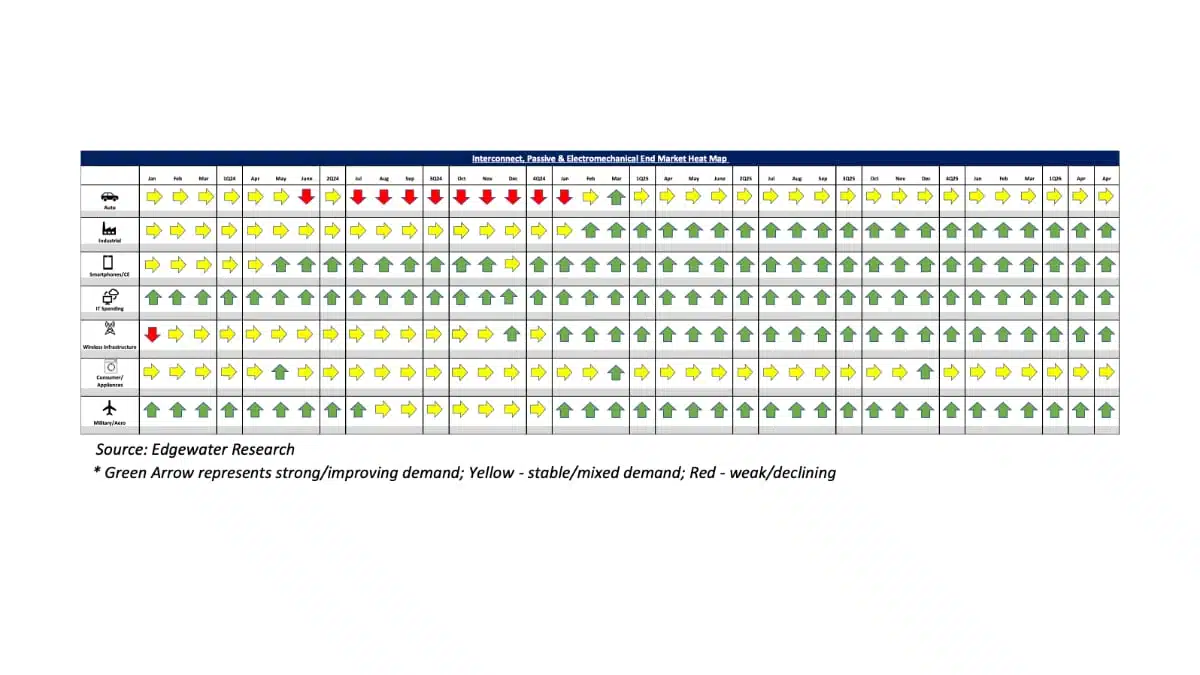
- Auto demand resilient, with datapoints suggesting supply assurance/inventory replenishment.
- Industrial demand reads remaining constructive, with AI/DC driving growth across power, energy, automation, and HVAC.
- Connector pricing cont. moving higher, with additional channel pass-through in July and some realization with direct customers.
Conclusions:
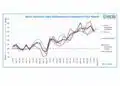
IP&E fundamentals remain constructive across the traditional end markets, with little change in industry conditions M/M. Book-to-bill ratios remain firmly above 1x, backlogs continue to build, and demand and bookings are broadening across the supplier base.
Pricing also remains supportive, with another round of price increases expected to take effect in July. In addition, the outlook for IT Datacom/AI also remains robust, with the emergence of Agentic AI creating an incremental TAM expansion opportunity for the industry in 2027.
With fundamentals remaining healthy across virtually all end markets through the middle of 2026, we maintain our constructive outlook for the industry through the balance of the year and are becoming increasingly optimistic about the setup for 2027.
Full report available from: Dennis Reed, Sr. Research Analyst, Edgewater Research